
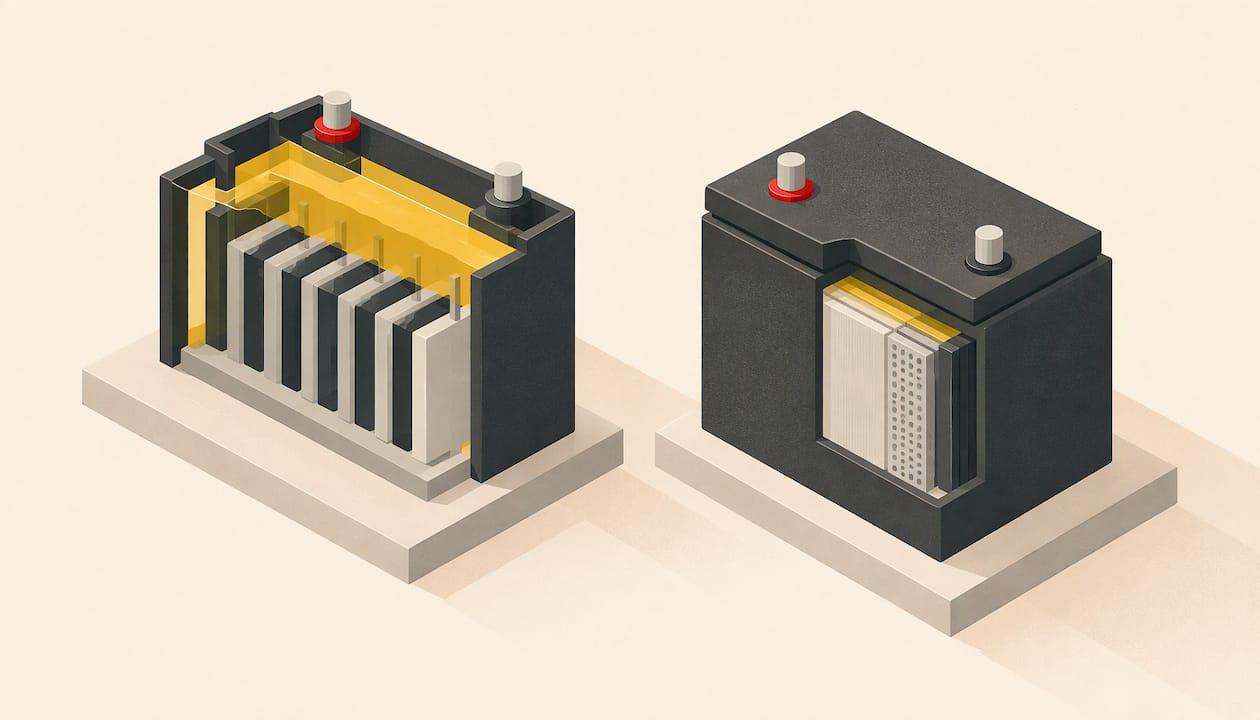
For most people who want a battery they can install and forget, a sealed lead-acid battery (AGM or gel) is the easier choice. It holds its electrolyte in a glass mat or gel, so there is nothing to top up and no liquid to spill. A flooded battery, also called a wet cell, keeps liquid acid behind removable vent caps. It needs regular checks and water refills, and it must stand upright with good ventilation. Below you will find how the two types differ in construction, upkeep, safety, charging and typical use, plus how to pick the right one.
TL;DR
- Flooded (wet cell): liquid electrolyte, vent caps, periodic water top-ups and electrolyte checks. Gas escapes into the surroundings.
- Sealed (VRLA: AGM or gel): electrolyte is bound in a glass mat or gel, the case is closed, and no topping up is needed. Gas recombines inside under normal charging.
- Safety: every lead-acid battery gives off hydrogen when charged, so ventilation always matters. Sealed types remove the spill risk, which is why they suit interiors and tilted installations.
- Charging: match the charger profile to the type. Gel is the most sensitive to overcharging, and flooded takes a higher charge voltage than AGM or gel.
- Quick pick: choose sealed AGM for cycling, standby and hard-to-reach spots. Choose flooded only if you are happy to maintain it.
Table of Contents
- What "flooded", "wet cell" and "sealed" actually mean
- How the two designs differ in construction
- Side-by-side comparison
- Maintenance: what a flooded battery needs from you
- Safety: hydrogen, spills and ventilation
- Charging: set the profile for the type
- Which type for which job
- Perspective
- Sealed options you can order at AkkuPlus
- How to choose in four steps
- FAQ
- Sources
What "flooded", "wet cell" and "sealed" actually mean
The names cause most of the confusion, so here is the vocabulary in one place. Concordia University's safety guide on lead-acid batteries calls vented batteries flooded, spillable or wet cell, because they contain liquid electrolyte and have vent caps. The same document describes valve-regulated (VRLA) batteries as the sealed or non-spillable group.
So "flooded", "wet", "vented" and "spillable" all describe one design. "Sealed lead-acid" and "VRLA" describe the other. Inside the sealed group you find two sub-types:
- AGM (absorbent glass mat): the acid is soaked into a glass-fiber separator between the plates.
- Gel: the acid is thickened into a gel.
Victron Energy explains that the electrolyte in lead-acid batteries is either liquid or immobilised in gel or AGM material. In these "starved" designs, oxygen formed at the positive plates travels to the negative plates and recombines with hydrogen, so no gas should escape under normal conditions. That recombination is the reason sealed batteries can stay closed and need no water.
"Sealed" does not mean airtight in every circumstance. Mitsubishi Electric notes that VRLA batteries vent through a one-way pressure relief valve when gas evolution becomes too high. The valve is a safety feature, not a service point.
How the two designs differ in construction
A flooded battery has plates standing in free liquid. Hollingsworth & Vose explain that flooded batteries vent gases into the environment, and that this loss depletes the electrolyte over time. It therefore has to be replenished so the plates are never exposed.
A sealed AGM battery packs the plates tightly with a glass-fiber separator holding the acid. VARTA states that in AGM the electrolyte is bound in a special glass-fiber separator, that the battery is closed airtight so oxygen and hydrogen recombine internally and water is not lost, and that the individual cells carry safety valves for fault conditions.

The Gel Handbook from a manufacturer's installation manual makes the practical point: VRLA batteries need no topping-up water, and their valves cannot be opened without destroying them. If you see a battery with removable caps over each cell, it is a flooded one.
Side-by-side comparison
| Criterion | Flooded (wet cell) | Sealed AGM | Sealed gel |
|---|---|---|---|
| Electrolyte | Free liquid | Absorbed in glass mat | Thickened gel |
| Water top-ups | Yes, with distilled water | No | No |
| Spill risk | Yes if tipped or cracked | Very low | Very low |
| Gas release | Vented to surroundings | Recombines internally, valve only in faults | Recombines internally, valve only in faults |
| Charging sensitivity | Tolerates higher boost voltage | Moderate | Highest, needs gel profile |
| Typical use | Starting, stationary, some deep-cycle | Start-stop, cycling, standby, mobility | Deep cycle, solar, slow discharge |
| Mounting | Upright, ventilated | More flexible | More flexible |
The table sums up the pattern: flooded asks more of you, sealed asks more of your charger.
Maintenance: what a flooded battery needs from you
If you own or are considering a wet cell, plan on these routines. Concordia's guide notes that water is lost through evaporation and that vented designs allow maintenance checks during service. Victron's guidance lists electrolyte checks for flooded automotive and wet deep-cycle batteries, and periodic high-voltage charging for wet deep-cycle types.
A practical flooded routine looks like this:
- Check electrolyte levels at regular intervals, more often in hot weather or with heavy cycling.
- Top up only with distilled water, and only as far as the level the maker specifies. Cat Lift Trucks confirms that flooded lead-acid forklift batteries are topped up with distilled water.
- Keep terminals clean and the case dry.
- Charge in a ventilated space, away from sparks and flame.
Sealed batteries are low-maintenance, not zero-attention
No water does not mean no care. The same Gel Handbook tells users to keep the battery clean and dry and to measure and record voltage and temperature on a schedule, for example at least every six months and annually. For a car or scooter, that simply means checking the resting voltage now and then, and using a maintainer if the vehicle stands for weeks. Our guide to battery maintainers by battery type covers that in detail.
Safety: hydrogen, spills and ventilation
The key safety fact applies to both designs: charging produces hydrogen. GS Yuasa's operating instructions for its German entity state that ventilation is mandatory because hydrogen released through the pressure relief valves can form an explosive mixture above 4% by volume. A German industrial-trucks specialist, itc-graf, describes the same effect: electrolysis during charging releases hydrogen and oxygen that form an explosive oxyhydrogen mixture once hydrogen exceeds 4% in air.
Safe use therefore means the same basics for either type: charge in a ventilated place, no smoking, no open flames, no sparks near the battery. EnerSys says the same in its charger manual, instructing users to avoid smoking, open flames and sparks and to provide sufficient ventilation.
Where the types differ is spill risk. Cat Lift Trucks notes that sealed lead-acid batteries can only spill their contents if damaged. For vehicles, the German electrical industry association ZVEI says that, to reduce injury risk from escaping acid inside the vehicle interior, a battery with fixed electrolyte (AGM or gel) can be used as a battery-side measure. That is why a boot-mounted or under-seat battery is usually a sealed one.
One more safe-use point: excessive charge voltage can make gas escape from a VRLA battery. Use a charger set for the right type, and do not force a sealed battery with a high-voltage flooded setting.

Charging: set the profile for the type
This is where buyers most often go wrong. Victron says gel batteries charge more slowly and are more sensitive to overcharging than AGM, so they typically need a gel-specific profile.
Typical settings from charger makers show the spread. An EPEVER solar controller lists boost voltage at 14.2 V for gel, 14.4 V for sealed AGM and 14.6 V for flooded, with a 13.8 V float for all three. Other makers use different numbers: an Enerdrive charger guide gives 14.4 V absorption for gel, 14.6 V for AGM and 14.4 V for flooded. The lesson is not to memorize one figure. Read the battery label and the charger manual, and pick the mode that names your battery type.
Discover Battery adds a firm rule for gel: use only voltage-regulated or voltage-limited chargers, not constant-current or taper chargers, and use a temperature-sensing charger for VRLA batteries. A German review site also notes that a charger without a GEL program or with only an AGM mode is unsuitable for gel.
In practice:
- Flooded: use a charger with a flooded or standard lead-acid mode.
- AGM: use an AGM mode. Our overview of AGM chargers for Germany shows what to look for.
- Gel: use a dedicated gel mode only.
Which type for which job
Car and motorcycle starting
Starter batteries deliver a short, high burst of current for cranking. Flooded versions are the traditional choice. For vehicles with start-stop systems, an Iveco parts document states that AGM batteries are optimized for partial state of charge and very high cycling capability, which suits frequent discharge and recharge cycles. For bikes, which often sit unused and tilt on stands, sealed batteries are the common pick; see our motorcycle battery guide.
Deep-cycle, leisure and marine
Deep-cycle batteries are built for sustained discharge, such as marine use, golf carts and forklifts, and Victron stresses they are not interchangeable with starter batteries. Here the sealed AGM or gel route spares you the water top-ups under a bunk or in a locker. Our guides to the best deep cycle battery and the best marine battery go deeper.
Household, alarm, UPS and mobility
Standby and low-drain uses reward a sealed battery: no refilling, no acid on the shelf, and flexible mounting. Alarm systems, small UPS units, mobility scooters and garden tools almost all run on sealed lead-acid. If your device is an e-scooter, our checklist on e-scooter battery replacement lists the checks to run before ordering.
Perspective
Most of the questions we get about this topic come down to one thing: how much attention do you want to give the battery? A flooded wet cell is a fine, proven design, but it asks for a routine. A sealed AGM battery takes that routine away, and for most household, mobility and standby jobs that is what customers are really buying.
What we try to do is match the battery to the device, then match the charger to the battery. Check the voltage and capacity printed on the old battery, pick the same chemistry and a cycle-rated version if the device is discharged often, and make sure the charger has the right mode. Those three steps prevent most early failures.
Our catalog covers sealed lead-acid batteries from brands such as Vision, PowerSonic, MK Battery and Panasonic, plus chargers and test equipment, and we also repair and refurbish battery packs. If you are unsure which type your device needs, start from the label and work outward.
Waldemar Pelich
Sealed options you can order at AkkuPlus
If you have decided that a sealed battery suits your use, these are examples from our range, all lead-acid with closed construction:
- Vision 6FM75D-X, 12 V 75 Ah, AGM cycle type: a larger AGM block for cycling use.
- MK Battery MK73-12, 12 V 73 Ah: listed as cycle-resistant ("zyklenfest").
- PowerSonic PS-12170, 12 V 17 Ah: listed with VdS approval, relevant for alarm installations.
- Panasonic LC-R124R5P, 12 V 4.5 Ah: a compact 12 V unit.
Need a charger or a tester to go with it? Browse our battery and battery tester range, or the CTEK MXS 3.8 charger.
If your device still has the original battery and you only need new cells, we offer pack repair and cell replacement. See the overview of our services on the AkkuPlus homepage, and browse the full Batterien category.
How to choose in four steps
- Read the label. Note voltage, capacity (Ah) and type markings such as AGM, gel or "VRLA". A removable cap over each cell means flooded.
- Ask how the battery will be used. Short cranking bursts point to a starter battery. Repeated deep discharges point to a deep-cycle or cycle-rated AGM or gel battery.
- Look at where it sits. Interiors, boots, boats, bikes and anything that may tilt favor a sealed type. Open, ventilated, upright and easy to reach suits a flooded one.
- Check the charger. Make sure it has a mode for the type you pick. If not, plan the charger purchase together with the battery.
Do not swap types casually in a system with a built-in charging circuit, such as a vehicle with start-stop or a solar controller. These systems are set for one profile, and the maker's specification decides which battery they expect. For vehicle questions, a workshop or the vehicle manual is the right authority.
FAQ
Is a sealed battery the same as an AGM battery?
Not exactly. "Sealed" is the broad group (VRLA), and AGM is one kind within it, alongside gel. Both hold the electrolyte in an immobilised form and are closed, with a safety valve for fault conditions.
Can I use a flooded charger on an AGM or gel battery?
Only if the charger has a matching mode. Flooded profiles typically use a higher charge voltage, and gel is the most sensitive to overcharging. Check the battery label and the charger manual, and select the gel or AGM program where the battery requires it.
Do sealed batteries give off gas?
Under normal charging, the oxygen and hydrogen recombine inside, so little or no gas escapes. If the charge voltage is excessive, the safety valve can open and release gas, which is why you should still charge in a ventilated space.
What does a wet cell battery need in terms of maintenance?
Regular electrolyte checks, top-ups with distilled water when the level drops, clean terminals and charging with ventilation. How often depends on temperature and use, so follow the maker's instructions for your battery.
Sources
- Concordia University: Lead Acid Batteries
- Victron Energy: Types of lead-acid batteries
- Mitsubishi Electric: Lead acid UPS batteries
- Hollingsworth & Vose: Flooded lead acid battery
- VARTA: Battery technologies
- Gel Handbook, Part 2, Edition 17
- Cat Lift Trucks: Forklift battery safety
- GS Yuasa: Operating instructions
- itc-graf: Safety when charging electric forklifts
- EnerSys: NexSys+ charger owner's manual
- ZVEI: Hinweise zu Einsatz und Anwendung
- EPEVER: GoMate 30A solar charge controller
- Enerdrive: DC2DC Plus user guide
- Discover Battery: GEL or AGM friendly chargers
- Elektronik-Zeit: Ladegerät für GEL-Batterien
- Iveco: Batteries parts document
Recommended
- Best Deep Cycle Battery: AGM, Gel or LiFePO4 for Your Use
- Best UPS Batteries: Lead-Acid vs. Lithium and What to Buy
- Best Battery Maintainers 2026: Compared by Battery Type and Use
- Best Marine Battery: Match the Job, Then Check Lithium Safety
This article was created with the assistance of Artificial Intelligence (AI) and has been reviewed by our editorial team. Despite careful preparation, we assume no liability for the completeness, accuracy, or timeliness of the information provided. The technical data and specifications supplied by the respective manufacturer shall always prevail.