
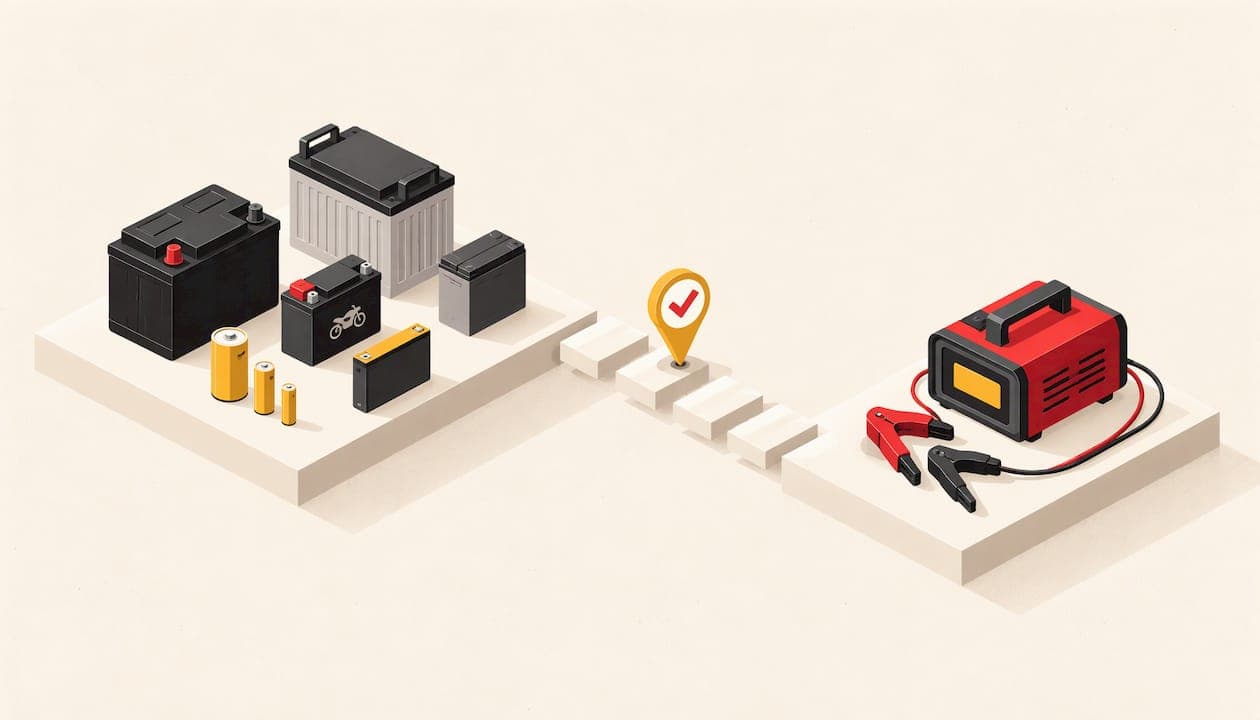
The best battery maintainer is a fully automatic, multi-stage smart unit that matches your battery chemistry (lead-acid, AGM, gel or lithium) and switches to a float or maintenance mode on its own. For most cars and motorcycles stored over winter, a 2 to 5 amp unit such as the NOCO GENIUS2, NOCO GENIUS5 or a CTEK model is enough. If you also want to recharge a flat battery quickly, step up to a 10 amp unit. Below we compare the real options, explain the jargon, and show how to size one for your battery.
TL;DR
- A maintainer holds a full battery at charge. A charger refills an empty one. Most modern smart units do both, which is why they are sold as "charger and maintainer".
- A true trickle charger delivers current constantly. A maintainer (float charger) stops when the battery is full and resumes when it drops. For long storage, choose the maintainer.
- Match the unit to your chemistry first, amperage second. A 2 to 5 A unit suits most bikes and cars in storage, while 10 A suits big batteries or faster charging.
- Skip units without automatic shut-off or a maintenance mode. They can overcharge and damage a battery.
Table of Contents
- Maintainer, charger, trickle, float: what is the difference?
- Battery maintainers compared
- Which maintainer for which job
- How to choose: five checks
- Safe use
- Our perspective
- Get the right charger and the right battery
- FAQ
- Sources
Maintainer, charger, trickle, float: what is the difference?
The terms get mixed up in shops, so here is the short version.
A charger brings a depleted battery back to full. A maintainer keeps a battery topped up over weeks or months with a small, continuous charge, and it usually has a maintenance mode that prevents overcharging, as Autoweek explains. Canadian outlet Driving makes the same point from the other side: maintainers are designed to hold a state of charge, not to provide the boost a dead battery needs.
Float charger vs trickle charger
This is the pair readers ask about most. According to AutoGuide, a battery maintainer, also called a float charger, charges when the battery falls below a threshold, while a trickle charger charges constantly, whether or not the battery is already full. That constant current is the problem: left on for weeks, an old-style trickle charger can keep pushing current into a full battery.
So "trickle charger vs maintainer" has a practical answer. If the device is a basic, non-regulated one, use it for a few hours and watch it. If it is a regulated maintainer with a float mode, you can leave it connected.

Smart charger vs trickle
A smart charger sits one step above both. Counterman notes that smart chargers generally work in multi-step procedures of three to eight steps and switch to float or maintenance mode automatically. Many of them also run a desulfation routine: pulses meant to dislodge sulfate from the plates, which can extend the life of a lead-acid battery according to the same source. In practice, nearly every unit in the table below is a smart charger with a maintenance mode, so the choice is about fit rather than category.
Battery maintainers compared
The models below keep appearing in recent tests and are widely available. Prices are the manufacturer's own list prices in their home currency and date from the cited pages, so check the current euro price at your retailer before buying.
| Model | Output | Batteries | Standout features | List price (source) |
|---|---|---|---|---|
| NOCO GENIUS2 | 6 V / 12 V, 2 A | Lead-acid, lithium-ion | Temperature compensation, automatic repair, force mode for batteries below 1 V | $49.95 |
| NOCO GENIUS5 | 6 V / 12 V, 5 A | Flooded, gel, AGM, maintenance-free lead-acid, lithium-ion | Charger, maintainer and desulfator in one | $69.95 |
| NOCO GENIUS10 | 6 V / 12 V, 10 A | Lead-acid, lithium-ion | Force mode can charge batteries down to zero volts | $99.95 |
| Draper 32283 | 6 V / 12 V, 12 A | 4 to 230 Ah batteries | LCD, 10-step charging, reconditioning mode, lithium BMS wake-up | £100 (UK list price, valid until October 2027) |
| Bosch C3 | n/a | Lead-acid, EFB, AGM | Entry-level option | from 48 euros (Heise, January 2024) |
| CTEK CT5 Time to go | n/a | Car batteries | Regeneration function | Rated "very good" in a 2021 KÜS test |
The German tests give useful context. KÜS and Auto Bild tested chargers in the 20 to 80 euro range in 2021, and the CTEK CT5 Time to go earned "very good" for its regeneration function and charging procedures. BILD's 2026 test covered devices from 20 to 200 euros and judged charging performance, safety, operation and features. Its 2026 test also singled out the AEG CW10 and the NOCO Genius 10, both 10 amps, for supporting 6 V and 12 V batteries including lead-acid, AGM, EFB, gel and LiFePO4.
Which maintainer for which job
Motorcycles, scooters and rarely driven classics
A small unit is the right tool. The NOCO GENIUS2 is described by its maker as built for year-round continuous maintenance without overcharging, and it covers automotive, marine, powersport and deep-cycle applications. At 2 A it is gentle enough for small motorcycle batteries and still adequate for a car battery that only needs holding steady through winter.
Everyday cars
A 5 A unit is the sweet spot. The GENIUS5 handles flooded, gel and AGM batteries, which covers most cars including start-stop vehicles, and it can recharge a half-empty battery overnight as well as hold it afterward. In Germany, the CTEK range is a common reference point thanks to the KÜS result above, and we stock the CTEK MXS 3.8 battery charger for readers who want that brand.
Large batteries, caravans, boats
Here a 10 A or 12 A unit makes sense. The NOCO GENIUS10 and the Draper 32283 are made for bigger capacity, and the Draper's 4 to 230 Ah range spans everything from a motorcycle to a large leisure battery. Its reconditioning mode and lithium wake-up are useful if a battery has been left flat for months.
Budget buyers
If you mainly want a safe, simple charger for a standard lead-acid, EFB or AGM car battery, Heise points to the Bosch C3 from 48 euros. BILD's price band (20 to 200 euros) shows how wide the market is, so set your budget by the chemistry and size you need, not the cheapest listing.
How to choose: five checks
BILD sums up the decision well: the right device depends on the use case, such as quick charging for a daily vehicle versus gentle maintenance for winter storage. Work through these five checks.
- Battery type. Confirm whether you have lead-acid, AGM, gel or lithium before buying, because requirements vary by technology. A unit with a dedicated lithium mode matters if you have LiFePO4.
- Voltage. Most cars and motorcycles are 12 V, older bikes and some small equipment are 6 V. The units in the table above handle both.
- Amperage versus capacity. See the sizing section below.
- Modes and automation. Look for automatic multi-step charging and a real maintenance or float mode.
- Protections. Autoweek lists the features to look for: overcharge, short-circuit, reverse-polarity and thermal protection.
Sizing: amps versus amp-hours
Two rules of thumb from US sources agree broadly. BatteryStuff suggests an amp rating of about 10% of the battery's Ah rating, and warns that a battery's maximum charging rate is about 20 to 25% of its Ah rating, so going higher could damage it. AutoGuide says to keep output within 30% of total capacity.
A worked example with our own arithmetic: for a typical 60 Ah car battery, 10% is 6 A, and the 20 to 25% ceiling is 12 to 15 A. A 5 A unit is therefore a sensible match and a 10 A unit is still within the safe range. For a 10 Ah motorcycle battery, 10% is 1 A, so a 2 A unit is already at the upper end of comfortable and is meant for maintaining, not rapid charging. Check the Ah figure printed on your own battery.

Safe use
A maintainer is only as safe as its automation. Driving warns that units without automatic shut-off can overcharge and permanently damage a battery, and can create a fire risk. Keep these habits:
- Connect the clamps before switching on the mains, and disconnect in the reverse order.
- Use the setting that matches your battery type. A lead-acid mode on a lithium battery, or the reverse, is a classic mistake.
- Do not leave a non-regulated trickle charger connected for weeks.
- Charge in a ventilated space, away from open flames.
- If a battery is swollen, hot or leaking, stop and have it checked by a workshop.
For lithium packs, a built-in battery management system matters just as much. Our guide on how charge cycles age a battery explains why partial, gentle charging is kinder to lithium-ion cells.
Our perspective
Most battery failures we see on the bench are not defects. They are batteries that sat half-empty for a season, were charged with the wrong profile, or were pushed by a charger that was far too strong for the cell.
That is why we tell customers to start with the chemistry and the capacity, then pick the charger. A good maintainer protects a battery you already own, and that is cheaper than replacing it. When a pack is already past saving, a cell replacement or refurbishment often brings a device back without buying a new one, and we offer that service for specialized and electronic batteries.
We also like to see a test before a purchase. If you are not sure whether a battery is weak or just undercharged, our battery testing service and our range of test devices give you a clear answer before you spend money on a new unit.
Waldemar Pelich
Get the right charger and the right battery
AkkuPlus sells batteries, cells, battery packs, power supplies and chargers for cars, tools, hobby gear and the household, and also repairs and tests batteries. If you want a CTEK unit, start with the CTEK MXS 3.8. If you need to know the state of a battery first, browse our battery and battery tester range. Prices and availability for Germany and neighboring countries are shown in the shop.
For repairs, cell replacement and battery testing, see our service overview, and for a replacement battery browse the Batterien category.
FAQ
Can I leave a battery maintainer connected all winter?
Yes, if it is a regulated smart maintainer with a float or maintenance mode. It charges only when the battery drops below a threshold. Do not do this with a basic trickle charger that delivers current constantly, and never with a unit that lacks automatic shut-off.
Is a battery maintainer the same as a battery charger?
Not strictly. A charger refills a depleted battery, while a maintainer holds a charged battery at full with a small current. Most modern smart units combine both functions, so a single device such as a 5 A smart charger can recharge and then maintain.
What amperage do I need?
A useful starting point is about 10% of the battery's amp-hour rating, and never above roughly 20 to 25% of it. A 60 Ah car battery pairs well with a 5 A unit, while a small motorcycle battery is fine with 2 A or less. Always check the figure on your battery.
Can one maintainer handle lithium and lead-acid batteries?
Some can. The NOCO GENIUS models and the Draper 32283 list support for both lead-acid and lithium-ion types, but you must select the right mode for each battery. Check the product page of any unit for the exact chemistries it supports, including LiFePO4.
Sources
- NOCO GENIUS2 product page
- NOCO GENIUS5 product page
- NOCO GENIUS10 product page
- Draper 12A 6/12V Smart Battery Charger with Light (32283)
- KÜS and Auto Bild charger test, 2021
- BILD battery charger test, 2026
- Heise online, battery care and chargers
- Autoweek, best car battery chargers and maintainers
- AutoGuide, the best battery maintainers
- Driving, battery maintainer buying guide
- BatteryStuff, how to choose the correct battery charger
- Counterman, smart battery chargers
Recommended
- Best Deep Cycle Battery: AGM, Gel or LiFePO4 for Your Use
- Best Battery Chargers 2026: Car, Smart and AA/AAA Picks
- Best LiFePO4 Battery: Test Winners and What to Check
- Best UPS Batteries: Lead-Acid vs. Lithium and What to Buy
This article was created with the assistance of Artificial Intelligence (AI) and has been reviewed by our editorial team. Despite careful preparation, we assume no liability for the completeness, accuracy, or timeliness of the information provided. The technical data and specifications supplied by the respective manufacturer shall always prevail.