
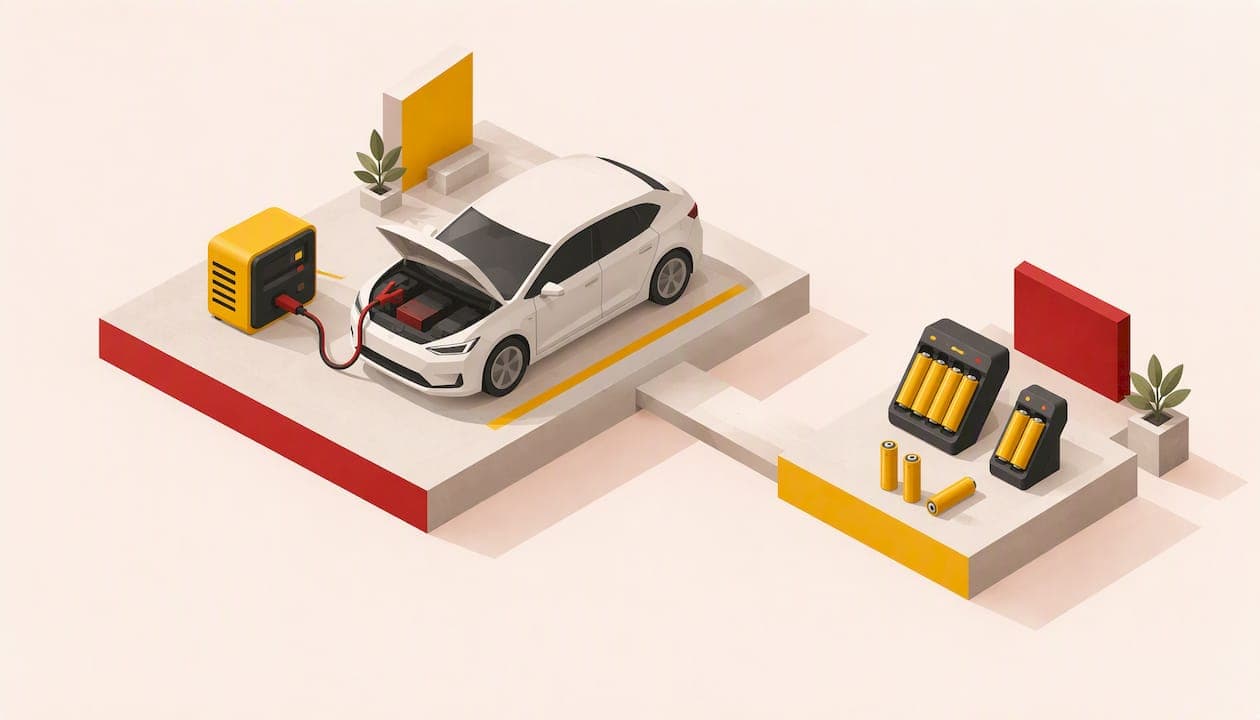
The best battery charger is the one that matches your battery's chemistry and size, not the one with the most amps. For a car or motorbike in Germany, independent tests in 2025 and 2026 keep returning to a short list: AEG, Bosch, CTEK and NOCO for 12 V lead-acid and lithium starter batteries. For AA and AAA cells, the Voltcraft IPC-3 and the Varta LCD Ultra Fast Charger+ lead the rankings. Below we compare these options, explain how to pick the right current, and say where a charger is the wrong answer.
TL;DR
- For cars and motorbikes, choose a microprocessor-controlled, multi-stage smart charger. Autozeitung's test ranked the AEG LT 10 first, with Bosch C40-Li, NOCO Genius 5 and CTEK MXS 5.0 as strongly recommended.
- Size the current to the battery: roughly one tenth of its Ah capacity. A 60 Ah battery suits about 6 A.
- For household rechargeables, the CHIP test put the Voltcraft IPC-3 first. F.A.Z. Kaufkompass preferred the Varta LCD Ultra Fast Charger+.
- Never charge a battery with a charger that does not explicitly support its chemistry, even if the plug fits.
- A dead pack is not always a charger problem. Cell replacement may be the real fix.
Table of Contents
- What the German tests agree on
- Best chargers compared
- How to choose a battery charger
- Household rechargeables: AA, AAA and more
- Charging safely
- Our view: a charger is not always the answer
- Where AkkuPlus fits
- Quick recommendations by situation
- FAQ
- Sources
What the German tests agree on
Charger tests differ in detail, but they point the same way. Autozeitung names the AEG Automotive 97024 LT 10 as its test winner and lists the Bosch C40-Li, the NOCO Genius 5 and the CTEK MXS 5.0 as very recommendable. The Einhell CE-BC 10 M is its price-performance pick. BILD's buying guide also found an AEG model, the CW10 11278, narrowly ahead of the field.
The pattern is clear: a few established brands, all with automatic multi-stage charging, win car charger tests. Differences between them are small. Your battery size, how you use the vehicle and where you charge matter more than the logo.
Testers also stress that "best" depends on the user. According to the Autozeitung findings, heavy users and people looking after several vehicles benefit from a microprocessor-controlled charger with diagnostic and reconditioning modes, such as the CTEK MXS 5.0. Someone who only wants to get a car through winter should look for a set-and-forget device that is safe and simple.

Best chargers compared
The table sums up the models the cited tests name. We have left out prices: street prices move week by week, so check a current price comparison before you buy.
| Charger | Best for | What the test says |
|---|---|---|
| AEG LT 10 (97024) | Larger 12/24 V batteries, all-round use | Test winner at Autozeitung, nine-stage smart charging, 10 A |
| Bosch C40-Li | Cars with lithium or lead-acid batteries | Rated very recommendable by Autozeitung |
| NOCO Genius 5 | Cars and bikes, mixed chemistries | Rated very recommendable by Autozeitung |
| CTEK MXS 5.0 | Winter care, motorbikes, small to mid-size batteries | Rated very recommendable by Autozeitung, with a reconditioning mode |
| Einhell CE-BC 10 M | Tight budgets, basic maintenance | Price-performance winner at Autozeitung |
| Voltcraft IPC-3 | AA/AAA NiMH cells | Test winner at CHIP, grade 1.1 ("sehr gut") |
| Varta LCD Ultra Fast Charger+ | Fast charging of up to four cells | Best of 14 chargers at F.A.Z. Kaufkompass |
AEG LT 10: the test winner
AEG's LT 10 tops the Autozeitung ranking and only narrowly misses an overall "sehr gut". With 10 A it covers big batteries, but that same power is its limit: on a small motorbike battery a 10 A charger is overkill. If your battery is 60 to 100 Ah, this is a sensible choice.
CTEK MXS 5.0: the all-round winter charger
The MXS 5.0 appears in almost every roundup, including the UK and US ones that Google also ranks. The research behind this article notes its multi-stage charging and safety features. It is the classic pick if you keep a car, a motorbike and perhaps a camper battery topped up through the cold months.
NOCO Genius 5 and Genius 10
NOCO's strength is breadth. The larger Genius 10 delivers 10 A and handles several chemistries, including lead-acid, gel and LiFePO4, according to the testing summary we reviewed. That matters if you own both an older car and a lithium leisure battery.
Bosch C40-Li
The C40-Li is a mainstream choice, easy to find in German stores, and Autozeitung rates it very recommendable. It fits drivers who want a familiar brand and a simple operating routine.
Einhell for light duty
For standard maintenance charging, budget models can be sufficient. Autozeitung's price-performance winner is the Einhell CE-BC 10 M. Expect fewer diagnostic functions than on the premium models.
How to choose a battery charger
Four questions settle most purchases.
1. What chemistry is the battery?
Lead-acid (flooded, AGM, gel), lithium-ion, LiFePO4 and NiMH all need different charging curves. Practitioners prefer chargers that detect the chemistry automatically. Even slight overcharging can cause hazardous heating in Li-ion cells, which is why the VDE advises using the original charger or a high-quality device that explicitly supports your battery type. A plug that fits proves nothing.
2. How many amps?
The rule of thumb from the Autozeitung test: maximum charge current of about one tenth of the battery's Ah capacity.
| Battery capacity | Suggested maximum current |
|---|---|
| 12 Ah (motorbike) | about 1.2 A |
| 45 Ah (compact car) | about 4.5 A |
| 60 Ah (mid-size car) | about 6 A |
| 95 Ah (large car, SUV) | about 9.5 A |
Too much current can shorten the battery's life, and too little makes charging slow. A charger with a lower trickle mode and a higher main mode, such as 0.8 A and 5 A, covers more situations.
3. Do you need maintenance mode?
If the vehicle stands for weeks, pick a charger that can stay connected and switches to float or maintenance charging. If you only charge occasionally after a short-trip winter, any smart charger will do. The KÜS test notes that short trips and long standing times are when regular charging pays off, as do heavy loads like seat heating.
4. Where will you use it?
Garage, balcony or workshop: you need ventilation and a stable, non-flammable surface. More on that in the safety section.
Household rechargeables: AA, AAA and more
Car chargers are the most searched, but many readers want a charger for AA and AAA cells. Two tests give different winners, and both make sense.
CHIP's winner, the Voltcraft IPC-3, scored 1.1 overall and 1.0 for features. Its draw is diagnostics: capacity testing and individual current adjustment per slot. The F.A.Z. Kaufkompass picked the Varta LCD Ultra Fast Charger+ from 14 devices, praising its fast, safe charging of up to four cells and its display.
Choose the Voltcraft if you care about knowing each cell's real condition. Choose the Varta if speed and a clear display matter more.
One battery-care detail: NiMH cells that are always partly discharged can develop a so-called lazy effect. The Umweltbundesamt says a full discharge and charge cycle with a dedicated charger now and then can counter it. Lithium-ion behaves differently: the same agency recommends keeping it between 20 and 90 percent where practical. Our article on NiMH versus Li-ion explains why checking voltage matters before any pack repair.

Charging safely
This is where a charger purchase turns into a safety decision. The Verbraucherzentrale and the other German bodies we reviewed give consistent advice for lithium-ion batteries:
- Use only a charger compatible with the specific chemistry.
- Charge on a non-flammable surface such as tile, away from anything that burns.
- Stay nearby while charging, and do not charge in the bedroom overnight.
- Do not cover the charger. Blocked ventilation can trigger thermal shutdown or damage the device.
If a battery swells, smokes or gets unusually hot during charging, stop immediately and remove it from use. The DGUV guidance on lithium-ion fire protection is the reference for workplaces, and the same logic applies at home. A damaged battery belongs in a designated collection point, never in household waste. For a battery that looks fine but behaves oddly, talk to a specialist before the next charge cycle.
Storage matters too. For lithium-ion packs that sit unused, the Umweltbundesamt advises roughly 50 percent charge, and a check at least every six months, since a deeply discharged cell can be damaged for good.
Our view: a charger is not always the answer
We see many customers who buy a charger for a problem it cannot fix. A smart charger can top up a healthy battery and, on some models, recondition a sulfated lead-acid one. It cannot repair a pack with a dead cell, and it cannot make an unsafe lithium pack safe. Prevention, meaning cool and dry storage and the right chemistry-specific charger, beats any repair function.
Our rule of thumb for readers:
- Identify the battery first: chemistry, voltage and capacity. The label usually has all three.
- Test before you charge repeatedly. If a pack loses charge within hours or heats up, a tester will tell you more than another charge cycle. Our battery and battery tester range is meant for exactly this.
- Pick the charger for the battery you own today, not the one you might buy later. A universal-sounding device that does not name your chemistry is a risk.
- If the pack is the problem, replace the cells or the pack, not the charger. That is what our repair service is for. See our guide to e-scooter battery replacement for the checks to run first.
— Waldemar Pelich
Where AkkuPlus fits
We sell batteries, cells, battery packs, power supplies and accessories for German-speaking and wider European customers, and we offer battery repair, battery testing and cell replacement. If you already know your battery and need the right power supply or accessory, start with our Stromversorgung category. For replacement packs and cells, see Akku- und Batteriepacks, and for AA/AAA and other standard cells, Batterien. If a pack no longer holds charge, our services such as battery repair, battery testing and refurbishment are listed on the AkkuPlus home page. We publish no repair prices, so ask us for a quote.
Quick recommendations by situation
- One family car, parked in winter: a 4 to 6 A smart charger with maintenance mode. The CTEK MXS 5.0 and NOCO Genius 5 are the tested options.
- SUV, van or several vehicles: a 10 A model such as the AEG LT 10 or NOCO Genius 10, so charging is not slow.
- Motorbike or scooter: a charger with a low-current mode, around 0.8 A, so you do not push too much into a small battery.
- Lithium or LiFePO4 battery: only a charger that names the chemistry in its specifications.
- Remote controls, torches, cameras: a four-slot NiMH charger such as the Voltcraft IPC-3 or Varta LCD Ultra Fast Charger+.
- Strict budget: the Einhell CE-BC 10 M for basic maintenance charging.
FAQ
What is the best brand of battery charger?
There is no single best brand. In German tests, AEG, Bosch, CTEK and NOCO score best for car batteries, and Voltcraft and Varta for AA/AAA cells. Pick by your battery's chemistry and capacity first, then by brand.
How many amps do I need to charge a car battery?
About one tenth of the battery's capacity in Ah. A 60 Ah battery suits roughly 6 A. Higher currents can shorten battery life, while very low currents just take longer.
Is a smart charger worth it over a basic one?
For most people, yes. A smart charger monitors the battery in several stages and stops or switches to maintenance charging automatically. That reduces overcharging risk, which matters most with lithium-ion.
Can I leave a charger connected all winter?
Only if it has a maintenance or float mode and is designed for permanent connection. Keep it ventilated and uncovered, and check it on occasion. A basic charger without automatic shut-off should not be left alone.
Can I use any charger if the plug fits?
No. According to the VDE, the charger must support the battery's specific chemistry, otherwise the wrong voltage profile can lead to overheating or fire. Use the original charger or a verified one that names your battery type.
Sources
- Autobatterie-Ladegeräte im Test, Autozeitung
- Autobatterie-Ladegeräte im Test 2026, BILD-Kaufberater
- Autobatterie-Ladegeräte im KÜS-Test
- Akku-Ladegeräte im Test 2026, CHIP
- Das beste Batterieladegerät, F.A.Z. Kaufkompass
- Batterien und Akkus richtig nutzen und fachgerecht entsorgen, Umweltbundesamt
- Batterien und Akkus richtig verwenden und entsorgen, Verbraucherzentrale
- Batterien und Akkus, VDE Verbraucherschutz
- DGUV Information 205-041, Brandschutz beim Umgang mit Lithium-Ionen-Batterien
Recommended
- NiMH vs Lithium Ion in Germany: Check Voltage Before a Pack Repair
- Best Marine Battery: Match the Job, Then Check Lithium Safety
- Electric Scooter Battery Replacement: 6 Checks Before You Buy
This article was created with the assistance of Artificial Intelligence (AI) and has been reviewed by our editorial team. Despite careful preparation, we assume no liability for the completeness, accuracy, or timeliness of the information provided. The technical data and specifications supplied by the respective manufacturer shall always prevail.