
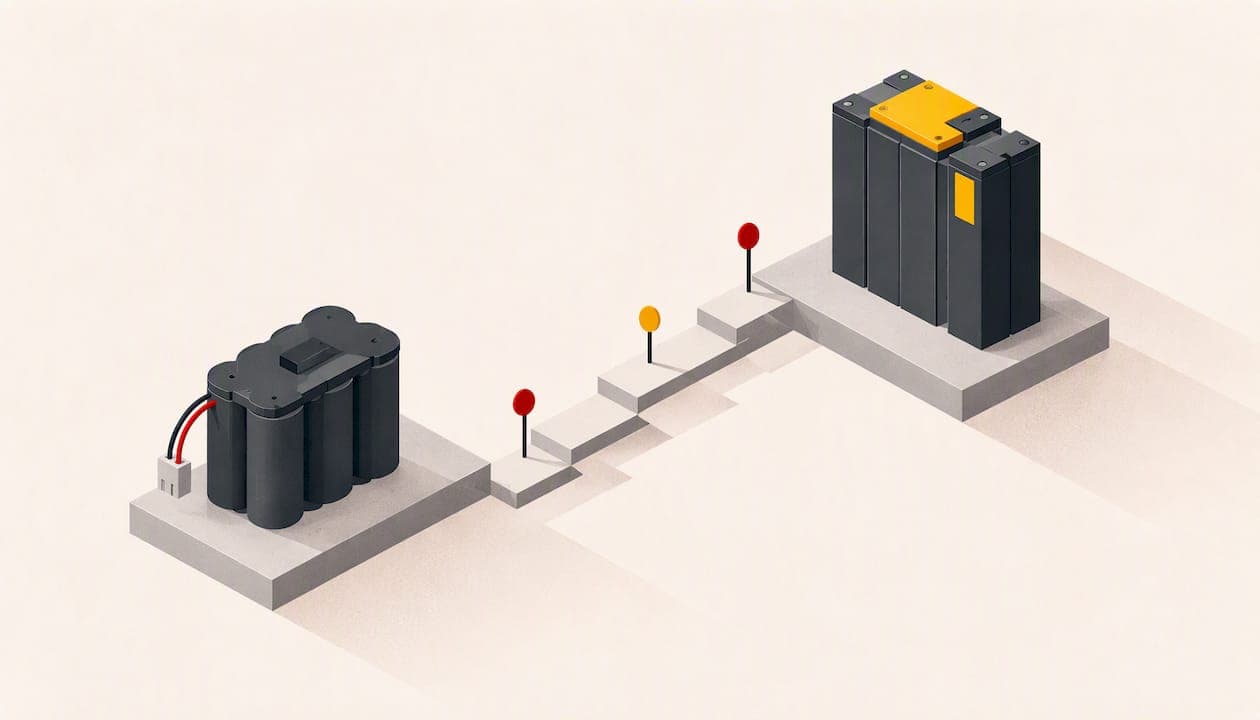
For most modern portable electronics and high-energy uses, choose Li-ion. For low-cost legacy AA/AAA devices or simple custom packs, choose NiMH, or low-self-discharge (LSD) NiMH when the device sits unused for months. Never swap chemistries without the manufacturer's approval, and always use the approved charger.
TL;DR:
- NiMH cells deliver about 1.2 V, while lithium ion cells deliver 3.6 to 3.7 V; never substitute chemistries unless the device maker approves.
- Standard NiMH loses about 25% of its charge monthly, compared with about 4% for LSD NiMH, making the latter better for stored devices.
- For daily lithium ion use, keep charge near 20% to 90%, store packs near half charge, and use only a matching charger.
- Avoid sustained temperatures above 40°C with either chemistry, and stop using lithium ion packs that swell, hiss, smell chemical, or emit smoke.
Table of Contents
- Quick pros and cons of NiMH vs Li-ion
- How do voltage, energy density and self-discharge compare?
- Which chargers and habits keep each chemistry healthy?
- What safety risks should you know about?
- What do the cost and environmental picture look like?
- Which chemistry should you pick for your device?
- Where I land on the Li-ion transition
- How we help you pick and repair batteries
- FAQ
- Sources
Quick pros and cons of NiMH vs Li-ion
- Li-ion pros: much higher energy density and far lower self-discharge than NiMH, plus no memory effect, according to the Fraunhofer lithium-ion roadmap.
- Li-ion cons: needs a battery management system and a matching charger, and carries a higher thermal runaway risk if damaged or overcharged.
- NiMH pros: tolerant, simple to charge, and sold in familiar AA and AAA sizes at modest prices. The LSD variant keeps its charge for months.
- NiMH cons: standard cells lose a lot of charge while idle, and they are heavier for the energy they hold.
- Where Li-ion shines: phones, laptops, cameras, e-scooters, cordless tools.
- Where NiMH shines: remote controls, older cordless phones, toys, and flashlights that take AA or AAA cells.
How do voltage, energy density and self-discharge compare?
Start with voltage, because it decides whether a swap is even possible. A NiMH cell delivers about 1.2 V, while a lithium-ion cell sits at about 3.6 to 3.7 V, as the Verbraucherzentrale explains. A device built around one chemistry expects that voltage window, and a different chemistry needs different pack design and a different charger.
Energy density is where Li-ion pulls ahead. A Li-ion cell stores considerably more energy per unit of weight and volume, so the same runtime fits in a lighter, smaller pack. For a phone or a handheld power tool, that difference is the whole reason the industry moved on.
Self-discharge matters just as much for devices you do not use daily. Fraunhofer puts standard NiMH at roughly 25% per month, and the Umweltbundesamt lists LSD-NiMH at about 4% per month, which is why LSD cells work well in a flashlight in a drawer. See the Fraunhofer roadmap and Umweltbundesamt guidance. Li-ion loses far less charge while idle than either NiMH type.
Cycle life depends on how you use the cell. NiMH can show a reversible "lazy effect," a capacity dip that full charge and discharge cycles can often restore, and it ages faster under deep discharge, as the Umweltbundesamt notes. Li-ion has no memory effect, but heavy draws, heat and constant full charging all wear it down. Keep either chemistry away from sustained heat above 40°C, which Fraunhofer's safety analysis flags as harmful to both.
For cylindrical Li-ion formats and replacement sizes, our 18650 listings show what is commonly available.
Which chargers and habits keep each chemistry healthy?
Li-ion packs rely on a battery management system, so pair them with a charger designed for them. For daily use, the Umweltbundesamt recommends keeping Li-ion between roughly 20% and 90%, and many devices already stop at 70 to 80% to protect the cell. For long storage, aim for about half charge. Li-ion also tends to charge faster than NiMH, but only on a charger built for it.
NiMH cells want a NiMH-rated charger. Standard cells need topping up before use after sitting, while LSD-NiMH cells come out of storage ready to go. If a NiMH cell has lost capacity, a few full charge and discharge cycles can often bring it back.
Some habits apply to both. Avoid hot cars and direct sun, do not charge unattended, and never use a charger meant for the other chemistry. The Verbraucherzentrale adds that you should use original chargers and correctly matched replacement batteries, charge in a monitored spot near a smoke detector and away from flammable material, and never charge while you sleep.
Pro Tip: Before you store or discard any lithium cell, tape its contacts with insulating tape so loose metal can never bridge them.

What safety risks should you know about?
Li-ion packs the most energy, and Fraunhofer's experts note that safety falls as energy density rises. That is why Li-ion demands a proper battery management system and stricter handling. The main danger is thermal runaway after damage, a crash, or overcharging. Swelling, hissing, a chemical smell or smoke mean you should stop using the pack, move it away from anything flammable, and keep your distance.
NiMH carries a lower thermal runaway risk, but it is not indifferent to abuse. Prolonged high temperatures and overheating still shorten its life and can damage it. Some Li-ion chemistries, such as LFP, are chosen specifically for higher intrinsic safety.
Prevention is simple. Insulate terminals, store cells in a cool, dry place, and replace any battery that looks deformed. Products sold in Germany must comply with the Product Safety Act (ProdSG), so a safety defect is a matter for the manufacturer and seller, and you should report it rather than keep using the pack. Durability and safety are different things: a pack that lasts years can still be dangerous once damaged.
What do the cost and environmental picture look like?
Li-ion cells usually cost more per unit, but higher energy density changes the math. You get more runtime per charge from a lighter pack, which can offset the higher price for devices you use heavily. Fraunhofer's analysis shows industry moving toward Li-ion on cost and energy-density gains, and NiMH struggling to compete on performance and cost over the long term.
For simple AA and AAA gear, NiMH remains an economical choice, especially in LSD form. You can see a NiMH cell in our product range.

Disposal rules apply to both. The Verbraucherzentrale explains that lithium cells need separate collection and must never go into household waste, so use a proper collection point after taping the poles. Repair also stretches value: professional services can often replace or refurbish a pack for less than buying new, as the Verbraucherzentrale's repair guidance points out.
Which chemistry should you pick for your device?
- Phones, laptops and cameras: use Li-ion in the pack the maker specifies, with its original charger.
- Cordless power tools and e-scooters: stay with the chemistry the tool was built for. Modern high-draw tools are almost always Li-ion.
- Toys and remote controls: NiMH in AA or AAA works well and is forgiving.
- Flashlights and rarely used devices: choose LSD-NiMH so the cells are ready when you need them. For some high-drain uses, lithium AA cells can beat alkaline, as our lithium AA guide explains.
- Model hobby equipment: follow the model and charger manufacturer's chemistry rules exactly.
- Unsure? Check the device specifications, or have a professional replace the cells or rebuild the pack.
Where I land on the Li-ion transition
Li-ion is the sensible default for modern devices, and NiMH keeps a few honest niches, mostly cheap AA gear and rarely used tools. Whatever you buy, the right charger and safe handling matter more than the chemistry label. Where a pack is worth saving, repair beats the bin, and recycling closes the loop.
— Waldemar Pelich
How we help you pick and repair batteries
Once you know the chemistry you need, we can help you act on it. Browse our single cells and battery and pack range, or send us a worn pack through our repair and cell replacement service. Tell us your device and we will check compatibility with you. Contact our customer support and we will point you to the right replacement or repair.
FAQ
Can you replace NiMH with a lithium-ion battery?
Not by default. The voltages differ (about 1.2 V against about 3.6 to 3.7 V per cell), and Li-ion needs a different charger and protection circuit. Only swap chemistries if the device manufacturer explicitly approves it.
Which battery is better, Li-ion or NiMH?
For most modern devices, Li-ion is better because it stores more energy in less weight and loses less charge while idle, according to Fraunhofer. NiMH is still a good fit for simple AA and AAA gear.
What are the disadvantages of NiMH batteries?
Standard NiMH loses roughly a quarter of its charge each month sitting idle, and it is heavier for the energy it stores. It can also show a reversible capacity dip if it is never fully cycled.
Is NiMH safer than Li-ion?
Generally yes. Fraunhofer's safety research notes NiMH does not carry the same thermal runaway risk as many lithium-ion chemistries. Both still suffer from sustained heat, so store and charge them carefully.
Sources
- Gesamt-Roadmap Lithium-Ionen-Batterien 2030
- AN LI-IONEN-BATTERIEN (LIB) IN
- Verbraucherzentrale
- Batterien und Akkus richtig nutzen und fachgerecht entsorgen | Umweltbundesamt
Recommended
- Battery Pack for Siemens Gigaset V30145-K1310-X50 - 4.8 Volt Ni-MH
- Replacement Battery - Bosch BH-1464N - 14.4 Volt 3000mAh Ni-MH
- Battery Pack - AAA-5 RTU - 6 Volt 800mAh Ni-MH for Self-Assembly
- Battery Repair - Cell Replacement - Siemens C30, M30 / L36880-N6001-A1
This article was created with the assistance of Artificial Intelligence (AI) and has been reviewed by our editorial team. Despite careful preparation, we assume no liability for the completeness, accuracy, or timeliness of the information provided. The technical data and specifications supplied by the respective manufacturer shall always prevail.