
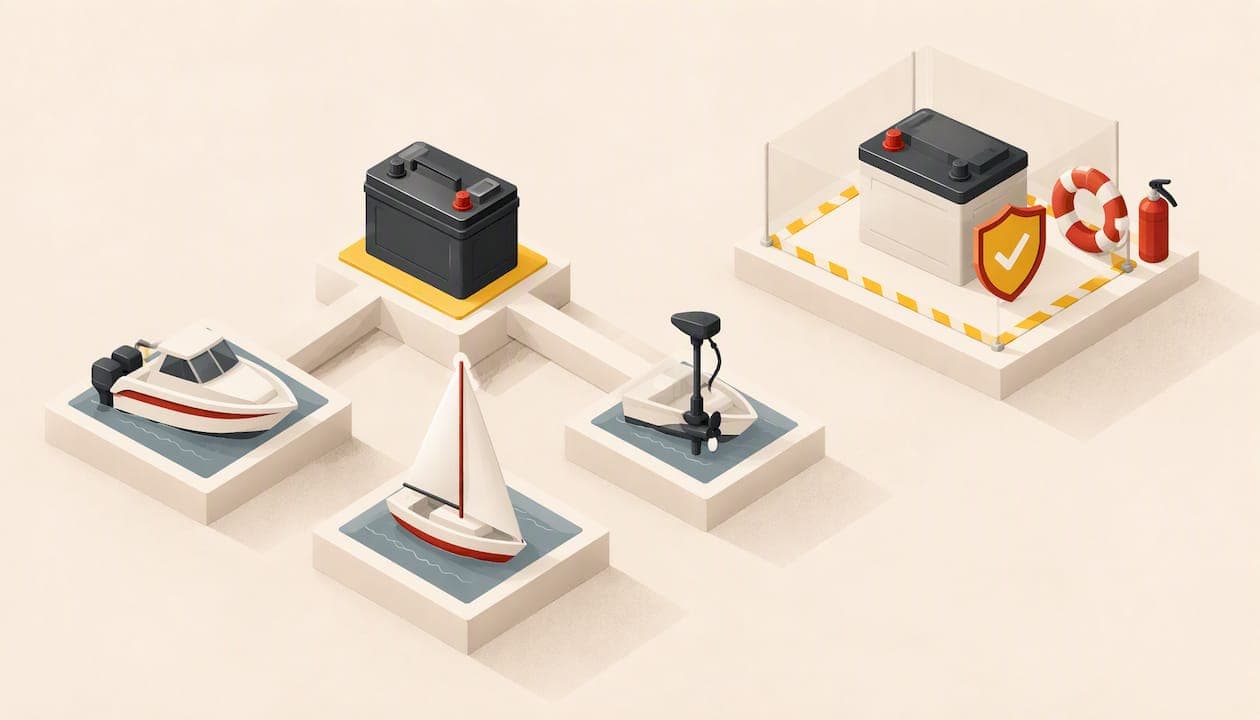
For engine starting, choose a dedicated starting battery sized to your engine's cranking demand. For house loads and trolling motors, a LiFePO4 deep-cycle battery gives the most usable capacity per pound, while AGM stays the lower-cost route. Whatever you pick, check that it is marine-rated and meets IEC 62619 or IEC 62620 for lithium. We stock batteries at AkkuPlus and can help you size one.
TL;DR:
- Calculate daily amp hour use from each device’s current and run time; a 30 amp trolling motor used for three hours consumes 90 Ah.
- Use usable Ah, not the label capacity, when estimating runtime; a 100Ah lithium battery can deliver more usable energy than a 100Ah AGM.
- Keep starting and house loads separate; upgrading only the trolling motor circuit need not replace a working AGM bank, but retain its matched charger profile.
- For lithium, verify marine suitability, IEC 62619 or IEC 62620 compliance, a protective BMS, and use a charger the manufacturer approves with competent installation.
Table of Contents
- Which marine battery should you pick for each job on your boat?
- What is the difference between starting, deep-cycle, and dual-purpose batteries?
- How do you size and choose a marine battery for your boat?
- How do you read marine battery specs like Ah, CCA, and cycle life?
- What safety and installation rules apply to marine batteries?
- How should you maintain batteries and store them over winter?
- What are the typical price, weight, and lifespan trade-offs?
- How do charging requirements differ between marine battery types?
- How do you recycle or dispose of marine batteries?
- How does performance degrade over a battery's lifespan?
- How do saltwater and the marine environment affect battery choice?
- What do we see in customer questions about marine batteries?
- Where can you buy the right marine battery and get sizing help?
- FAQ
- Sources
Which marine battery should you pick for each job on your boat?
Think of your boat as three separate battery jobs. Each one asks for something different, so one "best" battery rarely exists. Here is the shortlist we point buyers to, with what to verify on any product page before you order.
- Best starter solution: A dedicated starting battery, either a sealed AGM or a LiFePO4 pack built for high-current bursts. Check the CCA or MCA rating against your engine's requirement, and confirm the battery is designed for short, hard discharges rather than long, slow ones. For a lithium starter, confirm a built-in BMS that allows high peak current. A German-made example shows what the top of the market looks like: one LiFePO4 unit is reported to deliver 1,000 cold-start amps in its 150Ah version, with an IP67 housing and BMS protections.
- Best house/deep-cycle solution: LiFePO4 if your budget allows, because you can use far more of its rated capacity. Verify usable Ah (not just nominal Ah), the BMS alarm and cutoff features, and the charging profile the manufacturer approves.
- Best trolling-motor solution: A deep-cycle battery with strong continuous discharge ratings. Look for the continuous discharge current on the product page and make sure it covers your motor's maximum draw with some margin. Lithium keeps voltage steadier as it drains, so thrust stays consistent through the day.
- Best budget option: A sealed AGM deep-cycle battery. You give up weight and cycle life, but the upfront cost is lower and the charging requirements are familiar. Match the Ah to your loads and avoid buying the smallest unit that technically fits.
- Best premium/high-performance option: A marine-rated LiFePO4 battery with an integrated, alarm-capable BMS, a certified build, and a manufacturer-approved charger. This is the choice when weight, long cycle life, and usable capacity matter more than upfront price.
For each shortlist item, our ordering note is the same: start in our Batterien category, filter by voltage and capacity, and read the product page for Ah, usable capacity, CCA/MCA where it applies, BMS presence, and charging profile. If a page leaves one of those blank, ask us before you buy. We help you match the features to your boat rather than steering you to a brand name.
A few quick rules help when the choice feels close:
- Keep starting and house loads on separate batteries so a flat house bank never leaves you unable to start the engine.
- Size for the load you actually run, not the biggest battery that fits the tray.
- Pick one chemistry per bank and keep it consistent.
- Buy the charger and the battery as a pair, not as separate afterthoughts.
If your boat already has a working AGM bank and you only want to upgrade the trolling motor circuit, you do not need to rebuild everything. Change one circuit at a time, and keep each circuit's charger profile matched to its battery.
What is the difference between starting, deep-cycle, and dual-purpose batteries?
The three roles describe how a battery delivers its energy, not just how big it is.
A starting battery delivers a very large current for a few seconds to turn the engine over, then gets recharged by the alternator. It has many thin plates, which give high surface area and high burst power, but it does not like being drained deeply again and again.
A deep-cycle battery is built to deliver steady current for hours and be discharged much further, then recharged. It supports house loads: lights, electronics, fridge, pumps, and trolling motors.
A dual-purpose battery tries to do both. It can crank an engine and also handle moderate cycling, which suits a small boat with limited space. It is a compromise: it rarely starts as hard as a true starting battery or cycles as well as a true deep-cycle one.
The common chemistries behave differently in practice:
- Flooded lead-acid: The cheapest per amp-hour and widely available, but heavy and it needs topping up with water and good ventilation. Its usable capacity is limited because deep discharge shortens its life.
- AGM: Sealed, spill-resistant, and low maintenance. It tolerates vibration better and sits between flooded and lithium on cost.
- Gel: Sealed like AGM and gentle on slow, deep cycling, but more sensitive to charging voltage. It is less common on boats today.
- LiFePO4 (lithium iron phosphate): Much lighter, with greater usable capacity and longer cycle life, at a higher upfront cost. Comparative data shows typical 100Ah LiFePO4 batteries are far lighter than AGM equivalents and usually offer greater usable capacity and longer cycle lives.
One point matters across all of them: lithium installations on boats call for marine-rated equipment and competent installation. We cover the details in the safety section below. For now, remember that choosing lithium is a system decision (battery, BMS, charger, wiring), not just a battery swap.
How do you size and choose a marine battery for your boat?
Work through this in order with a notepad and your boat's equipment list.
- Audit your starting needs. Find your engine's cranking requirement in the manual or on the engine plate, and note the CCA or MCA the manufacturer recommends. Add margin if you boat in cold water.
- List your house loads. Write down every device that draws from the house bank, with its amps (or watts divided by volts) and how many hours you run it.
- Add up daily consumption. Multiply each load's amps by its running hours, then add the results to get amp-hours per day.
- Choose your usable-capacity target. Divide daily consumption by the share of capacity you can safely use. Lead-acid chemistries are typically cycled much more shallowly than lithium to protect their life, so you need a larger nominal bank to get the same usable energy.
- Pick the chemistry. Decide between AGM and LiFePO4 based on weight, budget, and how deeply you cycle.
- Verify compatibility. Confirm your charger, alternator regulator, and any solar controller can be set for the chemistry you chose.
- Prepare your questions for the seller and installer (see the checklist below).
A simple worked example, with illustrative numbers only: say your trolling motor draws 30 amps and you run it for 3 hours. That is 90 Ah of energy. If you can use roughly all of a lithium battery's rated capacity, a 100Ah LiFePO4 covers the trip with a small buffer. If you only plan to use around half of an AGM's rating to protect its life, you would want about 180 Ah of nominal AGM for the same outing. This is why a battery that looks smaller on the page can do the same job.
Rules of thumb for banks: size the bank to your load plus a buffer rather than to the exact minimum, keep all batteries in a bank the same chemistry, age, and capacity, and never mix lithium with other battery types. The Boat Safety Scheme guidance stresses using approved chargers and a robust BMS, and says lithium must never be mixed with other battery types.

Pro Tip: Write your daily amp-hour total on the inside of your battery locker lid. When you change equipment, update it, and you will never size a bank from memory again.
Questions to ask on a product page or of an installer:
- What is the usable capacity, not just the nominal rating?
- Does the BMS offer alarms, low-voltage cutoff, and overcurrent protection, and can it handle my engine's or motor's peak draw?
- Which charger profile does the manufacturer approve, and at what voltages?
- What are the warranty terms, and what are the return conditions if the battery does not suit my boat?
- Does the installer follow marine standards and document the installation?
How do you read marine battery specs like Ah, CCA, and cycle life?
Product pages are full of numbers. These are the ones that matter most, and what each means for your use case.
- Ah (amp-hours) versus usable Ah: Nominal Ah is the label capacity. Usable Ah is how much you can actually draw without shortening the battery's life or tripping its protection. Run-time estimates should use usable capacity, which is why a 100Ah lithium battery often outlasts a 100Ah AGM in the real world.
- CCA and MCA: Cold cranking amps and marine cranking amps describe the starting burst a battery can deliver. They matter for starting batteries and mean little for house banks. Match them to your engine's stated requirement, with margin for cold mornings.
- Continuous versus peak discharge: Continuous discharge is what the battery can supply for long periods, which is the figure a trolling motor cares about. Peak discharge is a short burst, which matters for starting and for inrush loads like windlasses and inverters. Check that the continuous figure covers your motor's maximum draw.
- Cycle life: Manufacturers quote the number of charge-discharge cycles to a stated capacity. Read the fine print: the claim depends on depth of discharge, temperature, and charge rate, so a larger number at a shallow depth is not the same as the same number at a deep one. Comparative tables suggest lithium can offer two to three times the cycle life of AGM, though the exact figure depends on the product and how you use it.
- Weight: Lighter batteries help trim, fuel use, and handling, and they make installation easier on small boats.
- BMS features and charging voltages: For lithium, look for protection against overcharge, over-discharge, overcurrent, short circuit, and temperature extremes, plus alarms. Use the charger voltages the manufacturer specifies, because the wrong profile can undercharge or damage the pack.
When you compare two pages, put the numbers side by side: usable Ah, continuous discharge, CCA or MCA if relevant, weight, and approved charging profile. The cheaper battery often looks cheaper only because one of these is left blank. If a number you need is missing, ask us, and we will check it for you before you order.
What safety and installation rules apply to marine batteries?
Lithium batteries can be operated safely when installed and charged correctly with a robust battery management system. The Boat Safety Scheme says installed lithium systems need marine-suitable equipment, installation to industry standards by a competent installer, and chargers approved by the manufacturer. We follow the same line when we advise buyers.
The standards to verify:
- IEC 62619 and IEC 62620: Safety and performance requirements for lithium cells and batteries. Product documentation should say the battery meets them.
- ISO 23625: The installation standard the guidance points to for small craft lithium systems. Ask your installer whether they work to it.
What acceptance looks like in product specs: a named standard, a described BMS with protections and alarms, a stated approved charger or charge profile, and a marine-suitable enclosure rating. Vague claims such as "marine grade" without a standard are not enough.
Practical precautions:
- Use a robust BMS with alarms, and never mix lithium with other battery types in the same bank.
- Charge under supervision. Marine insurer and skipper guidance recommends not leaving lithium batteries charging unattended and using fire-safe containment.
- Keep batteries out of damp bilges, fix them firmly against movement, and protect terminals from accidental shorting.
- Do not use a battery that is swollen, dented, or has been dropped hard.
- Tell your insurer about a lithium installation where required by your policy.
One point worth knowing: LiFePO4 behaves differently from other lithium chemistries and carries a lower thermal runaway risk, but the same insurer guidance says installation, storage, and charging supervision still matter and recommends professional installation.
A lower fire-risk chemistry still needs a careful installation: LiFePO4 reduces thermal runaway risk, but professional installation and supervised charging remain essential on a boat.
How should you maintain batteries and store them over winter?
A short routine keeps batteries healthy across seasons. ADAC Skipper guidance recommends removing or at least disconnecting batteries for winter, storing them at moderate temperatures (around 10°C is ideal), and giving them a maintenance charge at least every three months. Always follow the maker's instructions first.
Here is a practical routine:
- Charge fully before you lay up. Lead-acid batteries stored half-empty degrade faster.
- Disconnect and clean. Switch off the master isolator or remove the batteries, wipe the case, and clean corroded terminals.
- Store in a cool, dry, frost-free place. Avoid a damp locker and keep the batteries off bare concrete if the manufacturer advises it.
- Set the storage charge. For lithium, aim for the manufacturer's storage state of charge, commonly 20 to 40%. For lead-acid, keep them topped up.
- Check every three months. Give lead-acid a maintenance charge and check the lithium state of charge. If you want to understand why packs lose charge in storage, our post on lithium battery self-discharge explains how to measure it.
- Pre-season checklist: charge to 100%, inspect terminals and cables, verify the BMS and charger settings, and test under load before your first trip.
If a battery seems weak after storage, a proper test tells you more than guessing. We offer battery tests and checks, so ask us if you are unsure whether a pack is worth keeping.
What are the typical price, weight, and lifespan trade-offs?
The trade-off is simple to state: you pay once, or you pay over time.
Flooded and AGM lead-acid batteries cost less upfront but weigh more and give you less usable capacity per rated amp-hour. You also tend to replace them more often if you cycle them deeply. Lithium costs more at purchase but is much lighter and offers greater usable capacity and a longer cycle life. Comparative tables suggest lithium units can be two to four times lighter than AGM equivalents, with a longer cycle life, though they cost more upfront.
How that plays out depends on how you boat:
- Weekend boater with light loads: AGM often makes sense. You cycle shallowly, the low price matters, and the lifespan gap is smaller than the spec sheet suggests.
- Frequent cruiser or trolling-motor angler: Lithium usually pays back. You cycle deeply, you carry the weight in a small boat, and you use more of the capacity you paid for.
- Small boat where trim matters: Weight savings alone can justify lithium.
Do not forget the extras. Lithium may need a new charger profile, a compatible alternator regulator, and professional installation. Add these to the price before you compare. Think in cost per usable amp-hour per cycle rather than sticker price, and the picture often changes.
How do charging requirements differ between marine battery types?
Each chemistry wants its own charging profile, and using the wrong one shortens life or creates risk.
- Flooded lead-acid: Needs a multi-stage charge with a periodic absorption phase and a float stage. It can release gas, so ventilation matters.
- AGM: Wants a controlled charge voltage and is sensitive to overcharging. Many chargers have a dedicated AGM setting.
- Gel: The most voltage-sensitive of the lead-acid group. A gel-specific profile is required.
- EFB and similar: Have their own voltage windows. Our post on EFB battery charging shows why one headline voltage is only part of the fix.
- LiFePO4: Needs a lithium-specific profile, with a BMS that protects the cells. Use the charger the manufacturer approves, as the Boat Safety Scheme guidance stresses.
Compatibility checklist:
- Your shore charger, alternator regulator, and solar controller must all support the chemistry.
- Do not charge lithium from a charger set to a lead-acid profile unless the maker confirms it is safe.
- Never mix chemistries on one charging bus.
- Prefer chargers with selectable profiles so you can change them if you switch chemistry later.
If you are unsure whether your existing charger fits a new battery, send us the model and we will check against the battery's approved profile.
How do you recycle or dispose of marine batteries?
Never throw a marine battery in household waste. Both lead-acid and lithium batteries contain materials that are harmful if they leak or burn, and both are recyclable.
- Take them to a proper collection point. Retailers that sell batteries are generally expected to take back used ones, and municipal recycling centers accept them as well. Ask the seller when you buy.
- Tape terminals on damaged or lithium batteries to prevent short circuits during transport, and keep them upright.
- Do not store a damaged or swollen battery indoors. Keep it somewhere dry and non-flammable until you can drop it off.
- Do not try to open or dismantle a battery. Lead-acid cases contain acid, and lithium packs can ignite when punctured.
- Hand over old batteries when you replace them. This is the easiest way to make sure they reach a recycler.
If you are unsure what to do with a pack that no longer holds charge, contact us. We can tell you whether a repair or cell replacement is worth considering or whether it is time to recycle.
How does performance degrade over a battery's lifespan?
Batteries do not fail all at once. They fade, and knowing the typical shape of that fade helps you plan replacement before a bad day on the water.
- Early life: Capacity is at or near the rated figure and voltage holds steady under load.
- Middle life: You may notice slightly shorter run times and a little more voltage sag under heavy loads. Lead-acid batteries lose capacity gradually, faster if they are often left discharged.
- Late life: Run time drops clearly, the battery charges quickly but empties just as fast, and starting batteries turn the engine over more slowly, especially when cold.
- End of life: The battery cannot meet the loads it was bought for, even after a full charge.
Lithium tends to hold its capacity and voltage more evenly through most of its life, then declines more noticeably near the end, but the exact pattern depends on the product and use. You cannot read health from voltage alone, so test under load. Habits that slow the fade include avoiding deep discharges, charging with the right profile, keeping batteries cool, and storing them at a sensible charge level. Our post on the battery memory effect explains which myths about capacity loss to ignore.
A yearly load test, taken at the start of the season, is the cheapest warning system you can have.
How do saltwater and the marine environment affect battery choice?
Salt air and spray attack terminals, lugs, and cables long before they affect the battery itself. The result is resistance, heat, and voltage drop, which can look like a failing battery when the real problem is a corroded connection.
What this means for your choice and care:
- Prefer sealed batteries (AGM, gel, or sealed lithium) in exposed or damp locations. A sealed case with a high ingress rating, such as the IP67 housing noted on one heavy-duty LiFePO4 example, resists water and spray.
- Protect terminals. Use tinned marine-grade lugs and cable, tighten connections properly, and apply a terminal protectant after cleaning.
- Keep batteries dry and secured. A battery sitting in a wet bilge or sliding around in a seaway is a hazard in any chemistry.
- Ventilate where needed. Flooded batteries release gas, so give them airflow, and keep any battery away from heat sources.
- Rinse and inspect regularly. Check terminals at the start of each season and after rough trips, and clean any white or green deposits.
- Mind temperature. Cold reduces cranking power, and heat shortens life. Store the battery within the temperature range the manufacturer gives.
In a salt environment, the best battery is the one with a sealed case, quality connections, and a routine inspection habit.
What do we see in customer questions about marine batteries?
Our most common conversations follow a pattern. Buyers focus on the sticker price and nominal Ah, then discover later that usable capacity, charger compatibility, or a missing BMS feature changes the picture. The mistakes we see most often are undersized banks, a lithium battery paired with the old lead-acid charger, and a starting battery asked to do deep-cycle work.
Installation oversights come next: loose or unprotected terminals, no fuse close to the battery, and batteries left charging unattended. None of these are exotic. They are easy to avoid when the specs are clear and someone checks the whole system, not just the battery.
That is why we think buying from a specialist who publishes clear specs and answers sizing questions lowers your risk. If you are unsure, send us your loads, your engine's starting requirement, and your charger model, and we will help you choose or order.
— Waldemar Pelich
Where can you buy the right marine battery and get sizing help?
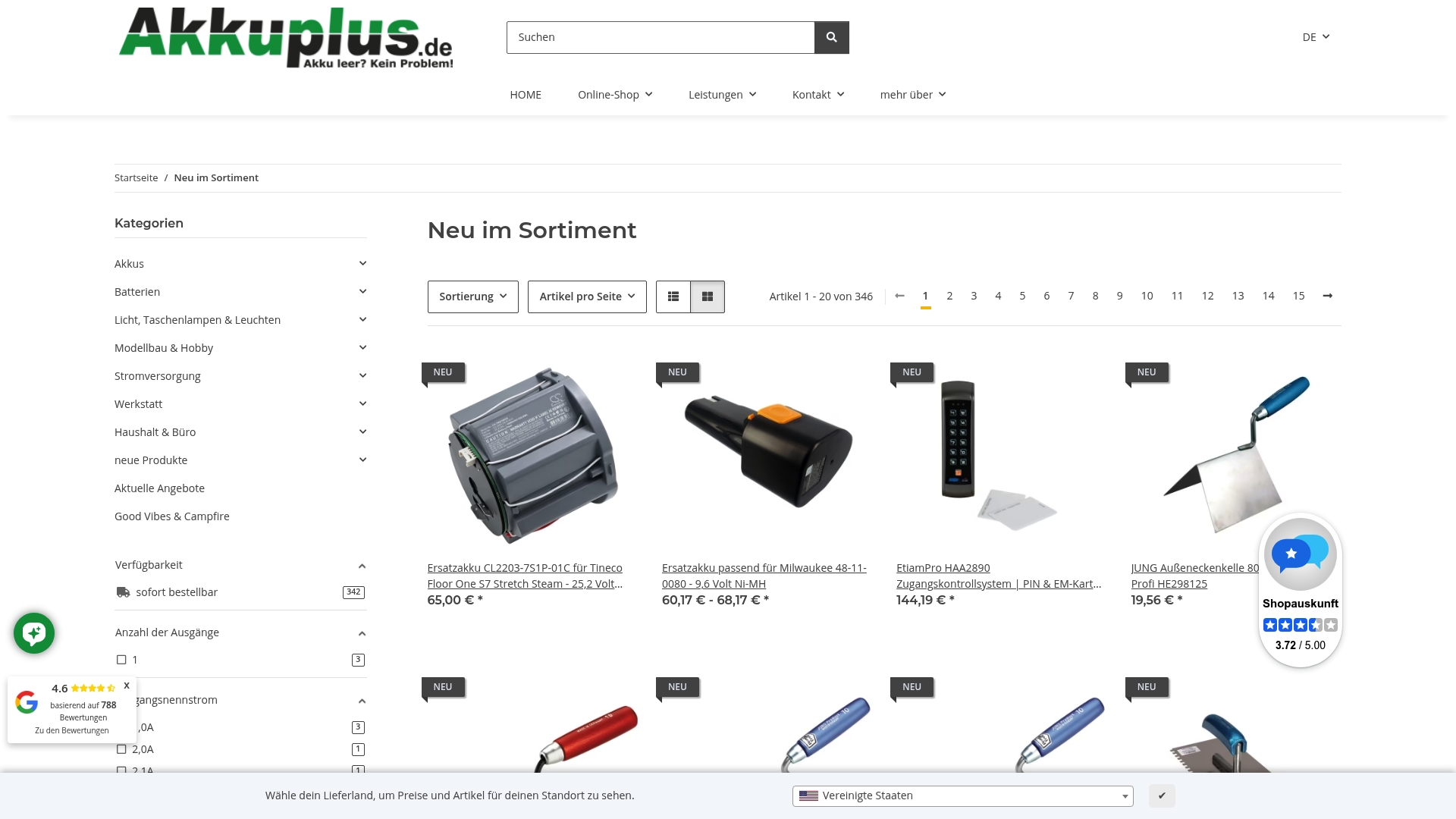
We make the purchase simple: browse, filter, and ask us if anything is unclear. Our Batterien category is the place to start. Our homepage also lists our wider range, including battery repair, testing, and more.
How to use the category effectively:
- Filter by voltage and capacity first, then read each page for usable capacity, discharge ratings, and the BMS description.
- For a starter, look for the CCA or MCA figure. For house or trolling use, look for the continuous discharge rating.
- Check the stated charging profile and confirm your charger can supply it.
- Choose your country at the top of the site so you see the availability and pricing that apply to you.
What we can do for you:
- Help you size a battery or a bank from your loads and your engine's requirements.
- Check whether the charger you already own suits the battery you are considering.
- Test an existing battery, so you know whether it is worth keeping.
- Advise on repairs and cell replacement where that is a sensible option. Current prices are on our site.
For disputes or questions on cross-border online purchases, the EU also provides an online dispute resolution portal that buyers can use.
Ready to order? Open the Batterien category, pick your voltage and capacity, and contact us with your boat's loads. We will confirm the match before you check out.
FAQ
What brand is the best marine battery?
No single brand is best for every boat. The better question is which type and specification fit your job: a starting battery for cranking, a deep-cycle battery for house loads, or a lithium pack for weight and usable capacity. Compare usable capacity, discharge ratings, BMS features, and the approved charging profile.
What is the longest lasting marine battery?
Lithium iron phosphate batteries generally offer the longest cycle life, and comparative data suggests two to three times the cycle life of AGM. Actual life depends on depth of discharge, charging, temperature, and storage, so correct care matters as much as chemistry.
Is there a difference between a marine battery and a deep cycle battery?
Yes, though they overlap. "Marine" describes a battery built for boat conditions such as vibration and moisture, while "deep cycle" describes how it delivers energy: steady current over hours. A marine battery can be a starting, deep-cycle, or dual-purpose type, so check which one you are buying.
Which marine battery is safest to install?
Any battery is safe when it is marine-rated, correctly charged, and properly installed. For lithium, the Boat Safety Scheme advises a robust BMS, manufacturer-approved chargers, and a competent installer.
Sources
- Installed Lithium-ion Batteries and Systems | Boat Safety Scheme
- Lithium-Akkus auf Booten: Was ist wichtig?
- Bordbatterien über Winter lagern. So geht’s richtig. | ADAC Skipper
- T-Rex, German-made lithium battery for consumers and motor | BOOTE
- Lithium Bordnetzbatterien im Vergleich mit AGM
Recommended
This article was created with the assistance of Artificial Intelligence (AI) and has been reviewed by our editorial team. Despite careful preparation, we assume no liability for the completeness, accuracy, or timeliness of the information provided. The technical data and specifications supplied by the respective manufacturer shall always prevail.