
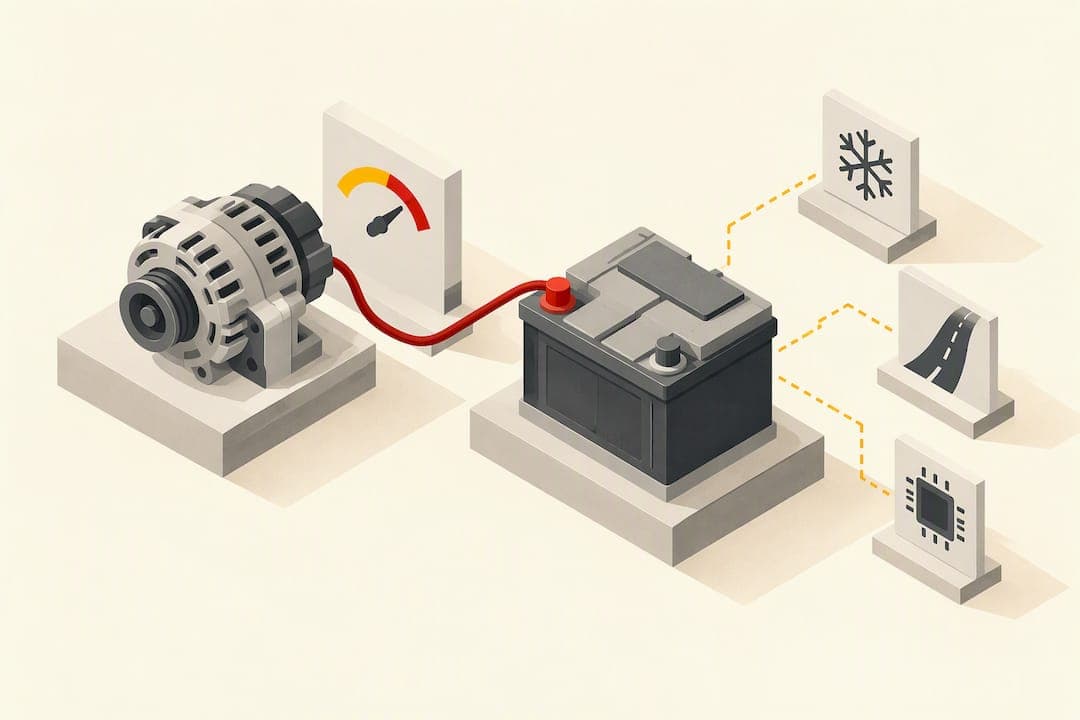
Charge an EFB battery only with an intelligent charger that explicitly supports EFB or Start-Stop batteries, or through the vehicle's designated charging points. Target an absorption voltage around 14.4 volts and use a charger with temperature compensation. Connect the clamps in the correct order and use the mass point your vehicle manual specifies, never a random ground point near sensors.
TL;DR:
- Choose an EFB or Start Stop mode; if unavailable, use a standard lead acid setting, and size continuous current at about 10% of battery capacity.
- Check resting voltage after charging: at least 12.6 volts indicates full charge, below 12.4 volts calls for charging, and below 11.5 volts signals deep discharge.
- Follow the manual’s charging points: connect positive, then the specified ground; plug in last, and unplug before removing ground and positive clamps.
- In near freezing weather, avoid fast charging, favor slow maintenance charging, and use temperature compensation; cold batteries accept less charge at a given voltage.
- If a full cycle leaves voltage below 12.4 volts or a load test shows weak starting power, seek professional testing before replacing the battery.
Table of Contents
- How EFB batteries differ from conventional and AGM batteries for charging
- How to choose a charger for an EFB battery
- Step-by-step: safely charging an EFB battery
- Temperature and winter charging: compensation and practical tips
- Maintenance, diagnostics and when charging won't fix the battery
- Author background and practical resources
- Quick checklist for a reliable fix fast
- How AkkuPlus can help with EFB batteries
- FAQ
- Sources
How EFB batteries differ from conventional and AGM batteries for charging
An Enhanced Flooded Battery (EFB) is built for vehicles with Start-Stop systems, where the engine shuts off at every red light and the battery alone powers the car's electronics for those seconds. That constant cycling demands better charge acceptance and cycling durability than a standard flooded lead-acid battery offers, though EFB chemistry still uses a liquid electrolyte rather than the glass-mat separators found in AGM batteries.
This construction difference matters once you plug in a charger. EFB batteries accept charge differently than AGM units, and AGM and EFB batteries require intelligent chargers built for their specific technology rather than a generic setting. An AGM charging profile can run at a voltage or current curve that suits sealed AGM cells but overcharges or undercharges an EFB, since the two chemistries don't absorb energy at the same rate.
A few points decide which charger mode is safe:
- EFB batteries use a flooded electrolyte design, similar in principle to standard lead-acid batteries but reinforced for frequent cycling.
- AGM charging modes aren't always appropriate for EFB batteries, even though both serve Start-Stop vehicles.
- The battery label and your vehicle's manual always take priority over generic charging advice, since manufacturers calibrate these specs for the exact battery installed.
When the label and the manual disagree with a general rule of thumb, follow the label.
How to choose a charger for an EFB battery
Picking the right charger comes down to matching its feature set to what an EFB actually needs. Look for these in order of importance:
- EFB or Start-Stop mode, or at minimum a multi-stage IUoU algorithm that ramps through bulk, absorption, and float phases automatically.
- Temperature compensation, which adjusts the target voltage based on ambient or battery temperature.
- Reverse-polarity and short-circuit protection, standard on any charger worth buying but worth confirming on the spec sheet.
- Automatic float or maintenance mode, so the charger doesn't overcharge the battery once it reaches full state of charge.
Sizing the charger's output current matters just as much as the mode. A widely used rule of thumb sets safe continuous charge current at about 10% of the battery's amp-hour rating, and consumer chargers in the 3.8 to 10 amp range fit most starter batteries. A 60 Ah EFB battery pairs well with a charger around 6 amps, while a 90 Ah unit suits something closer to 9 amps.
Diagnostic features and desulfation modes earn their keep on older or deeply discharged batteries, where sulfation has built up on the plates. On a battery that's simply low from short trips, these modes add little and can extend charging time unnecessarily.
Pro Tip: Check both the charger's spec sheet and the battery label before buying: the label lists the battery type, Ah rating, and sometimes a recommended charging voltage range, which you can match directly against the charger's listed output.

Step-by-step: safely charging an EFB battery
Before connecting anything, check the battery label for its type and Ah rating, and consult your vehicle manual for the designated jump-start or charging points. Many modern cars route charging through a point in the engine bay or trunk rather than the battery terminals directly, specifically to protect onboard sensors.
Follow this connection order:
- Connect the charger's positive clamp to the positive terminal or designated positive point.
- Connect the negative clamp to the ground or mass point specified in your manual, not an arbitrary metal surface.
- Plug the charger into the mains outlet last, after both clamps are secure.
- Select the EFB or Start-Stop mode on the charger; if that option isn't listed, use a standard lead-acid setting rather than AGM or Gel, since those higher-voltage profiles aren't appropriate for EFB chemistry.
- When charging finishes, unplug the mains cord first, then remove the ground clamp, then the positive clamp.
A few additional notes make the process safer:
- A battery at roughly 50% state of charge on a 6 amp charger typically needs several hours to reach full absorption, while a deeply discharged battery takes longer.
- Stop and test resting voltage once the charger indicates float or maintenance mode rather than disconnecting mid-cycle.
- Remove the battery from the vehicle only if your manual requires it for access, or if onboard sensors and immobilizer systems need to be disconnected first.
Handle a removed battery upright, away from sparks, and recheck terminal tightness before reinstalling it.
Temperature and winter charging: compensation and practical tips
Cold weather raises a battery's internal resistance and reduces how much charge it can accept at any given voltage. Integrated temperature compensation improves charging effectiveness in cold conditions by adjusting the target absorption voltage to match the measured temperature, since a cold battery needs a higher voltage to reach the same charge state as a warm one.
A few habits help through winter:
- Favor slow or maintenance charging over fast-charge settings when temperatures drop near freezing or below.
- Charge indoors when possible, or at least shield the battery from direct wind and extreme cold.
- Avoid fast-charge modes in deep cold, since they push more current than a cold battery can safely absorb.
Pro Tip: If a battery fails to hold charge after two or three cold snaps in a row, that pattern points to a battery nearing the end of its service life rather than a charging problem, and it's worth getting it load-tested.
Maintenance, diagnostics and when charging won't fix the battery

Resting voltage tells you most of what you need to know before reaching for a charger. A reading at or above roughly 12.6 volts indicates a healthy, fully charged battery. Below about 12.4 volts, the battery needs charging. Below roughly 11.5 volts, you're looking at deep discharge, and repeated drops to that level shorten the battery's lifespan.
A few checks round out a proper diagnosis:
- A battery tester or a charger with a built-in diagnostic mode can flag sulfation or a failing cell that charging alone won't fix.
- A CCA or load test under real demand shows whether the battery can still deliver starting current, not just hold voltage at rest.
- Persistent undercharging despite a full cycle often points to cell failure rather than a charging issue, and that calls for professional testing or replacement.
- Seasonal storage benefits from an automatic maintenance charger left connected, since it prevents the slow self-discharge that leads to sulfation over weeks of inactivity.
Author background and practical resources
This guide was written by Waldemar Pelich. We stock EFB, AGM, and conventional replacement batteries, along with battery testers and chargers, in our battery category, and we offer battery testing and repair services for drivers who want a professional check rather than a DIY diagnosis.
Quick checklist for a reliable fix fast
Three steps cover most situations: identify your battery type from the label, charge it only with an EFB-capable charger, and recheck resting voltage once charging finishes. If that voltage doesn't climb above roughly 12.4 volts after a full cycle, a workshop or battery test is worth more than another charge attempt.
— Waldemar Pelich
How AkkuPlus can help with EFB batteries
We carry EFB and AGM-compatible chargers, battery testers, and maintenance equipment alongside our battery and power accessory categories, so you can match a charger to your exact battery type without guessing at compatibility. When a battery won't hold charge despite the right equipment, our testing and repair services are available to confirm what's actually wrong before you replace anything.
Browse our battery category to find a replacement or charger suited to your vehicle, or reach out through our site to request a test.
FAQ
Do EFB batteries need a special charger?
Yes, an EFB battery needs a charger that explicitly supports EFB or Start-Stop technology, or at minimum a multi-stage automatic charger. A generic charger without the right mode can apply the wrong voltage curve and reduce the battery's lifespan.
What setting do I charge my EFB battery on?
Select the EFB or Start-Stop setting if your charger has one; if not, a standard lead-acid setting works better than AGM or Gel modes. Target an absorption voltage around 14.4 volts, matching what the battery label or vehicle manual specifies.
What happens if I charge my AGM battery with a normal charger?
A normal, non-intelligent charger can overcharge an AGM battery or fail to reach the absorption voltage it needs, since AGM batteries require chargers built for their technology. This can shorten the battery's service life or leave it chronically undercharged.
Do you need a special charger for a Start-Stop battery?
Yes, Start-Stop batteries, whether EFB or AGM, need an intelligent charger with a profile matched to their chemistry. Manufacturer examples like the CTEK Start/Stop charger line use a multi-stage cycle with an absorption voltage designed specifically for AGM and EFB batteries near the manufacturer's recommended value.
How do I know if my EFB battery just needs charging or needs replacing?
Check resting voltage first: above roughly 12.6 volts means healthy and charged, below 12.4 volts means it needs charging, and below 11.5 volts signals deep discharge. If a full charge cycle won't bring the voltage back up, or a load test shows weak cranking performance, the battery likely needs professional testing or replacement rather than another charge.
Sources
Recommended
- Battery voltage: 14.6 Volt
- Battery voltage 14.8 Volt
- Battery voltage: 14.4 Volt, page 2
- Battery voltage: 14.4 Volt
This article was created with the assistance of Artificial Intelligence (AI) and has been reviewed by our editorial team. Despite careful preparation, we assume no liability for the completeness, accuracy, or timeliness of the information provided. The technical data and specifications supplied by the respective manufacturer shall always prevail.