
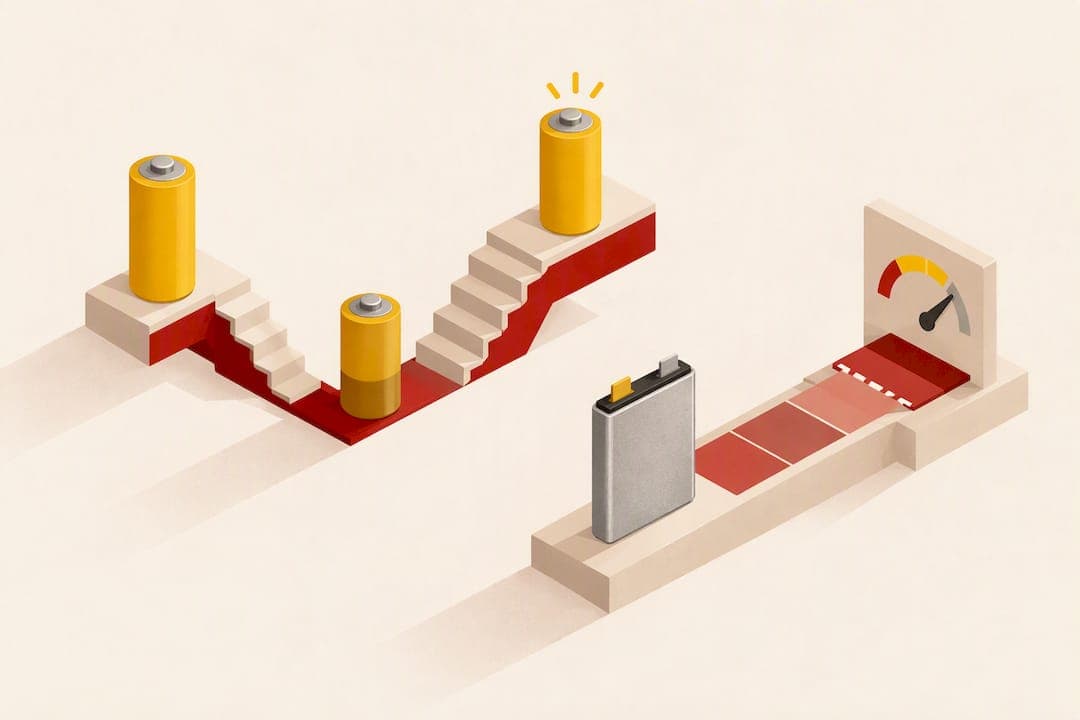
Battery memory effect mostly describes an old problem: nickel-cadmium cells losing usable capacity after repeated partial discharges. Modern nickel-metal hydride and lithium-ion batteries rarely show true memory, and any voltage drop in NiCd is often reversible with a full discharge and recharge, while lithium-ion aging is usually permanent. If your device cuts off early, skip the routine full-discharge ritual on lithium-ion and get the pack tested instead.
TL;DR:
- A controlled full discharge and recharge may help older NiCd cells recover from classic memory symptoms, but use it only when early cutoff appears.
- For lithium ion devices, skip routine full discharges and store packs partly charged; frequent deep cycles and fully charged or empty storage increase wear.
- Fast charging in cold conditions can cause lithium plating, while elevated storage temperatures speed permanent aging even when a pack is not in use.
- In large LiFePO4 stacks, discharge history, uneven cell temperatures, and cell variation can distort state of charge readings without proving capacity loss.
- Repeated early shutdowns can also signal a worn cell; professional pack testing distinguishes actual degradation from reporting errors before you attempt a reset or replacement.
Table of Contents
- What is battery memory effect, and how does it show up?
- Which battery chemistries actually show memory-like behavior?
- How your charging and discharge habits affect usable capacity
- Is the memory effect still a real concern today?
- Practical maintenance for NiCd, NiMH, and lithium-ion batteries
- SOC estimation, BMS behavior, and large-format battery history effects
- Why I don't recommend chasing reset cycles
- How AkkuPlus can help if your battery is underperforming
- FAQ
- Sources
What is battery memory effect, and how does it show up?
Battery memory effect refers to an apparent loss of usable capacity: a battery still holds energy, but a device shuts down early because voltage drops below the cutoff threshold sooner than expected. The cell is not actually empty, but repeated partial discharges appear to teach it a shorter run.
Researchers studying older nickel-cadmium cells pointed to cadmium microcrystal growth and recrystallization inside the electrode as a likely mechanism. Repeated discharges to the same partial depth encourage larger crystal structures to form, which raises internal resistance in that section of the discharge curve and triggers an earlier voltage drop.
The practical symptoms are consistent across cases:
- A device powers off well before the battery is truly depleted.
- A full discharge and recharge cycle sometimes restores lost runtime in older NiCd cells.
- The voltage curve shows a step or dip at roughly the same point where partial discharges used to stop.
That voltage signature is the real fingerprint of the effect, separate from simple aging or a worn-out cell.
Which battery chemistries actually show memory-like behavior?
Not every rechargeable chemistry behaves the same way, and the differences matter for how you treat your batteries.
- Nickel-cadmium (NiCd): the classic case. Older sintered-plate NiCd cells showed measurable memory-like voltage drops, and ZSW testing found these reductions were usually reversible with a full discharge and recharge.
- Nickel-metal hydride (NiMH): older NiMH designs could show a milder "lazy battery" effect, but low self-discharge NiMH (LSD-NiMH) formulations have largely reduced this relevance.
- Lithium-ion, including LiFePO4 (LFP): no classic memory effect, but history-dependent aging and quirks in state-of-charge reporting can produce symptoms that look similar, particularly in large battery stacks.
A 2016 study in the Journal of Power Sources found that LiFePO4/graphite full cells show memory-like behavior where the depth of discharge during a "memory-writing" period affected later state-of-charge estimation, a different mechanism from the crystal growth seen in NiCd.
Regulation has also reshaped the picture: cadmium content above 0.002% by weight is restricted in consumer batteries sold in the EU under the EU Battery Directive and the German Battery Act, so standard consumer NiCd cells have become uncommon on the market.
How your charging and discharge habits affect usable capacity
The way you charge and discharge a battery changes how much usable capacity it keeps over time, and the mechanisms differ by chemistry.
In NiCd and older NiMH cells, consistently discharging to the same partial depth can "write" a pattern into the electrode structure, which is what produces that early voltage cutoff. In lithium-ion cells, the aging drivers are different and largely irreversible: loss of cyclable lithium and growth of the solid electrolyte interphase reduce capacity permanently, and lithium plating can occur during fast charging or charging at low temperatures.
- Daily shallow cycles tend to be gentler on lithium-ion cells than frequent full cycles.
- High charge currents combined with cold temperatures accelerate lithium plating and permanent capacity loss.
- Elevated storage temperature speeds up SEI growth even when the battery is not in use.
Pro Tip: Charge lithium-ion devices at room temperature whenever possible. A cold battery charged quickly loses capacity faster than a warm one charged slowly.
Is the memory effect still a real concern today?
For most people, no. Lab testing on modern NiCd and NiMH cells shows the classical memory effect has been greatly reduced by manufacturing and material improvements, and LSD-NiMH chemistry has made the "lazy battery" pattern largely a non-issue in current consumer products.
Where history-dependent effects remain relevant is at the large-format end of the lithium-ion world. Field and lab work on LiFePO4 stacks used in vehicles and stationary storage has found that realistic load profiles can cause more severe capacity loss than standard lab cycle tests, along with history-dependent quirks in state-of-charge estimation.
- Consumer phones, laptops, and power tools: classic memory effect is essentially a non-factor.
- Older NiCd power tools still in service: occasional full-discharge resets can help if symptoms appear.
- Large-format LFP packs (EVs, home batteries): history effects show up more in monitoring accuracy than in true capacity loss.
For most consumer lithium-ion devices, routine full discharges are unnecessary and can accelerate wear instead of preventing it.
Practical maintenance for NiCd, NiMH, and lithium-ion batteries
Treating every battery the same way causes more harm than good. Match the habit to the chemistry.
- For older NiCd tools: if you notice an early cutoff, a controlled full discharge followed by a complete recharge can sometimes restore lost runtime; do this only occasionally and only when symptoms actually appear.
- For NiMH batteries: avoid deliberately draining them to zero on a routine basis; treat occasional resets as a troubleshooting step, not a habit.
- For lithium-ion batteries: skip routine full discharges, follow the manufacturer's charging guidance, and store packs at a moderate state of charge rather than fully charged or fully empty.
- For any chemistry: avoid high charge currents in cold conditions, and let the device's own charge management handle the details rather than overriding it.
- For repeated early cutoffs: have the pack professionally tested rather than guessing, since a worn cell and a memory-related symptom look similar from the outside but need different fixes.
Pro Tip: If a device keeps cutting off early despite normal charging habits, that pattern may point to a degraded cell group rather than memory effect. Testing can help identify the cause.
Signs that point toward professional cell replacement rather than a home fix include a pack that no longer holds a charge overnight, a runtime that has dropped sharply within a short period, or a device that shuts down at a voltage far above what the manufacturer specifies.

SOC estimation, BMS behavior, and large-format battery history effects
In large lithium-ion systems, a battery management system (BMS) estimates state of charge (SOC) and state of health (SOH) from voltage, current, and temperature data rather than measuring stored energy directly. A SOC estimation error can look exactly like memory effect, a device reports less available capacity than the cell actually has, even though no permanent degradation occurred.
- Cell-to-cell heterogeneity and temperature gradients across a stack can distort SOC readings without reducing real capacity.
- BMS balancing corrects some of this drift by equalizing cell voltages during charge cycles.
- Depth of discharge during a "memory-writing" period affects later SOC estimation in LiFePO4 stacks specifically, according to the Journal of Power Sources research.
- Incremental capacity analysis and capacity-trajectory modeling are used as early diagnostic tools to separate reporting drift from genuine aging.
Why I don't recommend chasing reset cycles
Most consumer batteries today don't need a reset ritual. The effort is better spent on sensible charging habits and trusting the battery management system built into modern devices. When a pack genuinely underperforms, diagnostics and professional testing can tell you more than guesswork and unnecessary full-discharge cycles.
— Waldemar Pelich
How AkkuPlus can help if your battery is underperforming
If your device keeps cutting off early and you're not sure whether it's memory effect, normal aging, or a failing cell, we offer Akkutests & -prüfungen to find out before you replace anything unnecessarily. A proper test avoids the wear that comes from repeated full-discharge "resets" on packs that don't need them.

Depending on what the test shows, we offer:
- Professional diagnostics through our battery testing service.
- Cell replacement and repair for packs with a failing section rather than a dead whole unit.
- Replacement batteries and single cells when a pack is beyond repair.
Get a diagnosis before you decide, browse our battery and cell catalog to see what's available for your device.
FAQ
Do batteries still have memory?
Classic memory effect, the kind tied to NiCd cells, is now rare because modern manufacturing and material changes have greatly reduced it. Lithium-ion batteries don't show true memory effect, though large-format stacks can show history-dependent quirks in state-of-charge reporting.
What is the 20/80 rule for batteries?
Limiting the charge reduces stress linked to loss of cyclable lithium and SEI growth, which are the main drivers of permanent lithium-ion aging.
What are the downsides of nickel-cadmium batteries?
Nickel-cadmium batteries are prone to the classic memory effect in older sintered-cell designs and contain cadmium, a toxic heavy metal now tightly restricted in EU consumer batteries. These restrictions have made standard NiCd cells uncommon in current consumer electronics.
Should I charge my lithium battery after every use?
You don't need to fully recharge a lithium-ion battery after every use, and topping it up to a moderate level is generally gentler than deep discharges or constant full charges. Following the device manufacturer's charging guidance and avoiding extreme temperatures matters more than the frequency of charging.
Sources
Recommended
- BYD - D-SC1900P - 1,2 Volt 1900mAh Ni-CD - Hochstrom - PP
- CMOS Backup Batterie 92P0991 RTC - 3 Volt Lithium
This article was created with the assistance of Artificial Intelligence (AI) and has been reviewed by our editorial team. Despite careful preparation, we assume no liability for the completeness, accuracy, or timeliness of the information provided. The technical data and specifications supplied by the respective manufacturer shall always prevail.