
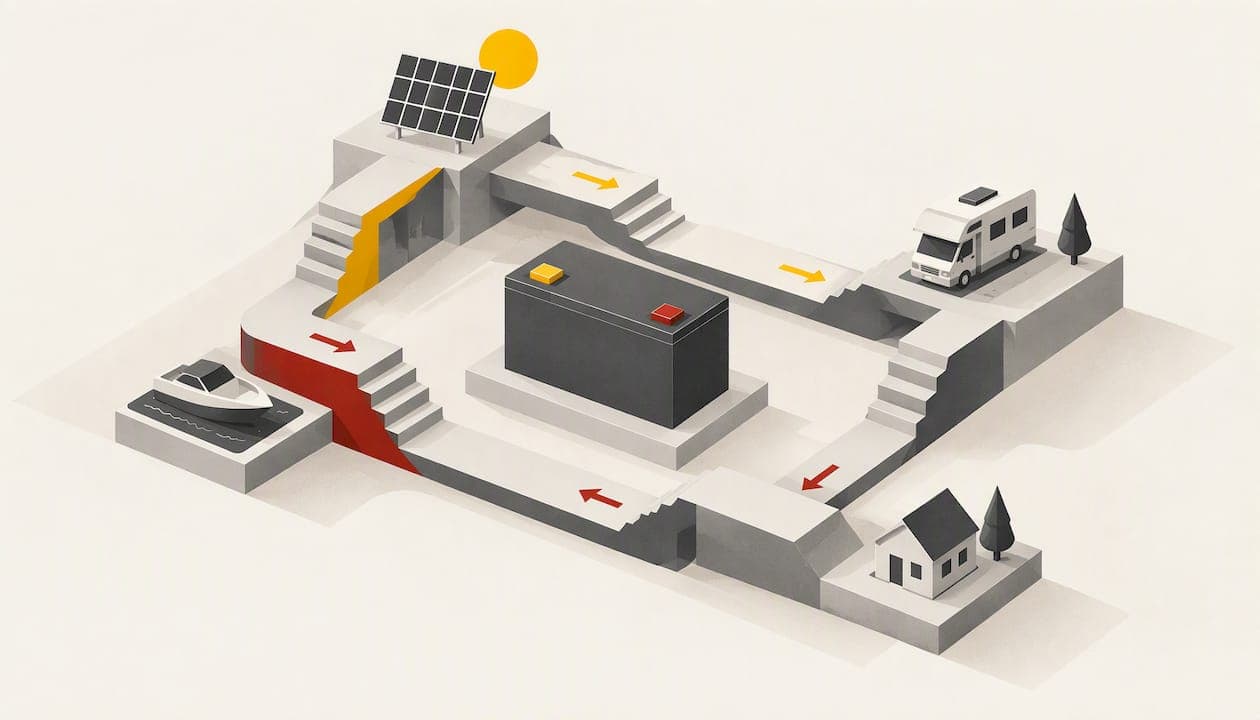
There is no single best deep cycle battery, but there is a best one for each job. For a caravan, boat or small off-grid setup in Germany, a LiFePO4 (lithium iron phosphate) battery usually wins on cycle life and weight. A sealed lead-acid AGM or gel battery wins on upfront cost and on simple, forgiving charging. A starter battery is the wrong tool for either job. Below we compare the types on the criteria that decide the purchase, then show how to match one to your use.
TL;DR
- A deep cycle battery is built to be discharged deeply and recharged again and again. A starter battery is built to deliver a short, strong burst and then be topped up.
- LiFePO4 offers the most cycles and the lowest weight. One manufacturer datasheet we checked rates a 12.8 V lithium battery at 2,500 cycles at 80 % depth of discharge.
- AGM and gel lead-acid batteries cost less upfront and tolerate a wider range of chargers, but you should plan on using only part of their rated capacity.
- Size, charger and temperature matter as much as the brand. Check voltage, amp-hours, physical dimensions and your charger's profile before you order.
- Do not run a starter battery as a leisure battery, and do not charge lithium on a flammable surface or unattended.
Table of Contents
- What makes a battery "deep cycle"
- Deep cycle vs starter battery
- The main types compared
- What the numbers on the label mean
- Which battery for which use
- Our pick for cyclic duty: lead-acid you can order today
- Perspective: what we see on the bench
- Charging and safety
- How to choose in five steps
- When repair or retrofit beats buying new
- FAQ
- Sources
What makes a battery "deep cycle"
A battery cycle is one complete charge and discharge. DKE, the German standards body for electrical engineering, defines it as a connected, complete charging and discharging process, and notes that service life in cycles depends on battery type, application and handling. That last point is the key to the whole topic. A deep cycle battery is designed so that cycling it deeply does not destroy it quickly.
The difference is mostly construction. Starter batteries use many thin plates to maximize surface area and deliver high current for a few seconds. Deep cycle designs use sturdier plates or, in lithium, a chemistry that tolerates deep discharge. Sebang describes its lead-acid deep cycle series as developed for cyclic applications such as golf carts, electric vehicles and unmanned vehicles, with leak-resistant, impact-resistant and vibration-resistant construction and glass-mat reinforcement.
Deep cycle batteries are also used for marine equipment, off-grid solar storage, recreational vehicles, golf carts, motorized wheelchairs and UPS systems. What they have in common is a steady, long draw instead of a short peak.
Deep cycle vs starter battery
This is the question that causes the most expensive mistakes, so it comes early.
| Criterion | Starter battery | Deep cycle battery |
|---|---|---|
| Job | Short, high-current burst to crank an engine | Steady, long discharge for lights, fridge, motor, inverter |
| Typical discharge | Shallow, a few percent of capacity | Deep, often half or more of capacity |
| Recharge | Engine alternator tops it up quickly | Mains charger, solar or DC-DC charger over hours |
| Used in | Cars, vans, trucks | Boats, caravans, motorhomes, solar storage, mobility scooters |
| If misused | Wears out fast if repeatedly drained | Cranks weakly if undersized for high current |
If you want an example of what a true starter battery looks like, our range includes commercial-vehicle types such as the Banner SHD 680 89, a 180 Ah starter battery rated at 1,050 A. The cold-cranking figure is the headline spec, which is exactly what a deep cycle battery is not chosen for.
There is one more thing to know about starter batteries. Even a healthy one slowly drains in a parked car. In an ADAC test of 25 vehicles, possible standing times with a healthy battery ranged from roughly two to twelve months once the locked cars' consumers had switched off. A second, separate battery for your fridge or inverter keeps that reserve for the engine.
The main types compared
Four families cover almost everything you will find in German shops.
| Type | Strengths | Weaknesses | Best for |
|---|---|---|---|
| Flooded lead-acid (deep cycle) | Lowest price per Ah, proven | Needs checking and venting, heavy, upright only | Golf carts, fixed installations with space |
| AGM | Sealed, spill-resistant, no topping up, tolerates vibration | Heavier than lithium, shorter life if deeply drained often | Caravans, boats, backup power |
| Gel | Sealed, good for slow, deep discharges | Sensitive to overcharge, lower peak current | Solar storage, slow steady loads |
| LiFePO4 | Most cycles, light, flat voltage, usable capacity close to rated | Highest upfront price, charging limited in cold, needs a BMS | Frequent use, weight-sensitive builds, off-grid |
The general profile of the lead-acid variants is described in the overview of lead-acid deep-cycle types, including the maintenance-free OPzV and the OPzS that needs distilled water. For a mobile setup, AGM is the practical lead-acid choice because it is sealed and does not need refilling.
Lead-acid: AGM and gel
Lead-acid is the budget route. You buy more nominal capacity per euro, but you should not plan on using all of it. As a rule of thumb, treat roughly half of a lead-acid battery's rating as usable if you want a long life, and check the manufacturer's cycle table for the depth of discharge you actually expect. A 100 Ah AGM that you routinely drain to 20 % will age far faster than one you keep above 50 %.
The upside is simplicity. Lead-acid batteries accept a wide range of chargers, they cope with cold better than lithium when charging, and a replacement is easy to find. If you use the battery a few weekends a year, the lower price usually beats the lithium advantage.
LiFePO4
Lithium iron phosphate is where most of the current "best" lists point, and with good reason. Take one manufacturer datasheet as an example: Victron's Smart LiFePO4 12.8 V series lists 2,500 cycles at 80 % depth of discharge, 3,000 at 70 % and 5,000 at 50 %, measured to 80 % of rated capacity. The same sheet gives a charging temperature range of +5 °C to +50 °C and a discharging range of -20 °C to +50 °C. That cold-charging limit is the detail many buyers miss: an unheated caravan in a German winter can stop a lithium battery from accepting charge.

Cycle figures from marketing pages, including the bold "15,000 cycles" claims you see in marketplace listings, are usually quoted at shallow discharge and under lab conditions. Compare them only at the same depth of discharge, and prefer a datasheet to a product title.
What the numbers on the label mean
Volts and amp-hours. Most leisure systems run at 12 V. Multiply volts by amp-hours to get watt-hours: a 12.8 V, 100 Ah lithium battery stores about 1,280 Wh, which is what the Victron datasheet lists for its 100 Ah model. For a lead-acid battery, remember that only part of that is practically usable.
Cycle life at a stated depth of discharge. This is the single most useful comparison number. A figure without a depth of discharge is not comparable.
Size groups. Questions such as "what is the difference between a group 24 and a group 27" come from North American BCI size codes, which describe the case dimensions. Group 27 is the longer case and so usually holds more capacity. In Germany, retailers rarely list those codes, so measure your battery compartment in millimeters and compare it with the length, width and height on the datasheet. Leave room for terminals and cable bend radius.
Cold and heat. Capacity falls in the cold. The same Victron sheet shows a 100 Ah lithium model delivering 80 Ah at 0 °C and 50 Ah at -20 °C, so size up if you camp in winter.
Which battery for which use
Caravan and motorhome
You need a battery that handles daily small loads and months of storage. AGM is the safe default. LiFePO4 pays off if you live in the vehicle for weeks, use an inverter or want to save weight, and some manufacturers now offer it as factory equipment: a 2027 Knaus Boxlife listing shows a LiFePO4 leisure battery as optional equipment in place of the standard battery. Make sure the onboard charger has a lithium profile, or add a DC-DC charger.
Boat and trolling motor
Motors pull steady current for hours, which is the textbook deep cycle case. Weight matters on kayaks and small boats, so lithium is attractive, but corrosion, vibration and safety rules matter too. We cover the marine specifics in our marine battery guide, including how to check lithium safety before you install.

Solar storage and off-grid cabins
Gel or AGM works for small garden-house systems. For larger setups, LiFePO4 gives more cycles per euro over the life of the system. For a house with rooftop PV, keep in mind that independent tests judge complete systems, not batteries alone. Expert Hendrik Stotz explains that the HTW Berlin performance index assesses battery and inverter together, so a high score for a home storage product tells you little about a loose 12 V block.
Household backup and UPS
For a router, alarm or small UPS, a sealed AGM lead-acid battery is usually enough, because the load is small and discharges are rare. We stock sealed lead-acid types in this class, such as the Panasonic LC-R124R5P, 12 V 4,500 mAh, and the Panasonic LC-P123R4J, 12 V 3,400 mAh.
Our pick for cyclic duty: lead-acid you can order today
We do not pretend a webshop catalog covers every deep cycle battery on the market. What we can say is what we sell. For heavy cycling on a lead-acid budget, the MK-Battery MK73-12, a 12 V 73 Ah lead-acid battery sold as cycle-resistant ("Zyklenfest"), is the type to look at first for a camper, a small solar buffer or a mobility device. Check its datasheet cycle table against your expected depth of discharge, and its dimensions against your compartment.
For other formats, the Batterien category, the Akku- und Batteriepacks category and the Stromversorgung category hold the rest of our range. Prices are shown in the shop and can change, so we do not quote them here.
Perspective: what we see on the bench
Most deep cycle battery problems we see are not caused by a bad battery. They come from a mismatch: a starter battery asked to run a fridge, a lithium battery fed by an old lead-acid charger, or a pack too small for the load, so it is drained to the bottom every night. Capacity on the label then becomes a number nobody reaches.
Our advice follows from that. Decide your load first, in watts and hours. Pick the chemistry second. Choose a charger that suits it third, and only then compare brands. If you are unsure whether an older battery is worn out or just badly charged, a capacity test tells you more than guessing, and we offer battery testing for that. If a specialized pack is failing, a cell replacement can cost less than a new unit. Our guide on NiMH vs lithium-ion and checking voltage before a pack repair explains how we think about that decision.
Do not rate a battery on cycle count alone either. Cycle numbers are only comparable at the same depth and temperature, and our explainer on charge cycles shows how full, partial and equivalent cycles are counted.
— Waldemar Pelich
Charging and safety
The charger is half of the system. A lead-acid AGM, a gel and a LiFePO4 battery each want a different charging profile, and a wrong one shortens life or, with lithium, creates a hazard. A multi-stage smart charger with a profile for your chemistry is the baseline. We compare current options in our battery charger guide, and for a compact, well-known 12 V unit you can look at the CTEK MXS 3.8.
For lithium batteries, the DGUV advises charging with manufacturer-recommended equipment, on non-combustible surfaces in dry, dust-free rooms, and preferably under supervision. Apply that in practice: not on a sofa, not in a stuffed locker with no airflow, and not overnight in a closed van if you can avoid it. Never charge a lithium battery below its minimum charging temperature, which is +5 °C on the Victron datasheet above. For lead-acid, keep the room ventilated, as flooded types can release gas while charging.
Also keep a deep cycle battery out of long periods of deep discharge. A battery left flat for weeks can be permanently damaged, whatever the chemistry.
How to choose in five steps
- Add up the load. List each device in watts and the hours per day. Convert to watt-hours.
- Set a usable fraction. About half of the rating for lead-acid, and the datasheet's stated depth for lithium.
- Pick the chemistry. Occasional use and tight budget: AGM. Frequent use, weight limit or off-grid: LiFePO4. Slow, constant loads in a fixed place: gel.
- Check fit and temperature. Measure the space. Decide whether the battery will sit below 5 °C when charging.
- Match the charger. Buy or check a charger with the right profile, and add a battery monitor if you want to see real state of charge.
A worked example: a caravan with a 12 V fridge drawing about 40 W on average, lights and a phone charger needs roughly 1 kWh per day. A 100 Ah 12 V lead-acid battery holds 1.2 kWh nominal, but you would use only about 0.6 kWh, so you would need two in parallel for a day of autonomy. A 100 Ah LiFePO4 battery stores about 1.28 kWh and delivers most of it, so a single unit covers the day. That is the real saving, and it is why lithium costs more up front but less per usable kilowatt-hour.
When repair or retrofit beats buying new
Not every weak battery needs replacing. Specialized packs, from e-scooters to power tools and radios, often fail because of a few worn cells, not the whole pack. We offer repair, cell replacement, refurbishment, custom pack assembly and retrofit on our main service page. If you are weighing a new pack for a scooter, our e-scooter battery replacement checklist lists the six checks to do before you buy.
FAQ
What is the best deep cycle battery for a trolling motor?
For frequent use and weight-sensitive boats, a LiFePO4 battery is usually the best choice because it holds its voltage under load and weighs far less. If you fish a few times a year, a sealed AGM costs less and does the job. Size it from the motor's current draw and your trip length.
Can I use a deep cycle battery to start an engine?
Only if it can supply the current the starter needs, and most deep cycle batteries are not built for that peak. A dedicated starter battery is the better choice, and a second battery for the leisure loads protects it.
Is a lithium deep cycle battery worth the higher price?
It is if you cycle the battery often. Datasheets such as Victron's list thousands of cycles at 50 to 80 % depth of discharge, and lithium delivers most of its rated capacity. For occasional use, the extra price may never pay back.
What is the difference between a group 24 and a group 27 battery?
Both are North American case-size codes. Group 27 has the longer case and generally more capacity. In Germany, compare millimeter dimensions and amp-hours on the datasheet instead.
Do I need a special charger?
Yes, in most cases. Use a charger with a profile for your battery type, and for lithium follow the manufacturer's charger recommendation and the temperature limits.
Sources
- Deep-cycle battery overview (Wikipedia)
- Sebang Europe: Deep Cycle series
- DKE Kompendium: Li-Ionen-Batterien
- ADAC: Ruhestrom im Auto
- Victron Energy datasheet: 12.8 and 25.6 V lithium iron phosphate batteries Smart
- ADAC Wohnmobilmarkt: Knaus Boxlife 600 ME listing
- Reduco: Fox ESS storage test and HTW Berlin SPI
- DGUV Information 205-041: Brandschutz beim Umgang mit Lithium-Ionen-Akkus
Recommended
- Best Motorcycle Battery: AGM, Gel or Lithium for Your Bike
- Best UPS Batteries: Lead-Acid vs. Lithium and What to Buy
- Best Marine Battery: Match the Job, Then Check Lithium Safety
This article was created with the assistance of Artificial Intelligence (AI) and has been reviewed by our editorial team. Despite careful preparation, we assume no liability for the completeness, accuracy, or timeliness of the information provided. The technical data and specifications supplied by the respective manufacturer shall always prevail.