
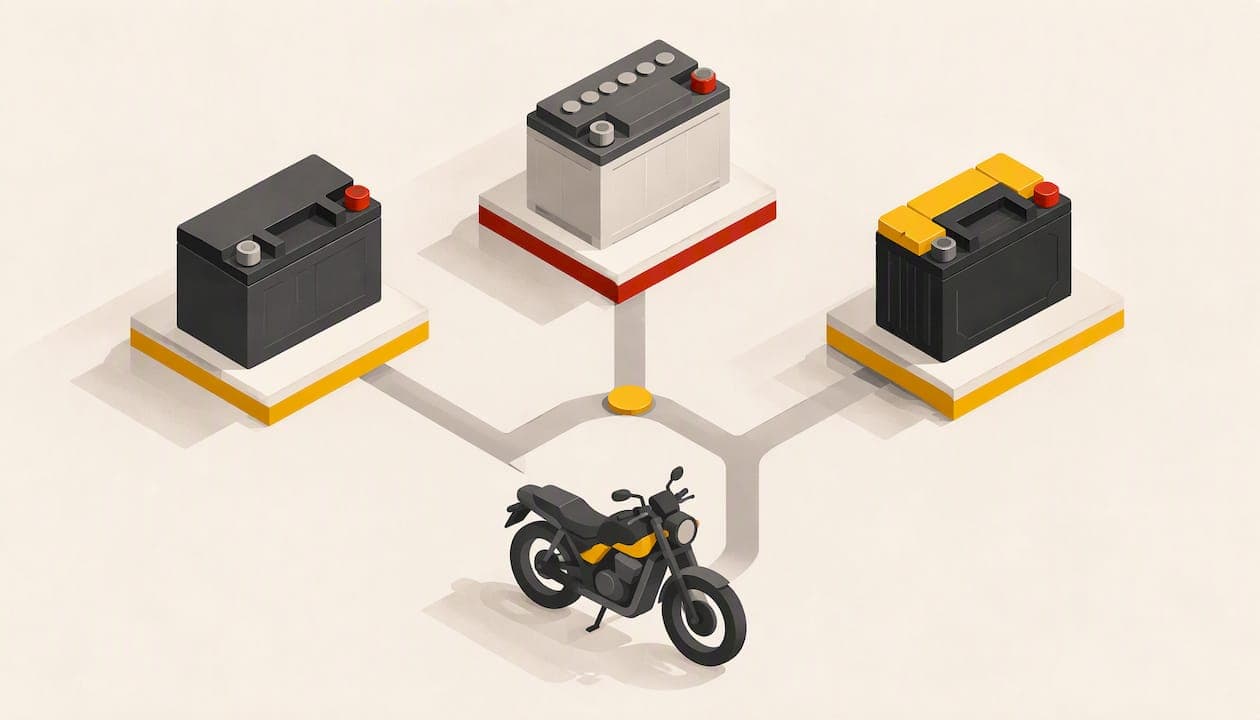
There is no single best motorcycle battery, but there is a best one for your bike, your riding and your winters. For most riders in Germany, a sealed AGM battery in the exact size and rating your manufacturer specifies is the safest choice. Lithium (LiFePO4) wins if weight matters and you are willing to charge it properly. Classic lead-acid and gel still make sense on older bikes and tight budgets.
This guide compares the real options on the criteria that decide the purchase: weight, cold starts, charging, storage, fitment and price logic. It also shows where the common brand advice falls short, and when a battery is not the problem at all.
TL;DR
- AGM is the default. It is sealed, maintenance-free and reliable in cold weather, which is why most motorcycles are still fitted with it.
- Lithium (LiFePO4) is the weight-saver. It can weigh 0.5 to 1 kg against 3 to 5 kg for a comparable AGM, but it needs a suitable charger and a little patience on frosty mornings.
- Match size, terminal layout and rating to your bike first. A great battery that does not fit, or lacks the cold cranking current your engine needs, is the wrong battery.
- Charging decides lifespan. A monitored automatic charger beats a cheap trickle charger, and a battery that sits for months needs a plan.
- Check the date code. An old battery from a shelf will not live up to its type.
Table of Contents
- How we judge a motorcycle battery
- Battery types compared
- AGM: the safe default
- Lead-acid and gel: still valid, with limits
- Lithium (LiFePO4): light, powerful and a bit fussy
- Best motorcycle battery for cold weather
- Brands riders actually mention
- Fitment: the step most people skip
- What about Harley-Davidson and other premium bikes?
- Is the battery really the problem?
- Where AkkuPlus fits
- Our perspective: buy for the bike, then look after it
- FAQ
- Sources
How we judge a motorcycle battery
Brand rankings go out of date quickly and often compare batteries that suit different bikes. We would rather compare on criteria that stay true:
- Fit. Dimensions, terminal position, polarity and vent arrangement must match the original. Fitment sources stress that voltage and a similar-looking model name are not enough.
- Starting power. Look at the cold cranking amps (CCA) rating against what your manufacturer specifies. Big twins and bikes with high compression need more than a 125 cc commuter.
- Capacity (Ah). It carries the bike through electronics, lights and short rides, particularly on modern machines with ABS, traction control, a dash and LED lighting.
- Weight. Matters for sport bikes and track use, rarely for a touring bike.
- Behavior in cold. Matters from October to March, especially if you ride year-round or start a bike after weeks of standing.
- Storage and self-discharge. Matters if the bike rests over winter.
- Cost over time. Purchase price divided by realistic years of service, plus the charger it needs.
Battery types compared
The market offers flooded lead-acid, AGM, gel, lithium-ion and, more recently, sodium-ion batteries. In practice, four matter for most riders today.
| Criterion | Flooded lead-acid | AGM | Gel | Lithium (LiFePO4) |
|---|---|---|---|---|
| Maintenance | Top up with distilled water | Sealed, none | Sealed, none | Sealed, none |
| Typical weight | Heavy | 3 to 5 kg in comparable sizes | Similar to AGM | 0.5 to 1 kg in comparable sizes |
| Cold starts | Weakest of the four | Strong, the usual benchmark | Good, slower under heavy loads | Strong once warmed, sluggish when very cold at first |
| Charger need | Basic charger | Monitored automatic charger | Gel-specific profile | Lithium-compatible charger |
| Storage | Loses charge fastest | Moderate self-discharge | Moderate | Very low self-discharge |
| Best for | Old bikes, tight budgets | Almost any bike | Cyclic use, older fitments | Sport bikes, weight-sensitive builds |
The weights come from a comparison of lead, AGM, gel, lithium and sodium batteries. The rest of the table summarizes the general chemistry of each type and the guidance of the manufacturers cited below. Treat it as a map, not a spec sheet: individual models vary.
AGM: the safe default
An AGM (Absorbed Glass Mat) battery holds its electrolyte in glass fiber mats. It is sealed, vibration-tolerant and does not leak when the bike is tipped or on a side stand. Harley-Davidson describes its AGM design as superior to conventional lead-acid batteries, and its rider advice stresses that a quality battery matters most on late-model bikes with engine management, stability systems and infotainment.

German testing sites reflect the same trend. The consumer portal Testberichte.de notes that maintenance-free batteries have overtaken wet-cell ones, and AGM and gel are in high demand. Its list of the best motorcycle batteries is headed by the intAct Bike-Power HVT, a 12 V, 14 Ah maintenance-free model rated "Sehr gut" (1.5).
Choose AGM if you ride a mainstream bike, want zero maintenance and do not want to think about the charger beyond buying a decent one.
Skip it if every kilogram counts, or the bike is a track toy that sits for six months at a time.
Lead-acid and gel: still valid, with limits
A conventional flooded battery is the cheapest to buy and works fine in a simple older bike with a modest electrical system. The downsides are known: you must check the electrolyte level, vibration and tipping are less forgiving, and self-discharge is the highest of the group. Harley-Davidson's lithium guidance says lead-acid batteries can lose about 1% of their charge per day when left standing, which is why a winter without a charger often ends in a dead battery in spring.
Gel batteries bind the electrolyte into a gel. They tolerate repeated deep discharge better than flooded types, which suits low-current, cyclic use. They like gentle, gel-appropriate charging. If your bike came with a gel battery from the factory, keep to gel or move up to AGM after checking the charging profile.
Lithium (LiFePO4): light, powerful and a bit fussy
Lithium iron phosphate batteries are the headline-grabbers. The weight difference is large: roughly 0.5 to 1 kg against 3 to 5 kg for a comparable AGM, which the same guide frames as up to 70% less. Harley-Davidson says a lithium motorcycle battery can offer significantly more cold cranking amps and longer life than standard lead-acid options.

Two practical points decide whether lithium is right for you.
Charging. Use a charger designed for lithium. Harley-Davidson's service guidance for its batteries recommends an automatic charger with constant monitoring, maximum 5 amps at no more than 14.6 volts. It warns that an unmonitored trickle or float charger can overcharge, damage cells and void the warranty. Those figures are Harley's for its own batteries. Follow your battery maker's sheet for any other brand.
Storage. The same source family says Harley's lithium LiFe batteries lose only about 10% of their charge over a year when disconnected from the bike. You may have read about a "40-80 rule": keeping lithium cells between roughly 40% and 80% for long storage. That is a common rule of thumb, not a universal motorcycle standard. LiFePO4 is more forgiving than other lithium chemistries, so for a bike parked all winter, follow the manufacturer's storage advice rather than inventing your own routine.
Choose lithium if you ride a lightweight sport bike or build a custom machine, you value weight, and you will use the right charger.
Skip it if you ride short hops in deep winter without warming the battery first, or you run an old bike whose charging system you have not checked.
Best motorcycle battery for cold weather
Cold hurts every battery because chemical reactions slow down. The question is how each type copes.
- AGM remains the reference for reliable cold starts. It is the type the 2026 comparison we used names as standard for reliability and cold-weather performance in most motorcycles.
- Lithium can feel sluggish near or below freezing. That is not a defect. The tip from the same guide: switch on the headlight or ignition for 30 to 60 seconds before cranking. The current flowing through the cells warms them and restores starting capacity.
- Old or half-charged batteries of any type fail first. Before blaming the chemistry, check charge state and age.
For a bike you ride through German winters, our pick is AGM with a rating at or above your manufacturer's CCA figure, plus a monitored charger on the days you do not ride. If you choose lithium for weight, accept the 30 to 60 second warm-up as part of the routine.
Brands riders actually mention
You will see Bosch, Yuasa, Exide, Varta, intAct and Skyrich lithium models in German comparisons. We are not going to crown one of them, because the right model depends on the bike. A few observations help more than a ranking:
- Price comparison sites show the spread. The Bosch FA102, a popular 12 V 8 Ah model, is listed from 49,00 € in their 8 Ah ranking at the time of the page we read. Prices move, so check before you buy.
- Premium and OEM-type AGM batteries from established brands usually cost more than no-name versions. Part of that is the quality of the lead, the sealing and the quality control.
- Bike-specific lithium models are sold by size code. Compare the lead-acid equivalent rating rather than the marketing Ah figure.
Fitment: the step most people skip
The fitment guidance from German battery specialists boils down to this: dimensions, power and terminal type have to match your vehicle exactly. A short checklist:
- Read the type code printed on the existing battery (for example a YTX-style or similar code).
- Measure length, width and height. Even 5 mm can matter in a tight battery tray.
- Check the position of the plus and minus terminals. A mirrored layout can make the cables too short.
- Compare the CCA rating with your owner's manual.
- Confirm the vent hose arrangement if your bike has one.
Check the date code
A battery that has sat on a shelf for two years has already aged. In Harley-Davidson's dealer guidance, batteries are meant to be rotated first-in, first-out and typically sold within 18 months of manufacture. Older ones carry a higher risk of premature failure and warranty trouble. That is a Harley procedure, but the logic applies to any lead-acid battery. Ask the seller for the manufacturing date.
What about Harley-Davidson and other premium bikes?
Harley riders ask which battery fits their bike most often. The safe route is the AGM battery the factory specifies, or a LiFe lithium unit designed for your model, charged as described above. Premium bikes with heavy electronics are less tolerant of a weak battery, so skimping on the battery is a false economy. Check the model-year compatibility list before ordering.
Is the battery really the problem?
Before spending money, rule out the cheaper causes:
- Parasitic drain from an alarm, GPS tracker or phone charger left connected.
- A weak charging system. If the regulator or stator is failing, a new battery will die too.
- Loose or corroded terminals.
- Short rides. Starting costs more energy than a five-minute ride replaces.
If you measure under about 12.4 V at rest on a battery that was recently charged, it is worth testing it under load. We offer battery testing and inspection as one of our services, and our battery test equipment category covers the tools if you prefer to check it yourself.
Where AkkuPlus fits
We are a specialist in batteries and battery services, not a motorcycle dealer, and we would rather say so than pretend. Here is what that means for you:
- Browse our Batterien category for lead-acid and sealed batteries, and our Akku- und Batteriepacks if you need a pack rather than a drop-in unit.
- If you are building or restoring a vehicle, our Akkus (Einzelzellen) category lists individual cells.
- For packs that are no longer healthy, our services include Akkureparatur, cell replacement, Konfektionen (custom packs) and Retrofit. Prices are not published, so ask us for a quote.
- We also repair e-scooters. If you ride one as well, read our guide to replacing an electric scooter battery.
If you are comparing chemistries more broadly, our explainer on NiMH versus lithium-ion shows why checking voltage matters before any repair, and our piece on choosing a marine battery covers lithium safety in another demanding use.
Our perspective: buy for the bike, then look after it
We handle batteries all day: cells, packs, testing and repairs. The pattern is consistent. Most "bad battery" stories begin with a battery that was never matched to the load or never charged correctly. A premium AGM on a monitored charger will usually outlast a bargain unit left on a trickle charger in a damp garage.
Our advice is plain. Start with fitment and the manufacturer's rating. Choose AGM if you want to forget about it, and lithium if weight is worth the extra care. Date-check anything you buy. Then spend part of the budget on a proper charger. Chemistry matters, but behavior matters more.
When a pack cannot be replaced like for like, such as on an older machine or an unusual build, repair or custom assembly is often more practical than hunting for a discontinued part. That is where a workshop with cell-level experience helps.
— Waldemar Pelich
FAQ
Is AGM or lithium better for a motorcycle?
AGM is better for most riders: it is sealed, proven and reliable in cold weather. Lithium is better if you want to save 2 to 4 kg and will use a lithium-compatible charger. The weight gap is based on typical figures of 0.5 to 1 kg against 3 to 5 kg.
What is the 40-80 rule for lithium batteries?
It is a rule of thumb to keep a lithium battery between about 40% and 80% charge during long storage, to avoid the stress of a full charge or deep discharge. It is not a universal motorcycle standard. LiFePO4 is more robust than other lithium types, and Harley-Davidson says its LiFe batteries lose about 10% a year when disconnected.
Why is my lithium motorcycle battery weak in the cold?
The internal reactions slow down near freezing, so the battery can feel sluggish at first. It is not necessarily faulty. Switching on the headlight or ignition for 30 to 60 seconds warms the cells before you crank the engine.
Can I use a trickle charger on my motorcycle battery?
Only if it suits the battery type and is monitored. Harley-Davidson warns that an unmonitored trickle or float charger can cause overcharging and cell damage. An automatic charger with a maintenance mode for your chemistry is the safer choice.
How do I know if the battery or the charging system is at fault?
Charge the battery fully, then test it under load and measure voltage with the engine running. If the battery fails the load test, replace it. If it passes but keeps going flat, look at the regulator, stator and any parasitic drain. A workshop can do this quickly, and a motorcycle mechanic is the right person to check the charging system.
Sources
- Motorradbatterie Vergleich: Blei, AGM, Gel, Lithium, Natrium (moto-guide.com)
- Harley-Davidson service information: charging AGM batteries
- Harley-Davidson
- Testberichte.de: Die besten Motorrad-Batterien
- Vergleich.org: Motorradbatterien 12 V 8 Ah
Recommended
This article was created with the assistance of Artificial Intelligence (AI) and has been reviewed by our editorial team. Despite careful preparation, we assume no liability for the completeness, accuracy, or timeliness of the information provided. The technical data and specifications supplied by the respective manufacturer shall always prevail.