
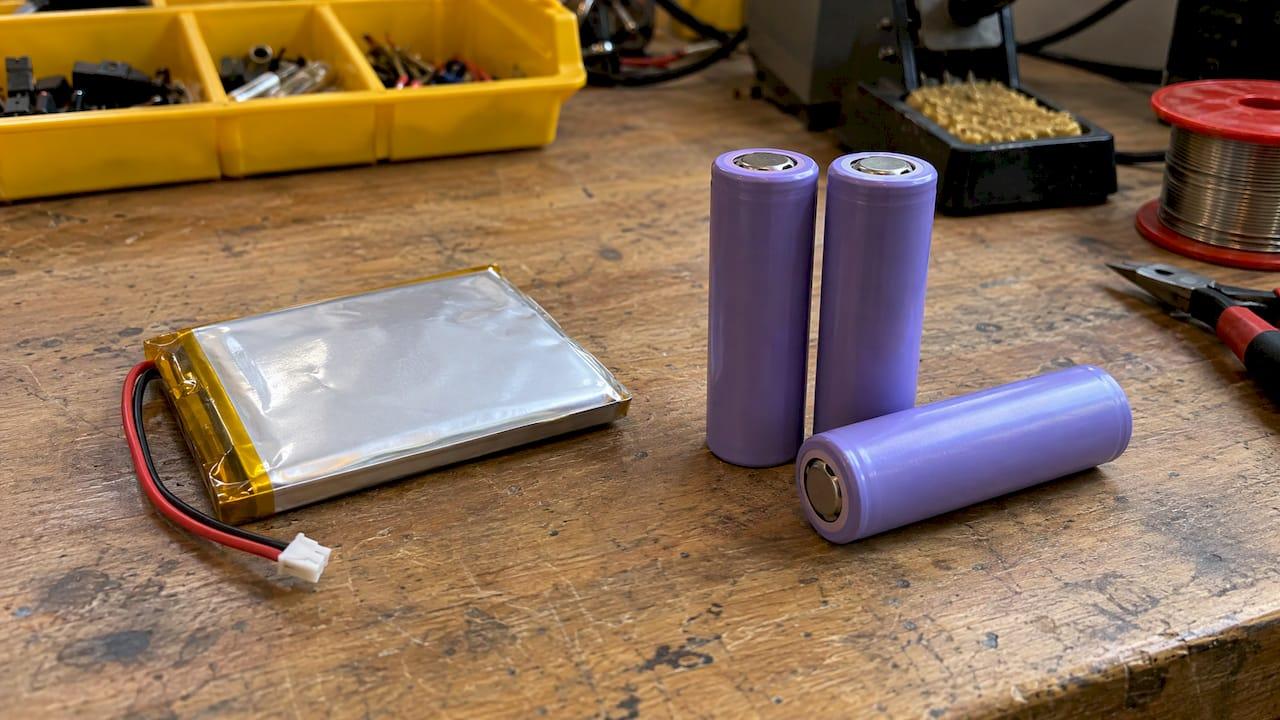
A LiPo battery is a lithium-ion battery with a gel-type polymer electrolyte, usually in a soft pouch. It is not a different technology. Both use the same cathode and anode materials, so the real choice is between a rigid cell (cylindrical or prismatic) and a light, flat pouch. Pick the pouch when weight and shape matter most, such as in drones, RC models and thin devices. Pick the rigid cell when you want longevity and robustness. Either way, the care you give it at charge and storage decides how long it lasts and how safe it is.
TL;DR
- LiPo and Li-ion are the same family. "Li-ion" names the chemistry, "LiPo" describes a cell with a gel polymer electrolyte, mostly in a pouch.
- LiPo wins on weight, thin shapes and high discharge. Cylindrical Li-ion wins on cycle life, energy per volume and mechanical toughness.
- Store either type partly charged (about 40 to 60%), cool, dry and frost-free. For LiPo that is roughly 3.8 V per cell.
- A swollen or damaged pack is taken out of use at once and kept away from anything combustible.
- If you are unsure what your pack contains or whether it is still healthy, a battery test or a repair is the safer route than guessing.
Table of Contents
- Is LiPo the same as Li-ion?
- How they differ in practice
- Which one should you choose?
- Safety: what applies to both
- LiPo storage voltage and how to store batteries
- A swollen or damaged battery
- Our view: match the cell to the job, then look after it
- Replacement, testing and repair at AkkuPlus
- FAQ
- Sources
Is LiPo the same as Li-ion?
Mostly, yes. The names describe different things. "Lithium-ion" describes the electrochemical family, with variants such as NMC, NCA, LCO and LFP. "LiPo" describes a lithium-ion cell with a gel polymer electrolyte, most often in a pouch, while cylindrical (18650, 21700) and prismatic are physical formats. A LiPo is, in the words of a university safety standard, essentially the same as a Li-ion battery, with a plasticized or gelled electrolyte.
That is why a shop listing can say "Li-Ion" for an 18650 cylinder and "LiPo" for a flat phone or drone pack, and both are right. It also means most of what you read about lithium-ion safety applies to LiPo too.
How they differ in practice
The differences come from the housing, not the chemistry.
| Property | Li-ion (rigid cell) | LiPo (pouch) |
|---|---|---|
| Housing | Rigid cylindrical or rectangular case, liquid organic electrolyte | Flexible plastic or aluminum pouch, gel or solid polymer electrolyte |
| Weight | Heavier | About 20% lighter than hard-shell Li-ion |
| Shape | Standard sizes | Custom shapes, down to under 1 mm in height |
| Energy density | Up to 60% higher in one aviation guide (260 Wh/kg vs. about 185 Wh/kg) | Lower in that comparison |
| Discharge rate | Lower C-rating | Handles the high discharge rates of multi-rotor aircraft |
| Cycle life | 300 to 700 cycles for cylindrical cells | 300 to 500 cycles |
| Cost | Higher in that guide | Cheaper and more common in that guide |
Treat these as typical values, not promises for every cell. A good LiPo can outlast a poor cylindrical cell, and energy density varies a lot between models.
Weight and shape
The pouch is a thin aluminum foil construction with very thin layers, which is what makes smartphones, tablets, drones and slim e-bikes possible. Rigid cases cannot be shaped that way. The price of that freedom is mechanical sensitivity: a pouch needs careful handling, and a dent or puncture is a serious matter. Li-polymer cells must always run with protection electronics (a protection circuit module) that cuts the circuit on overcharge, over-discharge or short circuit.
Power and capacity
If you fly a quadcopter or run a fast RC car, discharge rate is the number that matters, and LiPo packs are built for it. If you want a flashlight to run for hours or a pack in a tool that sits in a drawer, rigid Li-ion cells give more capacity per volume and tend to last through more cycles.
Lifespan
A pouch cannot vent gas the way a cylinder with a release vent can. Gas from aging builds up and the cell swells, which is part of why LiPo cycle life is shorter. The same source recommends replacing lithium batteries once they fall to 80% of their capacity. The German DKE compendium uses that same 80% line to define end of life for electric vehicle batteries.

Which one should you choose?
Start from the device, not from the label.
- Drones, RC planes, cars and boats: LiPo, for weight and discharge current. Our Modellbau & Hobby category covers this kind of use.
- Phones, tablets, slim gadgets: LiPo pouches are what the case was designed around, so a replacement has to match the original shape and connector.
- Flashlights, tools, e-scooters, e-bikes: rigid cylindrical Li-ion cells, often built into packs. See Akkus (Einzelzellen) for single cells and Akku- und Batteriepacks for finished packs.
- Backup power, long life, high safety margin: compare other lithium chemistries as well. Our guide to the best LiFePO4 battery explains what to check.
If your old pack is NiMH and you are wondering whether lithium can replace it, check voltage first. Our article on NiMH versus lithium-ion before a pack repair walks through it.
Safety: what applies to both
The hazard is the same in both formats. Lithium is a highly reactive metal, and the German Federal Environment Agency (Umweltbundesamt) warns that reactions with air or water, and short circuits between the plus and minus poles, can lead to fire or explosion. The German fire protection association vfdb lists the triggers of thermal runaway (a self-heating chain reaction inside the cell): external heat, external short circuit, internal short circuit from a defect or mechanical damage, and overcharging.
In practice that gives you a short list of habits:
- Use the charger that belongs to the battery, or one made for its exact chemistry and cell count.
- Charge on a non-combustible surface in a dry, dust-free place, and do not charge unattended. The German statutory accident insurance (DGUV) in its information sheet 205-041 advises supervised charging at ambient temperatures of at least 0 °C, with a cold battery first warmed to room temperature.
- Protect the terminals against short circuits. Tape exposed contacts or use a cover.
- Never use a pack that is dented, punctured, hot or swollen.
VdS, a German property-loss prevention body, takes a measured view: with today's manufacturing standards, lithium batteries are comparatively safe when handled properly and become dangerous mainly when used or stored outside their specification, especially through mechanical damage and heat. That is good news, because those are things you control.
Note on German rules: VdS states that there are no public-law regulations for storing lithium batteries in Germany. Its guidance is voluntary, and aimed at businesses. The DGUV sheet is likewise aimed at companies, but its advice is sensible at home too.
LiPo storage voltage and how to store batteries
This is where most readers lose capacity. A lithium cell ages fastest when it sits full or empty.
The right charge level
DGUV 205-041 says lithium-ion batteries age least when stored at 40 to 60% state of charge, cool but frost-free and dry. Jauch likewise recommends room temperature and half charge to slow aging.

For standard LiPo cells, whose full voltage is 4.2 V and whose minimum discharge voltage is 3.0 V, half charge lands at roughly 3.8 V per cell. That is the target most hobby balance chargers use for their storage function. Check your charger's manual for the exact figure it uses.
For a whole pack, multiply by the number of cells in series (the "S" count):
| Pack | Cells in series | Storage voltage (about 3.8 V per cell) |
|---|---|---|
| 1S | 1 | 3.8 V |
| 2S | 2 | 7.6 V |
| 3S | 3 | 11.4 V |
| 4S | 4 | 15.2 V |
| 6S | 6 | 22.8 V |
The special high-voltage cells (charged to 4.35 or 4.4 V) have a different full-charge level, so use the manufacturer's data for those.
How to set it
- Connect the pack to a balance charger and choose the storage mode, if it has one.
- Let it charge or discharge to the storage level. Do not leave it running unattended.
- Check each cell. A well-matched pack has cells within a few hundredths of a volt of each other.
- Store the pack in a cool, dry place, away from anything combustible. A fireproof container is a sensible extra.
- For long storage, check it periodically. DGUV notes that long-stored batteries may need recharging to avoid deep discharge.
Deep discharge matters because it can cause lithium plating inside the cell, and overcharge can start thermal runaway. If a pack has been left to fall far below its minimum voltage, do not force-charge it.
The same logic works for rigid Li-ion packs in e-scooters, tools and vacuums: roughly half full, cool, dry. Not in a car in summer, and not in an unheated shed in winter.
Charging temperature
The Jauch benchmarks give charging at 0 to 45 °C and discharging from -20 to +60 °C. A pack that spent the night in a cold garage should come to room temperature before it goes on the charger.
A swollen or damaged battery
Swelling in a pouch means gas has built up. Take it out of service immediately. Do not charge it, do not pierce it, and do not try to flatten it.
What to do next:
- Disconnect it and move it outdoors or to a place with nothing flammable nearby. VdS advises keeping damaged batteries at a safe distance or in a fire-protected area until disposal.
- Store it in a non-combustible container. DGUV mentions acid-resistant containers away from combustibles.
- Dispose of it properly. In Germany, batteries fall under the Battery Act, which regulates return and environmentally compatible disposal of all battery types, including ones built into devices. Take it to a battery return point, not into household waste.
If a battery is on fire, leave the area and call the emergency number 112. Fire protection expert Jörn-Bo Hein explains that in a thermal runaway temperatures can reach up to 900 °C within seconds and corrosive gases form. Do not stay to fight it.
Our view: match the cell to the job, then look after it
We think the LiPo-versus-Li-ion question is asked too often as "which is better". They are one family, so the useful question is which housing and which discharge profile suit the device in your hand.
In our range you will find single cells, finished packs, power supplies and chargers, and we also work on packs: cell replacement, refurbishment, assembly of custom packs (Konfektionen), retrofit and EEPROM programming. Because we work with cells and packs every day, we put the same three questions to any battery: what is the nominal voltage, what current does the device draw, and what shape does it have to fit?
A pack that matches those three answers, is charged with the right charger and stored half full, will give you far more cycles than the data sheet minimum. Our guide to battery chargers covers how to choose the charger side of that equation.
Waldemar Pelich
Replacement, testing and repair at AkkuPlus
If your pack no longer holds charge, you have a few options, and they depend on the device. A single worn cell in a pack can often be replaced. A complete pack can be swapped for one with matching voltage and connector. For e-scooters, vacuums and other devices with rigid cells, our guides to e-scooter battery replacement and cordless vacuum battery replacement list what to check before you order.
AkkuPlus offers battery repair (Akkureparatur), battery tests and inspections (Akkutests & -prüfungen), e-scooter repair, EEPROM programming, custom pack assembly and retrofit. Browse the full range of batteries, packs, cells and chargers on akkuplus.de, or go straight to Akku- und Batteriepacks if you know what you need.
For the small parts that keep a pack safe, such as thermistors that watch temperature and resettable fuses, see Stromversorgung and the Werkstatt category.
FAQ
Is a Li-ion a LiPo?
Nearly. A LiPo is a lithium-ion cell whose electrolyte is a gel polymer, usually sold in a soft pouch. The cathode and anode materials are the same as in other Li-ion cells, so the two share the same charging limits and the same safety rules.
What voltage should a LiPo be stored at?
About half charged, which is roughly 3.8 V per cell for standard LiPo cells. That means about 7.6 V for a 2S pack and 11.4 V for a 3S pack. Many balance chargers have a storage mode that sets this level for you, so follow its manual.
Which is safer, LiPo or Li-ion?
Both are safe within their specification and both can fail dangerously when overcharged, shorted, overheated or mechanically damaged. A pouch is softer, so it needs extra care against dents and punctures, while a rigid cell has a more robust case. Original chargers, protection electronics and partially charged, cool storage matter more than the label.
Can I leave a LiPo fully charged between uses?
For a day or two, that is fine if you use it soon. For longer, bring it down to storage level. Full charge speeds up aging, and DGUV advises 40 to 60% for longer periods.
How long does a LiPo last?
In one white paper, LiPo packs reach about 300 to 500 charge cycles, compared with 300 to 700 for cylindrical Li-ion. Replace any lithium pack once it falls to around 80% of its capacity, and immediately if it swells.
Sources
- Lithium Cell and Battery Standard, University of Waterloo Safety Office (2019)
- Lithium-Ion vs. Lithium-Polymer Batteries, Gadgets Now (2026)
- Lithium Battery Safety, RPI Environmental Health & Safety
- Battery-Chemistry Overview, PX4 Guide
- The difference between lithium ion and lithium polymer batteries, Battery Power Tips (2021)
- Introduction to Lithium Polymer Battery Technology, Jauch white paper (2018)
- Comparison of NiMH, Li-Ion, and LiPo Batteries, Power Products (2024)
- Compendium: Li-ion batteries, DKE (2022)
- Ratgeber Batterien und Akkus, Umweltbundesamt
- Merkblatt MB 10/17, vfdb
- DGUV Information 205-041, Brandschutz beim Umgang mit Lithium-Ionen-Batterien (2024)
- Lithium-Batterien, VdS 3103 (2019)
- Interview: Risiken und Schutzmaßnahmen bei Lithium-Ionen-Akkus, FeuerTRUTZ (2025)
Recommended
- NiMH vs Lithium Ion in Germany: Check Voltage Before a Pack Repair
- Best LiFePO4 Battery: Test Winners and What to Check
- Best Rechargeable D Batteries: NiMH vs. 1.5 V Li-Ion
- CR123A vs 18650: Which Battery Fits Your Device?
This article was created with the assistance of Artificial Intelligence (AI) and has been reviewed by our editorial team. Despite careful preparation, we assume no liability for the completeness, accuracy, or timeliness of the information provided. The technical data and specifications supplied by the respective manufacturer shall always prevail.