
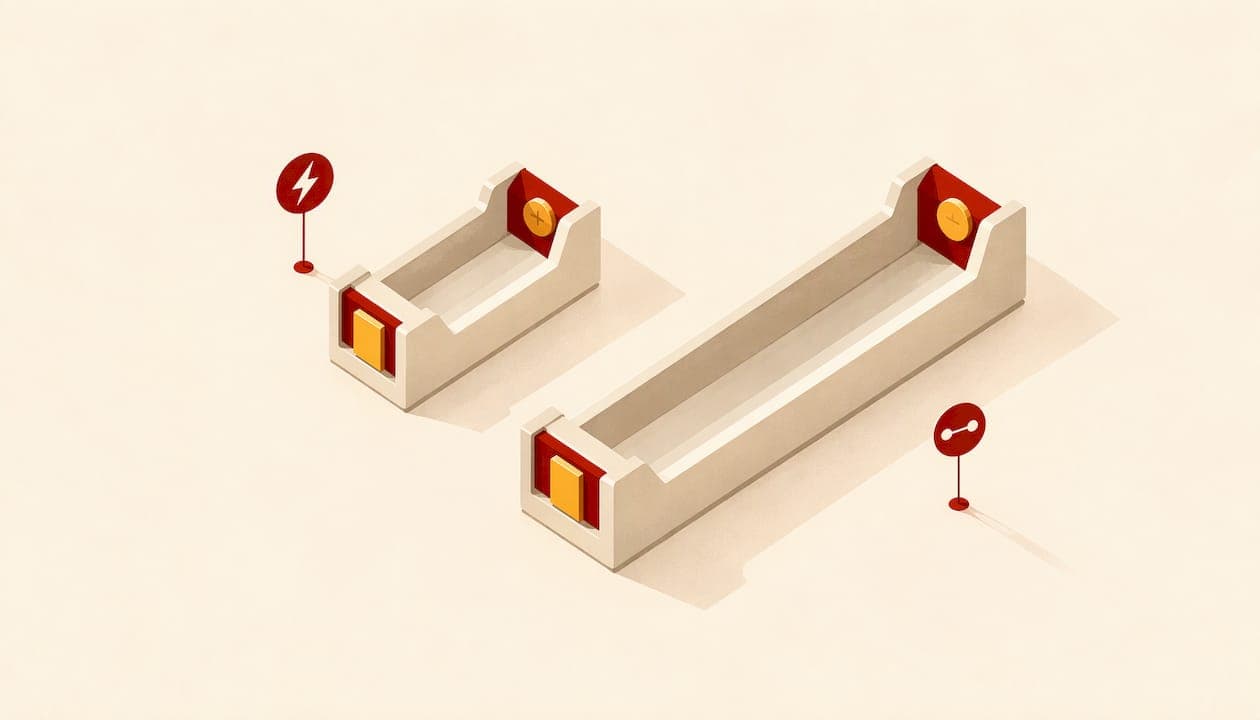
The CR123A is a small, non-rechargeable 3 V lithium cell. The 18650 is a larger, rechargeable lithium-ion cell at 3.6 to 3.7 V. For a torch you use often, the 18650 usually gives longer runtime and lower running costs. For an emergency light, an alarm sensor or a camera that sits unused for months, the CR123A is the safer, simpler choice. In most devices the two are not interchangeable, because the size and the voltage differ.
TL;DR
- Size: the CR123A is 17 × 34.5 mm, the 18650 about 18 × 65 mm. The 18650 is nearly twice as long.
- Voltage and charging: the CR123A is a 3 V primary cell and must never go in a charger. The 18650 is rechargeable at 3.6 to 3.7 V nominal.
- Energy: one 18650 can hold more energy than two CR123A cells, so it often runs longer in the same light.
- Best use: the 18650 suits frequent use. The CR123A suits long storage and cold conditions.
- Swapping: only use the cell type your device manual lists. Never force one in place of the other.
Table of Contents
- The core differences at a glance
- Size: why they do not fit the same holder
- Voltage: the difference that matters most
- Capacity and runtime
- Rechargeability and cost over time
- When the CR123A is the better choice
- When the 18650 is the better choice
- Can you swap one for the other?
- CR123 vs CR123A: the same cell
- How to decide in four questions
- Find the right cell at AkkuPlus
- FAQ
- Sources
The core differences at a glance
The numbers below combine manufacturer data and published specifications. Real cells vary by brand and chemistry.
| Feature | CR123A | 18650 |
|---|---|---|
| Dimensions | 17 × 34.5 mm | about 18 × 65 mm |
| Nominal voltage | 3 V | 3.6 to 3.7 V |
| Maximum voltage | 3 V nominal, higher fresh off the shelf | 4.2 V fully charged |
| Typical capacity | about 1400 to 1600 mAh | about 1800 to 3500 mAh and above |
| Chemistry | Lithium manganese dioxide (primary) | Lithium-ion (rechargeable) |
| Rechargeable | No | Yes, hundreds of cycles |
| Shelf life | Up to about 10 years, depending on brand | Needs periodic recharging if stored long |
The dimensions and chemistry come from Strike Batteries' size chart, which lists the CR123A as a 3.0 V lithium manganese dioxide primary cell and the 18650 as a rechargeable cell rated 3.6 to 3.7 V nominal and 4.2 V when full. The Panasonic CR123A datasheet gives a nominal capacity of 1550 mAh, a nominal voltage of 3 V, a weight of about 17 g and a discharge temperature range of -20 to 60 °C.
Size: why they do not fit the same holder
A CR123A is 17 mm across and 34.5 mm long. An 18650 is 18 mm across and 65 mm long. The name itself tells you the 18650 size: 18 mm diameter, 65.0 mm length.
That is why a flashlight built for one cannot take the other. A body made for a CR123A has a tube that is too short and too narrow for an 18650. Torches built for two CR123A cells in a row are close to the length of one 18650 (two stacked cells run about 69 mm, according to refpit's comparison), which is why some lights are sold in both variants. Even so, the electronics inside are tuned for a specific voltage, so length alone never decides compatibility.

Voltage: the difference that matters most
Two CR123A cells in series deliver 6 V. One 18650 delivers 3.6 V nominal, and up to 4.2 V when fully charged, per the same refpit comparison. A light designed for 2 × CR123A is built around a higher input than a light designed for a single 18650.
The practical rule is the same in every source: use the battery type listed in the manual. Olight's battery comparison states that the voltage must match what the flashlight specifies. A 3 V device does not automatically tolerate a higher voltage.
Capacity and runtime
A single CR123A holds roughly 1400 to 1600 mAh at 3 V, which is around 4.5 Wh. A high-capacity 18650 can store far more. In Olight's example, the 18650 stores 12.6 Wh against 4.5 Wh for the CR123A, and more watt-hours means longer runtime in the same light.
Two CR123A cells are the fairer comparison for many torches, because they are used as a pair. Even then, a good 18650 usually holds more. One laboratory test reported by Large Battery saw an 18650 run a device at 225 lumens for 2.8 hours, outlasting CR123 batteries under similar conditions. Cloud Defensive goes further and notes that an 18650 at 50% charge can offer more energy than two brand-new CR123A cells.
A caveat on capacity numbers: the 1550 mAh Panasonic figure is measured at a specific load and temperature. Under a heavy drain, such as a bright torch, the delivered capacity of any cell is lower. Compare cells from the same brand and the same test conditions, not headline numbers from different sheets.
Rechargeability and cost over time
A CR123A is used once and replaced. An 18650 is charged again and again; sources quote 300 to 1000 cycles or more depending on the chemistry, with Ufine Battery describing a higher upfront cost but a lower cost over its lifetime.
The maths is simple. If you run a torch or a headlamp weekly, the 18650 plus a charger pays for itself, because you stop buying cells. If you use a device a few times a year, the savings never accumulate, and the convenience of a ready-to-use primary cell matters more.
Why CR123A cells cost more per use
A lithium primary cell is single-use and made in a smaller, specialized format, so you pay for each hour of energy again and again. An 18650 spreads its price across many charge cycles. Prices change often and differ between brands and shops, so check the current listing for the exact cell rather than relying on a figure from a guide.
When the CR123A is the better choice
The CR123A earns its place in three situations.
- Long storage. Fenix says CR123A cells can sit in storage for up to 10 years depending on the brand, and perform reliably below freezing. That makes them a sensible fit for emergency kits and a glovebox light.
- Devices that must work without charging maintenance. Test-Stiftung's CR123A guide notes that for security-relevant devices such as smoke detectors or alarm systems, rechargeable cells are often not the best choice unless the manufacturer explicitly permits them. Classic CR123A cells suit occasional users and emergency devices because they stay ready without charging.
- Compact, low-power devices. Cameras, sensors, door locks and small lights that were designed around the 3 V cell and its size.
When the 18650 is the better choice
Choose the 18650 when you use the device regularly and the holder or the manual allows it:
- Everyday carry torches, bike lights and headlamps that you charge weekly.
- High-output lights where the higher capacity gives noticeably longer runtime.
- Power banks, tools and vaping or hobby equipment that were designed around 18650 cells.
- Anyone who wants a lower cost per hour of use over the years.
Refpit's comparison sums it up: the 18650 is cheaper to run for a torch used often, while the CR123A's shelf life wins for a torch kept in a drawer for emergencies.
For a single-cell 18650 example, our shop lists the Samsung ICR18650-26F, a 3.7 V 2600 mAh Li-Ion cell. You can browse the full range under rechargeable single cells.
Can you swap one for the other?
Short answer: no, not as a rule. The 18650 is almost twice as long as a CR123A, so it does not fit a CR123A compartment. And a CR123A will not fill an 18650 holder and give the right voltage.
The real trap is the in-between cell. The rechargeable RCR123A, also sold as 16340, has the same format as a CR123A but runs at 3.6 to 3.7 V instead of 3 V. Test-Stiftung says these are not normal CR123A batteries, and a device designed for 3 V does not automatically tolerate the higher voltage. Some modern flashlights are approved for both variants, and others are not. Olight advises using 16340 cells only if the flashlight maker lists them.
A few safety rules follow from this:
- Check the manual or the label inside the battery tube before inserting any cell.
- Never put a CR123A in a charger.
- Do not mix brands, old and new cells, or different chemistries in one device. Manufacturers such as SureFire and Streamlight warn about leakage, fire and explosion risks, according to Olight.
- If a device does not state that it accepts rechargeable lithium-ion cells, ask the manufacturer before trying one.
If you need a rechargeable in a smaller format than the 18650, read our guide on the best 14500 battery, which covers the AA-sized lithium-ion option and the voltage issue behind it.
CR123 vs CR123A: the same cell
Readers often ask whether the "A" matters. It does not. Ufine Battery calls the two technically and dimensionally interchangeable in compliant devices. The German retailer akkusbatterien.de says the only difference is the letter, with some manufacturers labeling the cell CR123 and others CR123A. Buy either, as long as the voltage is 3 V and the chemistry is a lithium primary.
How to decide in four questions
- What does the manual list? If it names the cell, that is your answer.
- How often do you use it? Weekly or daily: 18650. A few times a year or only for emergencies: CR123A.
- Will it sit in a cold place or a drawer for years? The CR123A handles this better.
- Is the device safety-relevant? Smoke detectors and alarm sensors usually specify a primary cell. Follow the manufacturer.
Our view: match the cell to the job
We see the same question again and again: which one is better? In our experience the better question is which one is right for how you use the device. A rechargeable 18650 is the sensible workhorse for torches and tools that you use every week, and a quality cell with a proper charger is built to serve you for many cycles.
For devices that were designed around the 3 V CR123A, the right answer is to stay with that cell type. We recommend reading the manual first and choosing the cell the manufacturer lists. When you are not sure about a voltage, we are happy to help you check before you buy, and our range of single cells, battery packs and chargers is organized so you can find the right format quickly.
Waldemar Pelich
Find the right cell at AkkuPlus
Whether your device takes a lithium primary or a rechargeable cell, we carry a wide range of formats for German and European customers: batteries, rechargeable single cells and torches and lights.
If your battery pack is the problem rather than a single cell, we also offer cell replacement and refurbishment. You can find an overview of everything on the AkkuPlus home page.
FAQ
Can you use a CR123 instead of an 18650?
No, not in a normal device. A CR123 is about half the length of an 18650 and runs at 3 V instead of 3.6 to 3.7 V. Some torches take either one 18650 or two CR123A cells, but only because the maker designed them for it.
Is a CR123 battery the same as a CR123A?
Yes. The letter A is a labeling difference between manufacturers. The size, the 3 V voltage and the use are the same, so the two names are interchangeable.
What can replace a CR123A?
A CR123 or another CR123A of the same chemistry is the direct replacement. A rechargeable RCR123A or 16340 has a similar size but a higher voltage, so use it only when the device maker states that it is approved.
Why is the CR123A more expensive?
It is a single-use lithium cell, so the cost repeats every time you replace it. A rechargeable 18650 spreads its price over many charges. Check current prices for the exact brand, since they change.
Sources
- Battery Size Chart: AA, AAA, C, D, 9V, CR2, CR123A, 14500 & 18650, Strike Batteries
- Panasonic CR123A lithium battery specifications
- CR123A vs 18650, refpit
- 18650 vs CR123A vs 21700 vs AAA Batteries, Olight
- Choosing Between 18650, CR123, and CR123A Batteries, Large Battery
- Battery FAQ, Cloud Defensive
- 18650 vs CR123 vs CR123A Batteries, Ufine Battery
- Flashlight Battery Guide, Fenix
- CR123A Test & Ratgeber, Test-Stiftung
- CR123 vs CR123A: Unterschied, akkusbatterien.de
Recommended
- Best 14500 Battery: How to Choose and What to Avoid
- Best Battery Chargers 2026: Car, Smart and AA/AAA Picks
This article was created with the assistance of Artificial Intelligence (AI) and has been reviewed by our editorial team. Despite careful preparation, we assume no liability for the completeness, accuracy, or timeliness of the information provided. The technical data and specifications supplied by the respective manufacturer shall always prevail.