
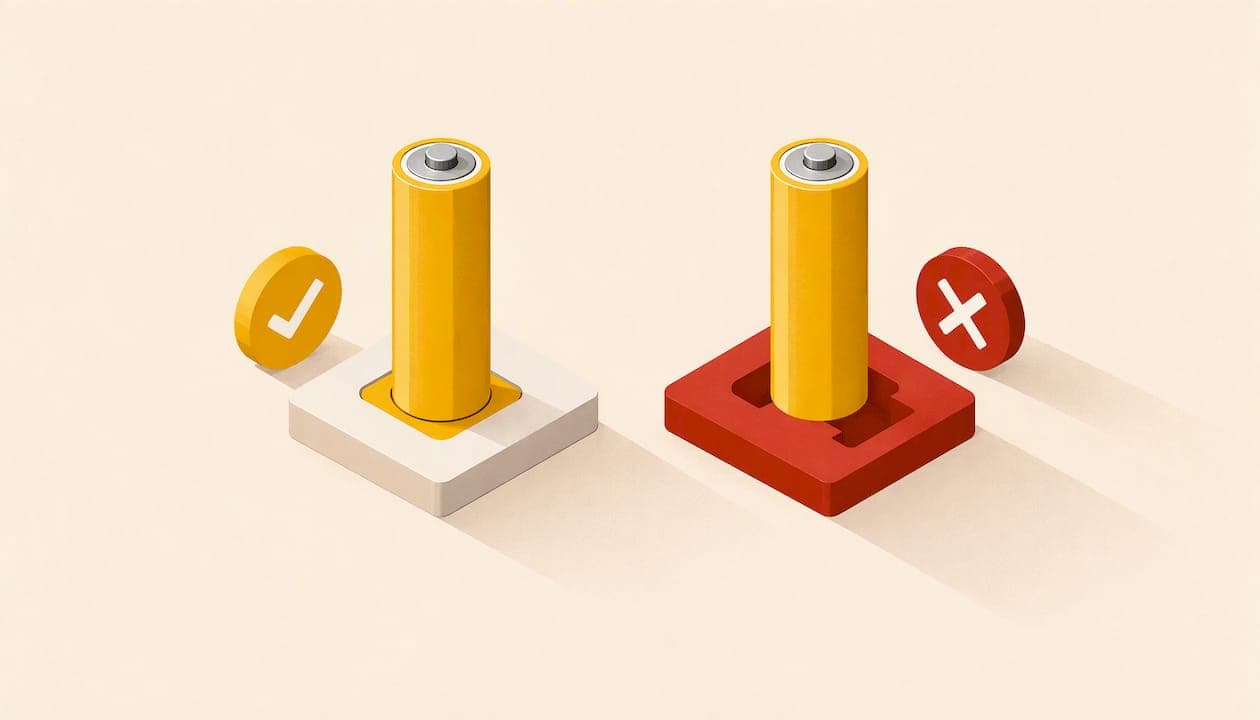
The best 14500 battery is a protected, button-top lithium-ion cell from a known brand, with an honest capacity of roughly 700 to 1,000 mAh, used only in a device built for 3.7 V cells. There is no single winner for every use. A flashlight that needs high current wants a different cell from a remote control or a toy, and a wrong match can damage the device. This guide compares the real types of 14500 cell, explains how to read the numbers on the wrapper, and shows when you should not buy a 14500 at all.
TL;DR
- A 14500 has the size of an AA cell but a nominal 3.6 V to 3.7 V, while alkaline and NiMH AA cells deliver 1.5 V and 1.2 V. Never swap them blindly.
- For flashlights, pick a protected button-top cell with a believable capacity. Cells that claim far more than 1,000 mAh are almost always exaggerated.
- Independent test results (measured capacity and voltage under load) tell you more than the printed label.
- If your device is designed for AA, a 1.2 V NiMH cell is the safe rechargeable choice. If you are unsure which chemistry a battery pack needs, ask us before you buy.
Table of Contents
- What a 14500 battery is, and why it is not an AA
- Which devices actually use 14500 cells
- The main types of 14500 cell compared
- How to read the capacity claim
- What to check before you buy for a flashlight
- Choosing a charger
- When you should not buy a 14500
- Perspective: what we see at the bench
- Where AkkuPlus fits in
- Our recommendation by use case
- FAQ
- Sources
What a 14500 battery is, and why it is not an AA
The name is a size code: 14 mm diameter, 50 mm length, the 0 marking a cylindrical cell. That is the same footprint as an AA, which is exactly the trap. The difference is voltage: 14500 cells provide 3.6 V to 3.7 V, while AA cells run at 1.2 V to 1.5 V. Those two figures, 3.6 V and 3.7 V, are only different labels for the nominal voltage of the same lithium-ion chemistry. Akkutests makes the same point: the labels do not describe different types of battery.
The practical consequence is simple. A device that expects 1.5 V and receives 3.7 V can overheat or fail. The reverse also happens: a device designed for a 14500 may not run properly on an AA. Check the manual for an explicit statement that 14500 is supported. If it is not there, assume it is not.
We covered the same voltage question for larger packs in our article on NiMH versus lithium-ion before a pack repair. The logic is identical: identify the chemistry first, then choose the cell.

Which devices actually use 14500 cells
The main users are compact LED flashlights, headlamps, some vaping and hobby gadgets, and a few electronics designed around a single lithium cell. Many flashlights are built to accept either a 14500 or an AA. A German flashlight site that tested 22 lamps running on 14500 or AA lists them with two brightness figures: the same torch is considerably brighter on a 14500 than on an AA. Look at the Klarus XT1A in that table: 1,000 lumens with a 14500 against 300 with an AA. That gap is the reason people buy these cells.
But it only works if the manufacturer designed the lamp for both. Dual-voltage drivers regulate the higher input. A lamp meant only for AA has no such circuit.
The main types of 14500 cell compared
Instead of ranking brand names whose stock and prices change month to month, it helps to compare the cell designs. Almost every 14500 you will find fits one of these.
| Type | Typical use | Strengths | Weaknesses |
|---|---|---|---|
| Protected, button-top | Flashlights, headlamps | Built-in circuit guards against over-discharge, over-charge and short circuit; the raised positive terminal fits most tubes | Slightly longer than a bare cell, sometimes too long for tight battery tubes |
| Unprotected, flat-top | Devices with their own protection, enthusiast gear | Shorter, can deliver higher current, often cheaper | Needs a device or user who handles protection; not for beginners |
| Protected with built-in USB port | Occasional use, no separate charger | Charge from any USB source | Added bulk and an extra failure point; often lower real capacity |
| High-drain flat-top (rated for several amps) | High-output torches | Holds voltage under load | Lower capacity than a standard cell; protection often absent |
Protected button-top cells
For most buyers this is the right answer. Models such as the Lumintop 14500 with a Micro-USB port and the Orbtronic 1500 mAh protected cell follow this pattern, and the type is what long-running flashlight forums have recommended for years. The protection circuit costs a few millimeters of length, so measure your battery tube before ordering.
Flat-top and high-drain cells
Vapcell sells flat-top 14500 cells in the 1,000 mAh class with a 3 A rating. In German tests the interesting question is what a cell does under load. Akkutests notes that the Vapcell K10 has slightly more capacity than the H10 but a somewhat lower voltage under high loads. It also lists the Vapcell H10 as end of life, a reminder that model lines disappear. In the same overview, the VariCore VC-1410S is specified at 1 A yet can deliver 10 A. Specification sheets and real behavior can differ in both directions.
USB-rechargeable cells
These are convenient: plug in a cable and you are done. For a flashlight in a drawer, that convenience is fine. For heavy daily use, a separate charger and standard cells are easier to replace and usually more honest about capacity.
How to read the capacity claim

A genuine 14500 cell holds somewhere in the range of 700 to 1,000 mAh. The physical volume of a 14 by 50 mm cylinder limits what any chemistry can do today. When a no-name cell claims 2,000, 2,800 or 3,000 mAh, it is not a breakthrough; it is a printed number.
Three checks help:
- Compare against the physical limit. If the number is far above 1,000 mAh, treat it as false until a test shows otherwise.
- Look for measured data. Independent testers discharge cells and publish real capacity and voltage curves. Akkutests, a German test site, does this across many Li-ion cells.
- Treat discharge ratings with care. For the CDR figure, there is no binding standard or norm, and it describes thermal capability, not the usable voltage a cell holds under load. A cell can be rated 10 A and still sag so far that your flashlight dims or shuts off.
A useful reality check from video testing: one reviewer put cheap "high capacity" cells against a normal-capacity Sanyo cell in the
. The cheaper cells cost about a third as much, and their claims did not hold up.What to check before you buy for a flashlight
- Does the lamp support 3.7 V? Look for "14500" in the manual or on the body. Some lamps list a range such as 0.9 V to 4.2 V.
- Protected or unprotected? If the lamp has no low-voltage cutoff, a protected cell is the safer choice.
- Length. A protected 14500 can run 52 to 54 mm. Check the tube.
- Terminal shape. Spring-loaded tubes accept flat-top cells; tubes with a fixed contact may need button-top.
- Charger match. The charger must be one for lithium-ion cells with a 4.2 V cut-off. A NiMH-only charger is not suitable.
- Real capacity. See above: believe measurements, not wrapper numbers.
- Brand and traceability. Buy from a seller who names the cell manufacturer and offers a return route.
Store and carry cells in a case, never loose in a pocket with keys or coins.
Choosing a charger
A 14500 needs a charger designed for lithium-ion. Ansmann's Lithium 2 charger lists 14500 cells as supported, detects the cells automatically and stops charging when they are full. Whatever model you choose, check that the supported-cell list names 14500 or 14xxx sizes explicitly and that it terminates charging at the correct voltage. Do not charge a lithium cell in a charger made for NiMH, and do not leave a charging cell unattended on a flammable surface.
Our own range of chargers and power supplies is in the Stromversorgung category, and testing equipment is under Akku- & Batterietestgeräte.
When you should not buy a 14500
If your device takes AA and does not explicitly mention 14500, do not use one. The manufacturer of a 3.7 V 14500 states plainly that it should not replace standard 1.2 V to 1.5 V NiMH cells and that you should check the manual. Using one in an ordinary AA device can cause overheating, damage or safety hazards.
In that situation the right rechargeable is a NiMH cell. Examples in our shop range from the Varta VH1600AA Mignon AA at 1,2 V and 1600 mAh to the GP 180AAH at 1,2 V and 1800 mAh. They have lower voltage than a lithium cell, but they are made for the devices that expect AA.
Perspective: what we see at the bench
Most battery problems we see are not caused by a bad cell. They come from a mismatch: the wrong chemistry, the wrong voltage, a charger that does not fit. A 14500 is a good example because the housing invites the mistake. Same shape, three times the voltage.
Our advice is plain. Decide what the device was designed for first. Then buy the cell that is honest about its numbers, not the one with the biggest figure. A 800 mAh cell that holds its voltage will run your flashlight better than a "2,000 mAh" cell that does not exist. If you have a pack that has stopped working and you are not sure whether it is NiMH or Li-ion, do not guess; that is exactly what our testing and repair service is for.
— Waldemar Pelich
Where AkkuPlus fits in
We are a specialist for single cells, packs and the services around them. If you need a battery for a flashlight or hobby device, browse Licht, Taschenlampen & Leuchten and Akkus [Einzelzellen] for current availability, because our range of lithium cell sizes changes and we do not want to promise a specific model here.
If the problem is an existing pack, we offer cell replacement, battery testing and EEPROM programming, all described on our main page. Prices are given per job, so ask before you send anything in. For larger electric devices, our checklist on e-scooter battery replacement will save you a wrong purchase.
Our recommendation by use case
| Your situation | Best choice |
|---|---|
| Dual-voltage flashlight, occasional use | Protected button-top cell, 700 to 1,000 mAh, from a known brand |
| High-output torch with a documented current requirement | High-drain flat-top cell with independently measured voltage under load, plus a device that supplies protection |
| No charger and light use | Protected cell with built-in USB port |
| AA-only device (remote, toy, radio) | NiMH AA, not a 14500 |
| Unknown pack that no longer works | Have it tested before buying anything |
FAQ
Can I use a 14500 battery instead of an AA?
Only if the device is designed for lithium-ion 3.7 V cells and says so in the manual. In a normal AA device the higher voltage can cause overheating and damage. For ordinary AA equipment, use alkaline or NiMH cells.
Why do some 14500 cells say 3.6 V and others 3.7 V?
Both are nominal voltages for lithium-ion chemistry, and the labels do not indicate different battery types. Fully charged, the cell reads about 4.2 V. What matters is that the charger and device are made for lithium-ion.
Is a protected 14500 better than an unprotected one?
For most people, yes. The protection circuit guards against over-discharge and short circuits, which is useful in a flashlight without its own cutoff. The trade-offs are extra length and a slightly lower current ceiling.
How can I tell if a capacity claim is exaggerated?
A 14500 realistically holds around 700 to 1,000 mAh. A claim far above that is a warning sign. Look for independent measurements, and remember that discharge ratings such as CDR have no binding standard.
Sources
- AA vs 14500: what is the difference?
- Akkutests: test results and notes
- Akkutests: overview of tested Li-ion cells
- Ansmann Lithium 2 charger
- 14500 battery product information, Orbtronic
- 22 14500 and AA LED flashlights tested
Recommended
- Best UPS Batteries: Lead-Acid vs. Lithium and What to Buy
- Best LiFePO4 Battery: Test Winners and What to Check
- Best Motorcycle Battery: AGM, Gel or Lithium for Your Bike
- Best 9V Rechargeable Battery: Tested Options and How to Choose
This article was created with the assistance of Artificial Intelligence (AI) and has been reviewed by our editorial team. Despite careful preparation, we assume no liability for the completeness, accuracy, or timeliness of the information provided. The technical data and specifications supplied by the respective manufacturer shall always prevail.