
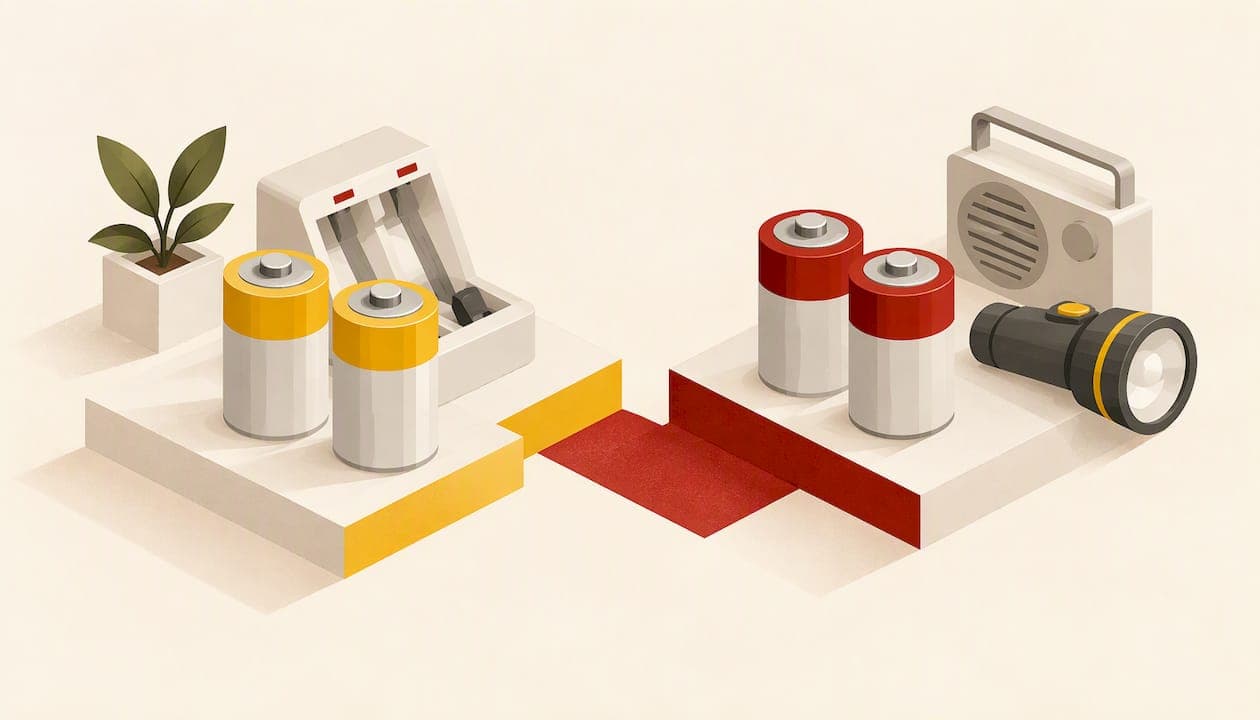
The best rechargeable D battery depends on your device. For most lamps, radios and toys, a high-capacity NiMH cell such as the GP ReCyko 5700 mAh is the safe pick. If your device really needs a steady 1.5 V, a USB-C rechargeable Li-Ion D cell such as MediaRange's is the alternative. Below you will find how the main models compare on voltage, capacity, charging and lifespan, and how to avoid the one mistake that ruins most purchases: the wrong charger.
TL;DR
- Best all-rounder: a NiMH D cell with high capacity. GP lists its ReCyko D at 5,700 mAh, 1.2 V and up to 1,000 charge cycles.
- Best for 1.5 V devices: Li-Ion D cells with built-in regulation and USB-C charging, such as MediaRange's, which are specified at 5,400 mAh.
- Biggest trap: Li-Ion D cells must not go into a regular NiMH/NiCd charger, and NiMH cells deliver about 1.2 V instead of 1.5 V.
- Eneloop fans: Panasonic's eneloop lineup lists only AA and AAA sizes, so there is no true D-size eneloop to compare.
- Good fit: frequently used, power-hungry devices. Rarely used gadgets (a smoke detector, say) are better left to other battery types.
Table of Contents
- What counts as a good rechargeable D battery
- The main options compared
- GP ReCyko 5700 mAh: the dependable NiMH choice
- MediaRange Li-Ion D: constant 1.5 V and USB-C
- Energizer Recharge Power Plus D and VARTA NiMH
- Rechargeable vs. disposable D cells
- The voltage question: 1.2 V or 1.5 V?
- How to charge rechargeable D cells correctly
- Our perspective
- Where to find D cells and packs at AkkuPlus
- Other D-size options worth knowing
- Which one should you buy?
- FAQ
- Sources
What counts as a good rechargeable D battery
D cells (also called Mono, LR20 or HR20) power the heavy hitters of the household: large flashlights, camping lanterns, portable radios, door chimes, toys, measuring gear. They are big because those devices draw a lot of current for a long time, which is exactly where rechargeables pay off.
We judge a rechargeable D cell on five points:
- Real capacity in mAh. Large numbers on the label only matter if they come from a reputable manufacturer's datasheet.
- Voltage behavior. NiMH cells run at a nominal 1.2 V, while alkaline cells start at 1.5 V.
- Charging. Which charger does it need, and does it come charged?
- Cycle life and self-discharge. How many recharges, and how much charge is left after a few months on the shelf?
- Safety features. Protection against overcharge, deep discharge and short circuit.
Price matters too, but D-cell prices change by retailer and week. Check the current price on the product page rather than trusting any number in a review.
The main options compared
The table below uses manufacturer data from the cited pages. Where a manufacturer does not publish a figure on the page we used, we leave it out instead of guessing.
| Model | Chemistry | Voltage | Capacity | Cycle life | Charging |
|---|---|---|---|---|---|
| GP ReCyko D | NiMH | 1.2 V nominal | 5,700 mAh | Up to 1,000 cycles | Pre-charged; PB19 universal charger |
| MediaRange D Li-Ion | Li-Ion with regulated output | Constant 1.5 V | 5,400 mAh | Up to 1,200 cycles | Built-in USB-C |
| Energizer Recharge Power Plus D | NiMH | 1.2 V class | See product page | Hundreds of cycles | NiMH charger |
| VARTA NiMH D | NiMH | 1.2 V nominal | See datasheet | See datasheet | NiMH charger |
Two things stand out. First, the capacity range is similar between NiMH and the Li-Ion type, so the real difference is voltage and charging, not runtime on paper. Second, the usual enthusiast favorite is missing: Panasonic's eneloop lineup shows AA and AAA cells, not D. If a listing sells "eneloop D", it is typically an AA cell in an adapter shell, and a D-sized cell of true capacity is a different product.
GP ReCyko 5700 mAh: the dependable NiMH choice
GP's ReCyko D is the model we would point most people to first. The manufacturer lists 5,700 mAh at 1.2 V nominal and up to 1,000 charge cycles. The cells come pre-charged and ready to use, and GP positions them within its ReCyko charging system, with the PB19 universal charger named for D cells.
Why it works: it is a classic NiMH, so any decent NiMH charger that accepts D cells will do. It is a good match for a big torch, a radio or a toy that you use weekly. A forum thread among flashlight enthusiasts also singles out the GP ReCyko 5700 as a well-regarded D cell, which fits the datasheet picture.
What to check: whether your device tolerates 1.2 V. Most lamps and radios do. Some older gear designed around 1.5 V can behave differently, which we cover below.
MediaRange Li-Ion D: constant 1.5 V and USB-C
MediaRange takes a different approach. According to the manufacturer, its D cell contains a Li-Ion cell with electronic regulation that holds the output at a constant 1.5 V. It lists 5,400 mAh, up to 1,200 charge cycles, USB-C charging, and protection against overcharge, deep discharge, short circuit and overcurrent.
This is the option for devices that care about voltage: measuring and monitoring equipment, certain audio gear, and big lanterns whose brightness depends on voltage. There is also no separate charger to buy, since the charging port is on the cell.
The rule that goes with it, from the same manufacturer: these cells are meant for compatible 1.5 V D devices and must not be charged in conventional NiMH/NiCd chargers. Put a label on your charger drawer if you keep both types in the house. For background on how the two chemistries differ, see our post on NiMH vs. Li-Ion and checking voltage.

Energizer Recharge Power Plus D and VARTA NiMH
Energizer Germany lists its Recharge Power Plus D as suitable for lamps, clocks, door bells, remote controls, audio devices and wireless electronics. The manufacturer cites hundreds of charge cycles, up to three years of usable life and up to twelve months of charge retention. Those are the manufacturer's own claims, so treat them as best-case figures. The upside is easy availability in German stores and clear device guidance.
VARTA publishes a nominal voltage of 1.2 V for its NiMH range, including the D type. The same datasheet is a useful safety read: misuse such as overcharging, deep discharge, reverse polarity or short circuit can cause heat and electrolyte leakage. In practice that means a matched charger, correct polarity, and not leaving cells drained in a device for months.

Rechargeable vs. disposable D cells
The case for rechargeables is strongest where usage is high. Stiftung Warentest describes NiMH cells as worthwhile when they go through many charge cycles in frequently used devices with medium to high consumption, such as cameras and portable speakers. The VDE likewise sees rechargeables as sensible for frequently used or power-hungry devices.
A simple way to think about it:
- Weekly or daily use (camping lantern, workshop radio, kids' toys): rechargeable D cells are the natural fit. You buy once and recharge many times.
- Occasional use (an emergency torch in a drawer): self-discharge is the issue. Energizer's NiMH handbook explains that, depending on temperature and storage, NiMH cells typically keep roughly 50 to 80 percent of their capacity after twelve months, and heat speeds up the loss. If you keep rechargeables for standby use, top them up before you rely on them.
We do not give a euro-per-hour figure here, because it would depend on the price you pay and how often you charge. A fair calculation takes the cell price, the charger, and the number of cycles you realistically use.
The voltage question: 1.2 V or 1.5 V?
This is where most disappointment comes from. The VDE notes that NiMH cells typically deliver about 1.2 V, while some older devices need 1.5 V. It recommends checking whether a device needs 1.5 V or can live with the lower voltage of a NiMH cell.
A practical test:
- Read the device's manual or battery compartment label for a note on rechargeables.
- If it is a lamp, radio, toy or doorbell, NiMH usually works. Energizer lists exactly these device types for its D cells.
- If the device is a precision instrument or older equipment with a voltage-sensitive circuit, choose a regulated 1.5 V Li-Ion cell, or ask the manufacturer.
- Never mix chemistries or old and new cells in the same device.
How to charge rechargeable D cells correctly
- NiMH: use a charger made for NiMH D cells. GP names the PB19 universal charger for its ReCyko D. Chargers built only for AA/AAA will not take D cells.
- Li-Ion with USB-C: charge through the cell's own port. Keep these out of NiMH/NiCd chargers.
- Insert correctly: reverse polarity is one of the misuse cases VARTA warns about.
- Charge in sets: pair cells that are used together and charge them together.
- Store cool: heat accelerates self-discharge, as the Energizer handbook explains.
Our perspective
Most questions we get about D cells are not about brands. They are about fit: a customer has a big lamp, a radio or a piece of measuring gear, and wants to know whether a 1.2 V cell will run it.
Our view is simple. Check the voltage your device expects first, then pick the chemistry, then the brand. A well-matched NiMH cell is the best value for most households, and a regulated 1.5 V cell is the right tool where voltage matters.
We also see the other side of the D-cell world every day: devices whose original pack has aged. That is why we offer more than single products: cell replacement, custom pack assembly (Konfektionen) and retrofit for devices built around D-size cells, next to a catalog of single cells and packs. Choosing a battery, matching a charger and rebuilding a worn pack are one job for us, not three.
Waldemar Pelich
Where to find D cells and packs at AkkuPlus
If you want to browse single cells, our Akkus (Einzelzellen) category is the place to start, and Akku- und Batteriepacks covers assembled packs. For lamps specifically, see Licht, Taschenlampen & Leuchten. Product ranges and prices change, so check the live pages for what is in stock today.
If your device uses a built-in pack made of D-size cells, you may not need new loose batteries at all. We offer battery repair with cell replacement, battery testing and pack assembly, so an old pack can often be rebuilt rather than discarded.
Not sure what your device needs? Start on our main page to see the repair, testing and pack-assembly services, or browse the Batterien category for standard cells.
Other D-size options worth knowing
Not every "D" is a 1.2 V or 1.5 V cell. AkkuPlus lists, for example, an EnerSys Cyclon D cell with 2 V and 2,500 mAh in lead chemistry, a specialist cell for specific equipment rather than a replacement for a torch battery. There is also a 1/2 D Ni-Cd cell at 1.2 V and 2,200 mAh, which is a different size from a standard D. Always match the exact cell designation and voltage before you order.
If you also need rechargeables in other formats, our guide to the best 9V rechargeable battery follows the same logic of checking voltage first.
Which one should you buy?
| Your situation | Our pick |
|---|---|
| Large torch, radio or toy used weekly | NiMH D with high capacity, such as the GP ReCyko 5700 mAh |
| Device that needs a steady 1.5 V | Regulated Li-Ion D with USB-C, such as MediaRange's |
| Household with an existing NiMH charger | NiMH D from GP, Energizer or VARTA |
| Built-in pack of D cells that has worn out | Cell replacement or pack rebuild instead of new loose cells |
| Standby use only | Check charge before use, or consider a different battery type |
FAQ
Are there rechargeable D batteries from eneloop?
Panasonic's eneloop lineup page lists AA and AAA cells, not D. Products sold as eneloop D are usually smaller cells in a D-size adapter, which have less capacity than a true D cell. For real D-size capacity, look at NiMH models such as the GP ReCyko.
Can I use rechargeable D batteries in any device?
Mostly yes, but check the voltage. NiMH cells deliver about 1.2 V, and the VDE points out that some older devices need 1.5 V. For lamps, radios, toys and doorbells NiMH is typically fine, and for voltage-sensitive equipment a regulated 1.5 V cell is the safer match.
Can I charge Li-Ion D cells in my NiMH charger?
No. MediaRange states that its Li-Ion D cells must not be charged in conventional NiMH/NiCd chargers. They charge through their own USB-C port. Using the wrong charger risks damaging the cell, so keep the two types clearly separated.
How long do rechargeable D batteries hold their charge?
NiMH cells self-discharge. According to Energizer's NiMH handbook, they typically retain about 50 to 80 percent of capacity after twelve months, depending on temperature and storage. Store them cool and recharge before important use.
How many times can I recharge a D cell?
Manufacturers state up to 1,000 cycles for the GP ReCyko and up to 1,200 for the MediaRange Li-Ion D. These are best-case figures under rated conditions, so real life depends on charger quality, depth of discharge and heat.
Sources
- GP ReCyko battery 5700mAh D
- MediaRange batteries
- VARTA nickel-metal hydride
- Energizer Recharge Power Plus D, Germany
- Energizer NiMH handbook
- VDE consumer protection: batteries
- Stiftung Warentest: batteries in test
- Panasonic eneloop lineup
Recommended
- NiMH vs Lithium Ion in Germany: Check Voltage Before a Pack Repair
- Best 9V Rechargeable Battery: Tested Options and How to Choose
- Best Battery Chargers 2026: Car, Smart and AA/AAA Picks
- Best 14500 Battery: How to Choose and What to Avoid
This article was created with the assistance of Artificial Intelligence (AI) and has been reviewed by our editorial team. Despite careful preparation, we assume no liability for the completeness, accuracy, or timeliness of the information provided. The technical data and specifications supplied by the respective manufacturer shall always prevail.