
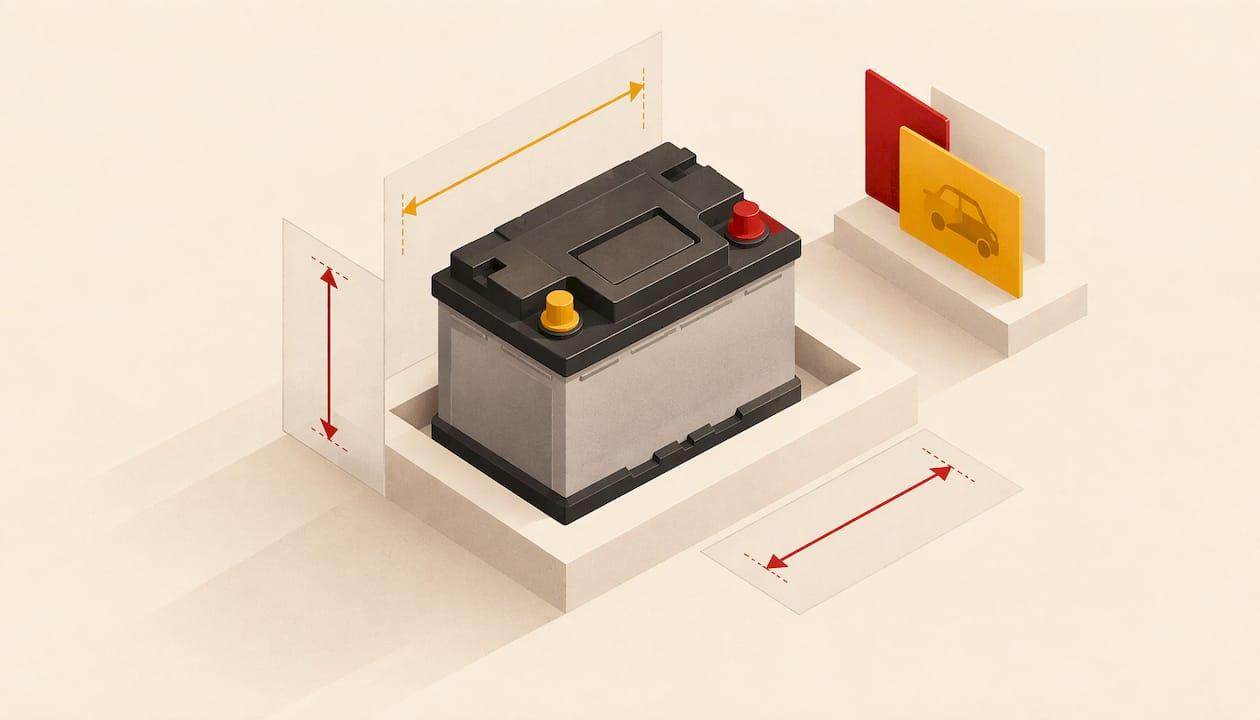
The right car battery is the one that matches your car's original technology (standard, EFB or AGM), its housing size (such as H5, H6 or H7), its 12-volt rating and its terminal layout. Read those four details off your old battery or your manual, and the choice mostly makes itself. Below we show where to find each one, how the three battery types compare, and when a new battery needs registering in the car.
TL;DR
- Start with the label on your current battery and your owner's manual. Voltage is 12 V, and the manufacturer prescribes the performance values.
- Never go down a technology level: an AGM battery needs another AGM, an EFB can be replaced by EFB or AGM, and a standard battery can be replaced by any of the three.
- The H-code (H5, H6, H7 and so on) tells you the housing size. Terminal position must match too.
- Many newer cars need the new battery registered with the battery management system, so ask who will fit it.
- Buying a starter battery online without returning the old one adds a €7.50 deposit, refundable on return.
Table of Contents
- Step 1: Read what your car already tells you
- Step 2: Match the housing size (H5, H6, H7 and others)
- Step 3: Choose the technology: standard, EFB or AGM
- Step 4: Compare the brands honestly
- Where AkkuPlus fits
- Step 5: Decide who installs it
- The deposit when you buy online
- Order a battery that suits your car
- Common mistakes when choosing a car battery
- FAQ
- Sources
Step 1: Read what your car already tells you
Your car was delivered with a battery that suits its electrics. The fastest route to the right replacement is to copy its specification. Three places give you the answer:
- The old battery's label. It shows voltage, capacity in Ah, cold cranking current in A, the type (often marked EFB or AGM) and a type number.
- The owner's manual. It names the prescribed battery and, in many cars, whether the car has start-stop.
- The vehicle documents and engine data. Make, model, engine and year narrow a fitment search in any online shop.
The ADAC explains that starter batteries run at 12 volts and that the vehicle manufacturer prescribes the performance values. When you replace the battery, the cold cranking current should be at least the recommended value. The nominal capacity should be as close as possible to the recommendation.
In practice that means a battery with a little more cold cranking current is fine, while one with clearly lower capacity or current is not.
Step 2: Match the housing size (H5, H6, H7 and others)
In Germany you will see sizes called H4 to H9. They come from the DIN housing codes and are standardized in the European norm EN 50342-2. Most are 175 mm wide and 190 mm high and differ mainly in length: roughly 242 mm for an H5, 315 mm for an H7 and 353 mm for an H8, according to a size overview from elektronik-zeit.de. The same source lists these typical assignments by vehicle class:
| Vehicle class | Example models | Typical size |
|---|---|---|
| Small cars | Polo, Corsa, Panda | H4 to H5 |
| Compact class | Golf, A3, Astra, Focus | H5 to H6 |
| Mid-size | Passat, A4, 3 Series, C-Class | H6 to H7 |
| Upper class and SUV | A6, 5 Series/X5, E-Class/GLE, Touareg | H7 to H8 |
| Premium upper class | A8, 7 Series, S-Class, Panamera | H8 to H9 |
Treat this table as a starting point, not a verdict. The same model can come with different batteries depending on engine, equipment and year, so the label on your own battery always wins.
Two more checks prevent a battery that fits on paper but not under the bonnet:
- Terminal position. Plus and minus must sit on the same sides as in the original, or your cables will not reach. The Haynes repair guide also stresses that dimensions and terminal positions must match the original exactly.
- Hold-down fixing. Many housings have a base ledge the clamp grips. A different ledge can leave the battery loose.
Step 3: Choose the technology: standard, EFB or AGM
This is the decision that most often goes wrong, and it is the one that matters most. Cars with start-stop systems or heavy electrical loads put far more demand on the battery than a simple older car.
| Standard lead-acid (flooded) | EFB | AGM | |
|---|---|---|---|
| Typical use | Older and simple cars without start-stop | Entry-level start-stop, cars with many electrical consumers, lots of short trips | Start-stop and recuperation systems, higher-equipped cars |
| Cycle resistance | Moderate | High | Highest |
| Can replace | Standard only (or upgrade) | EFB, or upgrade to AGM | AGM only |
| Typical cost level | Lowest | Middle | Highest |
The ADAC describes standard batteries as maintenance-free today, with a low purchase price. EFB batteries add a polyfleece material on the positive plate for a longer life, and they suit start-stop systems. For a car without start-stop, the ADAC notes that a more powerful EFB can optionally replace a standard battery, especially if you mostly drive short trips or have retrofitted electrical consumers.
The one rule you must not break
The replacement may match or exceed the original technology, never fall below it. VARTA Automotive, a battery manufacturer, states that a start-stop battery can only be replaced by the same type, though an EFB can be upgraded to AGM. Fitting a conventional battery in place of an AGM or EFB leads to rapid wear and early failure. We read that as a clear instruction: if your manual or label says AGM, buy AGM.
On cars with a battery management system, an upgrade from EFB to AGM usually means telling the car about the new specification. The Haynes guide mentions registering it with a scan tool. Ask your workshop whether your model needs this.

What about price?
Standard batteries cost the least up front, and AGM the most. But the price on the shelf is only half the sum. Compare cost per year of service. As a simple illustration, not a quote: a €70 battery that lasts 3.5 years costs €20 a year, while a €180 battery that lasts 7 years costs about €26 a year. Fit a standard battery to a car that needs AGM, and it may die in under two years, so the cheap option becomes the expensive one. Your real life also depends on how you drive, since short trips and cold weather are hard on any battery.

Step 4: Compare the brands honestly
The familiar names in Germany are Varta, Bosch, Exide, Banner and Moll, plus others. Reputable brands cover all three technologies, so the type and size you choose matter more than the label on the case. For a brand-by-brand look at who offers what, see our guide to the best car battery brands in Germany. For a deeper look at types, our article on the best car battery for your type of car goes further.
When you compare two offers for the same size and technology, use this checklist:
- Capacity (Ah) equal to or slightly above the original.
- Cold cranking current (A) equal to or above the manufacturer's value.
- Same technology or higher (see the rule above).
- Correct terminal layout and housing code.
- A date of manufacture that is recent. Ask for a fresh battery, because a battery that has sat for a long time on a shelf starts life with less charge.
Where AkkuPlus fits
We are a specialist battery retailer, not a car parts supermarket, and that shapes how we help. Our shop at AkkuPlus covers batteries for vehicles, household devices and electronics, and we give you what a reader on this page needs most: a catalog sorted by category, so you can go straight to the right section instead of searching through unrelated products. You can browse our Batterien category, and for heavy-duty needs we also list starter batteries for commercial vehicles such as the Banner SHD 680 89 with 180 Ah and 1050 A.
Before you decide a battery is dead, test it. Our category of battery test devices helps you see the state of a battery, and a good battery charger keeps a car that stands for weeks in shape.
Our view
We see the same mistake again and again: people shop by price and by the biggest number on the label. A battery is a part of the car's electrical system, and what counts is whether it speaks the same language as the car. That means the right technology first, then the right size and terminal side, then capacity and cold cranking current at or above the original.
We also think the cheapest battery rarely wins over a few years. A battery matched to your car's technology lasts longer and avoids the breakdown that always comes on the coldest morning. That is why we organize our shop by category and by specification, so you can find the type you need directly.
Our advice: read your label, keep the technology level, and when in doubt about registration, ask your workshop before you buy.
Waldemar Pelich
Step 5: Decide who installs it
The ADAC advises laypeople to leave a battery change to professionals. Modern cars have complex electronics and may need special equipment to register the new battery. If the battery is disconnected, the car can also lose settings.
The ADAC describes a do-it-yourself change as realistic mainly for older vehicles without a battery management system, where no error codes need clearing and no registration is needed. If that is your car:
- Check your manual first.
- Wear safety glasses and acid-resistant gloves.
- Disconnect the negative terminal first.
- Fit the new battery, reconnect the positive terminal, then the negative one last.
- Take the old battery to a recycling centre, dealer or workshop. Never put it in household waste, as the ADAC warns.
The same source notes that a battery can become weak after four to five years because modern cars carry more electrical consumers. If your battery is that old and the car starts slowly in winter, get it tested.
The deposit when you buy online
German law adds a small detail to every starter battery purchase. Under § 19 BattDG, a retailer must charge a deposit of €7.50 including VAT per starter battery if you do not hand in an old one when you buy. You get it back when you return an old battery. For online purchases, you can instead present a written or electronic proof of return that is no more than two weeks old. Plan this before ordering so the deposit does not surprise you.
Order a battery that suits your car
Once you know your type, size and ratings, go to our Batterien category and pick the matching product. Do you have a battery or pack from an electronic device that no longer holds a charge? Our repair and cell replacement services cover that, including battery testing and refurbishment.
If you need an e-scooter, motorcycle or leisure battery rather than a car battery, we have guides for those too, such as our motorcycle battery guide and our deep cycle battery guide.
Common mistakes when choosing a car battery
- Going by price alone. A cheap battery in a start-stop car can cost more per year than a better one.
- Matching only the capacity. Size, terminals and technology matter just as much.
- Ignoring registration. On many newer cars, skipping it can leave the new battery under- or overcharged and shorten its life.
- Forgetting the climate. According to a workshop blog's figures, at −18 °C a starter needs around 50% more current than at +20 °C, while available battery capacity drops to roughly 60% of its rated value. That is why a reserve in cold cranking current helps in winter.
- Leaving the car standing. A car that sits for weeks drains its battery. A smart charger solves that.
FAQ
What does H7 mean on a car battery?
H7 is a trade designation for a housing size from the DIN system, now covered by the European standard EN 50342-2. It stands for a battery of about 315 mm in length, 175 mm in width and 190 mm in height, according to the size overview. It does not say anything about the technology, so you still need to check whether your car wants standard, EFB or AGM.
Can I fit an AGM battery instead of a standard one?
In general, yes, because moving up in technology is allowed. A standard battery can be replaced by a standard, EFB or AGM type, while an AGM can only be replaced by another AGM. Ask your workshop whether the car needs the new battery registered.
How do I know if my car has start-stop?
Check the manual, look for an A with a circle on the dashboard or a button for it, and read your old battery's label for EFB or AGM. If you are unsure, ask a workshop to confirm before you buy, because the type decides which batteries you can use.
Can I replace my car battery myself?
The ADAC advises laypeople to leave it to professionals, because modern cars have complex electronics and may need battery registration. A do-it-yourself change is mainly an option for older vehicles without a battery management system. Always disconnect the negative terminal first and wear gloves and safety glasses.
Do I pay a deposit on a car battery?
Yes, if you do not return an old starter battery at purchase. The deposit is €7.50 including VAT per battery and is refunded when you return an old one, as set out in § 19 BattDG. Online, a proof of return that is no more than two weeks old also works.
Sources
- ADAC: Autobatterie kaufen, worauf muss man achten?
- ADAC: Autobatterie wechseln, das ist dabei zu beachten
- t-online: Autobatterie im Winter, ADAC warnt
- elektronik-zeit.de: Autobatterie-Größen 2026
- Haynes Manuals: Change car battery
Recommended
- The Best Car Battery: Which Type Fits Your Car
- Best Car Battery Brands in Germany: Varta, Bosch, Exide and More
- Best AGM Chargers in Germany: Picks and How to Choose
- Best Battery Chargers 2026: Car, Smart and AA/AAA Picks
This article was created with the assistance of Artificial Intelligence (AI) and has been reviewed by our editorial team. Despite careful preparation, we assume no liability for the completeness, accuracy, or timeliness of the information provided. The technical data and specifications supplied by the respective manufacturer shall always prevail.