
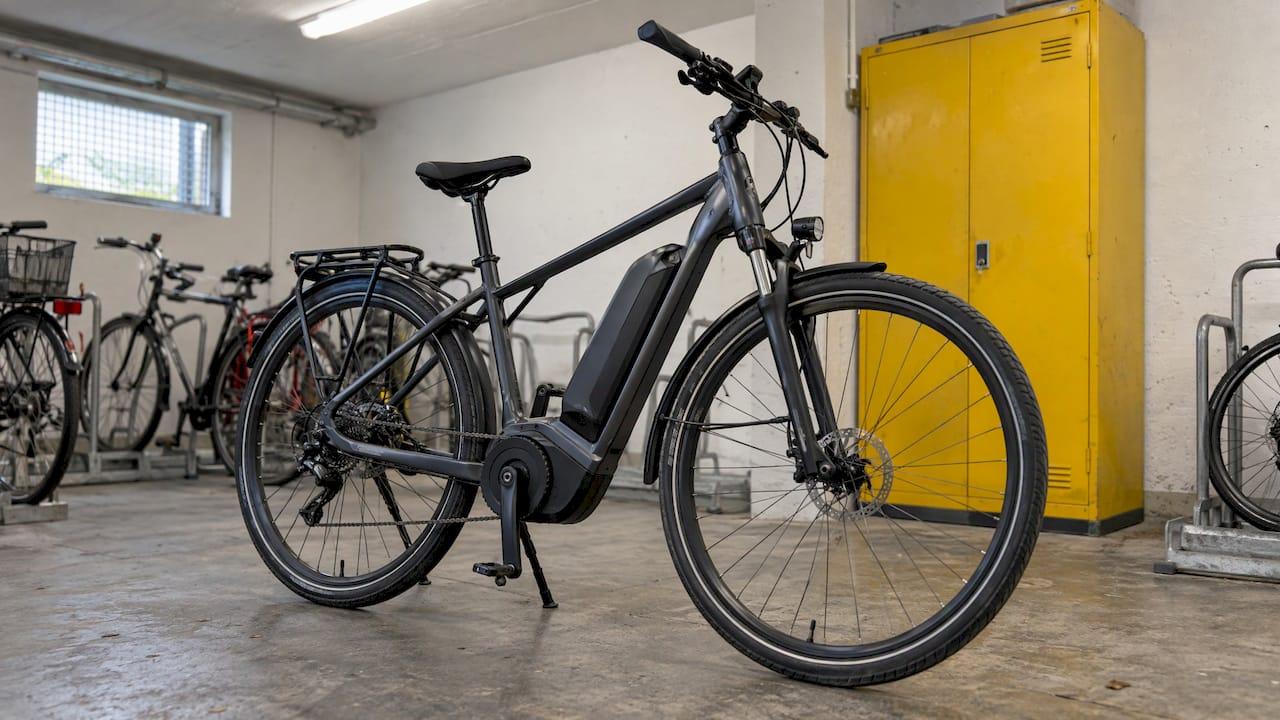
Almost every modern e-bike runs on a lithium-ion battery, and the number that matters most when you compare packs is energy in watt-hours (Wh), not amp-hours. Older chemistries such as lead-acid, NiCd and NiMH still exist, mostly in older bikes. Within lithium-ion there are several cell chemistries, and the voltage of the pack (36V, 48V) has to match your motor and charger. This guide shows how to read all of that, so you can replace, repair or buy a battery without guessing.
TL;DR
- Lithium-ion is the standard e-bike battery today. Germany's Federal Environment Agency calls it the most common pedelec battery type.
- Compare packs by watt-hours: volts multiplied by amp-hours. Amp-hours alone tell you very little.
- 36V is the long-standing standard in Germany, 48V packs exist too, but voltage must always match the bike's system and the charger.
- Range depends on assist level, terrain, rider and luggage weight as much as on capacity.
- Charge only with the approved charger, supervised, on a non-flammable surface, and store the battery at roughly 30 to 60 percent charge.
Table of Contents
- The main e-bike battery types at a glance
- Lead-acid, NiCd and NiMH: why you mostly see them in older bikes
- Lithium-ion: one family, several chemistries
- 36V or 48V: what the voltage means
- Range versus capacity: why watt-hours decide
- The biggest disadvantage of lithium-ion: handle it correctly
- Making the battery last
- What to do when your battery is worn out
- Our view: voltage and watt-hours first, brand second
- Get the right battery or repair from AkkuPlus
- FAQ
- Sources
The main e-bike battery types at a glance
When people search for e-bike battery types, they usually mean two different things: the chemistry inside the cells (lead-acid, nickel-based, lithium-ion) and the variants within lithium-ion. Here is the overview.
| Type | Where you meet it | What to know |
|---|---|---|
| Lead-acid (including AGM and gel) | Very old or very cheap e-bikes, mobility scooters | Heavy and bulky for the energy they store |
| NiCd (nickel-cadmium) | Early e-bikes, older cordless devices | Largely replaced; memory effect |
| NiMH (nickel-metal hydride) | Older e-bikes and tools | Better than NiCd, still behind lithium-ion in energy density |
| Lithium-ion (several chemistries) | Practically all current pedelecs | Highest energy density, practically no memory effect |
The ADFC, Germany's national cycling association, explains that modern pedelecs almost exclusively use lithium-ion batteries because they currently offer the highest energy density and practically no memory effect. The memory effect is the loss of usable capacity that some older battery types suffer when you recharge them before they are empty.
If your bike is older and you are unsure what is inside, the pack label or the manual will say. Our short guide on NiMH versus lithium-ion and checking voltage before a pack repair shows what to read off the label first.
Lead-acid, NiCd and NiMH: why you mostly see them in older bikes
Lead-acid packs are made of heavy lead plates in a sealed case. They are robust and cheap, but the weight is a problem on a bike, because you carry it with every ride. That is why bicycles moved on to lighter chemistries. Lead-acid is still common in mobility scooters, alarm systems and backup power, where weight matters less.
NiCd and NiMH cells powered the first generation of e-bikes. NiMH was the step up: more energy for the same weight, and without the cadmium of NiCd. Both are heavier than lithium-ion for the same energy and are rarely used in new pedelecs.
If you own a bike with a nickel-based pack, you do not necessarily have to replace the whole bike. A worn pack can often be rebuilt with new cells. We offer cell replacement and refurbishment for battery packs, and that includes bicycle packs such as a 24 volt NiCd or NiMH pack conversion.

Lithium-ion: one family, several chemistries
Lithium-ion is not a single battery. The ADFC lists lithium polymer, lithium manganese, lithium titanate, lithium iron phosphate and lithium-air as variants with different strengths and weaknesses. In practice, two things matter to you as a buyer.
Energy density. This is how much energy a cell stores per kilogram. The Federal Environment Agency gives lithium manganese oxide (LiMn2O4) as an example at 110 to 130 Wh/kg and up to 1,000 charge cycles, with low self-discharge and good stability and safety, in its pedelec report. Other chemistries trade some of that energy density for different qualities, such as longer life or higher stability.

Cell format. Most e-bike packs are built from many small cylindrical cells wired together, for example the familiar 18650 format. A pack is therefore a bundle of single cells plus a battery management system (BMS) that watches voltage, current and temperature. A cell like the Samsung ICR18650-26F, 3.7 volts and 2600 mAh shows what these building blocks look like on paper: nominal voltage, capacity and chemistry are all printed in the name.
If you want a closer look at the iron-phosphate variant, which is popular for stationary and heavy-duty use, see our LiFePO4 battery guide.
36V or 48V: what the voltage means
Voltage describes the electrical "pressure" of the system. The motor, controller, battery and charger are designed for one voltage. The ADFC calls 36 V the current standard and names 24, 26, 36 and 48 V drive systems.
So is 48V better than 36V? Not automatically. A higher voltage does not store more energy by itself, and the energy is what gives you range. A 48V battery with a small capacity can hold the same energy as a 36V battery with a larger one. What the higher voltage does, in general, is deliver the same power with less current. That is a design choice made by the bike's manufacturer, not something you can choose freely.
For you, the practical rule is simple:
- Match the system. The replacement battery must have the voltage your bike was built for. Check the label on the old pack and the data of the motor system.
- Match the charger. A German charger guide from FIT warns that battery voltage and the charger's charging voltage must fit together, and that an unsuitable charger can cause fire and explosion hazards.
- Match the connector and communication. Many pedelec systems talk to the battery electronically. Mechanical fit alone does not mean it works.
If you are unsure which voltage you have, do not try a pack "to see". Send us the label data and the type of bike through the main page, and we will look at the options for a replacement pack or a cell replacement.
Range versus capacity: why watt-hours decide
The third question readers ask is how battery capacity relates to range. The answer starts with a unit problem. Batteries are sold with amp-hours (Ah) printed in large type, but the ADFC points out that capacity in Ah alone does not let you compare packs sensibly. What matters is the energy content in Wh, which is voltage times capacity.
Worked example.
- A 36V battery with 13.9 Ah stores about 36 × 13.9 = 500 Wh.
- A 48V battery with 10.4 Ah stores about 48 × 10.4 = 500 Wh.
Both packs carry the same energy, so, all else equal, the same range. The larger Ah number of the 36V pack does not mean it goes further.
How far does 500 Wh actually go?
Stiftung Warentest, the German consumer testing foundation, describes 500 Wh as the current standard. In one of its e-bike tests, 500 Wh lasted around 20 km uphill with maximum assistance and around 85 km on the flat in eco mode. That spread is the real lesson: the same battery can deliver more than four times the distance depending on how you ride.
The ADFC lists the factors that change the figure:
- the strength of assistance you select,
- the topography,
- your riding style,
- rider and luggage weight.
Shifting into a low gear and keeping a higher cadence saves energy too.
Stiftung Warentest recommends 500 Wh for most medium distances. Larger batteries make sense mainly for long distances, but they add weight and price, while smaller ones can be enough for short city rides.
Which size for which rider
| Your riding | Sensible starting point |
|---|---|
| Short city trips, flat terrain | Smaller battery, lighter bike |
| Daily commute, mixed terrain | Around 500 Wh |
| Long tours, hills, heavy luggage | Larger capacity, accept the weight |
This table is a starting point, not a promise. The only reliable method is to estimate your own typical distance and terrain, then size the battery with a reserve.
The biggest disadvantage of lithium-ion: handle it correctly
The key point for safe use is the high energy density, which is also what makes lithium-ion so good. The Federal Environment Agency names mechanical damage, external short circuits, contact with water or the terminals, and overheating as typical hazards for lithium batteries in its pedelec guide. Deep discharge and the wrong charger can also promote a fire. That is why the rules below are worth following every time.
Charging
- Use only the charger approved for your battery. The Unfallkasse Hessen, a German public accident insurer, advises using only chargers approved by the manufacturer.
- Charge under supervision, on a non-flammable surface and away from things that can burn. Do not cover the battery.
- Do not charge a cold battery below 0 °C.
- Check the battery for visible damage before charging and let it cool down first, as Bosch's battery guide advises. It also recommends a dry room with a smoke detector and not charging in escape routes.
Storage
For longer storage, keep the battery dry at a charge level of about 30 to 60 percent. Bosch gives a storage temperature of 10 to 40 °C and says to avoid temperatures below minus 10 °C or above 60 °C. Never open or damage the pack.
If a battery has been dropped, swollen, got wet or smells unusual, stop using it. Have it checked by a qualified specialist before it goes anywhere near a charger. A battery that no longer holds its charge can be tested: we offer battery tests and inspections, and for packs that are worn but not damaged, cell replacement.
Making the battery last
A lithium-ion pack ages with every charge cycle and with time. Heat and deep discharge speed it up. You do not need to count cycles obsessively, but a rough idea helps you decide when a pack is on its way out. Our guide explains how to calculate equivalent full cycles yourself and what research shows about lithium-ion ageing.
A few habits that follow directly from the safety rules above:
- Store the pack at a partial charge, not full and not empty, for the winter break.
- Keep it out of freezing garages and hot cars.
- Use the original charger, always.
- Let it cool after a ride before you charge it.
A noticeably shorter range than you had two seasons ago is the usual sign that the cells are worn. Because a pack is made of single cells, a cell replacement can bring it back instead of replacing everything.
What to do when your battery is worn out
You have three realistic paths.
- Rebuild the pack with new cells. This suits packs whose housing, BMS and connectors are fine, but whose cells have lost capacity. It is the route that keeps your original housing and fit.
- Replace the pack. Best when the pack is damaged or the cells are not worth rebuilding.
- Retrofit. If a pack for an older bike is no longer available, a custom-built replacement (called a Konfektion in German) with modern cells can solve it.
Our service range covers battery repair, battery tests and inspections, custom pack assembly, retrofit and EEPROM programming, and we sell single cells and ready-made packs. Our catalog of battery packs and single cells is the place to start when you know the voltage and cell type you need.
The same logic applies to e-scooters: our checklist before you buy an e-scooter replacement battery walks through voltage, connector and capacity checks.
Our view: voltage and watt-hours first, brand second
Most questions we get about e-bike batteries are really questions about three numbers: voltage, watt-hours and cell type. If those match the bike, the rest is detail.
We see the label as the starting point. Voltage tells you which system you have, watt-hours tell you the range you can expect, and the cell chemistry tells you what the pack can and cannot take. When all three are known, choosing between a rebuild with new cells and a replacement pack becomes a clear decision instead of a gamble.
That is why we work with cells, packs, chargers and testing under one roof: you can get a pack tested, have the cells replaced or find a matching replacement, and keep the same charger discipline afterwards. A good battery decision is one that fits your bike, your riding and your safety.
Waldemar Pelich
Get the right battery or repair from AkkuPlus
If you know your bike's voltage and want a replacement pack, a rebuild or a test, start with our range of battery packs or the services overview with battery repair, battery tests and inspections, retrofit and custom pack assembly. Have the label data of your old battery at hand: voltage, capacity in Ah or Wh, and the type of bike.
For chargers, cells and accessories, our shop categories cover the rest, from power supplies to workshop equipment.
FAQ
What kind of battery is on an electric bike?
Most current e-bikes use a lithium-ion battery. The Federal Environment Agency calls it the most common pedelec battery type, and the ADFC says modern pedelecs almost exclusively use it. Older bikes may have lead-acid, NiCd or NiMH packs.
What is better, a 36V or a 48V e-bike?
Neither is better by itself. Range depends on energy in watt-hours, and the voltage is set by the bike's motor system. Always buy a battery and charger with the voltage the manufacturer specifies for your bike.
How many watt-hours do I need?
Stiftung Warentest sees 500 Wh as the current standard and suitable for most medium distances. Smaller packs can be enough for short city rides, and larger ones help on long distances at the cost of weight and price.
How do I store an e-bike battery over winter?
Keep it dry, at about 30 to 60 percent charge, and at a moderate temperature. Bosch gives 10 to 40 °C and says to avoid anything below minus 10 °C or above 60 °C. Check it for damage before you charge it again.
Sources
- ADFC: Voll geladen (Pedelec-Akkus)
- Umweltbundesamt: Electric bikes get things rolling
- Umweltbundesamt: E-Rad macht mobil
- Unfallkasse Hessen: Lithium-Ionen-Akkus richtig lagern
- Bosch eBike Systems: Battery guide
- Stiftung Warentest: E-Bike-Akku, Reichweite, Pflege, Laden
- FIT: Kurzanleitung Akkuladegerät 48V
Recommended
- Best Motorcycle Battery: AGM, Gel or Lithium for Your Bike
- Best Leisure Battery for Your Camper in Germany: AGM, Gel or LiFePO4
- Electric Scooter Battery Replacement: 6 Checks Before You Buy
- Best Deep Cycle Battery: AGM, Gel or LiFePO4 for Your Use
This article was created with the assistance of Artificial Intelligence (AI) and has been reviewed by our editorial team. Despite careful preparation, we assume no liability for the completeness, accuracy, or timeliness of the information provided. The technical data and specifications supplied by the respective manufacturer shall always prevail.