
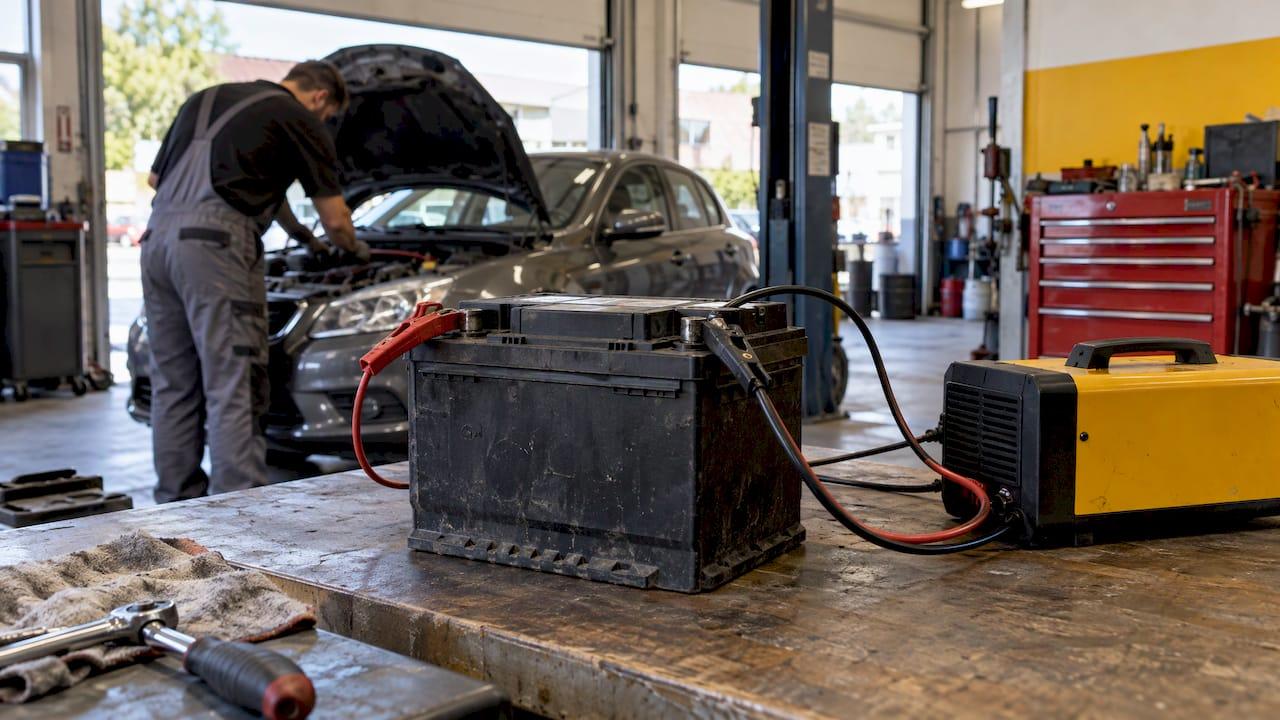
Desulfation means dissolving lead sulfate crystals that have built up on the plates of a lead-acid battery, so the plates can store and deliver energy again. It works best on early, soft sulfation: a battery that has sat partly discharged for a few weeks. It works poorly on hard, old crystals. The reliable approach is to prevent sulfation with correct, complete charging, and to test a weak battery before you spend hours trying to revive it. If the test says the battery is finished, a replacement is the fast fix.
This guide is for car, motorcycle, caravan, UPS, mobility scooter and garden-tool owners who have a lead-acid battery that no longer holds a charge. We explain what sulfation is, what happens during desulfation, what a charger can realistically do, and where to stop.
TL;DR
- Sulfation is normal: every discharge forms lead sulfate. It becomes a problem when the battery stays discharged and the sulfate hardens into crystals that block the plates.
- Desulfation tries to turn that sulfate back into active material and electrolyte. Success depends on how long and how deep the battery was discharged.
- Slow, complete charging is the core of any recovery attempt. Deeply discharged batteries need at least 24 hours, ideally 48 hours.
- Charging voltage must match the battery type. Too low causes permanent sulfation, too high causes gassing and wear.
- A load test or battery check tells you whether recovery is worth trying. A battery that fails it is a candidate for replacement.
Table of Contents
- What sulfation actually is
- Soft sulfate versus hard sulfate
- What desulfation methods do
- A sensible recovery routine for a sulfated battery
- How to tell if the battery is beyond recovery
- Preventing sulfation in the first place
- Testing before you decide
- Our view on desulfation
- When you want it handled for you
- Matching the replacement to the job
- FAQ
- Sources
What sulfation actually is
Every time a lead-acid battery delivers current, both plates turn into lead sulfate. That is the chemistry of discharge, not a defect. When you recharge, the sulfate converts back into lead and lead dioxide, and the sulfate returns to the electrolyte (the acid that fills the battery).
Trouble starts when the battery is left discharged. A U.S. Department of Energy-hosted technical review of lead-acid and lead-carbon batteries describes the harmful form as large-grained lead sulfate that becomes electrically disconnected from the electrode. Once it is disconnected, it blocks the reaction and reduces the capacity the battery can deliver.
In practice you notice it like this:
- A car battery cranks slowly even after a long drive.
- A UPS or alarm battery runs for minutes instead of hours.
- A charger says "full" quickly, but the battery drops fast under load.
- A battery that sat in a garage all winter will not take a charge at all.
Why batteries get sulfated
The usual causes are ordinary habits:
- Short trips. The alternator never fully recharges the starter battery.
- Long standing. A motorcycle, boat, caravan or lawn tractor sits for months without a maintainer.
- Undercharging. The ZVEI, the German electrical industry association, states in its 2024 leaflet on starter batteries in the vehicle system that too low a charging voltage leads to undercharge and permanent sulfation.
- Deep discharge and leaving it. Leaving the lights on, or a standby battery that runs flat during a power cut and is not recharged promptly.
Heat and age speed all of this up, which is why an old battery in a warm engine bay sulfates more readily than a young one in a cool cellar.
Soft sulfate versus hard sulfate
The distinction decides whether desulfation is worth trying.
Soft, early sulfation. Fine crystals formed during a few weeks of low charge. A long, patient, correct charge can convert much of this back. Many batteries in this state recover most of their usable capacity.

Hard, old sulfation. Crystals that have grown for months or years. They conduct poorly and dissolve slowly or not at all. Even if the battery accepts charge afterwards, the capacity may stay well below what it was.
There is a second issue that makes hard sulfate confusing. Because it raises the battery's internal resistance, the terminal voltage can climb quickly during charging. A charger that watches voltage may then decide the battery is full and cut the current early, when the plates are not actually charged. This is why a sulfated battery can show "charged" and still fail under load.
What desulfation methods do
There are three approaches you will come across.
1. Slow, controlled charging
This is the foundation, and the only method with clear guidance from battery industry bodies. The ZVEI's leaflet on charging starter batteries says that charging a deeply discharged battery takes at least 24 hours and ideally 48 hours. It also warns that very long storage can cause severe sulfation, after which a battery may not be readily chargeable.
So a recovery charge is measured in days, not the hour a quick charger takes for a top-up.
2. Charger desulfation or reconditioning modes
Many modern chargers and maintainers include a program with a name such as desulfation, recondition or repair. These typically run a modified charging profile for a set time, then hand over to normal charging. What they can do is limited by the state of your battery: they are most useful on a battery that is simply deeply discharged, and least useful on one with years of hard crystals or physical damage.
If you use one, check three things in the manual: the battery chemistry it supports (lead-acid flooded, AGM or gel), the capacity range, and whether the mode is meant for a battery that is installed or removed. Our guides to battery maintainers by battery type and to AGM chargers available in Germany explain how to match a charger to your battery.
3. Pulse and high-frequency desulfators
These small devices clip onto the battery and send short pulses, with the idea of breaking up crystals. They are widely sold and widely discussed. Their results vary with the battery's condition, and it is sensible to treat them as an add-on to correct charging, not a replacement for it. If a battery is physically worn out, with shed plate material or internal shorts, no electrical method restores it.
A sensible recovery routine for a sulfated battery
This is for lead-acid batteries only (starter, AGM, gel, sealed VRLA or flooded). Lithium packs, including LiFePO4, do not sulfate and need a different charger.
- Identify the battery. Read the label: flooded, AGM or gel, nominal voltage and capacity. This sets the correct charging profile.
- Inspect it. Look for a swollen case, cracks, leaks or white and blue crust around the terminals. A damaged battery is for replacement and safe disposal, not recharging.
- Measure it at rest. After several hours of no load or charge, check the voltage with a multimeter. A rested battery that sits far below its normal full-charge voltage has been deeply discharged and may be sulfated.
- Charge slowly with the right profile. Use a charger designed for your battery type and capacity, and let it run. Expect 24 to 48 hours for a deeply discharged battery, as the ZVEI guidance describes.
- Let it rest, then test under load. Voltage alone proves little. A load test shows whether the battery can deliver current, which is the real measure of recovery.
- Decide. If the battery holds voltage under load and delivers close to its rated duration, put it back in service on a maintainer. If it collapses quickly, further attempts rarely pay off.
Safety while you charge
Charging a lead-acid battery involves two separate hazards. The first is the electrolyte: the ZVEI notes that these batteries contain corrosive sulfuric acid and calls for careful adherence to the instructions of the battery, charger and vehicle. Wear eye protection and gloves when handling a flooded battery.
The second is gas. Batteries can release an explosive gas mixture while charging, so charge in a ventilated space and keep sparks, flames and cigarettes away. Connect and disconnect the charger with it switched off. The same ZVEI leaflet says not to open the plugs of starter batteries during charging.
Charging voltage deserves the same respect. The 2024 ZVEI leaflet explains that too high a voltage increases gassing, the risk of acid leaks, water consumption and wear. It also says the best voltage depends on the construction of the battery, the temperature and the load profile, so follow the battery manufacturer's and charger manufacturer's instructions rather than a universal number from a forum.

How to tell if the battery is beyond recovery
Signs that desulfation will not help:
- The battery gets hot while charging but its voltage barely rises, or the voltage shoots up immediately and drops as soon as you apply a load.
- After a full 48-hour charge and a rest, a load test still shows a rapid voltage collapse.
- One cell of a flooded battery is visibly different from the others, or the battery smells of sulfur.
- The case is bulging, cracked or leaking.
- It is several years old and has been repeatedly flat.
In those cases the plates have lost active material or a cell has failed, which is different from sulfate on the surface. The effective choice is a replacement. Choosing the right type matters as much as choosing the right size: our guide to sealed versus flooded lead-acid batteries explains which one fits your use, and the guide to the best deep cycle battery covers AGM, gel and LiFePO4 for repeated discharge.
Preventing sulfation in the first place
Prevention costs less than recovery. The habits that matter:
- Charge after every deep discharge, quickly. The longer a battery sits flat, the harder the sulfate becomes.
- Use a maintainer on anything that sits. Motorcycles, classic cars, caravans, boats, mowers and standby batteries benefit from a maintainer that keeps them topped up without overcharging.
- Match charger and battery. An AGM battery and a flooded battery want different profiles.
- Keep it cool and clean. Heat accelerates self-discharge and ageing.
- Test once a year. A quick check before the season starts catches a weak battery while it is still recoverable.
Testing before you decide
The most useful step in the whole process is the one most people skip: finding out the actual condition of the battery. Voltage at the terminals can look fine on a battery that has lost half its capacity. A proper test measures what the battery can deliver, and that tells you whether to recover it or replace it.
For home use, a battery tester is a sensible purchase if you own several lead-acid batteries. You can browse battery and accumulator testers at AkkuPlus, including the Ansmann energy-check LCD and the H-Tronic AL 600 plus, which is listed as a charging, diagnosis and test device.
Our view on desulfation
Most of the sulfated batteries people ask about were not defective when they were new. They were left flat, or charged with the wrong profile, and the crystals did the rest. That is why we put charging and testing ahead of any gadget.
Our advice is a simple order of operations. Identify the battery type, charge it slowly with a suitable charger for as long as the ZVEI guidance suggests, then test it under load. If it recovers, protect it with a maintainer. If it does not, replace it with the right lead-acid type for the job, so you do not repeat the problem.
We sell batteries, chargers and power supplies, and we also offer battery tests and repairs for batteries that are worth saving. A battery check first saves you days of charging a pack that cannot come back.
Waldemar Pelich
When you want it handled for you
If you would rather not spend two days charging and guessing, AkkuPlus offers battery tests and checks (Akkutests & -prüfungen) and battery repair (Akkureparatur), including cell replacement for special batteries. If the answer is a new battery, our battery range covers lead-acid types for household, automotive and electronic uses, and the power supply category has chargers and related equipment. Prices are shown on the individual product pages.
For an overview of all our services, start on the AkkuPlus homepage.
Matching the replacement to the job
If desulfation fails, buying the same battery again and treating it the same way will give you the same result. A few pointers that reduce the risk of a repeat:
- Standby and alarm use: sealed AGM batteries such as the Multipower MP62-12C or the Long WP65-12 are sold in the capacities typical for backup systems.
- UPS units: replacement packs exist for specific models, for example the pack for APC RBC6 and the replacement battery for APC RBC23.
- Small devices: compact 12 V lead-acid batteries such as the Long WP3.3-12 suit lights, toys and small equipment.
- Frequent deep discharge: if the battery is regularly drained, consider a design made for cycling, or look at LiFePO4 in our LiFePO4 guide, which does not suffer from sulfation.
Whatever you choose, put it on a suitable maintainer from the start. That single habit does more against sulfation than any recovery method.
FAQ
What does it mean when a battery is sulfated?
It means lead sulfate has built up on the plates and is no longer converting back during charging. The sulfate blocks the reaction and reduces the capacity the battery can supply. Early sulfation is often reversible, long-standing sulfation much less so.
Can a sulfated battery be recharged?
Often yes, but slowly. The ZVEI says a deeply discharged battery needs at least 24 hours of charging, ideally 48. After very long storage, severe sulfation can leave a battery not readily chargeable, and then a replacement is the practical answer.
Will a battery charger desulfate a battery?
A charger with a desulfation or reconditioning mode can help a deeply discharged battery in the early stage. Use it only with the battery type and capacity range the manual names, and finish with a load test to see what you gained.
How long does desulfation take?
Plan on days, not hours. A recovery charge on a deeply discharged battery runs 24 to 48 hours according to the ZVEI, and a battery that responds slowly may need further charge and rest cycles before you can judge the result.
Does a lithium battery sulfate?
No. Sulfation is specific to lead-acid chemistry. Lithium and LiFePO4 batteries age in other ways and need a charger made for lithium, so never use a lead-acid desulfation mode on them.
Sources
- Lead-Acid Batteries and Advanced Lead-Carbon Batteries (OSTI, U.S. Department of Energy)
- ZVEI: Laden von Starterbatterien (2016)
- ZVEI: Blei-Starterbatterien im System (2024)
Recommended
- Sealed vs Flooded Battery: Which Lead-Acid Type Fits Your Use
- Best UPS Batteries: Lead-Acid vs. Lithium and What to Buy
- Best AGM Chargers in Germany: Picks and How to Choose
This article was created with the assistance of Artificial Intelligence (AI) and has been reviewed by our editorial team. Despite careful preparation, we assume no liability for the completeness, accuracy, or timeliness of the information provided. The technical data and specifications supplied by the respective manufacturer shall always prevail.