
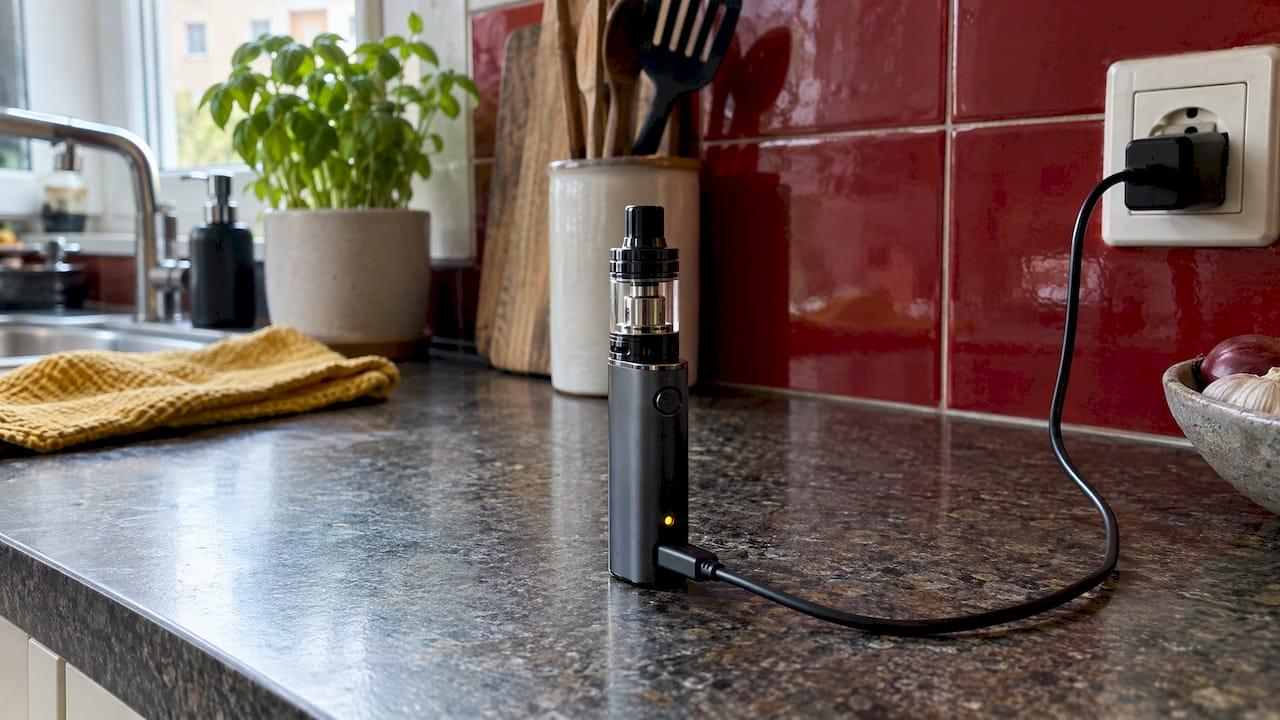
A vape battery is a lithium-ion cell, and it stays safe when you control four things: the charger, the charging spot, the temperature and the condition of the cell. Most incidents trace back to one of these. This guide covers each in practical terms, plus the warning signs, the emergency steps and the disposal rules that apply in Germany. If you use a device with removable cells, we also show where matched single cells and a battery check help, because at AkkuPlus we sell single cells, chargers and battery tests.
TL;DR
- Charge only with the charger and cable made for the device, on a non-combustible surface, never while you sleep and ideally near a smoke detector.
- Store batteries at roughly 10 to 25 °C, away from sun, cars and damp, and never loose in a pocket with coins or keys.
- Stop using a battery that swells, deforms, smells chemical, hisses, smokes or gets unusually hot.
- Never put vapes or batteries in household waste. Since 1 January 2026, retailers that sell e-cigarettes must take old devices back free of charge.
- If something starts to burn and you are in doubt, call the fire service on 112.
Table of Contents
- Why a vape battery can overheat or catch fire
- Charging: the routine that prevents most incidents
- Removable cells: extra care with loose batteries
- Storage and carrying
- Warning signs: when to stop using a battery
- If a vape battery starts to burn
- Disposal in Germany: what changed in 2026
- Where AkkuPlus fits in
- Our view
- FAQ
- Sources
Why a vape battery can overheat or catch fire
A vape runs on a small lithium-ion cell. Inside, an energy-dense chemistry sits in a thin casing. If the cell is damaged, overheated or short-circuited, it can enter what engineers call thermal runaway: a self-accelerating chain reaction. NDR describes it as a short circuit or overheating that makes the cell heat up to more than 600 degrees while releasing toxic gases. The UK Health and Safety Executive measured typical surface temperatures of 700 °C during thermal runaway in its vape battery tests. It also reports that cells can rupture and eject hot contents, and that the metal housings of vapes can turn into high-energy fragments.
What triggers it? German safety bodies list the same handful of causes:
- Mechanical damage. Drops, impacts and crushing. The Umweltbundesamt (the German Federal Environment Agency) warns that mechanical damage, heat or improper storage of lithium batteries can cause internal and external short circuits.
- Metal contact. If loose metal bridges the two poles of a cell, a short circuit can lead to fire or explosion, according to the same agency.
- Wrong charging. The DGUV, the German statutory accident insurance body, names charging a cell that is too cold or too warm, overcharging, poor heat dissipation and unsuitable chargers. A wrong charger can disable the battery management system.
- Deep discharge and heat. Letting a cell run completely flat, or leaving it in hot sun, pushes it toward a critical state.
One risk you cannot see: the HSE notes that manufacturing can leave tiny impurities inside a cell that only cause an internal short circuit after some use. That is why cell quality and a clean, undamaged cell matter, and why a cell that has been fine for months still deserves a look from time to time.
Charging: the routine that prevents most incidents
Charging is where the energy goes in, so this is where most of the discipline pays off. The recommendations from the Umweltbundesamt, the DGUV and the Berlin fire service agree closely. Here they are as a routine.
1. Use the right charger and cable
Use the charger and cable the manufacturer provides or approves. The DGUV explains that a charger's charging curve must match the battery; an unsuitable charger can push a lithium-ion cell into a critical state or start a fire. The FDA gives the same advice for vapes specifically: use only batteries recommended by the manufacturer, and do not mix brands, charge levels, or old and new batteries.
This is the step where a mismatch hides in plain sight. A cable that fits the port is not necessarily a cable that suits the cell. If you charge removable cells in an external charger, choose one made for that cell type. Our Stromversorgung category covers chargers and power supplies.
2. Pick the spot
Charge on a hard, non-combustible surface such as a tile, a stone slab or a metal tray. The SWR consumer reporting advises keeping distance from paper, curtains and furniture, and not charging on a sofa, bed or carpet, nor in hallways or escape routes. The Berlin fire service adds a smoke detector in the room and no combustible materials nearby.
3. Watch the temperature
NDR recommends charging at about 10 to 30 degrees. The DGUV and the Unfallkasse Hessen say not to charge below 0 °C, and to let a cold battery warm to room temperature before it goes on the charger. Do not cover a device while it charges, because heat needs to escape.
4. Stay present
Charge only when you are at home, and not while you sleep. The Berlin fire service sees the biggest everyday risk in the combination of unattended charging, for example overnight, and flammable material close by. A phone-style habit of plugging in at bedtime is the one to break.
5. Do not overcharge or drain to zero
The Umweltbundesamt advises recharging early rather than running a cell flat, and charging only to about 90 percent of the maximum charge where you can. Deep discharge matters most for stored cells: NDR points out that a cell that has gone too empty carries a higher fire risk when charged again.
Removable cells: extra care with loose batteries
Some mods take external cells that you handle directly. That is where the short-circuit risk is greatest, because a bare cell in a pocket can touch coins, keys or a lighter. Three habits cover it:
- Carry cells in a case that keeps them apart, never loose.
- Inspect the wrapping. The Berlin fire service says not to use defective, damaged, deformed or swollen cells.
- Keep to one matched set. Do not mix brands, ages or charge levels in one device, as the FDA advises.
The Berlin fire service also advises against building your own battery packs and leaving that to professionals. If you have a pack that needs new cells, our workshop offers Akkureparatur with cell replacement, so the assembly is in experienced hands. For checking a cell you already own, we stock battery test devices.
Storage and carrying
Heat and damp are the enemies. The Umweltbundesamt recommends storing batteries at best between 10 and 25 °C and avoiding anything above +50 °C or below minus 20 °C. Do not keep them outdoors, in damp rooms or anywhere very hot, and do not put them in the refrigerator, since condensation can form. The FDA specifically warns against leaving a vape in direct sun or in a car in heat or frost.
For longer breaks, such as a month away from your device, the storage charge matters:
| Source | Recommended storage charge | Temperature range |
|---|---|---|
| Umweltbundesamt | about 40 to 50 percent | best 10 to 25 °C |
| DGUV Information 205-041 | 40 to 60 percent | cool (0 to 45 °C), frost-free, dry |
Check the charge now and then during long storage and top it up so it never sinks into deep discharge. If you want to understand why partial charge levels age a cell more gently, our guide on charge cycles and battery care explains full cycles, partial cycles and how to estimate them.
Two more rules from the FDA: keep the device on a clean, flat, visible surface when charging, and do not vape near flammable gases or liquids such as oxygen, propane or gasoline.
Warning signs: when to stop using a battery
The SWR says to take a cell out of service at once if it swells, deforms, becomes unusually hot, smells chemical, hisses or smokes. NDR adds quieter signs: noticeably shorter runtime, faster discharge, overheating, a bulging case or leaking liquid.
What to do depends on the sign:
- Hot, smoking or hissing: stop charging, keep your distance and, if there is smoke or strong heat, call 112.
- Swollen, deformed or leaking but calm: take the cell out of the device if you can do so safely, tape over the poles and put it in a non-combustible container. The Umweltbundesamt suggests a screw-top glass jar for transport to a collection point.
- Shorter runtime only: a cell that has lost capacity is aging. Retire it before it becomes a swollen one.
Do not keep charging a battery that has given you a warning sign, even if it seems to work again.
If a vape battery starts to burn
Put your own safety first. Fire from a lithium cell throws off toxic gases, so do not lean over it. NDR advises that a small fire can be fought with plenty of water or an extinguisher, and that you should disconnect the device from the mains if that is possible. When in doubt, call the fire service straight away on 112.
The German fire-service guideline for lithium cells (vfdb MB 10/17) names water as the primary extinguishing agent, because it extinguishes the fire and cools the cell to stop further decomposition. The same guideline warns about possible hydrofluoric acid during lithium cell fires, so keep away from the fumes. If you suspect skin contact with it, see a doctor.
A cell can reignite after it looks out. NDR therefore suggests placing it afterwards in a container with plenty of water, ideally outdoors, or alternatively in a container of sand, until it can be handed in.

Disposal in Germany: what changed in 2026
Vapes are electrical waste, not household waste. Disposable vapes are the biggest problem: the Cologne waste company AWB calls them a particular problem case because they contain tiny batteries, are widespread and are often not returned correctly. They end up in compactors, where damage can start a fire.
The revised Electrical and Electronic Equipment Act (ElektroG) came into force largely on 1 January 2026. It added definitions for e-cigarettes and heated tobacco devices, and retailers that stock them, or have stocked them in the past six months, must take back old devices free of charge at the point of sale or very close by.
Practical steps:
- Tape over the poles of loose cells before you hand them in, as the SWR advises.
- Hand them in at a retailer collection box, a recycling center or a municipal collection point. KSD Dorsten, for example, says batteries can be returned free of charge at any shop that sells them.
- Check your local rules. The Ennepe-Ruhr district announced in 2026 that mobile hazardous-waste collections no longer accept batteries, mainly because of fire risk, and that damaged lithium cells are accepted only by appointment at its stationary centers.
- Until handover, keep a defective cell cool and dry, with poles taped, alone in a non-combustible container such as a metal bucket or a box of sand.
The stakes are real: an industry survey by the waste association BDE found that 78 percent of the disposal companies asked had already experienced a fire caused by wrongly disposed lithium batteries or devices containing them.
Where AkkuPlus fits in
If your device takes removable cells, the cell and the charger are the two parts you control. We sell single cells, battery packs, chargers and power supplies, and we run battery tests and repairs, including cell replacement. Browse the range on our shop and pick a cell and charger that suit each other.
For a battery you are unsure about, our Akkutests & -prüfungen service is the place to start.
Our view
Most battery trouble we see discussed comes down to a mismatch: a cell paired with the wrong charger, a pack left in a hot place, or a worn cell kept in use for one more month. None of that needs special equipment to prevent. It needs a matched charger, a sensible place to charge and the habit of retiring a cell when it shows signs of age.
That is why we sell batteries, chargers and test equipment together, and why we offer repairs with cell replacement as well. A battery is a system of cell, charger and use, and the safest results come when those three are chosen as a set.
Our advice for vape users with removable cells: keep a labeled, matched set, record when you bought it, and replace cells that lose capacity rather than stretching them. When you are ready to replace, look at our single cells and chargers.
Waldemar Pelich
FAQ
Is it safe to charge a vape overnight?
No. The Umweltbundesamt and the Berlin fire service both advise against charging while you sleep. Charge when you are awake and at home, on a non-combustible surface, with a smoke detector in the room.
Can I leave my vape in the car?
It is better not to. The FDA advises avoiding extreme temperatures, naming sun and a car in heat or frost. The Umweltbundesamt recommends storing batteries at about 10 to 25 °C and avoiding anything above +50 °C.
Can I put an old disposable vape in the household trash?
No. Vapes and batteries never belong in residual waste because they can start fires in collection trucks and sorting plants. Since 1 January 2026, retailers that sell e-cigarettes must take old devices back free of charge, and municipal collection points accept them too.
What should I do with a swollen vape battery?
Stop using and charging it, remove it from the device if that is safe, tape over the poles and keep it alone in a non-combustible container. Take it to a collection point. Where your local center requires an appointment for damaged lithium cells, as in the Ennepe-Ruhr district, register first.
What is the safest temperature for charging?
NDR names 10 to 30 degrees as a good range. The DGUV and the Unfallkasse Hessen say not to charge below 0 °C and to let a cold battery warm to room temperature before charging.
Sources
- Umweltbundesamt: proper handling of lithium batteries
- HSE: Testing of Vape Batteries
- DGUV: battery article on fire causes
- DGUV Information 205-041
- NDR: storing batteries correctly and preventing fires
- SWR: using lithium-ion batteries safely
- Berlin fire service: lithium-ion batteries
- FDA: tips to avoid vape battery fires or explosions
- vfdb MB 10/17: fire service guideline for lithium cells
- Ressource Deutschland: ElektroG amendment
- Rundschau: Cologne AWB on disposable vapes
- Dorsten Live: KSD Dorsten warning
- Ennepe-Ruhr district: battery collection
Recommended
- NiMH vs Lithium Ion in Germany: Check Voltage Before a Pack Repair
- Best Universal Battery Charger: What to Buy in Germany (2026)
This article was created with the assistance of Artificial Intelligence (AI) and has been reviewed by our editorial team. Despite careful preparation, we assume no liability for the completeness, accuracy, or timeliness of the information provided. The technical data and specifications supplied by the respective manufacturer shall always prevail.