
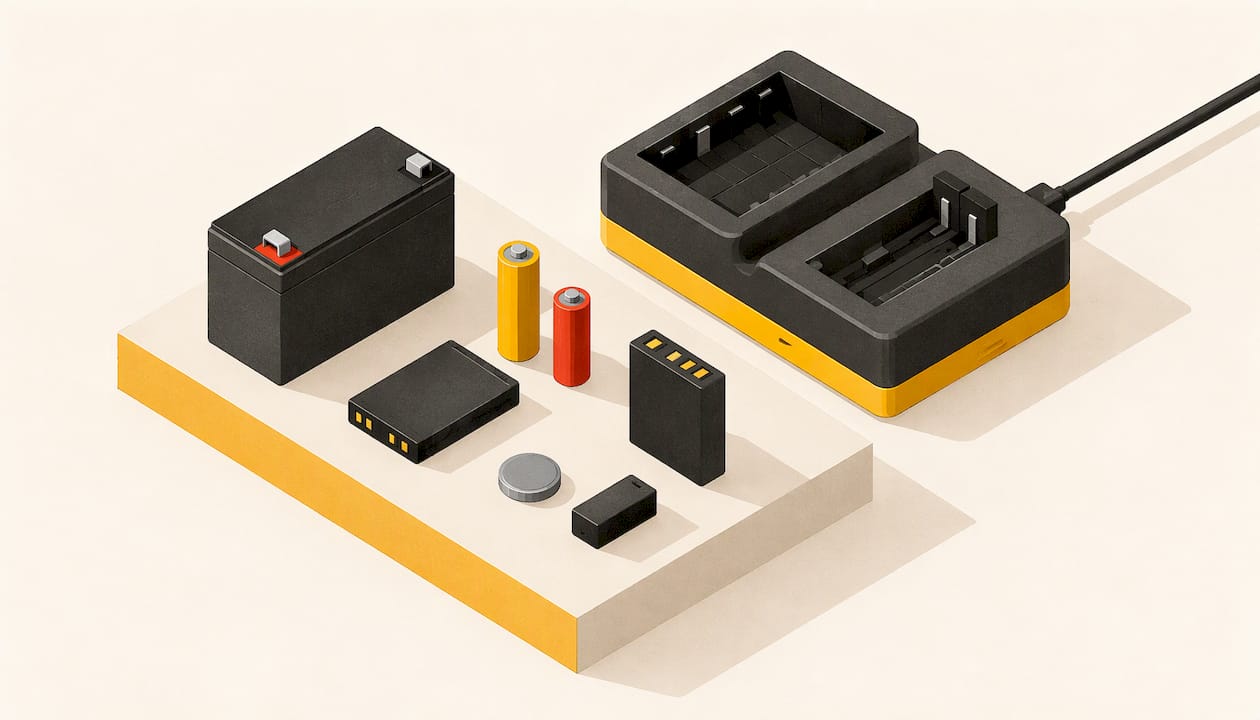
For most households in Germany, the best universal battery charger is a multi-slot, microprocessor-controlled model that charges each slot on its own. CHIP's current test names the Voltcraft IPC-3 the winner, with a Very Good (1.1) rating and prices of €47 to €55. If you only ever charge NiMH AA and AAA cells, a VARTA or Panasonic eneloop charger does the job for less. If you also run C, D or 9V cells, or want one unit to cover Li-Ion as well, the choice narrows quickly. This guide shows how.
TL;DR
- "Universal" never means every battery. Check the chemistry (NiMH, NiCd, Li-Ion) and the size (AA, AAA, C, D, 9V, 18650) before you compare anything else.
- Individual-slot charging and adjustable current are the features that separate a good charger from a basic one.
- Our pick for the widest coverage in CHIP's test is the Voltcraft IPC-3 (NiCd, NiMH and Li-Ion). For C, D and 9V NiMH-type rechargeables, the VARTA LCD Universal Charger+ is the most versatile model in VARTA's LCD range.
- For AA and AAA only, the Panasonic eneloop BQ-CC55 and VARTA's LCD Ultra Fast Charger+ are the simpler, quicker choices.
- Never put non-rechargeable cells into a charger, and stop using any cell that gets hot or swells.
Table of Contents
- What "universal" really covers
- How to choose a charger for your cells
- Comparison of the main options in Germany
- The picks, one by one
- Features that matter more than the headline speed
- Safe use of a universal charger
- Where AkkuPlus fits
- When a charger will not fix the problem
- Our perspective
- FAQ
- Sources
What "universal" really covers
A universal charger takes more than one cell size, and the better ones also take more than one chemistry. CHIP's 2026 charger test found that the chargers it compared support rechargeable NiMH, NiCd and/or Li-Ion cells, and that supported sizes vary by model: AA, AAA, C, 18650 and 9V all appear.
That variation is the whole point of this article. A charger that handles AA and AAA NiMH is "universal" in a retailer's category tree. It is not universal if your bike light uses 18650 cells or your wireless doorbell uses a 9V block.
Three questions settle most buying decisions:
- Which chemistry do your cells use? NiMH and NiCd cells are charged differently from Li-Ion cells. A charger must be designed for the chemistry you put in it.
- Which sizes do you need? Count AA and AAA first, then C, D, 9V and 18650.
- How many cells at once? Four slots suit most households. Eight suit photographers, gamers and anyone with a drawer full of remotes.
How to choose a charger for your cells
Start from the devices, not the charger. Make a short list of what you power and note the cell type printed on each battery.
Mostly AA and AAA NiMH. This is the typical household: remotes, wireless keyboards, toys, flashlights. You do not need a Li-Ion-capable charger. You need reliable per-cell monitoring and a sensible charging time.
AA, AAA plus C, D or 9V. Baby swings, large flashlights, smoke detectors and some musical gear use bigger cells. Here you want a charger that lists those sizes explicitly.
18650 and other Li-Ion cells. Power tools, e-bikes, vape-free torch builds and DIY power banks use Li-Ion cells. You need a charger that identifies Li-Ion cells and charges them with a constant-current, constant-voltage profile. A NiMH charger must never be used for them.
A mix of everything. Pick a multi-chemistry charger with independent slots, so a Li-Ion cell and a NiMH cell can sit side by side without affecting each other.
If you are unsure which cell your device uses, the markings on the cell itself and the device manual tell you. For vehicle, e-scooter or sealed-pack batteries, a standard cell charger is the wrong tool altogether, because those packs need a charger matched to the pack.
Comparison of the main options in Germany
The table collects the models that CHIP, the manufacturers and the expert reviews cover. Prices are CHIP's published ranges as of its update on 9 November 2026. Where the table shows a dash, no price was published in the sources we used, so check current retailer listings.
| Model | Cells supported | Slots | Standout feature | Price (CHIP) |
|---|---|---|---|---|
| Voltcraft IPC-3 | NiCd, NiMH, Li-Ion | Multiple, individually adjustable | Test winner, adjustable charge and discharge currents | €47 to €55 |
| VARTA LCD Universal Charger+ (57688) | AA, AAA, C, D, 9V, plus USB devices | Up to 4 | Widest size range in VARTA's LCD range | n/a |
| VARTA Universal Charger (57658) | AA, AAA, C, D (2 or 4), 9V (1) | 2 or 4 | USB-C input, USB-C cable included | n/a |
| VARTA LCD Multi Charger+ (57681) | AA, AAA (NiMH) | 8 | Highest slot count in the range | n/a |
| VARTA LCD Ultra Fast Charger+ | AA, AAA (NiMH only) | 4 | Four cells in 44 minutes in CHIP's test | €45 to €49 |
| Panasonic eneloop pro BQ-CC55 | AA, AAA (eneloop and eneloop pro NiMH) | 4 | Individual slot monitoring | n/a |
In CHIP's test, charging four batteries took anywhere from 44 to 269 minutes. A faster charger is convenient, but speed is not the first thing to optimize, as the next sections explain.
The picks, one by one
Voltcraft IPC-3: the widest coverage
The Voltcraft IPC-3 won CHIP's test with a Very Good (1.1) rating. It supports NiCd, NiMH and Li-Ion cells, and its charging and discharging currents can be adjusted individually. Listed prices run from €47 to €55.
This is the charger for a mixed collection. If your cells include 18650 Li-Ion cells for a torch and NiMH AAs for the family remotes, it is the only model in the table that covers both without a second purchase. Adjustable current per slot is also useful when you have a small low-capacity cell next to a large one, because each can get a current that suits it.
VARTA LCD Universal Charger+: for C, D and 9V
VARTA's LCD Universal Charger+ (Type 57688) charges up to four AA, AAA, C or D batteries, or one 9V battery, and can also charge USB devices. Its 4-hour charging time is based on four AA cells of 1600 mAh. The output is 450 mA for AA, C and D, 200 mA for AAA, 34 mA for 9V and 2400 mA over USB.

It has an LCD, Minus Delta V and timer switch-off, protection against wrong polarity and short circuits, and detection of alkaline and defective cells. Input is USB-C PD 12V/1.25A (15 W), and the power adapter is not included, so budget for that if you do not already own a suitable one. It measures 137 x 169 x 52 mm and weighs 304 g.
VARTA's own product comparison describes it as the only model in the LCD Charger+ range that supports C, D and 9V as well as AA and AAA. That makes it the natural choice when you have larger cells in the house.
VARTA Universal Charger (57658): the simple one
The VARTA Universal Charger (Type 57658) charges two or four AA, AAA, C or D batteries, or one 9V battery. It has a USB-C input, green LEDs, an included USB-C cable and a full set of safety features. Without a display it is less informative than the LCD models, but the setup is as plain as it gets.
VARTA LCD Multi Charger+: eight slots
The LCD Multi Charger+ (Type 57681) is a NiMH charger with eight independent slots for one to eight AA or AAA batteries. Four AA cells at 1600 mAh take about four hours, with charging currents of 450 mA for AA and 200 mA for AAA. It measures 116 x 146 x 32 mm and weighs 293 g. If you need to refill a lot of AA and AAA cells at once, this is the model to look at, but it does not take C, D or 9V cells.
VARTA LCD Ultra Fast Charger+: when time matters
CHIP reports that the Varta LCD Ultra Fast Charger+ charged four batteries in 44 minutes, the fastest time in its comparison. It supports only NiMH AA and AAA cells and is listed for €45 to €49. Choose it if you charge AA and AAA only and often need cells ready quickly.
Panasonic eneloop pro BQ-CC55: careful AA and AAA charging
Panasonic's BQ-CC55 is a four-slot wall-plug charger for one to four eneloop or eneloop pro AA or AAA cells. Its individual slot monitoring and Smart Charging detect when each cell is full and stop the current to that cell. Panasonic gives about 1.5 hours for one or two eneloop AA cells and about 3 hours for three or four. For eneloop pro AA cells, the figures are about 2 hours and about 4 hours. It takes 100 to 240 V input, measures 68 x 120 x 28 mm and weighs 120 g with the A-plug.
Expert Reviews also notes that the BQ-CC55 checks and charges each cell individually, while the HiQuick SW-8N has independent slots for different sizes and capacities.
Features that matter more than the headline speed
Individual slot charging. CHIP recommends charging each slot individually and adjusting the current per slot. Cells in a household are rarely identical in age or capacity. A charger that treats each slot separately will not keep pushing current into a full cell while a weaker one catches up.
Overcharge and heat protection. Expert Reviews advises choosing chargers with features that prevent overcharging and overheating and that slow charging to a trickle as cells approach full. Look for wrong-polarity and short-circuit protection too, as listed on the VARTA specifications above.
A display. CHIP notes that a display showing current and voltage is useful, and that USB inputs add flexibility. With a USB-C input you can run the charger from a power bank or a laptop adapter instead of a dedicated brick.
Capacity testing or conditioning. A charger or tester that can measure capacity tells you which cells are worn out. Expert Reviews says a capacity test can help assess how healthy a battery is. Cells that fall far short of their rated capacity are candidates for replacement.
Correct input power. Some models, like VARTA's LCD range, do not include a power adapter. Check the box contents before you order.
Safe use of a universal charger
- Charge only rechargeable cells in a charger. Alkaline cells are not meant to be recharged, which is why VARTA lists alkaline detection among its safety features.
- Match the chemistry. Put Li-Ion cells only in a charger that explicitly supports Li-Ion, and NiMH only in a charger that supports NiMH.
- Insert cells with the polarity the slot shows, even if the charger offers reverse-polarity protection.
- Charge on a hard, non-flammable surface and not under a pillow or on a sofa, and do not leave a charger running unsupervised if a cell feels unusually hot.
- Stop using any cell that swells, leaks or deforms, and take it to a battery collection point at a retailer or recycling center. Do not throw it into household waste.
Where AkkuPlus fits
A charger is only half the picture. The other half is the cells, and whether they are still healthy enough to be worth charging.
At AkkuPlus you can find single cells in the Akkus (Einzelzellen) category, including Li-Ion cells such as the Samsung ICR18650-26F, and household and device batteries in Batterien. For power supplies and chargers, browse Stromversorgung. If you want to know whether a cell is still good, our battery testers and analyzers are the place to start.
If you want a broader view, our guides on the best battery chargers for car, smart and AA/AAA use and the best AA battery charger in Germany go deeper on those use cases. If you are weighing chemistries for a bigger project, see our LiFePO4 battery guide.
When a charger will not fix the problem
Sometimes the issue is not the charger but the pack. E-scooters, cordless tools, vacuum cleaners and e-bikes use sealed packs whose cells wear out. In that case, we offer battery repair, cell replacement, battery testing and testing services, as well as EEPROM programming, custom pack assembly and retrofits. Our service range is on the AkkuPlus home page.
Tell us what the pack is for and which device it powers, and we will point you to the right category, test or repair option. Prices for repairs are not published on the site, so request them for your specific pack.
Our perspective
A universal charger solves one problem: filling cells that are still healthy. In our experience, the questions we hear most are not about speed. They are "which cell is in my device?" and "is my old cell still any good?"
That is why we think of a charger as part of a small system. You pick cells that match the device, you charge them with a charger that matches their chemistry, and you test them now and then so that a worn cell does not quietly ruin the whole set.
This is how we run AkkuPlus. We resell batteries, single cells, packs, power supplies and lighting, and we also test, repair and rebuild packs. If a pack is past saving, we can often replace the cells instead of sending you off to buy a whole new device. If you are building something yourself, such as a Li-Ion pack from 18650 cells, we can help you choose cells and assemble the pack.
Our advice: buy the charger that covers all of your cells, not just the ones you own today, and keep it for years.
Waldemar Pelich
FAQ
Can one universal charger charge every type of battery?
No. Universal chargers cover several sizes and sometimes several chemistries, but each model lists what it supports. CHIP's test found that supported cells vary between NiMH, NiCd and Li-Ion and between sizes such as AA, AAA, C, 18650 and 9V. Match the model's list to your cells before buying.
Is a faster charger better?
Not automatically. Speed matters if you need cells quickly, and CHIP measured 44 to 269 minutes for four batteries. But individual slot monitoring, protection against overcharging and the right chemistry support matter more for how long your cells last.
Can I charge alkaline batteries in a universal charger?
No. Alkaline cells are not designed to be recharged. Some chargers, such as VARTA's LCD models, detect alkaline cells and refuse to charge them, which is a safety feature. Use rechargeable NiMH, NiCd or Li-Ion cells as the charger specifies.
What do I need to charge 18650 cells?
You need a charger that explicitly supports Li-Ion and 18650 cells. In CHIP's test, the Voltcraft IPC-3 supports Li-Ion along with NiMH and NiCd. Do not use a NiMH-only charger for 18650 cells.
How do I know if an old rechargeable cell is worn out?
A capacity test shows how much charge a cell still holds compared with its rating. A big shortfall means the cell is worn. For sealed packs in tools or scooters, a professional test or cell replacement is the safer route.
Sources
- Akku-Ladegeräte im Test 2026, CHIP
- Best battery charger: Recharge your AA, AAA and 9V, Expert Reviews
- LCD Universal Charger+, VARTA AG
- Product Comparison LCD Charger+, VARTA AG
- Gesamtkatalog 2024/25, VARTA AG
- LCD Multi Charger+, VARTA AG
- BQ-CC55, Panasonic Energy
Recommended
- Best AA Battery Charger in Germany: 2026 Comparison
- Best Battery Chargers 2026: Car, Smart and AA/AAA Picks
- Best AGM Chargers in Germany: Picks and How to Choose
- Best Trickle Charger: Smart Maintainers Compared for Germany
This article was created with the assistance of Artificial Intelligence (AI) and has been reviewed by our editorial team. Despite careful preparation, we assume no liability for the completeness, accuracy, or timeliness of the information provided. The technical data and specifications supplied by the respective manufacturer shall always prevail.