
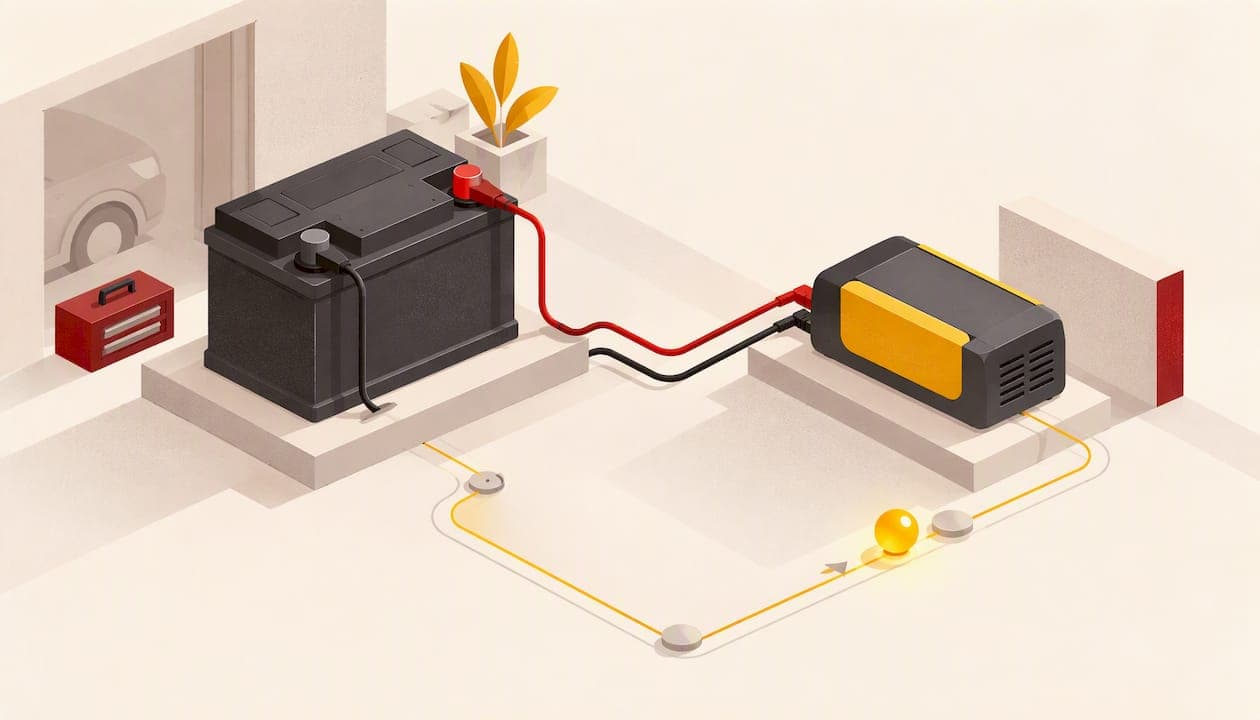
The best trickle charger today is rarely a true trickle charger. It is a fully automatic smart maintainer that checks the battery voltage, charges in stages and drops to a gentle float mode once the battery is full. For most cars and motorcycles in Germany, that means a 0.8 to 5 A unit from a proven range such as CTEK or NOCO, matched to your battery's capacity and chemistry. Below we compare the main options, explain how to choose, and cover what motorcycle owners should check before they plug in.
TL;DR
- Buy an automatic, multi-stage maintainer, not a fixed-current trickle charger, if the charger will stay connected for weeks.
- Match the charger to your battery: capacity in Ah first, then chemistry (lead-acid, AGM, gel, lithium), then extras.
- Small motorcycle batteries need a low-current automatic charger. High-amp workshop chargers can damage them.
- A 1 A unit suits small batteries, 3.8 to 5 A suits most cars and bikes, and 10 A suits large or mixed fleets.
- Connect to the vehicle's designated ground point where there is one, in a dry, ventilated place.
Table of Contents
- Trickle charger or smart maintainer: what is the difference?
- The best trickle chargers compared
- How to choose: four checks in order
- Best trickle charger for a motorcycle
- Storing a car, classic or camper for months
- Our view: buy for the battery, not for the amps
- Where to buy and what we can do for you
- Common mistakes to avoid
- FAQ
- Sources
Trickle charger or smart maintainer: what is the difference?
A classic trickle charger pushes a small, fixed current into the battery all the time. A smart maintainer watches the voltage, charges in several stages, switches to maintenance and resumes only when the voltage drops. RAC explains it this way: trickle chargers top up at roughly the rate of self-discharge, while smart chargers monitor the battery and adjust the rate to help prevent overcharging.
That difference decides the whole buying question. A fixed-current device left on for months can overcharge a battery. An automatic unit is built to stay connected. When shops and reviews say "trickle charger" today, they almost always mean the second kind, and so does this article.
The ADAC makes the same point for home garages. It describes the ideal charger as a universal, fully automatic model with protection against sparks, short circuits and reverse polarity, plus temperature compensation for winter charging. Treat those four features as the entry ticket. Anything without them is not a candidate.
The best trickle chargers compared
We looked at the models that keep coming up in tests and buyer discussions and that you can realistically buy in Germany: the CTEK MXS 3.8, and the NOCO GENIUS1, GENIUS5 and GENIUS10. We list no prices for the third-party models, because street prices in Germany move often and the only official figure we found for the GENIUS5 is a US dollar price that does not apply here. Check the current price in the shop before you decide.
| Model | Current | Battery size | Chemistry | Best for |
|---|---|---|---|---|
| CTEK MXS 3.8 | Up to 3.8 A | See product page | 12 V lead-acid | Cars and motorcycles you use or store through the year |
| NOCO GENIUS1 | 1 A | Up to 30 Ah | Lead-acid and lithium-ion | Small bikes, scooters, garden tractors, lawn mowers |
| NOCO GENIUS5 | 5 A | Up to 120 Ah | Lead-acid and lithium-ion | Cars, larger bikes, boats |
| NOCO GENIUS10 | 10 A | Up to 230 Ah | Lead-acid and lithium | Vans, caravans, several vehicles, big batteries |
CTEK MXS 3.8: the all-rounder we stock
The CTEK MXS 3.8 is the charger we would put in most garages. It is a fully automatic unit built for connecting and leaving. It covers the typical range of a compact car, a motorcycle or a classic that sits through winter, and it is a sensible single purchase for a household with two or three vehicles. If you own a 12 V lead-acid or AGM starter battery and want one charger that does the job without drama, this is the one to start with. Capacity range, modes and supported battery types are on the product page, so check them against your battery label before you order.
NOCO GENIUS1: small and light
The GENIUS1 is a 1 A, 6 V and 12 V unit. NOCO's datasheet states charging capacity up to 30 Ah, input of 100 to 240 VAC, a maximum power of 15 W, an operating range of -20 to +40 °C and a weight of 0.35 kg. Its approximate charging times from 50% discharge show the trade-off of low current: about 15 hours for a 20 Ah battery, 30 hours for 40 Ah and 75 hours for 100 Ah. It is a maintainer first. Use it for small motorcycle, scooter and garden-machine batteries, or to hold a healthy car battery over winter. Do not buy it to revive a flat 80 Ah car battery quickly.

NOCO GENIUS5: the middle of the range
NOCO describes the GENIUS5 as a 5 A charger, maintainer and desulfator for flooded, gel, maintenance-free, AGM and lithium-ion batteries, with charging capacity up to 120 Ah, thermal compensation and a three-year limited warranty. That range covers nearly every passenger car and every motorcycle. If your garage holds both a car and a big tourer, this is the flexible option, and it also charges a flat battery in a reasonable time.
NOCO GENIUS10: for large batteries and lithium
The GENIUS10 is a 6 V and 12 V, 10 A unit for batteries up to 230 Ah, according to NOCO's support table. Its approximate times from 50% discharge are 3 hours for 40 Ah and 6 hours for 80 Ah. The German-market version is described by a reviewer at elektronik-zeit.de as a 9-stage charger with support for lead-acid and LiFePO4 and IP65 protection. A separate comparison of the CTEK MXS 10, NOCO GENIUS10 and AEG LT 20 found that the NOCO was the one with a dedicated lithium mode. It is overkill for a single small bike, but it makes sense for vans, campers, boats or a LiFePO4 conversion. If lithium is your plan, read our guide to the best LiFePO4 batteries first.
How to choose: four checks in order
1. Battery capacity in Ah
The label on your battery gives the capacity. Pick a charger whose stated range includes it, and avoid the extremes. A 1 A unit on a 100 Ah battery will take days. The ADAC notes that charge time depends on capacity and the charger's maximum current: an empty 100 Ah battery brought to 80 percent with a 7 A charger can take up to eleven hours. Do the same arithmetic for your own battery before buying.
More current is not automatically better either. BLUETTI's guide says to choose charging current by battery capacity, the manufacturer's recommended and maximum current, and the time you are willing to wait.
2. Battery chemistry
Standard flooded, AGM, gel, EFB and lithium batteries want different charge curves. Gel batteries in particular are sensitive to overvoltage, and BLUETTI warns that an incompatible charger can permanently damage them. If you have AGM, our guide to AGM chargers in Germany goes deeper. If your battery is lithium, the charger must say so explicitly; a lead-acid-only unit is the wrong tool.
3. Safety features
Look for spark protection, reverse-polarity protection, short-circuit protection and temperature compensation, the same list the ADAC gives. Add an ingress rating if the charger will live in a damp garage, shed or boat house.
4. Connection type
WELT's comparison suggests that cigarette-lighter plugs are the easiest to handle while ring terminals are the safer permanent connection. For a vehicle that sits for months, a ring-terminal lead fixed to the battery, with the plug routed to a spot you can reach, is the tidy solution.

Best trickle charger for a motorcycle
Motorcycle batteries are small, often 6 to 14 Ah, and that changes the rules. The ADAC recommends an automatic charger with control electronics that adapts to battery size and state of charge, and it advises against high-amp car or hardware-store chargers because they can damage small motorcycle batteries.
If you do use a non-automatic charger, the same ADAC page says the maximum charging current must not exceed one tenth of the battery capacity, you must calculate the charging time, watch the battery and disconnect it from the mains once it starts to gas. For a 10 Ah battery that is 1 A. That is one more reason to choose an automatic model.
What to check before you buy:
- Capacity range. A 1 A to 3.8 A automatic unit covers most bikes. The GENIUS1 and the CTEK MXS 3.8 both sit in that territory.
- Battery type. Many modern bikes use AGM or lithium. Check the battery label, then the charger's list.
- Connector. Most maintainers come with a ring-terminal lead and a quick-connect plug. A permanent lead on the battery makes winter hooking up a ten-second job.
- Vehicle electronics. Some bikes have a CAN-bus system or a diagnostic socket that can be used for charging. A deeply discharged battery may not charge through the socket. The manufacturer's instructions always come first, and RAC also advises checking the charger against the battery maker's compatibility instructions.
On timing, the ADAC says that with a break of around three months the battery should be fully charged at least once in between. For longer periods, a special motorcycle charger should be connected permanently.
Storing a car, classic or camper for months
For long-term storage, WELT recommends an automatic charger that switches to maintenance mode when the battery is full. That is the single most important feature here. A few practical points from our workshop view:
- Charge the battery fully before the first long stand-still. A maintainer is built to hold a full battery, and it is slow at rescuing a deeply flat one.
- Leave the charger connected to the mains only in a dry, ventilated space. RAC says charging should only happen in dry, well-ventilated places because lead-acid batteries can give off gas.
- On a modern car, clamp the negative lead to the designated ground point rather than the negative terminal. The ADAC says this reduces the risk of sparks and avoids sensor damage or implausible readings in the battery management system.
- Once every few weeks, look at the battery and the leads. Automatic does not mean invisible.
If the battery is already old, weak or does not hold a charge, a maintainer will not fix it. Our test of car battery chargers and our overview of car battery brands help you decide whether to charge, test or replace.
Our view: buy for the battery, not for the amps
We sell batteries, chargers and test equipment, and we repair and rebuild battery packs. The most common mistake we see is people buying a charger by the number on the box, not by the battery in front of them. A powerful charger feels like the safe choice. In practice it is the one most likely to harm a small battery, and the one least suited to staying plugged in.
Our advice is simple. Start from the battery label: capacity, voltage and chemistry. Pick the smallest automatic charger that comfortably covers that range. Keep one that you can leave connected, and treat a quick high-current charger as a separate tool for emergencies. If you have several vehicles with different batteries, one mid-range unit such as the CTEK MXS 3.8 is often better than three cheap fixed-current devices.
If you are unsure whether the battery is healthy enough to maintain at all, have it tested before you buy a charger. Maintaining a dead cell costs time and does not bring it back.
— Waldemar Pelich
Where to buy and what we can do for you
At AkkuPlus you can find the CTEK MXS 3.8 maintainer, plus starter batteries, power supplies and battery testers in our Stromversorgung and Akku- & Batterietestgeräte ranges. We ship within Germany and to neighbouring countries, with prices and availability shown for your country.
And if the problem is not the charger but the pack itself, such as an e-scooter battery, a tool pack or an equipment battery that no longer holds charge, our repair and cell replacement service can often give it a new life. Our guide to e-scooter battery replacement lists the checks to make before you pay for a new battery.
Common mistakes to avoid
- Using a big workshop charger on a motorcycle battery. The ADAC specifically warns against it.
- Leaving a non-automatic charger on for weeks. Only a unit that switches to maintenance mode is meant for that.
- Ignoring chemistry. Gel and lithium need a compatible mode. See our guide to other battery chargers if you also charge AA, AAA or 9 V cells.
- Connecting in a closed, damp space. Ventilation and dryness matter.
- Skipping the manual. Modern vehicles have charging rules of their own, and the manufacturer's word wins.
FAQ
Can I leave a trickle charger on all the time?
Yes, if it is a fully automatic smart maintainer, because it monitors the voltage and switches to float mode when the battery is full. A classic fixed-current trickle charger can overcharge a battery that stays connected, so do not leave one on unattended. Whatever type you own, check the battery and leads from time to time.
What size trickle charger do I need for a motorcycle?
For most motorcycles a low-current automatic charger in the 1 to 4 A range is right. The ADAC advises against high-amp car chargers for small motorcycle batteries. For a non-automatic charger, the maximum current should not exceed one tenth of the battery capacity in Ah.
Is a 1 A or a 5 A charger better for a car?
A 5 A unit is more practical for a car battery, because a 1 A unit takes many hours or days to charge a large battery. NOCO lists about 15 hours for a 20 Ah battery on its 1 A model and 75 hours for 100 Ah, from 50% discharge. A 1 A unit is fine for holding a full battery over winter.
Can a trickle charger charge a lithium battery?
Only if the charger explicitly supports lithium or LiFePO4. Some models do, and some well-known lead-acid chargers do not. Check the product description for your exact battery chemistry before connecting.
Where do I connect the charger on a modern car?
Use the vehicle's designated ground point rather than the battery's negative terminal where the manufacturer provides one. The ADAC says this reduces sparking risk and protects sensors. If the car has special charging rules, follow the handbook.
Sources
- ADAC: Autobatterie laden
- ADAC: Motorrad-Batterie überwintern
- RAC Drive: Car battery conditioners and trickle chargers
- WELT: Erhaltungsladegerät Test und Vergleich
- NOCO GENIUS1 data sheet
- NOCO GENIUS5
- NOCO GENIUS2X2 support table
- elektronik-zeit.de: NOCO GENIUS 10 EU
- elektronik-zeit.de: CTEK MXS 10 vs. NOCO GENIUS10 vs. AEG LT 20
- BLUETTI: Portable 12V battery charger guide
Recommended
- Best AGM Chargers in Germany: Picks and How to Choose
- Best Battery Chargers 2026: Car, Smart and AA/AAA Picks
- Best Car Battery Brands in Germany: Varta, Bosch, Exide and More
- Best Jump Starter in Germany: What Tests Say in 2026
This article was created with the assistance of Artificial Intelligence (AI) and has been reviewed by our editorial team. Despite careful preparation, we assume no liability for the completeness, accuracy, or timeliness of the information provided. The technical data and specifications supplied by the respective manufacturer shall always prevail.