
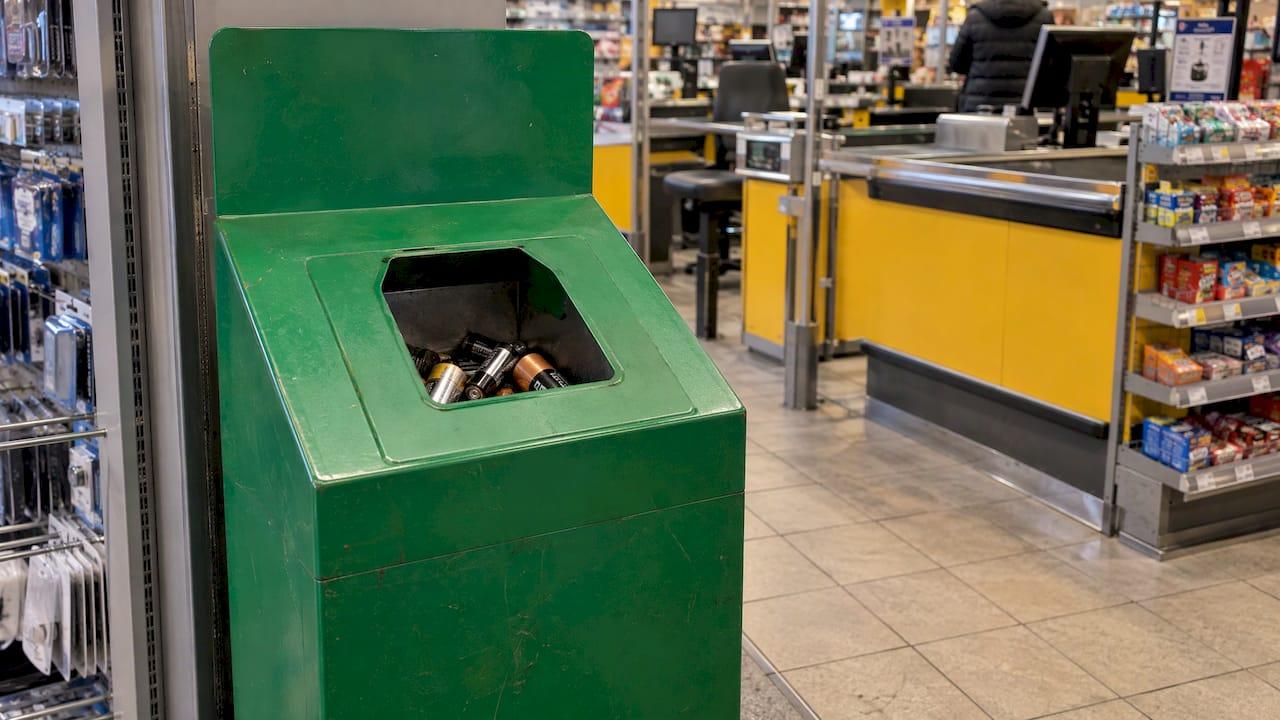
In Germany, you return used batteries free of charge to a shop that sells them or to your municipal recycling yard, and you never put them in household waste. Taping the terminals of lithium cells and sorting out damaged batteries first keeps the trip safe. If a pack is only worn out, not defective, replacing its cells can give it another working life before it needs to be recycled at all.
TL;DR
- Batteries and rechargeable batteries must never go into household waste, the yellow bag or scrap metal. Return them to retail collection boxes or municipal collection points, free of charge.
- Since 1 January 2026, e-bike and e-scooter batteries can also be handed in at municipal recycling yards.
- Tape the terminals of lithium batteries. Take swollen, cracked or hot batteries out of use and get them to proper disposal quickly.
- New car batteries carry a €7.50 deposit under the German battery law. Online sellers may refund it against proof of return.
- A pack with a worn-out cell is not always a waste case: cell replacement can extend its life.
Table of Contents
- What the law requires of you
- Where to return which battery
- Prepare batteries before you carry them
- Damaged lithium batteries need extra care
- Before recycling: does the pack really have to go?
- What happens after you hand a battery in
- What changed in 2025 and what applies now
- Replacing, then returning
- Our view
- FAQ
- Sources
What the law requires of you
The Umweltbundesamt (UBA), Germany's federal environment agency, is clear: batteries and rechargeable batteries do not belong in household waste, bulky waste, the packaging bin, metal scrap or the environment. Consumers are obliged to return them via collection boxes in shops or other take-back points, and this costs nothing.
There is a common misconception about labels. Batteries marked "0% Hg, 0% Cd" are not pollutant-free. According to the Verbraucherzentrale, the consumer advice organization, they can still contain substances such as potassium lye or sulfuric acid. So every empty battery goes back, whatever the printing says.
Why the effort? Separate collection keeps pollutants out of the environment and lets recyclers recover zinc, iron, aluminium, nickel, copper, silver, manganese, lithium and cobalt, as the UBA explains.
Where to return which battery
Germany has two parallel routes: retail take-back and municipal collection. Which fits depends on the battery.
| Battery type | Where to return it |
|---|---|
| AA/AAA, button cells, rechargeable cells | Collection box in any shop that sells batteries; recycling yard; hazardous-waste mobile |
| Small devices with built-in batteries (watches, small electronics) | Municipal WEEE collection points or retailers |
| Power tool and laptop packs | Retail take-back or recycling yard |
| E-bike and e-scooter batteries | Municipal recycling yards (since 1 January 2026), retailers of such batteries |
| Car batteries | Recycling yard, auto recycler, workshop, or the seller when you buy a new one |
Retail collection boxes
The UBA states that retailers must take back device batteries free of charge, regardless of chemistry, brand, origin, size or condition. The Verbraucherzentrale adds a detail that matters in practice: you do not have to buy new batteries to hand in old ones. A shop only has to accept the types it carries or has carried, so a drugstore will not take your car battery. Look for the green collection boxes near the checkout.
Municipal collection
The Federal Ministry for the Environment (BMUKN) lists recycling yards and hazardous-waste mobiles as free return points, and notes that from 1 January 2026 e-bike and e-scooter batteries can also go to municipal recycling yards. Rules differ in detail by city. The city of Mainz, for example, says small lithium-ion batteries such as those from smartphones are accepted at all its recycling centres. Large lithium-ion packs from e-bikes and e-scooters go to specific disposal centres, with taped terminals. Check your own district's waste authority for the nearest point and opening hours.
Car batteries are different
The waste authority of Kreis Steinburg explains that car batteries are not part of the hazardous-waste collection. They are accepted at recycling yards, auto recyclers and workshops, and new car batteries come with a deposit. More on that below.
Prepare batteries before you carry them
Most battery fires in the waste chain start with a short circuit. A few minutes at home reduces that risk.
- Tape the terminals. The Verbraucherzentrale advises taping the contacts of lithium batteries, both during storage and before disposal. Clear adhesive tape over the poles is enough for button cells and small packs. Larger packs get their connectors covered too.
- Keep them dry and cool. Store used batteries away from heat and water until your trip.
- Collect by type. One small container for household cells, a separate one for lithium packs, makes the trip quick.
- Don't stack loose cells in a metal tin. Loose cells touching each other or metal objects can short-circuit. Tape or bag them individually.
For storage in general, the German statutory accident insurance (DGUV) recommends keeping lithium-ion batteries at 40 to 60 percent state of charge, cool (0 to 45 °C), frost-free and dry. Indoors, it suggests a 2.5 m clearance from other goods or fire-rated storage. If you are unsure how your cells differ, our guide to LiPo versus Li-ion safety and storage covers the practical differences.
Damaged lithium batteries need extra care
The Bavarian environment ministry lists the warning signs of a damaged lithium battery:
- a deformed, cracked, dented or bulging casing
- warmth while not in use or charging
- a white crust from leakage
- a new battery that does not work
Such a battery must no longer be used and has to reach proper disposal as soon as possible. The ministry stresses that lithium batteries are safe with correct handling, but their high energy density makes a damaged one dangerous in the home, in collection vehicles, at waste yards and in recycling plants. The UBA reports that fires at waste-treatment and recycling plants caused by lithium batteries have increased sharply in recent years.
For a damaged battery, store it separately, away from anything flammable, and do not charge it. The DGUV recommends acid-resistant containment for damaged lithium-ion batteries. Contact your municipal waste authority or hazardous-waste collection before you transport it, and tell them it is damaged. Transporting lithium-ion batteries falls under dangerous-goods law for private senders as well as commercial ones, according to the DGUV. For batteries sent by commercial take-back schemes, the GRS (the joint battery take-back foundation) sets out that damaged or defective lithium batteries over 500 g need dedicated safety packaging, not ordinary yellow or green collection containers. Do not improvise: ask first.
Before recycling: does the pack really have to go?
Recycling is the right end for a battery that is finished. But many packs fail because of one or two tired cells while the casing, electronics and connectors are fine. That is the case for cordless tool packs, e-scooter packs, mobility scooter batteries and older cordless vacuum cleaner packs.
At AkkuPlus we offer battery repair, including cell replacement and refurbishment, as well as battery tests and checks, e-scooter repair and retrofit. A test tells you whether the cells or the electronics are the problem before you decide. Examples of what we repair are the 24 V Ni-Cd/Ni-MH pack conversion, the EMB-300 Pro mobility scooter battery and an 18 V lithium car phone pack.
If you are weighing chemistries for a rebuilt pack, read our note on NiMH versus lithium-ion and why voltage matters first. For a vacuum cleaner in particular, see the cordless vacuum battery replacement options.
A repaired pack postpones disposal. It does not replace it: the old cells that come out still have to be returned through the channels above, taped and sorted.
What happens after you hand a battery in
The journey of a collected battery is more technical than most people imagine. A GIZ report describes the typical sequence for large packs: central collection, transport under special safety precautions, sorting by cell chemistry, format and application, and dismantling. Cells are then crushed under protective gas or thermally decomposed, and the raw materials are recovered by hydrometallurgical or pyrometallurgical processes.

The WWF Battery Report 2026 adds detail for lithium-ion cells. Pre-treatment sites shred cells and separate "black mass", a powder of anode and cathode materials containing graphite, lithium compounds, cobalt, nickel and manganese, from iron, copper, aluminium and plastics. A second stage, either pyrometallurgy (smelting) or hydrometallurgy (chemical leaching), follows. Smelting mainly yields copper and a nickel-cobalt alloy, while hydrometallurgy can also recover graphite and lithium directly.
The practical lesson for you: the better sorted and undamaged the batteries arrive, the safer and more efficient every later step is.
What changed in 2025 and what applies now
German battery rules were rewritten recently. According to the BMUKN, the EU Battery Regulation (EU) 2023/1542 has largely applied in member states since 18 August 2025. Germany's new Battery Implementation Act (BattDG) replaced the old Batteries Act (BattG) and makes producers responsible for batteries across their entire life cycle. For you as a consumer, the core rule did not change: return waste batteries free of charge to retailers or other collection points.
What does change over time is the collection target. Germany keeps its 50% collection rate for portable batteries until the end of 2026, then applies 63% from 2027 and 73% from 2030. Taylor Wessing's analysis notes that the 50% target is deliberately above the EU minimum, because Germany's take-back system is established. Every battery that ends up in a household bin is a miss against those numbers.
The UBA also points to stricter substance limits under the EU regulation: mercury is banned, device batteries may contain at most 0.002 weight percent cadmium, and since 18 August 2024 lead in device batteries may not exceed 0.01 percent, with an exception for zinc-air button cells.

The €7.50 car battery deposit
Starter batteries (SLI batteries) carry a deposit of €7.50 including VAT. The BMUKN confirms that it is retained under the new law. The text of the draft law provides that the taking-back party must confirm the return in writing or electronically on request. Online sellers may refund the deposit against proof of return that is no more than two weeks old. Batteries already installed in a vehicle are exempt. In practice: keep the receipt, get the confirmation when you hand the old battery in, and do it promptly. If you are choosing a replacement, our comparisons of car battery brands in Germany and Varta versus Bosch help with the decision.
Replacing, then returning
The cleanest routine is a closed loop: buy the replacement, hand the old battery in, repeat when needed. Our shop covers batteries, single cells, battery packs and power supplies for household, workshop, lighting and hobby use. If your old pack still has life in it, our repair team can test it and rebuild it. Start at akkuplus.de and choose Akkureparatur or Akkutests & -prüfungen.

Prices for repairs are not published on the site, so describe your battery when you ask.
Our view
We think about batteries in two stages: use them as long as sensibly possible, then return them properly. Both stages matter.
A great many packs reach the recycling box with healthy housings, sound electronics and only a few weak cells. Cell replacement, refurbishment and testing exist for exactly this situation. A test shows whether the cells or the electronics are the problem, and rebuilding the pack with new cells can bring a tool, scooter or mobility aid back into service.
When a battery really is finished, the German system is generous and simple: free return, collection boxes at the shop, recycling yards in every district. Our advice is to tape the terminals, keep lithium packs dry and cool, and never gamble with a swollen or hot battery.
If you are unsure whether your pack is repairable or ready for recycling, ask us before you throw anything away.
Waldemar Pelich
FAQ
Can I return batteries without buying anything?
Yes. According to the Verbraucherzentrale, button cells, rechargeable batteries and alkaline-manganese batteries of all brands can be returned free in shops without buying new ones. The shop has to take back only the types it sells or has sold. Municipal recycling yards accept them as well.
Can I throw a nearly empty battery in the household bin?
No. The UBA states that batteries and rechargeable batteries must never go into household waste, regardless of charge level. Separate collection prevents fires and pollution and allows valuable metals to be recovered.
Where do I take an old e-bike or e-scooter battery?
Since 1 January 2026, municipal recycling yards accept these batteries, according to the BMUKN. Tape the terminals and ask your local waste authority about the nearest accepting yard, as large packs are sometimes limited to certain sites. If the battery is damaged or swollen, tell the staff before you arrive.
How do I get my car battery deposit back?
The deposit on a new starter battery is €7.50 including VAT. Hand the old battery in and ask for confirmation of the return. Online sellers may refund the deposit against proof that is no more than two weeks old, per the draft law text published in the EU notification system.
My battery has swollen. What now?
Stop using and charging it. The Bavarian environment ministry says such batteries must go to proper disposal as quickly as possible. Keep it separate, dry and away from flammable items, and call your waste authority or hazardous-waste collection for the safe way to deliver it.
Sources
- BMUKN: Altbatterien
- BMUKN: Batteries Act
- Umweltbundesamt: Batterien und Akkus richtig nutzen und fachgerecht entsorgen
- Verbraucherzentrale: Rückgabepflicht für Batterien und Akkus
- Kreis Steinburg: Batterien
- City of Mainz: Proper disposal of batteries
- Abfallratgeber Bayern: Lithium-Batterien entsorgen
- DGUV Information 205-041
- GRS safety standard
- GIZ: Recycling Ecosystem of Electric Vehicle Batteries
- WWF Battery Report 2026
- Taylor Wessing: German Batteries Implementation Act
- EU TRIS notification: draft German battery law
Recommended
- Cordless Vacuum Battery Replacement: Your Options in Germany
- NiMH vs Lithium Ion in Germany: Check Voltage Before a Pack Repair
- Battery Repair – Cell Replacement – Conversion – Mercedes-Benz / Ragazzi
This article was created with the assistance of Artificial Intelligence (AI) and has been reviewed by our editorial team. Despite careful preparation, we assume no liability for the completeness, accuracy, or timeliness of the information provided. The technical data and specifications supplied by the respective manufacturer shall always prevail.