
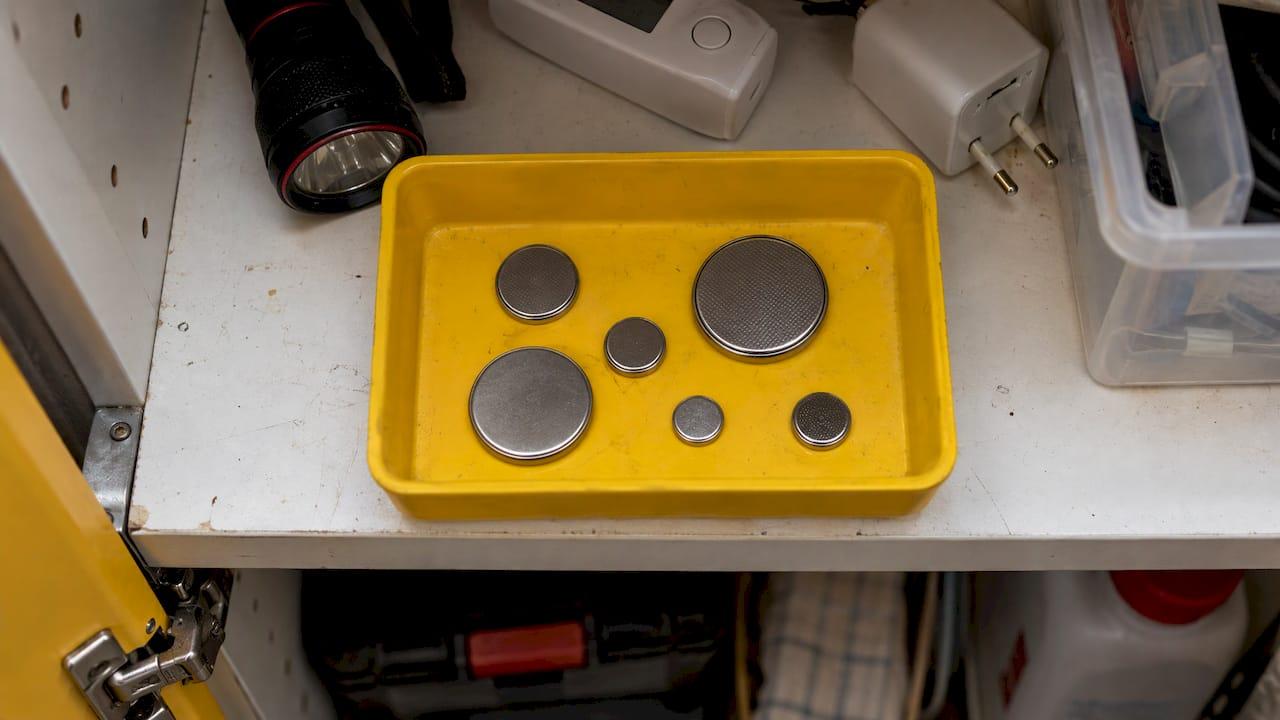
The size of a coin cell is written on the battery itself. In a code like CR2032, the letters give the chemistry and shape, the first two digits give the diameter in millimeters, and the last two give the height in tenths of a millimeter. CR2032 therefore means a round lithium cell, 20 mm wide and 3.2 mm high. Read that code, match it exactly to your device, and you will buy the right cell the first time. This guide shows how, lists the common sizes, explains which watch battery names are the same cell, and covers the safety rules that matter in a household with children. If you want to browse matching cells, our battery category is the place to start.
TL;DR
- Decode the number: CR2032 = lithium, round, 20 mm diameter, 3.2 mm height. CR2025 is just as wide but only 2.5 mm high, and CR2016 only 1.6 mm.
- Same diameter does not mean interchangeable. Thickness, voltage and contact fit decide whether a substitute works, and the safe rule is to use the size named in the device manual.
- Watch batteries often have several names for one cell (for example SR44, 303, 357 and V303). Match them through the IEC designation, not the brand label.
- When choosing a CR2032, compare capacity, shelf life and operating temperature on the datasheet, not just the brand.
- Coin cells are dangerous if swallowed. Keep new and used cells away from children and dispose of used ones at a collection point.
Table of Contents
- What the Code on a Coin Cell Means
- Common Lithium Coin Cell Sizes at a Glance
- Can a CR2032 Replace a CR2025?
- Similar Codes, Different Chemistry
- Button Cell Equivalents and Watch Battery Types
- How to Choose a Good CR2032
- Buying Coin Cells: A Short Checklist
- Our Perspective
- Where to Find the Right Cell
- Safety: Keep Coin Cells Away From Children
- FAQ
- Sources
What the Code on a Coin Cell Means
Coin cells, also called button cells, are small single-cell batteries shaped like a squat cylinder. They typically measure 5 to 25 mm across, according to a general reference on button cells from an electronics distributor. Their markings follow the international IEC code, which has two letters followed by three or four numbers:
- First letter: chemistry. C stands for lithium manganese dioxide, for example. Silver oxide cells start with S and alkaline cells with L.
- Second letter: shape. R means round, F flat, S square and P other.
- The digits: size. With four digits, the first two are the diameter in millimeters and the last two the height in tenths of a millimeter. With three digits, the first two are the diameter and the last one is the height in tenths of a millimeter.
That gives you a quick mental check. A CR1025 is 10 mm wide and 2.5 mm high. A CR2450 is 24.5 mm wide and 5.0 mm high. A CR2032 is 20 mm by 3.2 mm. A German buying guide confirms this reading for the CR2032 and notes that the CR2025 is equally wide but only 2.5 mm high, while the CR2016 is only 1.6 mm high.
Why does the system exist at all? Standard markings let you identify a cell's type and dimensions at a glance and find the correct replacement, as TME's technical library explains. The confusion comes from commercial names. Manufacturers use their own naming systems, so physically identical cells such as LR44, AG13, A76 and 357 appear under different labels.

Common Lithium Coin Cell Sizes at a Glance
The CR series is the one you meet most often in key fobs, remote controls, kitchen scales, motherboards and fitness trackers. All CR cells are 3 V lithium cells. Capacities below come from Renata's published comparison chart (2013 edition); they are typical values, and every manufacturer's datasheet differs slightly.
| Code | Diameter | Height | Typical capacity (Renata) |
|---|---|---|---|
| CR1025 | 10 mm | 2.5 mm | not listed in the chart |
| CR2016 | 20 mm | 1.6 mm | 90 mAh |
| CR2025 | 20 mm | 2.5 mm | 165 mAh |
| CR2032 | 20 mm | 3.2 mm | 225 mAh |
| CR2430 | 24 mm | 3.0 mm | 285 mAh |
| CR2450N | 24.5 mm | 5.0 mm | 540 mAh |
| CR2477N | 24.5 mm | 7.7 mm | 950 mAh |
Dimensions follow from the code. The pattern is clear: with the same diameter, a taller cell holds more energy. That is why the CR2032 outlasts the CR2025 in the same device, if the device has room for it.
Smaller cells follow the same logic. If your device takes a tiny cell for a memory backup or a small sensor, check the code against listed products such as the BECOCELL CR 1025, the Energizer CR1216 or the Panasonic CR1632, which has a listed capacity of 140 mAh.
Can a CR2032 Replace a CR2025?
This is the question people ask most, and the honest answer is: only if the manual says so. Both cells are 20 mm wide and 3 V, but the CR2032 is 3.2 mm thick against 2.5 mm for the CR2025. One key fob guide reports that a thicker cell fits some fobs, while in others the housing will not close fully and the tray contacts can crack.
Panasonic's consumer FAQ goes through the typical mistakes:
- A CR2025 in place of a CR2016 is too thick for the compartment.
- A CR1616 in place of a CR2016 is too small in diameter and makes poor contact.
- Two CR2016 cells in place of one CR2032 double the voltage to 6 V, which exceeds the device specification.
The manufacturer's advice is to always use the size specified in the device manual. ERNST & FRIENDS makes the same point from the supplier side: CR2016, CR2025 and CR2032 share the 20 mm diameter but differ in height (1.6, 2.5 and 3.2 mm), so equal diameter does not make cells interchangeable.
A practical test before you buy: open the compartment, read the code on the old cell, and compare it character by character with the new one. If the old cell is worn and unreadable, check the device manual or the cover of the compartment.
Similar Codes, Different Chemistry
A few lookalike codes cause real mistakes:
- CR2032 vs BR2032. SizeSheet's cross-reference explains that BR2032 uses carbon monofluoride chemistry while CR cells use manganese dioxide, and that BR2032 is a maker designation not listed in IEC 60086-2. Both are 20 mm by 3.2 mm, but check what the device manual asks for.
- CR2032 vs LiR2032. The LiR2032 is a rechargeable 3.7 V cell. The same cross-reference notes that it is not a substitute for the CR2032. Never put a rechargeable cell in a device built for a primary (non-rechargeable) one, and never try to recharge a CR cell.
- Brand equivalents. The same source lists DL2032, ECR2032 and 5004LC as equivalents of the CR2032. They are different labels for the same size and chemistry.
Button Cell Equivalents and Watch Battery Types
Watch cells are the other big family. Most are silver oxide cells running at 1.55 V, and the cheaper alkaline types such as the LR44 run at 1.5 V. Renata's chart lists the LR44 at 110 mAh and the silver oxide SR44SW at 175 mAh, which shows why watches with a tight energy budget usually specify silver oxide. The SR726SW comes in at 32 mAh on the same chart.
The chart also maps the many names for one cell. Three examples from Renata's comparison list:
| Common name | Same cell under other names | IEC designation |
|---|---|---|
| 397 | SR726SW, V397, Duracell D396/397, Timex N, Citizen 280-28, Seiko SB-AL | SR726 (SR59) |
| 303 | SR44SW, V303, Duracell D303/357, Timex A, Citizen 280-08, Seiko SB-A9 | SR1154 (SR44) |
| 362 | SR721SW, V362, Duracell D361/362, Timex S, Citizen 280-29, Seiko SB-AK/DK | SR721 (SR58) |
The lesson: when a shop lists a number you do not recognize, convert it to the IEC designation and compare that. Two labels that map to the same IEC code are the same cell.
377 vs 364
These two are different cells with different IEC designations and different dimensions, so neither is a drop-in for the other. Look up each in a manufacturer chart and match the number printed on your old battery. The same rule holds for any watch cell: find the exact code, not a near neighbor.
Watch battery compatibility in short
As with lithium cells, a watch cell must match in diameter, height and voltage. Silver oxide and alkaline cells of the same size differ in voltage and in how steadily they deliver it, so use the chemistry the watch maker specifies.
How to Choose a Good CR2032
The CR2032 is the most searched size, so it is worth knowing what separates one listing from another. Read the datasheet, not the packaging slogan. Three numbers matter.
Capacity. VARTA's CR2032 data lists 230 mAh as the maximum, while Rayovac's datasheet gives 220 mAh at a 15 kΩ load down to 2.5 V at 20 °C. Capacity depends on the test load and cutoff voltage, so compare only figures measured under the same conditions. Devices that draw little current, such as watches and key fobs, get closest to the rated capacity.

Shelf life. VARTA specifies up to 10 years when the cell is unused and packaged. Rayovac gives a storage loss of under 0.3 % per year at 20 °C. A long shelf life matters if you keep spares in a drawer.
Operating range. VARTA lists −20 to +60 °C. That matters for a tire pressure sensor, a bike computer or a garage remote that sits in the cold.
The other CR2032 specifics are standard: 3 V nominal, lithium manganese dioxide chemistry, non-rechargeable, about 3 to 4 g. Rayovac also lists an internal resistance of max 20 ohms, which is one reason these cells suit low-drain devices rather than high-current ones.
So which is the best CR2032? The one with a datasheet matching your device's drain, fresh stock, and the exact code your device asks for. Buy from a seller who moves stock regularly, so the cell has not sat for years.
Buying Coin Cells: A Short Checklist
- Read the code on the old cell or in the manual.
- Match chemistry letters, diameter and height exactly.
- Check voltage: 3 V for CR cells, 1.55 V for silver oxide, 1.5 V for alkaline.
- Compare capacity and shelf life on the datasheet.
- Buy single-cell blister packs, and keep them in the packaging until use.
- Never solder a standard coin cell. ERNST & FRIENDS advises that fixed installations need cells with solder tags or suitable holders.
Our Perspective
Most wrong coin cell purchases come from one habit: matching by diameter and brand and skipping the last two digits. A 20 mm cell is not automatically the right 20 mm cell. We tell customers to start from the code and the manual, and only then compare capacity.
The same discipline applies beyond coin cells. Batteries, single cells, battery packs and chargers all have a precise spec behind the name, and the spec is what makes a device run reliably. That is why we organize our catalog by type and size, and why we also handle repairs such as cell replacement for packs that are no longer sold as a ready-made part.
If you are not sure which code your device needs, work it out from the manual first. Then pick the cell with the right chemistry, the right height and a datasheet that fits how your device draws power.
Waldemar Pelich
Where to Find the Right Cell
Our shop lists coin cells and many other formats by type. Start in the Batterien category for button cells and household batteries, or look at Akkus (Einzelzellen) and Akku- und Batteriepacks if your device uses rechargeable cells or a pack. Pick the code that matches your manual and order online; we ship within Germany and to neighboring countries.
If the battery in a device is a custom pack rather than a standard coin cell, our repair and cell replacement services are another route than buying a new device.
Safety: Keep Coin Cells Away From Children
This is the part of coin cell advice that matters most. When a coin cell gets stuck in the esophagus, current flows through the moist tissue and produces hydroxide ions, which cause severe chemical burns. Germany's Federal Institute for Risk Assessment (BfR) states in its FAQ on button cells that lithium cells and cells with a diameter of 20 mm or more, which includes the CR2032, are especially dangerous. Hundreds of cases have been reported to the BfR over ten years.
Storage and handling
- Keep all new and used coin cells out of children's reach. The BfR stresses that this includes apparently empty cells.
- In the EU, toys must secure coin cells so that direct access is not possible, for example with a screw-secured compartment (BfR). This rule does not cover remotes or scales, so a German consumer guide suggests taping those compartments shut.
- Do not open, deform, short-circuit, heat or burn cells, and do not use damaged or leaking ones (ERNST & FRIENDS).
- Do not recharge non-rechargeable cells or expose them to water or fire.
If a swallowing is possible
Go to a children's hospital or emergency room immediately, even without symptoms. The BfR advises an immediate X-ray and calling an ambulance so that diagnosis is as fast as possible. After two hours of contact, burns can reach deep tissue, and in rare cases the injury is fatal. Children often show hardly any symptoms at first, and the same guide says even a suspected case, including a cell in the nose or ear, needs immediate care. In Germany, the emergency number is 112.
Disposal
Used batteries do not belong in household waste. Under German battery law you must return them to an official collection point, as a manufacturer manual also states. Retailers that sell batteries take them back as well.
FAQ
What is the typical size of a coin battery?
Coin cells range from about 5 to 25 mm in diameter and 1 to 6 mm in height. The most common household size is the CR2032 at 20 mm by 3.2 mm. The four-digit code gives you the exact dimensions.
What happens if I use a CR2032 instead of a CR2025?
The voltage is the same at 3 V, but the CR2032 is 0.7 mm thicker. In some devices it fits, in others the compartment does not close or the contacts can be damaged. Follow the device manual and buy the size it names.
Are button cell equivalents really the same battery?
Yes, when they map to the same IEC designation. For example, 303, SR44SW and V303 are the same cell under different brand labels. Equal diameter alone is not enough; height, voltage and chemistry must also match.
Can I use a rechargeable cell in place of a CR2032?
No. A rechargeable LiR2032 delivers 3.7 V and is not a substitute for the 3 V CR2032. Use the cell type your device manual specifies.
What should I do if a child swallows a button cell?
Go straight to a children's hospital or emergency room and call an ambulance, as the BfR advises. Do not wait for symptoms. An X-ray shows quickly whether the cell is stuck.
Sources
- Button Batteries, Coin Cell | RS
- Knopfzellen: Welche Batterie für Schlüssel, Uhr und Waage? | handgetestet.de
- Battery cross-reference | SizeSheet
- Miniature energy sources: everything about button batteries | TME
- Renata comparison chart (WBR.Vergleichsliste)
- Mercedes-Benz Key Fob Battery Replacement guide | mr-key.com
- Specialty Batteries FAQ | Panasonic Energy
- Lithium coin cells CR1025 to CR3032 | ERNST & FRIENDS
- CR2032 (6032) Battery | Wentronic, VARTA data
- Rayovac CR2032 datasheet
- Gefährliche Verätzungen im Hals: Fragen und Antworten zu Knopfzellen | BfR
- Knopfzellen: Schwere Gesundheitsschäden bei Kleinkindern | BfR
- HEITECH 04003554 manual | ManualsLib
Recommended
- CR123A vs 18650: Which Battery Fits Your Device?
- maxell - 395 / SR927SW - 1.55 Volt 2.7x9.5 (HxØ/mm)
This article was created with the assistance of Artificial Intelligence (AI) and has been reviewed by our editorial team. Despite careful preparation, we assume no liability for the completeness, accuracy, or timeliness of the information provided. The technical data and specifications supplied by the respective manufacturer shall always prevail.