
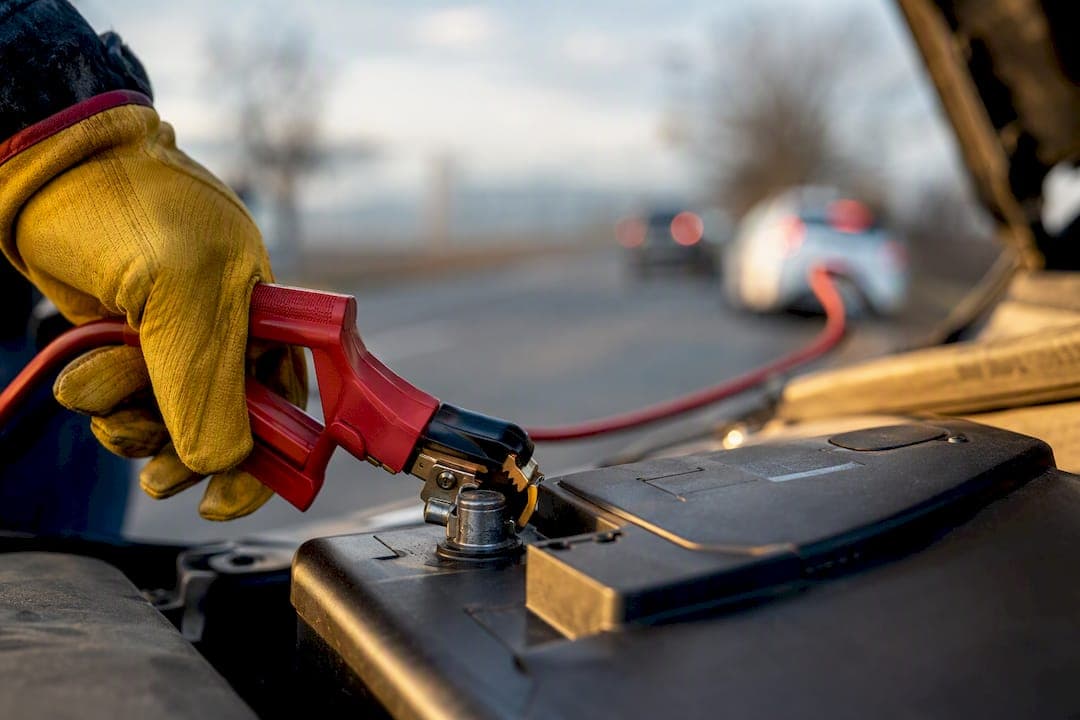
If your car battery is dead, your fastest fix is a jump-start from another vehicle or a portable booster pack, using a multimeter first to confirm the voltage if one's handy. Most cars fire right back up within a minute of a proper jump. Stop and call a professional instead if the case looks swollen, cracked, or smells like sulfur, or if AkkuPlus-grade jumper cables don't get it started after two tries.
TL;DR:
- A multimeter can confirm if a battery is weak by measuring voltage, but a load test is essential to determine actual capacity for reliable starts.
- Signs of a dead or failing battery include total silence or slow cranking when turning the key, dim headlights, or a swollen case, but not a warning light.
- Proper jump-start procedures require connecting cables in a specific order, grounding securely, and avoiding jump-starting swollen or leaking batteries to prevent damage or hazards.
- Batteries under 12.6 volts at rest or below 65% of rated cold cranking amps are likely dead or near failure and should be replaced without attempting to recharge.
- Repeated jump-starts indicate underlying charging system issues, making regular load testing and checking the alternator critical to avoid premature battery replacement.
Table of Contents
- How Do You Know It's Actually the Battery?
- How Do You Safely Jump-Start a Dead Car Battery?
- Can a Dead Battery Be Revived, or Does It Need Replacing?
- What Tools Do You Need to Test a Car Battery Yourself?
- How Do You Stop a Dead Battery From Happening Again?
- Where This Advice Comes From
- What Most Guides Get Wrong About a Dead Battery
- Get Back on the Road With the Right Battery or Tester
- Sources
How Do You Know It's Actually the Battery?
Not every no-start is a dead battery. The alternator, the starter motor, and a corroded connection all fake the same symptoms, and jumping the wrong part wastes time and can strain your electrical system for nothing.
The clearest signs point straight at the battery. Turn the key and get nothing but silence, or a slow, groaning crank that never catches. Rapid clicking under the hood usually means the starter solenoid isn't getting enough juice. Headlights that glow dim at idle but brighten noticeably when you rev the engine are a classic battery symptom, since the alternator is picking up slack the battery can't provide on its own.
Run a couple of quick checks before you reach for the cables. Do your interior lights and radio still work with the key out of the ignition? If accessories power up fine but the engine won't crank, the battery is likely too weak specifically for the high current a starter demands. If the engine catches after a jump but stalls again within a mile or two, that's usually an alternator problem, not a battery problem, since the battery got the car started but nothing is recharging it while you drive.
Watch for these red flags before you touch a single cable:
- No crank, no clicking, total silence when you turn the key
- Rapid, repeated clicking from under the hood
- Dim dashboard lights or headlights that brighten when you rev the engine
- An illuminated battery warning light on the dash
- A swollen, cracked, or bulging battery case
- A rotten-egg or sulfur smell near the engine bay
A swollen or leaking battery is not a jump-start candidate under any circumstance. Heat and overcharging cause that swelling, and the case can vent corrosive gas or acid if you apply more current to it. If you see any of that damage, skip the jumper cables entirely and call a tow truck or mobile mechanic.
Pro Tip: A battery light that's on while the engine runs usually indicates a charging problem, not a dead battery. Don't waste a jump-start on a car that's already running.
How Do You Safely Jump-Start a Dead Car Battery?
Getting this wrong can fry a fuse box, damage a sensor, or send sparks near battery gas, so follow the order below exactly rather than improvising.
Jump-starting with another vehicle:
- Park the working car close enough that the cables reach, but don't let the vehicles touch.
- Turn off both engines and set both parking brakes.
- Connect the red clamp to the positive terminal of the dead battery.
- Connect the other red clamp to the positive terminal of the good battery.
- Connect the black clamp to the negative terminal of the good battery.
- Connect the final black clamp to an unpainted metal surface on the dead car's engine block, away from the battery itself, to ground the circuit safely.
- Start the working vehicle and let it run for two to three minutes.
- Try starting the dead vehicle. If it fires, let both engines run for at least five minutes before disconnecting.
- Remove the clamps in reverse order: negative/ground first, then the positives.
The grounding step matters more than most people realize: clamping the final negative connection directly onto the dead battery's terminal, rather than a metal point nearby, raises the risk of a spark igniting hydrogen gas the battery vents while charging.
Using a portable booster pack:
- Confirm the booster is charged and check its polarity markings before connecting anything.
- Clamp red to positive, black to negative, same order as above.
- Turn the booster on and try starting the car, typically within 30 seconds.
- Disconnect once the engine runs steady, negative first.
Portable boosters skip the need for a second car entirely, which makes them worth owning if you often drive alone. One caution: some compact boosters aren't rated for hybrid or EV auxiliary batteries, so check the manual before using one on anything but a standard gas or diesel vehicle.
Before you touch any terminal, take off metal jewelry, skip the cigarette, and confirm neither battery case shows cracks or bulging. If the car starts, then stalls again within a few minutes, or refuses to restart later that day, don't keep jumping it. That pattern points to a charging-system fault worth a proper diagnostic rather than another round of cables.
Can a Dead Battery Be Revived, or Does It Need Replacing?
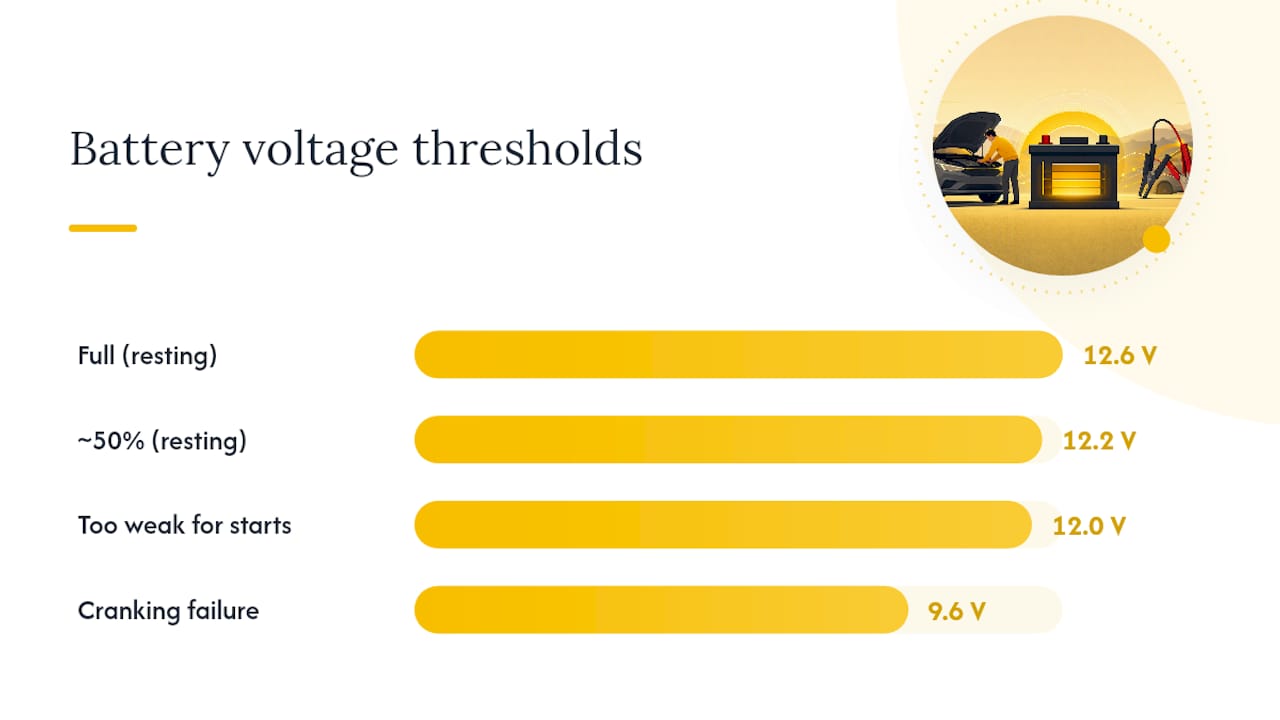
A resting voltage around 12.6 volts means the battery is full; about 12.2 volts is roughly 50% charged; anything under 12.0 volts is effectively too weak for reliable starts. Those numbers are a starting point, not the final word, because a battery can rest at a decent voltage and still collapse the moment the starter demands real current.
That's where load testing comes in, and it's the test that actually settles the question:
- 80% or more of rated CCA (cold cranking amps): the battery is still serviceable
- 65% to 80% of rated CCA: borderline, worth watching, may need replacement soon
- Under 65% of rated CCA: the battery has failed and should be replaced
- Voltage drops below 9.6V during cranking: the battery can't supply starter current and is functionally dead, regardless of what the resting voltage showed
Replace immediately, without attempting a charge or jump, if you see a swollen case, a sulfur smell, or visible leakage around the terminals. Also treat repeated jump-starts as a warning sign rather than routine maintenance. Every deep discharge shortens a lead-acid battery's remaining lifespan, so a battery you keep reviving is usually a battery on its way out anyway. Home charging works for a battery that's simply low; a shop-grade load test is what you need when you genuinely don't know whether it's low or dying.
What Tools Do You Need to Test a Car Battery Yourself?
A $15 digital multimeter tells you more in thirty seconds than guessing ever will. Set it to DC volts, touch the red probe to the positive terminal and black to negative, and read the number with the engine off and the car sitting for at least an hour. That resting number is a decent gut check, but it can be misleading on its own, since it doesn't measure whether the battery can actually push current under load.
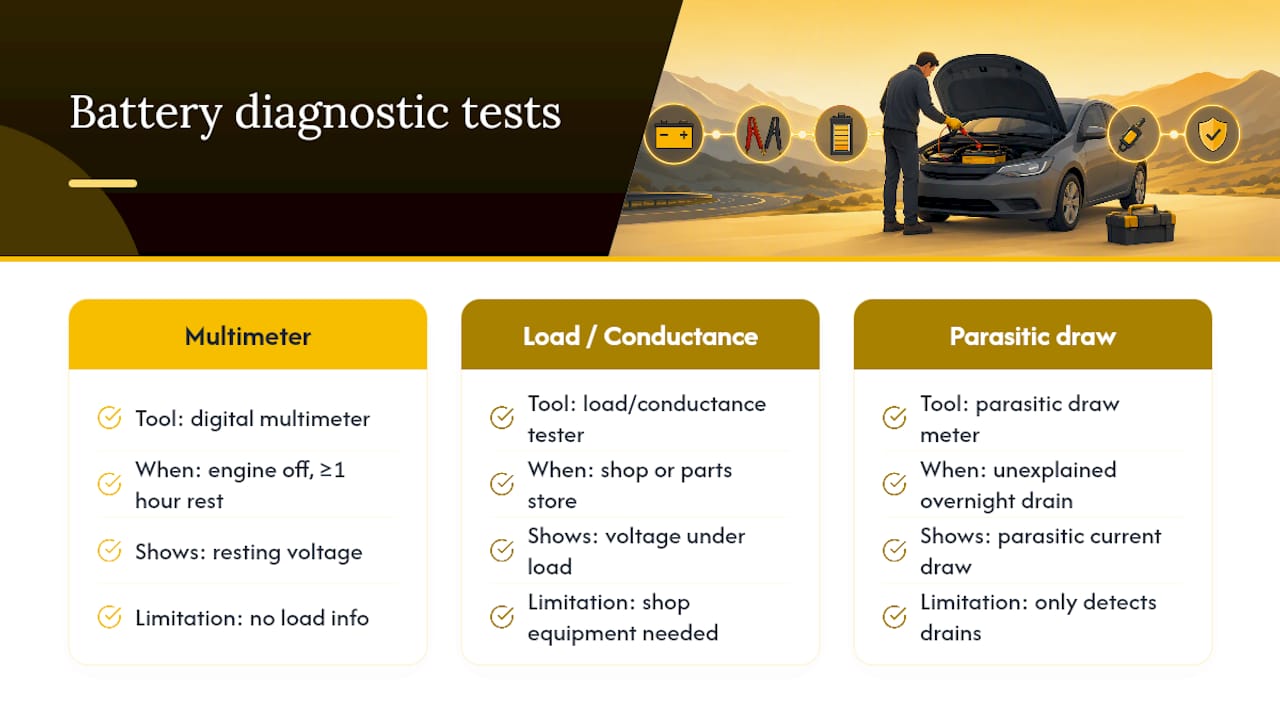
A proper load test or conductance test, the kind shops and parts stores run for free, applies a real electrical demand and measures how the voltage holds up. That's the number that separates a battery worth keeping from one worth replacing, using the same CCA percentages covered above.
If a battery keeps going dead overnight for no obvious reason, ask a shop to run a parasitic draw test. It measures how much current keeps flowing after everything's shut off, catching a dome light left ajar, a faulty relay, or an aftermarket alarm quietly bleeding the battery dry while the car sits in the driveway.
Keep a set of heavy-gauge jumper cables and a multimeter in the trunk year-round. For anyone who wants to test small-format batteries too, not just the 12V starter battery, AkkuPlus's battery testers cover standard and button-cell formats in one unit.
How Do You Stop a Dead Battery From Happening Again?
Most repeat dead-battery calls trace back to the same handful of habits, and every one of them is fixable in a weekend afternoon.
- Test resting voltage annually once the battery passes its third year in service
- Clean corrosion off the terminals with a wire brush and a baking-soda solution
- Confirm the hold-down bracket is tight; vibration damage shortens battery life
- Cut back on frequent short trips, which never let the alternator fully recharge the battery
- Unplug aftermarket alarms, dash cams, or phone chargers that draw power with the engine off
- Replace proactively once a load test shows the battery under 80% of rated CCA, rather than waiting for a no-start
Batteries commonly last three to five years depending on climate and driving habits, with heat and short-trip driving cutting that span down noticeably. If you've needed more than one jump-start in the past month, that's not bad luck. It's your charging system telling you something's wrong, and it's worth a proper alternator check before you spend money on a battery that isn't the actual problem.
Pro Tip: Mark your battery's install date on a piece of tape stuck to the case. Nobody remembers when they bought it, and that one detail tells you exactly how much runway you've got left.
Where This Advice Comes From
This guide reflects Waldemar's ongoing work covering battery diagnostics and replacement for everyday drivers, cross-checked against manufacturer and roadside-assistance guidance rather than guesswork. The voltage thresholds, CCA percentages, and jump-start sequence above match the same benchmarks technicians use at the counter, not shortcuts invented for a blog post.
AkkuPlus backs that advice with actual inventory: starter batteries like the Optima Red Top AGM, replacement units such as the Long WP1250 12V, and testers built for both standard and button-cell formats. Availability and pricing are set by country, so what you see reflects your own local shop rather than a generic listing.
What Most Guides Get Wrong About a Dead Battery
Most advice treats a dead battery like a single event: jump it, drive off, forget it happened. That's the wrong lens. A battery that dies once is an inconvenience. A battery that dies twice in a month is a diagnostic clue you're ignoring, and the second jump-start almost never fixes the actual problem.
The conventional wisdom oversells resting voltage and undersells the load test. A number on a multimeter reading 12.4V feels reassuring, but it tells you nothing about whether that battery can deliver 400 amps for two seconds on a cold morning. That's the gap between what feels like proof and what actually is proof.
If you take one thing from this, prioritize the load test over the guess. Buy the multimeter, sure, but treat it as a screening tool, not a verdict. And if you're reaching for jumper cables more than once every few weeks, stop treating it as routine. Get the charging system checked before you spend money replacing a battery that was never the real issue.
— Waldemar
Get Back on the Road With the Right Battery or Tester
AkkuPlus sells the exact tools this guide just walked you through, not just batteries, but the testers and boosters that tell you which one you actually need before you spend money guessing.

If a load test showed your battery under 80% of rated CCA, browse 12V replacement batteries sized for standard passenger vehicles, or the Optima Red Top AGM starter battery if you need stronger cold-cranking output. Want to check before you buy anything? Pick up a battery tester that covers standard and button-cell formats in one unit, or read AkkuPlus's guide to replacing sealed battery packs if your dead battery is part of a UPS or device rather than a car. Every listing shows country-specific pricing and shipping, with warranty terms stated on the product page before checkout. Pick your part, confirm it fits, and order it today so the next dead battery doesn't catch you stranded.
Sources
- How to Test & When to Replace a Dead Car Battery | Bridgestone
- Car Battery Dying? 7 Warning Signs + Load Test Guide - Steer
- How to jump-start a car | RAC