
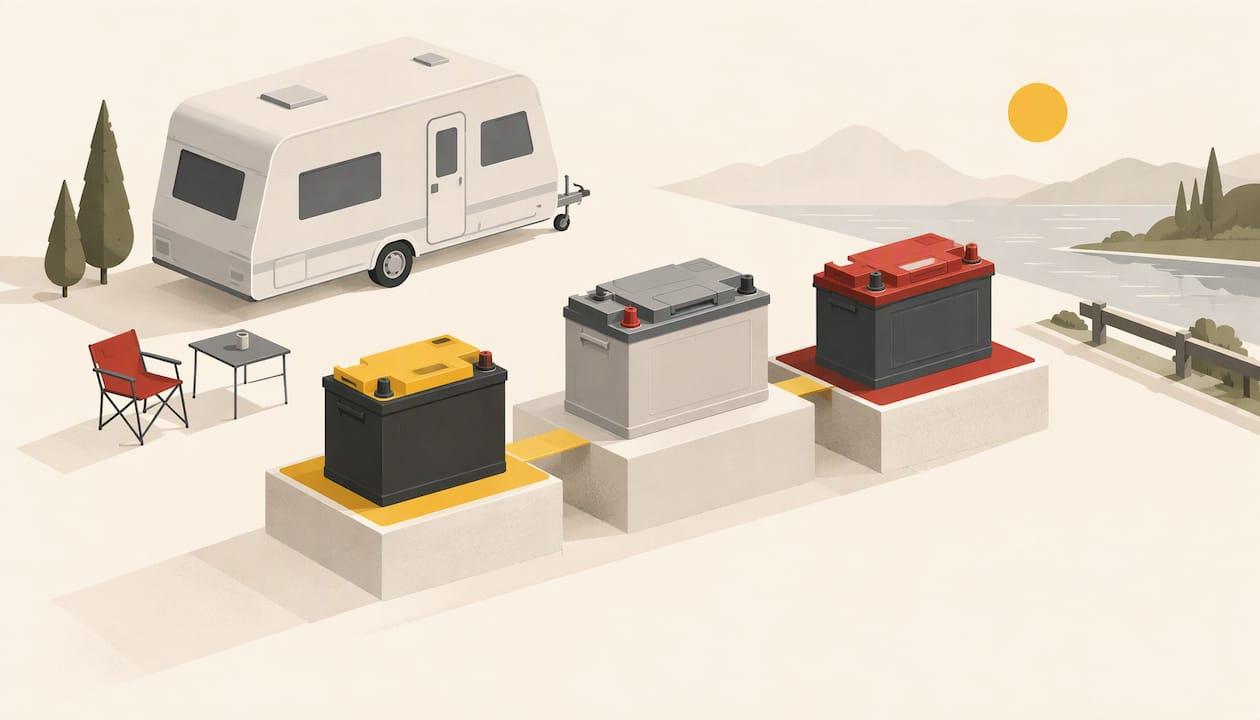
For most caravanners who camp off-grid, the best caravan battery is a LiFePO4 (lithium iron phosphate) battery of 100 to 200 Ah. It is lighter, usable down to a low charge and rated for far more cycles than lead-acid. If you mostly stay on electric hook-up and just need lights, a TV and a motor mover, a leisure-rated EFB or AGM battery costs much less and does the job. Below we compare tested models available in Germany, then show how to size, charge and look after the battery you pick.
TL;DR
- Best overall for off-grid use: a LiFePO4 battery. In promobil's tests, the Super B Epsilon 150 Ah scored 91/100 and the Carbest Li100BT won its 100 Ah group.
- Best on a tight budget: a leisure EFB such as the Yuasa L36-EFB (100 Ah), designed for hook-up pitches with modest off-grid use.
- Size by habits: about 100 Ah for weekends, about 200 Ah for most travelers, about 300 Ah for induction cooking or air conditioning.
- Check the charger first: lithium needs a charger, solar controller and booster with a LiFePO4 profile, and must not be charged below 0 °C.
Table of Contents
- The caravan batteries compared
- LiFePO4, AGM, gel and EFB: what actually differs
- How much capacity does a caravan need?
- Charging and compatibility: check this before you buy
- Making a caravan battery last
- Our perspective
- Where to look at AkkuPlus
- FAQ
- Sources
The caravan batteries compared
The table lists options that German test magazines and manufacturers have documented. Prices change often, so treat them as a snapshot and confirm the current price with the seller.
| Battery | Type | Capacity | Weight | Price / result |
|---|---|---|---|---|
| Super B Epsilon 150 Ah | LiFePO4, DIN housing | 150 Ah | see test | Scored 91/100, test winner |
| Wattstunde Nova Core 180Ah | LiFePO4, DIN housing | 180 Ah | see test | Scored 76/100, buying tip |
| Carbest Li100BT | LiFePO4 | 100 Ah | 11.3 kg | €899 (€949 RRP), 83 points |
| JUBE-Tech JU-12150 | LiFePO4 | 150 Ah | about 16 kg | around €600 |
| Yuasa L36-EFB | Leisure EFB (lead-acid) | 100 Ah | 24 kg | €203.22 listed by Yuasa |
The data behind the table: promobil's test of nine 150 Ah LiFePO4 batteries put the Super B Epsilon 150 Ah first with 91 out of 100 points, 200 A continuous discharge and a password-protected app. The Wattstunde Nova Core 180Ah scored 76 points and was named the buying tip. In promobil's wider test of 15 lithium batteries, the Carbest Li100BT won with 83 points. It offers 100 Ah at 11.3 kg, a 5-year warranty and 2,000 to 5,000 cycles, at €899 against a €949 list price.
The JUBE-Tech JU-12150 was tested by techtest.org in September 2026. It delivered 107% of its rated capacity, weighs about 16 kg, is rated for over 5,000 cycles at 80% depth of discharge and costs around €600, with a 5-year warranty.
On the lead-acid side, the Yuasa L36-EFB is a 12 V, 100 Ah, maintenance-free EFB battery measuring 353×175×190 mm with an integrated flame arrestor. Yuasa lists it at £173.99, or €203.22 in euros. It is classed NCC B, meaning hook-up use with minimal off-grid living such as lights, a TV and a motor mover.
How to read the table
The cheapest battery per amp-hour is not automatically the cheapest to own. A 100 Ah lead-acid battery gives you far less usable energy than a 100 Ah lithium battery, so compare usable amp-hours and cycles, not the label alone.
LiFePO4, AGM, gel and EFB: what actually differs

Usable capacity. Lead-acid batteries should not be run flat. The planmycamper.de guide puts usable capacity at about 90% for LiFePO4, 60 to 70% for AGM and gel, and 50% for flooded lead-acid. A 100 Ah AGM therefore delivers roughly 60 to 70 Ah in daily use.
Weight. The same guide gives roughly 10 to 14 kg per 100 Ah for LiFePO4 and 20 to 30 kg for lead-acid types. The Camping and Caravanning Club notes that LiFePO4 batteries typically weigh half as much as an equivalent lead-acid battery. On a caravan, where noseweight and payload matter, 12 kg saved is real.
Lifespan. Planmycamper cites 10 to 15 years for LiFePO4, 4 to 7 for AGM, 5 to 10 for gel and 3 to 5 for flooded lead-acid. Treat those as ranges: actual life depends on how deeply you discharge, temperature and how well you charge.
Price. The same guide lists €450 to €2,200 for LiFePO4, €200 to €400 for AGM, €250 to €500 for gel and €100 to €200 for flooded lead-acid. The test prices above (€600 to €899) sit inside the LiFePO4 range.
Self-management. The Camping and Caravanning Club also points out that LiFePO4 batteries are self-contained units with an on-board charge manager, can be fully discharged and recharged, and hold a stable voltage while discharging.
Which type suits which caravanner
- Hook-up pitches, short trips, motor mover: an EFB or AGM leisure battery is enough and keeps the purchase small.
- Wild camping, solar, long trips: LiFePO4. More usable energy, less weight, longer life.
- Cold-weather camping: lithium works if you keep it above freezing while charging. See the charging section below.
How much capacity does a caravan need?
Planmycamper says most campers are well served by about 200 Ah. Roughly 100 Ah covers weekends with a cooler box and lights, while 300 Ah is for induction cooking, air conditioning or home office work. Use that as a starting point and then do your own sum:
- List every 12 V consumer you run: fridge, lights, water pump, TV, router, fans.
- Multiply each one's watts by hours per day, and add them for watt-hours.
- Divide by 12 to get amp-hours, then add a reserve for several cloudy days.
- Compare with the usable capacity of the battery, not its label.
For example, a 100 Ah LiFePO4 holds about 1,280 Wh nominal, and with roughly 90% usable that is close to 1,150 Wh. A 150 Ah unit such as the JUBE-Tech or Super B gives you a day or two of moderate use without solar.
Charging and compatibility: check this before you buy
Switching chemistry means checking the whole system.
- Charger, solar controller and booster. Planmycamper advises that all three need a LiFePO4 profile, and some existing components may need replacing. Older onboard units are often built for lead batteries: the Schaudt EBL 109-5 E manual, for instance, describes a charging unit designed for 6-cell lead-acid or lead-gel batteries with 14.3 V maximum charging voltage and a 14.4 V booster while driving. Check your own unit's manual.
- Cold. LiFePO4 should not be charged below 0 °C. The Votronic solar regulator manual says to keep LiFePO4 above 0 degrees Celsius and describes low-temperature protection in the regulator.
- Solar installation. The TÜV-Verband published a Merkblatt on mounting solar systems on motorhomes in August 2025. It covers module and storage mounting, cable protection and the relevant DIN standards, and is worth reading before a DIY install.
- Ventilation. The Yuasa EFB, when fitted in an occupied space, must have a breather pipe routed to the vehicle exterior.
If you run a lead-acid battery, a good maintenance charger helps. Our shop carries chargers such as the CTEK MXS 3.8 alongside battery and power supply categories.
Making a caravan battery last
The Knaus owner's manual for 2026 (Royal and Imperial series) says service life depends on usage: avoid complete discharge, recharge fully, charge as early as possible and do not leave the battery half-charged for long. For winter storage it advises removing the battery, charging it fully, keeping it cool and dry and recharging it every three months.

The Camping and Caravanning Club adds safety points for lead-acid batteries: mount them securely, fit the gas vent correctly and keep naked flames away when charging or disconnecting leads, because battery gas is explosive. Wear eye protection and gloves when inspecting cells. Manufacturers often recommend recharging below 50% to prevent sulphation.
Our perspective
For us, the best caravan battery is the one that matches how you travel and the charging gear you already own. We see too many buyers focus on the label capacity and forget the rest of the system: the charger profile, the cable, the fuse and the state of the cells.
That is why we think in systems. Batteries, single cells, battery packs and power supplies belong together, and so does a test of what you already have. A battery that no longer holds its capacity is not always a lost cause, and a proper test tells you more than guessing.
If you want a shortlist for your camper or caravan, start with the type, then the size, then the charger. Our guide to leisure batteries in Germany walks through AGM, gel and LiFePO4 step by step.
Waldemar Pelich
Where to look at AkkuPlus
At AkkuPlus you can browse batteries, battery packs and power supply products in one place, with country-specific availability for Germany and neighboring markets.
We also offer battery testing, battery repair and custom pack assembly (Konfektionen). If a pack in your caravan, mover or e-scooter is weak, start at our service overview and tell us what you have. Prices for services are not published, so ask us for a quote.
FAQ
How long should a battery last in a caravan?
It depends on type and use. Planmycamper cites 3 to 5 years for flooded lead-acid, 4 to 7 for AGM, 5 to 10 for gel and 10 to 15 for LiFePO4. Avoiding deep discharge and storing the battery fully charged are the biggest factors, as the Knaus manual explains.
Is 200 Ah lithium enough for a caravan?
For most travelers, yes. Planmycamper says 200 Ah suits most campers, including fridge, lights and devices. If you cook on induction, run air conditioning or work from the caravan, plan for about 300 Ah or add solar.
What battery do I need for a caravan?
If you mostly use hook-up and only need lights, a TV and a motor mover, a leisure EFB or AGM such as the 100 Ah Yuasa L36-EFB is designed for that. For regular off-grid stays, choose LiFePO4 and check that your charger supports it.
Can I charge a lithium caravan battery in winter?
Not below 0 °C. LiFePO4 cells should stay above freezing when charging, and regulators such as Votronic's include low-temperature protection. In cold weather, store the battery in a heated space or use a battery with built-in heating.
Sources
- promobil: 15 Lithium-Batterien fürs Wohnmobil im Test
- promobil: Lithium-Batterien für Wohnmobile mit 150 Ah im Test
- techtest.org: JUBE-Tech JU-12150 im Test
- Yuasa: L36-EFB YBX Active Leisure battery
- Planmycamper: Lithium-Batterie Wohnmobil 2026
- Camping and Caravanning Club: A Guide To Leisure Batteries
- Schaudt EBL 109-5 E operating manual
- Votronic solar regulator manual
- TÜV-Verband: Merkblatt Anbau von Solaranlagen an Wohnmobilen
- Knaus caravan owner's manual 2026
Recommended
- Best Leisure Battery for Your Camper in Germany: AGM, Gel or LiFePO4
- Best AGM Chargers in Germany: Picks and How to Choose
- Best LiFePO4 Battery: Test Winners and What to Check
- Best Deep Cycle Battery: AGM, Gel or LiFePO4 for Your Use
This article was created with the assistance of Artificial Intelligence (AI) and has been reviewed by our editorial team. Despite careful preparation, we assume no liability for the completeness, accuracy, or timeliness of the information provided. The technical data and specifications supplied by the respective manufacturer shall always prevail.