

Trickle charging a car battery makes sense whenever a vehicle sits idle for weeks or months, and it works by holding the battery at a float voltage between 13.2 and 13.8 volts using a multi-stage charger with automatic shutoff. A quality maintenance charger, ideally one with a DIN 41773 IUoU profile and a battery-type selector, offsets natural self-discharge of roughly 2 to 5 percent per month. There are chargers and batteries available built for exactly this job.
TL;DR:
- Modern maintenance chargers with IUoU staging and proper float voltage settings are safe to leave connected for months during extended storage or infrequent use.
- Charging settings must match the specific battery chemistry, such as AGM, Gel, EFB, or LiFePO4, to prevent long-term damage or capacity loss.
- A 50 Ah battery typically requires around 10 hours to top up with a 5-amp charger or up to 24 hours for a full recharge from a deep discharge, depending on the state.
- Regularly check the connection, terminal condition, and charger indicators every few weeks to avoid corrosion, overheating, or unnoticed faults.
- Use a microprocessor-controlled charger with features like reverse polarity protection and temperature compensation to ensure long-term safety and battery health.
Table of Contents
- What Trickle and Maintenance Charging Actually Mean
- How Multi-Stage Charging and Float Voltage Work
- Which Battery Type Changes Your Charger Settings
- How Long Should a Maintenance Charger Stay Connected?
- Common Mistakes and Safety Basics
- What to Look for When Buying a Charger
- A Workshop Note on Seasonal Storage
- How AkkuPlus Helps You Keep a Battery Ready Year Round
- Sources
- FAQ
What Trickle and Maintenance Charging Actually Mean
"Trickle charging" is the term most drivers grew up with, but it describes something narrower than what modern chargers do. A true trickle charger just feeds a small, constant current into the battery, no matter what the battery needs at that moment. A maintenance charger, sometimes called a float charger, reads the battery's condition and adjusts output automatically, cycling between charging and monitoring. In practice, when people ask about trickle charging a car battery today, they mean the modern version.
Either way, the reason you need one comes down to physics. Every 12 volt lead acid battery loses charge on its own, and even a parked car draws power for its alarm, clock, and onboard computers. That idle draw typically runs 3 to 50 milliamps, which adds up fast over a quiet month in the garage.
Situations where a maintenance charger earns its keep:
- Seasonal vehicles like convertibles, classic cars, motorcycles, or boats parked for winter
- A second car or work vehicle that only gets driven occasionally
- Short-trip commuting patterns that never let the alternator fully replenish the battery
- Extended travel, hospital stays, or any stretch where the car sits untouched for more than two or three weeks
How Multi-Stage Charging and Float Voltage Work
Modern chargers don't just dump current into a battery until it's full. They follow a staged process usually called IUoU, and understanding the stages explains why these devices are safe to leave connected for long stretches.
- Bulk (I): constant current pushes the battery up to roughly 80 percent capacity quickly
- Absorption (U): voltage holds steady while current tapers as the battery approaches full charge
- Verify (o): a brief pause or test checks whether the battery holds its charge
- Float (U): the charger settles into maintenance mode, holding a float voltage in the 13.2 to 13.8 volt range to offset self-discharge without overcharging
That float stage is the whole point of a maintenance charger. Too low, and the battery slowly drains anyway. Too high, and you risk gassing and water loss in flooded batteries. Getting that number right is exactly what separates a modern IUoU charger from an old-school dumb trickle unit.
Many chargers add a pulse or reconditioning phase on top of float mode. These brief voltage pulses can help break down soft lead sulfate crystals that form during storage, though the effect only works on early-stage sulfation and won't rescue a battery that's already failing.
Which Battery Type Changes Your Charger Settings
Not every 12 volt battery wants the same treatment, and this is where a lot of well-meaning trickle charging goes wrong. Flooded, AGM, EFB, Gel, and LiFePO4 batteries each have different tolerances for voltage and current, and a charger built for one chemistry can quietly damage another over weeks of continuous use.
- Flooded (wet cell): the most tolerant type, but still needs a proper float stage to avoid water loss from gassing
- AGM: requires a lower absorption voltage than flooded batteries; a mismatched profile causes overcharging and dry-out
- EFB: similar to AGM but even more sensitive to prolonged overvoltage in stop-start vehicles
- Gel: the most voltage-sensitive of the lead acid family; too high a float setting damages the gel electrolyte permanently
- LiFePO4: needs its own dedicated charging algorithm entirely; lead acid settings can trigger the battery's protection circuit or shorten its life
Charging the wrong chemistry at the wrong voltage doesn't always fail instantly. It usually shows up months later as reduced capacity or a battery that won't hold a charge, by which point the damage is done.
Pro Tip: Check the label on top of the battery before you buy a charger. It lists the chemistry, and matching that to your charger's selector switch takes ten seconds and prevents a genuinely expensive mistake.
Before connecting anything, confirm three things: the battery type printed on its case, what your vehicle manual specifies, and that your charger actually has a mode for that chemistry. Skipping that check is how AGM and Gel batteries end up replaced years early.
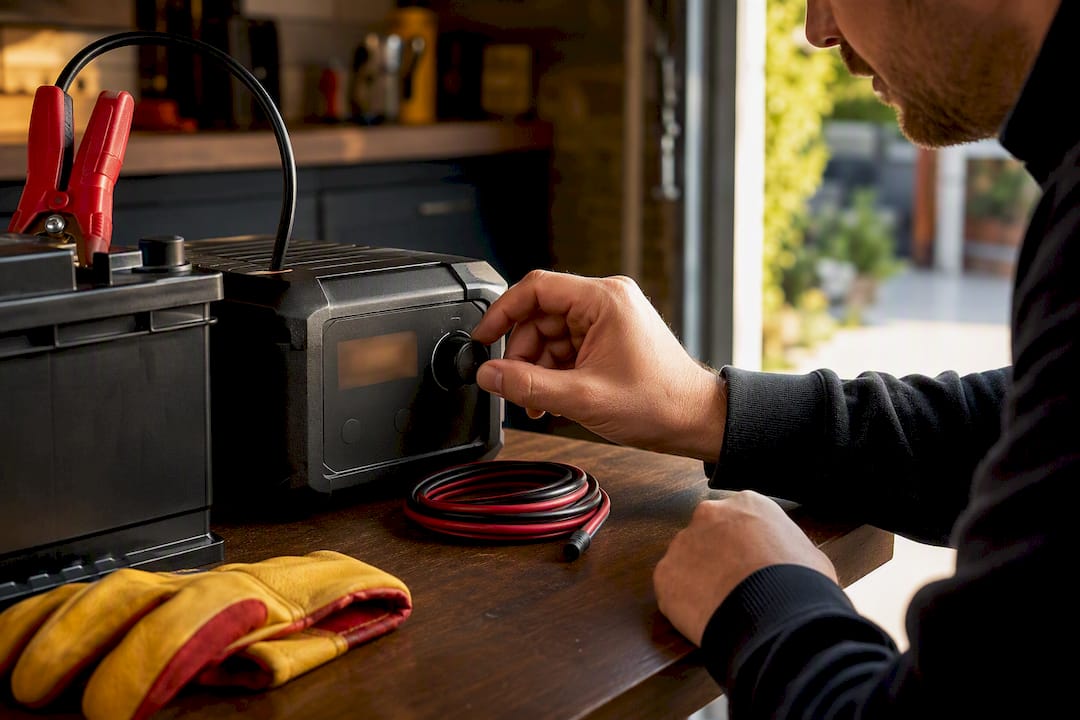
How Long Should a Maintenance Charger Stay Connected?
Sizing a charger correctly makes the difference between an overnight top-up and a multi-day slog. The rough math: divide the battery's amp-hour (Ah) rating by the charger's output current to estimate charging time. A 50 Ah battery on a 5 amp charger takes roughly 10 hours to go from significantly depleted to full, though the absorption stage stretches that somewhat.
- For a quick top-up after a battery has sat for a few weeks, expect a few hours on a charger sized to about 10 percent of the battery's Ah rating, a sizing rule workshops commonly use for reasonably fast recharge times.
- For a full recharge from a deeper discharge, budget closer to 24 hours, since the absorption and float stages taper current deliberately to protect the cells.
- For long-term storage, plug in a true maintenance charger and leave it connected for the entire idle period. Devices designed for this purpose can stay attached for months without issue.
Even with a "set it and forget it" charger, check the connection every few weeks. Look for corrosion at the terminals, confirm the charger's indicator light shows float or maintenance mode, and disconnect if you notice unusual heat, swelling, or a smell of sulfur.
Common Mistakes and Safety Basics
The biggest safety risk isn't the electricity, it's using the wrong kind of charger on the wrong kind of battery. A non-microprocessor-controlled charger left on an AGM or EFB battery for weeks can overcharge it steadily, causing gassing and permanent capacity loss. Reversed polarity is the other classic error, and it can damage both the charger and the vehicle's electronics instantly.
- Always connect the positive clamp first, then the negative to an unpainted metal ground point away from the battery, and reverse the order when disconnecting
- Charge in a ventilated space, since flooded and even some AGM batteries can vent gas
- Inspect terminals for corrosion before connecting; clean contacts charge more reliably and safely
- Never trickle charge a battery that's swollen, leaking, or visibly damaged
If the charger shows a persistent fault light, or the battery voltage won't climb above 12.4 volts after a full charge cycle, that usually points to a battery nearing the end of its life rather than a charging problem. At that point, a diagnostic test beats guessing. Ignoring manufacturer guidance on charging is one of the more common reasons batteries fail early, according to industry practitioners.
Pro Tip: A quick engine start every so often isn't a substitute for maintenance charging. A short run rarely lets the alternator replace what the battery lost sitting idle, so it gives a false sense of security.
What to Look for When Buying a Charger
A capable maintenance charger isn't defined by price, it's defined by a short list of features that actually protect your battery over months of unattended use.
- Microprocessor control with full IUoU staging, not a simple constant-current design
- A battery-type selector covering at minimum flooded, AGM, and Gel, with a separate lithium mode if you own an LiFePO4 battery
- Automatic float and pulse maintenance so the unit can be left connected safely
- Reverse polarity and short-circuit protection, non-negotiable for anyone connecting and disconnecting clamps regularly
- Temperature compensation, which adjusts float voltage slightly for cold garages or hot summer storage
| Feature | Why it matters | Typical spec |
|---|---|---|
| Charging current | Determines top-up speed vs. pure maintenance | a few amps for maintenance; several amps for recharging from partial discharge |
| Float voltage range | Keeps battery topped without overcharging | 13.2–13.8 V |
| Battery-type modes | Prevents chemistry-specific damage | AGM, EFB, Gel, Lithium, Flooded |
| Sizing rule | Balances speed and battery safety | About 10% of battery Ah rating |
For everyday maintenance on a single car, 1 to 2 amps is plenty. If you also want to recover a battery that's dropped to 30 or 40 percent charge, look for something in the 4 to 10 amp range so you're not waiting two days for a full charge. A fixed ring-terminal connector kit, left permanently attached to the battery under the hood, makes plugging in the charger a five-second job instead of popping the hood and hunting for clamps every time.
A Workshop Note on Seasonal Storage
Every fall, the same pattern shows up: batteries that sat all winter without a maintenance charger come back in spring reading well under 12 volts, sometimes too far gone to recover. The fix isn't complicated. A fixed connector pigtail left on the battery terminals turns a five-minute chore into a two-second habit, which is usually the only thing standing between a battery lasting five years or two.
— Waldemar Pelich
How AkkuPlus Helps You Keep a Battery Ready Year Round
Customers can have direct access to sorted battery options without guessing at compatibility charts on a forum. Instead of piecing together a charger from a general electronics aisle, shoppers can find a battery lineup built with chemistry and Ah rating clearly listed, browse power supply and charger accessories matched to real vehicle use cases, or book diagnostics through repair and testing services if a battery is already showing signs of trouble.
Before you order or book a test, have three details ready: the battery's chemistry (check the case label), its Ah rating, and a plain description of the symptom, whether that's slow cranking, a dashboard warning, or a battery that won't hold charge overnight. That information can help point to the right charger or assist in diagnosing the actual fault instead of replacing a part that wasn't the problem. Visit the AkkuPlus site to browse compatible products or request a battery diagnosis today.
Sources
- Erhaltungsladung erklärt: Dauer, Spannung & passende Ladegeräte (2026)
- Autobatterie Ladegerät 2026: Praxis-Vergleich & Kaufberatung
- Erhaltungsladung bei längerer Standzeit: Sinnvoll oder nicht? (2026)
- Addressing customer misconceptions about battery maintenance
FAQ
Is Trickle Charging Good for a Car Battery?
Yes, when done with a modern microprocessor-controlled charger. It offsets self-discharge and idle current draw without the overcharging risk older constant-current trickle chargers carried.
How Long Should You Leave a Trickle Charger on a Car Battery?
For a routine top-up, a few hours on a charger sized to about 10 percent of the battery's Ah rating is typical. For long-term storage, a true maintenance charger with float and pulse modes can stay connected for months.
Can I Leave a Car Battery on Trickle Charge Indefinitely?
Yes, as long as the charger has automatic float or pulse maintenance and matches your battery's chemistry. Check the connection every few weeks for corrosion or unusual heat.
Does It Hurt to Leave a Trickle Charger on a Battery?
It can, if the charger is an old constant-current design without automatic float shutoff, especially on AGM or EFB batteries. A proper IUoU maintenance charger is designed for continuous connection and won't overcharge a healthy battery.
Recommended
- Optima Red Top RT S - 4.2, 12V 50Ah, AGM Starter Battery Spiralcell
- Car Key Battery Type: How to Identify and Replace It
- Multipower - MP1222A - 12 Volt 2000mAh Pb - Maintenance-Free Lead Battery
This article was created with the assistance of Artificial Intelligence (AI) and has been reviewed by our editorial team. Despite careful preparation, we assume no liability for the completeness, accuracy, or timeliness of the information provided. The technical data and specifications supplied by the respective manufacturer shall always prevail.