
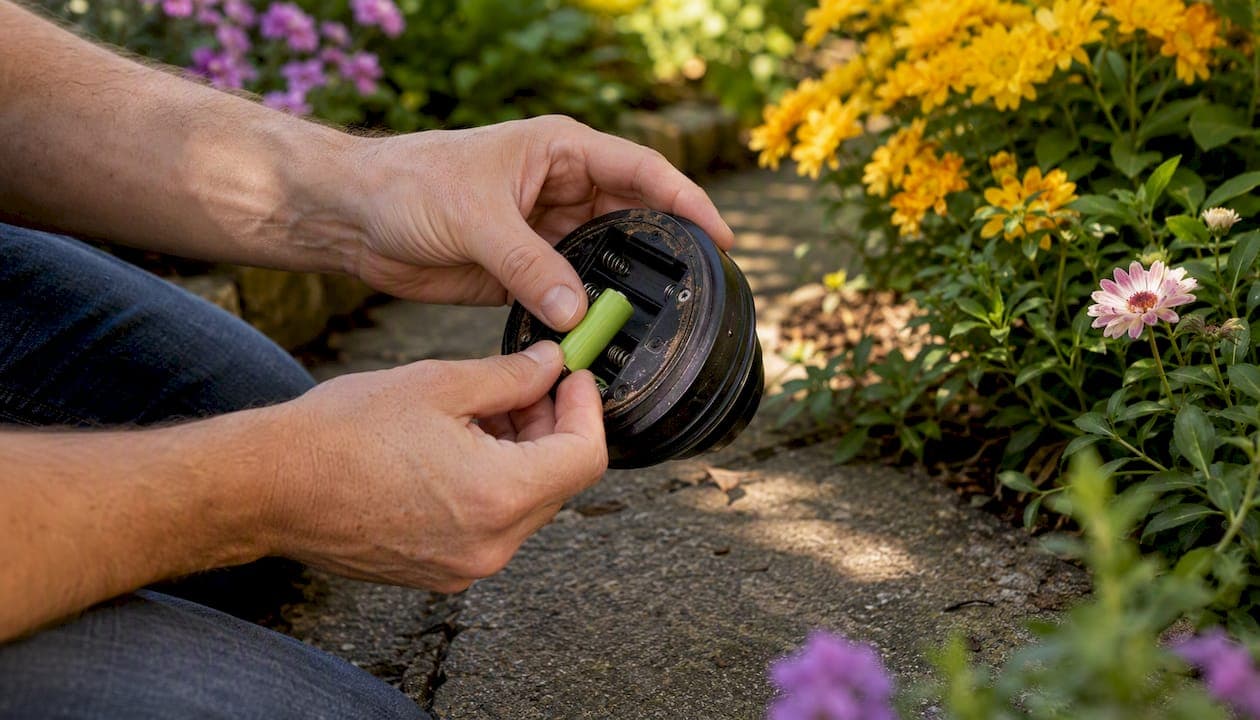
Use a 1.2 V NiMH cell in AA or AAA size that matches your lamp's original dimensions and equals or beats its mAh rating. Check the size stamped on your old cell, pick a NiMH replacement with the same or slightly higher capacity, and pop it in. NiMH wins over the alternatives because it balances runtime, wide availability, and a lower environmental footprint compared to older nickel cadmium (NiCd) cells.
Key Takeaways
Matching a NiMH AA or AAA cell at 1.2 V to your lamp's original size and mAh rating solves most solar garden light failures without buying a new fixture.
| Point | Details |
|---|---|
| Match the core specs | Confirm voltage (1.2 V), size (AA or AAA), and mAh rating before ordering a replacement. |
| Choose NiMH by default | NiMH offers longer cycle life and fewer environmental concerns than NiCd for most fixtures. |
| Follow safety and disposal rules | Tape damaged terminals and return used batteries to collection points, never household trash. |
| Buy from a specialist retailer | Akkuplus lists chemistry, voltage, and mAh clearly, with warranty and returns support included. |
Table of Contents
- Solar Garden Light Battery: Specs You Must Match Before Buying
- Which Battery Chemistry Works Best in Solar Lights?
- How Much Runtime Does Battery Capacity Actually Buy You?
- How Do You Replace a Solar Light Battery Step by Step?
- How Long Do Solar Garden Light Batteries Last?
- What If a New Battery Doesn't Fix the Light?
- How Should You Store and Dispose of Old Batteries?
- Where Should You Buy Replacement Solar Light Batteries?
- What Tools Help You Test and Maintain Solar Light Batteries?
- Why Choose Akkuplus for Replacement Cells
- Sources
Solar Garden Light Battery: Specs You Must Match Before Buying
Before you order anything, pull the old cell out and check three things. Get these wrong and your new battery either won't fit, won't charge properly, or will drain the lamp faster than the one you're replacing.
Voltage comes first. Almost every solar garden light runs on 1.2 V per cell, whether it takes one cell or a stack of several wired in series. You'll find this printed directly on the battery wrapper or, if that's worn off, in the tiny compartment where the cells sit. A multi-cell pack (say, three AAs wired together) delivers 3.6 V total, but each individual cell is still rated at 1.2 V. Never assume; always check.
Size and format matter just as much. AA and AAA are the two dominant formats in garden lighting, and mixing them up is a common mistake since both are cylindrical and easy to confuse at a glance. AA cells run about 50mm long and 14mm wide; AAA cells are shorter and thinner, around 44mm by 10mm. Some fixtures use unusual multi-cell packs or soldered tabs instead of a simple slide-in cell, so photograph the compartment before you remove anything.
Capacity (measured in mAh) and polarity round out the checklist. Most AA and AAA cells used in solar lights fall somewhere in the 600 to 1600 mAh range, depending on the lamp's design and how much room the manufacturer left inside the housing. Polarity refers to which end is positive and which is negative. Solar light compartments almost always have molded plus and minus markings, but confirm the orientation before inserting anything, since reversed polarity can damage the charging circuit.
- Voltage: confirm 1.2 V nominal per cell (standard for NiMH and NiCd garden light batteries).
- Size: measure the old cell or match it against AA/AAA dimensions; note if it's a soldered multi-cell pack.
- Capacity and polarity: aim for equal or higher mAh than the original, and respect the plus/minus markings in the housing.
A typical spec line for a common replacement reads: "1.2 V NiMH AA, 1200 mAh." Memorize that format. It's the same shorthand you'll see on every product page you compare.
Which Battery Chemistry Works Best in Solar Lights?
Four chemistries show up in solar garden lighting: nickel metal hydride (NiMH), nickel cadmium (NiCd), lithium ion (Li-Ion), and sealed lead acid. For the overwhelming majority of garden stake lights, path lights, and string lights, NiMH AA or AAA cells at 1.2 V are the right call, and here's why that recommendation holds up.
NiMH cells generally deliver higher capacity, longer cycle life, and fewer toxic materials than NiCd, which is the older chemistry most manufacturers have phased out. NiCd still turns up in cheaper imported fixtures and older lights, largely because it's inexpensive and tolerates rough treatment, but it suffers from a well-documented memory effect that shortens usable runtime over repeated partial charges. Cadmium is also a heavy metal that most retailers now restrict for consumer sale, so replacements are getting harder to find.
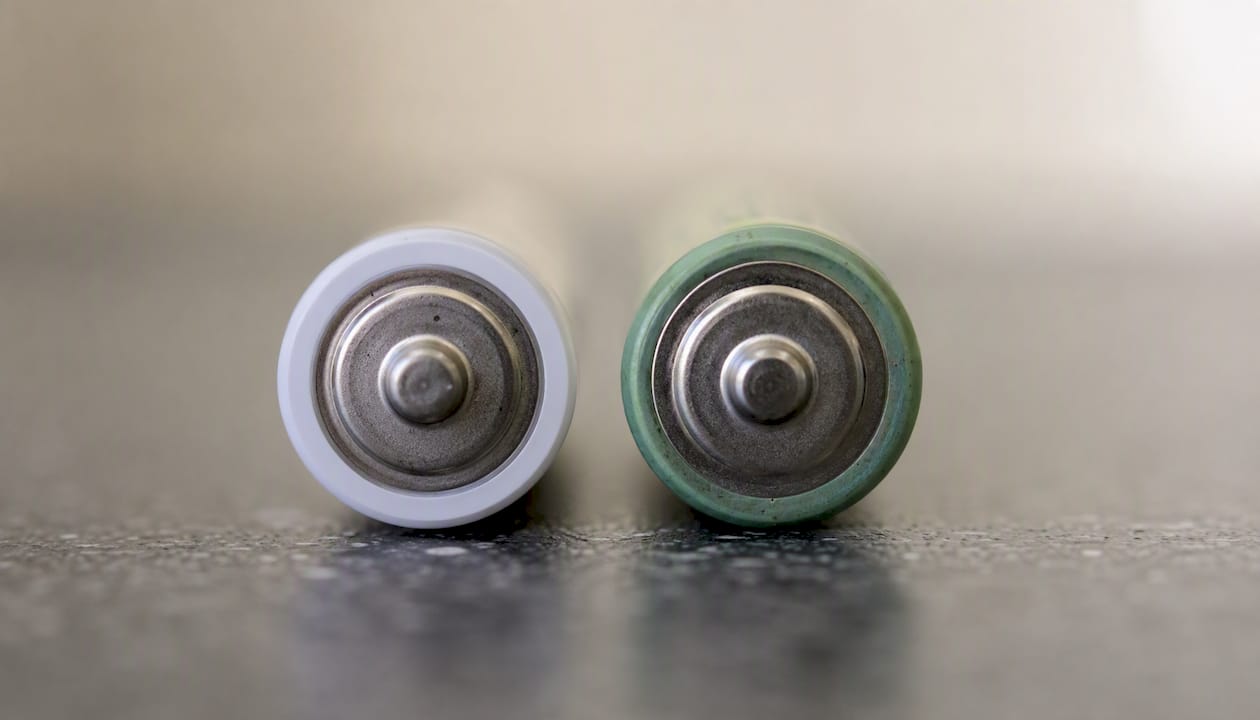
Li-Ion packs appear in higher-end solar fixtures, particularly larger post lights or units with brighter LEDs that draw more current. These usually come as a sealed manufacturer pack rather than a swappable AA or AAA cell, and they require a compatible charge controller, so a generic Li-Ion cell rarely works as a drop-in replacement. Sealed lead acid batteries show up almost exclusively in larger solar installations, like fence or driveway lighting systems with bigger panels, not the typical garden stake light.
| Chemistry | Typical use in garden lights | Cycle life | Practical notes |
|---|---|---|---|
| NiMH | Most AA/AAA garden and path lights | Commonly 500 to 1,000 cycles for quality cells | Best all-around choice; widely available |
| NiCd | Older or budget fixtures | Shorter than NiMH; memory effect reduces usable capacity | Being phased out; harder to source new |
| Li-Ion | Higher-output or premium fixtures | Varies by pack design | Usually a sealed factory pack, not a swap-in cell |
| Sealed lead acid | Large-panel installations (fences, driveways) | Varies by application | Rare in standard garden stake lights |
- Choose NiMH AA or AAA unless your lamp's manual explicitly specifies otherwise.
- Never mix chemistries in the same fixture, and never combine a fresh cell with a partially used one.
- If your old cells were NiCd, you can usually swap in NiMH as long as the built-in charging circuit tolerates the higher capacity, which it does in nearly all standard garden light designs.
The one real exception worth flagging: if your fixture came with a sealed, soldered Li-Ion pack from the factory, don't try to force a generic NiMH cell into that slot. Order the matching Li-Ion pack instead, or treat that as a signal the fixture may be near the end of its practical life.
How Much Runtime Does Battery Capacity Actually Buy You?
Capacity, expressed in milliamp hours (mAh), tells you how much energy a fully charged cell can deliver before it's empty. Think of it as a fuel tank size. A bigger tank means longer runtime for the same LED, assuming everything else stays equal.
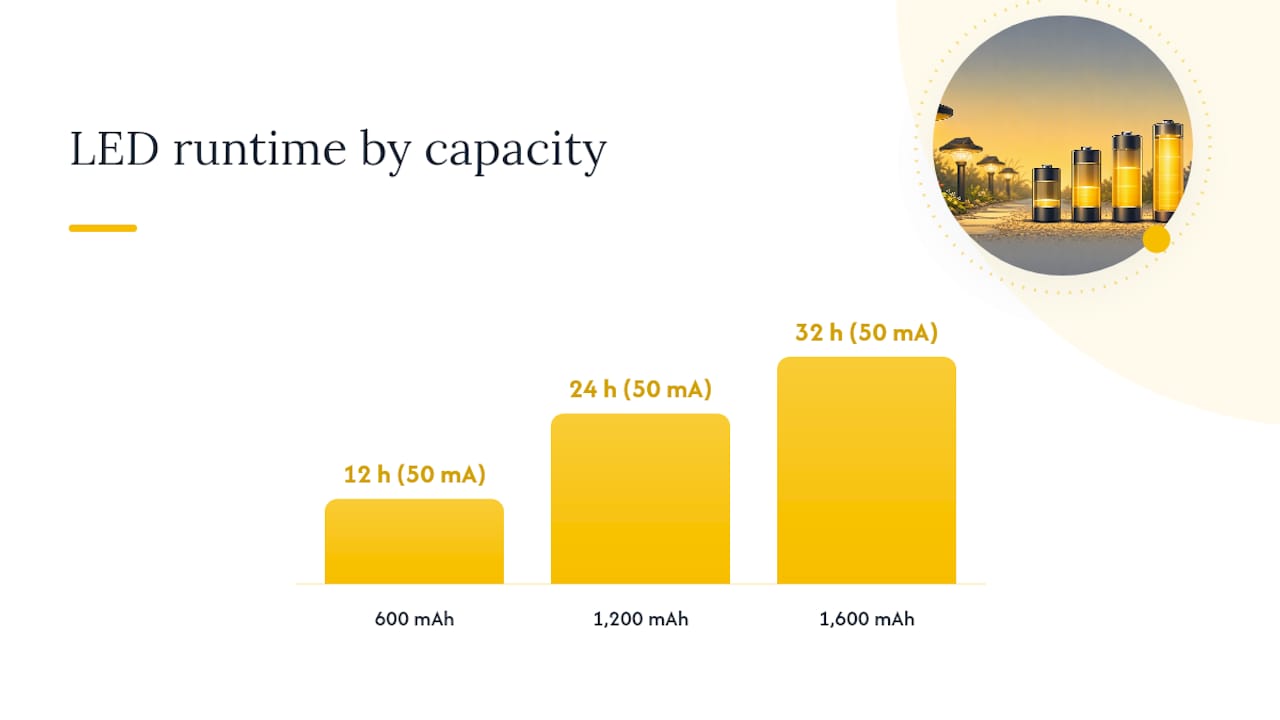
The math is straightforward once you know your LED's current draw. Multiply the draw (in milliamps) by the number of hours you want the light to run, and that gives you the minimum mAh you need. A typical small garden LED draws somewhere around 20 to 50 mA. If your light pulls 50 mA and you want it running for a full 8-hour night, you need at least 400 mAh (50 × 8) just to break even, though real-world efficiency losses mean you'll want a comfortable margin above that.
Pro Tip: When two replacement cells are the same physical size, always grab the higher mAh option if the price difference is small. A 1,600 mAh AA cell costs only slightly more than a 1,200 mAh version but can add an extra hour or two of light on long winter nights, since choosing a bit more capacity when space allows rarely has any real downside beyond a slightly longer charge time.
- Higher mAh generally means longer runtime, all else being equal.
- Higher mAh cells sometimes take longer to fully charge during short winter days with limited sun.
- Physical size limits how much capacity you can fit. Don't force an oversized cell into a compartment that wasn't designed for it.
Most standard garden lights ship with cells in the 600 to 1200 mAh range, which is plenty for typical dusk-to-dawn operation in summer. If you're in a region with shorter winter daylight hours, or if your fixture sits partially shaded, stepping up toward the top of that 1600 mAh ceiling gives you a buffer against weaker daytime charging.
How Do You Replace a Solar Light Battery Step by Step?
Replacing the cell in a solar garden light takes about five minutes once you've got the right part in hand. Here's the sequence that avoids the most common mistakes.
- Switch the light off and test it in daylight first. Confirm the panel is charging by covering it briefly and checking if the LED responds, which rules out a dead switch before you start disassembling anything.
- Open the battery compartment or lamp head. Most garden stakes have a twist-off cap or a small screw-secured panel near the solar panel or base.
- Photograph or note the cell arrangement and polarity before removing anything, especially in multi-cell fixtures where orientation matters.
- Remove the old cell and inspect the compartment for corrosion, a white or crusty residue, or a swollen, leaking casing. Any of these signs means you should clean the contacts carefully or consider the fixture a total loss if damage is severe.
- Insert the new NiMH cell, matching polarity exactly to what you noted.
- Test the light by exposing it to direct sun for a full day, then checking that it activates properly after dark.
Stop and don't proceed if you find a swollen, cracked, or leaking cell. Leaking electrolyte can irritate skin, and a swollen casing signals internal damage that risks a short circuit if you force it out. In that case, wear gloves, avoid puncturing the cell, and take it directly to a collection point rather than continuing the repair yourself.
Pro Tip: Before transporting or storing any failed or high-energy cell, tape over both terminals with non-conductive tape. This simple step prevents the terminals from touching a metal surface or another battery and causing a short circuit, which is one of the more common causes of storage-related battery fires.
If your fixture's manual mentions initial conditioning, give the new cells a full charge and discharge cycle before relying on them for a full night. Most modern NiMH cells don't strictly require this, but it doesn't hurt and helps calibrate the light's internal charge sensor.
How Long Do Solar Garden Light Batteries Last?
Quality NiMH cells in solar garden lights typically hold up for 500 to 1,000 charge cycles before performance drops off noticeably. Since a solar light charges and discharges once per day, that works out to roughly one and a half to three years of daily use, though heat, deep discharges, and cheap cell quality all accelerate wear.
Watch for these signs that a cell has reached the end of its useful life:
- The light turns on later at dusk and shuts off earlier than it used to.
- Brightness noticeably dims within the first hour or two after sunset.
- The light flickers or cycles on and off erratically during the night.
- You spot corrosion or a white crust around the battery contacts.
- The cell won't hold a charge at all, even after a full sunny day.
Run a quick cost comparison before you decide between replacing the battery or replacing the whole fixture. A NiMH AA replacement typically costs a few euros, while a comparable new solar garden light runs considerably more. Unless the plastic housing, solar panel, or LED itself is damaged, swapping the cell is almost always the cheaper move, and it keeps a working fixture out of the waste stream.
What If a New Battery Doesn't Fix the Light?
Fresh batteries solve most solar light problems, but not all of them. If your light still won't work after a battery swap, work through this checklist before assuming the fixture is dead.
- Clean the solar panel. Dust, pollen, and grime block sunlight from reaching the cells underneath, and a quick wipe-down often restores charging without any new battery at all.
- Check for shading. A light positioned under a tree branch or near a fence that casts afternoon shadow may simply never get enough sun to charge fully.
- Test the on/off sensor or switch. Many garden lights have a manual switch buried inside the compartment that can get bumped to "off" during battery changes.
- Use a multimeter to check cell voltage after a full day of charging. A NiMH AA reading well below 1.2 V after charging points to either a bad cell or a charging fault, not a fixture problem.
- Look for a failed charge controller or corroded wiring, especially in lights that are several years old or have been through a harsh winter.
If the multimeter shows a properly charged battery but the LED still won't light, the problem is almost certainly the LED itself or the internal circuit board, not anything you can fix with a battery swap. At that point, weigh the cost of a repair service against simply replacing the fixture, particularly for inexpensive stake lights where a full replacement often costs less than professional diagnostics.
How Should You Store and Dispose of Old Batteries?
Handle used and failing batteries with a bit of caution, and know that Germany has specific legal requirements around how you get rid of them.
Store spare or removed cells at moderate room temperature, away from direct heat or freezing cold, both of which degrade NiMH chemistry faster than normal use. Never insert a swollen, cracked, or visibly damaged cell into any device. If you're setting a failed cell aside for disposal or storing a spent high-energy battery temporarily, tape the terminals to eliminate any short-circuit risk during handling.
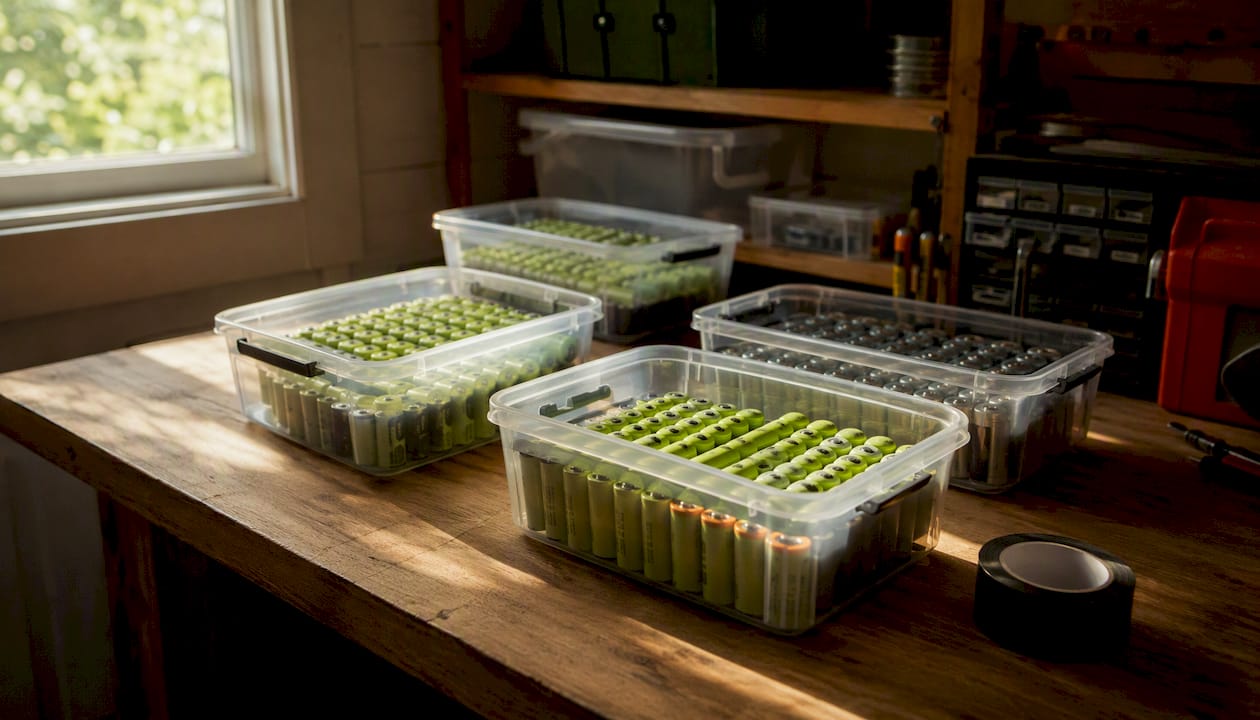
On the legal side, German law prohibits disposing of batteries in household waste. Under the Battery Act, you're required to return used batteries free of charge to designated collection points, which you'll find at most electronics retailers, supermarkets, and municipal recycling centers. Look for the collection bins usually positioned near the store entrance or checkout.
This isn't just red tape. Germany's recycling system recovered 166,326 tonnes of secondary raw materials from used batteries in a recent reporting year, with the collection rate for device batteries climbing above 50%, ahead of the EU's minimum target. Separating batteries from general waste also protects garbage trucks and sorting facilities from fire risk, since a punctured high-energy cell mixed in with regular trash can short circuit and ignite. It also lets recyclers recover valuable materials like nickel and cobalt for reuse rather than sending them to a landfill.
Where Should You Buy Replacement Solar Light Batteries?
A product listing tells you almost everything you need before you buy, as long as you know what to check. Look for the chemistry (NiMH, ideally), the nominal voltage (1.2 V for standard cells), the exact size (AA or AAA), and a clearly stated mAh rating rather than a vague "high capacity" claim. Reputable listings also disclose an approximate cycle count and carry CE and RoHS certification marks, confirming the product meets European safety and environmental standards.
Check the seller's returns and warranty policy too. A seller confident in their stock typically offers at least a basic return window if a cell arrives faulty or doesn't match the listed specs.
On pricing, a single NiMH AA or AAA replacement typically costs a modest few euros, with better-known brands like Panasonic, Varta, and Energizer sitting at the higher end of that range and generic or store-brand cells at the lower end. Buying in packs of two or four, since most fixtures need multiple cells anyway, usually brings the per-cell cost down further. Compare cost per cell against the expected cycle count rather than judging purely on sticker price. As the Umweltbundesamt notes, electricity drawn from disposable batteries costs far more per unit than mains power, which is exactly why a rechargeable NiMH cell pays for itself many times over compared to single-use alkalines.
For sourcing, you've got a few solid routes: specialist battery retailers, local electronics stores, or established online sellers who list full specs upfront. Akkuplus's NiMH replacement cell listings show voltage, capacity, and format clearly on every product page, which makes matching your old cell far easier than guessing from a generic marketplace listing.
- Confirm chemistry, voltage, size, mAh rating, and cycle count on the listing.
- Check for CE and RoHS marks as a baseline safety and quality signal.
- Compare cost per cell against expected cycle life, not just the sticker price.
What Tools Help You Test and Maintain Solar Light Batteries?
A handful of inexpensive tools make battery maintenance far less guesswork. A basic multimeter lets you check whether a cell is actually holding voltage after a day of charging, which takes the guesswork out of deciding whether a dim light is a battery problem or something else. A dedicated battery tester works similarly but gives a faster pass/fail readout without needing to interpret raw voltage numbers. Contact cleaner and a small screwdriver round out the kit for cleaning corroded terminals and opening tight battery compartments. A soft brush handles the solar panel itself, which needs an occasional wipe to keep dust and pollen from blocking sunlight.
On the maintenance side, a few habits extend cell life meaningfully. Keep the solar panel clean and unshaded so it gets a full charge each day. Avoid letting cells sit fully discharged for extended stretches, since the Umweltbundesamt specifically recommends against deep, prolonged discharges as a way to preserve rechargeable battery lifespan. If you live somewhere with harsh winters and don't need garden lighting through the coldest months, remove the cells and store them indoors at room temperature rather than leaving them in a frozen fixture all season.
- Keep a basic multimeter or battery tester on hand for quick voltage checks.
- Clean the solar panel every few weeks during peak growing season, when pollen and dust build up fastest.
- Remove batteries for indoor storage over winter if the fixture won't be used.
- Consider low self-discharge (LSD) NiMH cells for lights that sit unused for weeks at a time, since these retain charge far better than older-generation NiMH when sitting idle.
Why Choose Akkuplus for Replacement Cells
Akkuplus specializes in batteries for household, automotive, and electronic devices, with product pages built specifically to answer the compatibility questions this guide just walked through. Every listing states chemistry, voltage, exact size, and mAh rating upfront, so you're not left guessing whether a "high capacity AA" actually matches your old cell.
What matters most to someone standing in their garden holding a dead battery is speed and certainty. Akkuplus product filters let you search by voltage and format directly, and listings include warranty and returns information so you're covered if a replacement doesn't perform as expected. For less common configurations, like the small multi-cell packs used in some path lights, Akkuplus also stocks specialty NiMH replacement packs alongside standard AA and AAA cells.
- Clear specs on every listing: chemistry, voltage, size, and mAh rating stated upfront.
- Search and filter tools that let you find a match by voltage or format quickly.
- Warranty and returns coverage plus support for compatibility questions before you buy.
A Practical Note From Waldemar
Buy one size up in capacity whenever the compartment allows it. I've seen readers agonize over 200 mAh differences between two nearly identical AA cells, when the real decision that matters is chemistry and size. Get those two right, and the mAh gap between a 1,000 and a 1,200 rated cell just means an extra hour of glow on a cloudy week, nothing more dramatic than that.
The bigger mistake I see is people replacing an entire fixture when a $5 cell swap would have fixed it. If you're unsure which replacement matches your lamp, Akkuplus's product support can help you confirm compatibility before you order.
Get the Right Replacement Cell Without the Guesswork
Akkuplus stocks NiMH AA and AAA replacement cells with the exact specs this guide told you to check: voltage, size, and mAh rating listed clearly on every product page, not buried in fine print. That's the real advantage over grabbing a random pack off a supermarket shelf and hoping it fits.
Every listing includes warranty coverage and a straightforward returns process, and Akkuplus's support team can confirm compatibility if you're not sure which cell matches your fixture. Browse the NiMH replacement battery catalog to find a match for your solar garden light today, or check a specific product like the Panasonic 6 Volt lead battery listing for an example of how specs are laid out.
Sources
Readers who want the underlying legal and technical detail behind this guide can check these sources directly. The Umweltbundesamt pages cover Germany's legal disposal framework and practical battery care tips, while the recycling data page shows the measurable scale of battery collection nationally. The battery-chemistry explainers add technical depth on why NiMH outperforms NiCd in most solar applications.