
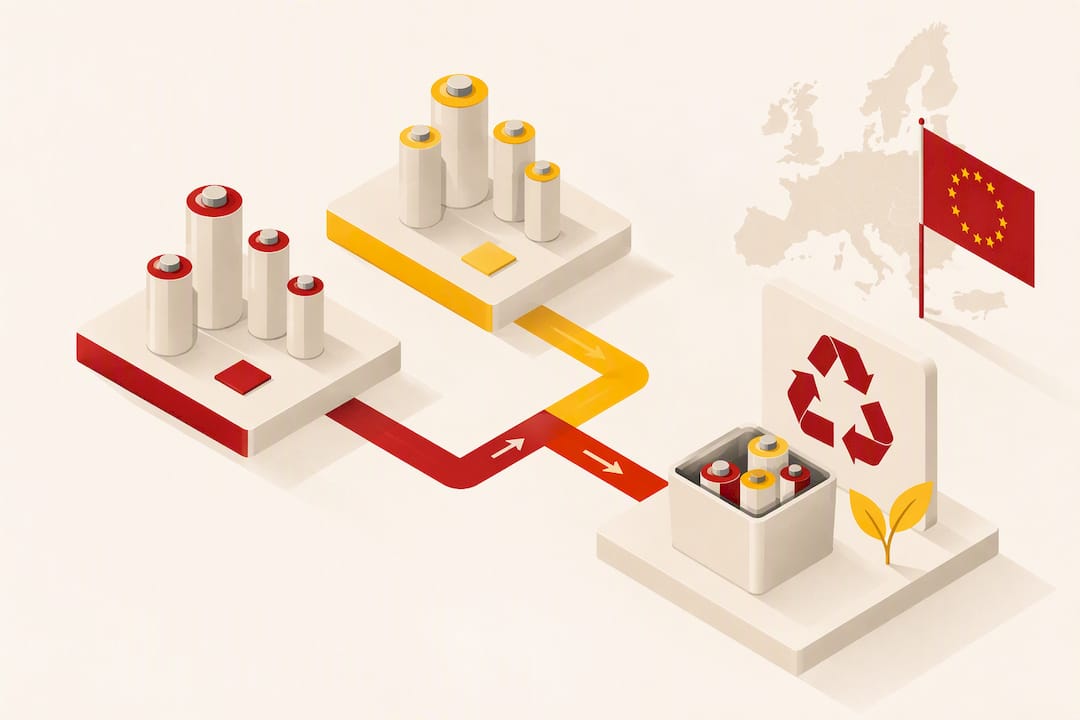
For most consumer AA and AAA uses, NiMH is the better choice because of higher capacity and lower toxicity. NiCd remains worthwhile only for a handful of legacy chargers, extreme temperature jobs, or high drain industrial packs. Before switching, check charger compatibility and remember that cadmium content makes disposal rules stricter, a factor regulators like the Umweltbundesamt and frameworks such as Regulation (EU) 2023/1542 now take seriously.
TL;DR:
- NiMH batteries offer higher capacity and lower environmental impact, making them the superior choice for most household and consumer devices.
- Cheaper, older NiCd cells are still useful in extreme temperatures or for legacy equipment but require compatible chargers with temperature sensing.
- Incorrect charging methods, especially chargers designed only for NiCd, can damage NiMH cells by overcharging or failing to detect full charge.
- Self-discharge rates are higher for standard NiMH but much lower for low self-discharge variants, affecting storage and occasional-use devices differently.
- Strict EU regulations significantly limit cadmium in batteries, pushing NiCd to niche use and requiring proper disposal as hazardous waste.
Table of Contents
- Comparing voltage, capacity, and self-discharge
- How charging differs and why the wrong charger causes problems
- Real-world performance and how long each chemistry lasts
- What cadmium means for disposal and EU rules
- Choosing the right chemistry for your device
- Where AkkuPlus fits when you need cells or a professional check
- The practical takeaway on making this choice
- Get the right cells or a professional repair
- Sources
- FAQ
Comparing voltage, capacity, and self-discharge
Both chemistries share a nominal cell voltage of about 1.2 to 1.25 volts, so a NiMH cell drops into most devices built for NiCd without any electrical mismatch. The real differences show up in capacity and how long a charge lasts on the shelf.

A standard NiMH AA cell typically holds far more energy than an old NiCd AA, which is why flashlights and digital cameras run longer between charges on NiMH. Smaller formats, like the 2/3 AAA NiMH cells sold for cordless phones, still outperform their NiCd equivalents in the same physical footprint. That extra capacity comes from higher energy density, meaning more runtime for the same weight and size, according to technical comparisons of the two chemistries.
Self-discharge is where the story gets more nuanced:
- Standard NiMH cells lose charge fairly quickly on the shelf, which is a real drawback for devices used only occasionally.
- Low self-discharge NiMH (LSD-NiMH) cells hold their charge much longer in storage, making them the practical choice for remote controls, flashlights, and other gear that sits unused for weeks.
- NiCd cells discharge more slowly than standard NiMH, which is part of why they lingered in tools and emergency lighting even after NiMH capacity pulled ahead.
A remote control that sits in a drawer for months benefits from LSD-NiMH. A digital camera used daily barely notices the self-discharge difference because it gets recharged constantly anyway.
How charging differs and why the wrong charger causes problems
Chargers detect a full cell in different ways, and getting this wrong shortens battery life. NiCd and NiMH chargers commonly use negative delta-V detection, watching for a slight voltage drop that signals full charge. NiMH cells produce a much smaller voltage drop than NiCd, so a charger tuned only for NiCd can miss the signal entirely and keep pushing current into a full NiMH cell.
Better chargers add delta-T sensing (watching temperature rise) or full temperature compensation to catch what delta-V alone misses. Basic timer based chargers avoid the detection problem but risk overcharging if you interrupt a cycle or swap in already-charged cells.
Practical steps to charge safely:
- Check the charger's label or manual for explicit NiMH support before assuming it's safe.
- Watch cells during the first few cycles for excess heat, a sign the charger isn't terminating correctly.
- Avoid mixing NiCd and NiMH cells in the same charging cycle, since their termination curves differ.
- Replace any charger relying solely on a fixed timer if you charge NiMH regularly.
Pro Tip: If a charger only lists "NiCd" on the housing, treat it as a legacy tool and buy a dedicated NiMH-capable charger with a temperature sensor instead of risking your cells.
Real-world performance and how long each chemistry lasts
High drain devices, like power tools and flash units, historically favored NiCd because it tolerated heavy current draw without much voltage sag. Modern NiMH formulations have closed much of that gap and often perform competitively in cycling and high-temperature tests when the cell is designed for the application, based on performance testing comparing various battery types. Low drain devices like remote controls and clocks run comfortably on either chemistry, though LSD-NiMH lasts longer between charges in that kind of intermittent use.
Failure modes differ too:
- NiCd is prone to the classic memory effect, where repeated partial discharges cause the cell to "remember" a shorter cycle and lose usable capacity.
- NiMH shows a milder version sometimes called the lazy effect, plus a slower, largely irreversible capacity loss as the cell ages.
- Both chemistries lose capacity faster in high heat, though industrial NiCd packs are still specified for some extreme cold or hot environments where past field data supports them.
A few conditioning cycles (full discharge then full charge every few months) help reduce memory effect in NiCd and can reset a sluggish NiMH cell.
What cadmium means for disposal and EU rules
Cadmium is toxic and persistent in soil and water, which is why NiCd cells are classified as hazardous waste rather than ordinary household trash. That classification drives collection and recycling obligations across the EU.
Regulatory pressure is a major reason NiCd has become a niche product in consumer channels, according to Regulation (EU) 2023/1542, which tightens cadmium restrictions and introduces recycled-content disclosure and future targets for nickel and other battery materials.
The regulation, along with the ECHA database of battery prohibitions and labeling requirements, sets out where cadmium is restricted and what labeling a battery containing it must carry. In practice, this means dropping spent NiCd cells at a designated collection point rather than the bin, and it means fewer manufacturers bother stocking new NiCd product lines for general consumer use. NiMH and lithium chemistries fill that gap for most everyday devices.

Choosing the right chemistry for your device
Match the chemistry to how you actually use the device, not just what came in the box originally.
- For household electronics used occasionally, like remotes or flashlights, choose LSD-NiMH cells so they're ready when you need them.
- For devices used daily, standard NiMH usually offers enough runtime at a lower cost per cell.
- For cordless power tools and other legacy NiCd packs, check the manufacturer's guidance first. Many can be retrofitted to NiMH or lithium-ion, but voltage and pack configuration matter.
- For critical systems like medical devices or alarm backups, stick to the manufacturer's specified chemistry. An unapproved substitution can cause a device to fail exactly when you need it.
Before replacing a NiCd pack with NiMH, confirm four things: the new cell fits the same mechanical space, the pack voltage matches, the charger can handle NiMH's termination behavior, and any multi-cell pack has cells balanced closely enough in capacity to avoid one cell dragging the others down.
Where AkkuPlus fits when you need cells or a professional check
AkkuPlus stocks single NiMH and NiCd cells, from AA and AAA formats to smaller sizes like 2/3 AAA NiMH, alongside legacy NiCd listings such as the Sanyo/Panasonic N-600AAC for readers maintaining older packs. For welded or multi-cell packs that can't simply be swapped by hand, AkkuPlus offers cell replacement and pack refurbishment through its Akkureparatur service, and a battery tester lets you check a cell's actual condition before deciding whether to replace it or send it in.
The practical takeaway on making this choice
NiMH is the right default for nearly everyone reading this: it's more available, less toxic, and covers the capacity needs of typical household devices. NiCd earns its keep only in narrow cases, mostly legacy tools and packs with specific charger requirements. When in doubt, check the manufacturer's charger and voltage specifications before swapping chemistries, and reach out to AkkuPlus for testing or repair if you're not confident the pack you have is safe to keep using.
— Waldemar Pelich
Get the right cells or a professional repair
Once you know which chemistry fits your device, buying the right cell or getting a damaged pack fixed shouldn't take more effort than the research did. AkkuPlus lists single NiMH and NiCd cells by size and capacity on its Akkus Einzelzellen page, so you can match the exact format your device needs instead of guessing from a generic multipack.
- Browse single NiMH and NiCd cells by size, voltage, and capacity on the Akkus Einzelzellen category page.
- For welded packs or devices with a built-in battery, request cell replacement or pack repair rather than risk a DIY swap on a pack you can't easily open.
- If you're unsure what chemistry or capacity your device actually needs, a battery tester can confirm the cell's real condition before you buy or repair anything.
Check current stock and pricing for your region directly on the Akkus Einzelzellen page.
Sources
- Regulation (EU) 2023/1542 of the European Parliament and of the Council concerning batteries and waste batteries
- ECHA: EU Batteries Regulation — prohibitions and labeling requirements
FAQ
Can I replace a NiCd battery with NiMH?
In most cases, yes, since both chemistries share a similar nominal voltage of about 1.2 volts and NiMH cells generally fit the same physical sizes. Confirm the charger can properly detect a full NiMH charge and that any multi-cell pack has cells matched closely in capacity before swapping.
Can a NiMH battery be charged in a NiCad charger?
It depends on the charger's detection method. Simple NiCd chargers using basic peak-voltage or delta-V detection may not terminate correctly on NiMH cells, since NiMH produces a much smaller voltage drop when full, so it's safer to use a charger explicitly rated for NiMH.
Which battery is better, NiMH or NiCd?
For most consumer AA and AAA devices, NiMH is the better option because of its higher capacity, wider availability, and lower toxicity. NiCd remains a reasonable choice only for a narrow set of legacy tools, older chargers, or extreme temperature applications where field history supports it.
Are NiCd batteries banned?
NiCd batteries are not banned outright, but cadmium use in batteries is heavily restricted under Regulation (EU) 2023/1542, which has pushed most consumer manufacturers toward NiMH and lithium-ion instead. NiCd cells that remain in circulation must be disposed of as hazardous waste rather than regular trash.
Recommended
- Mexcel - D-2/3A700 - 2/3 A - 1,2 Volt 700mAh Ni-CD
- Panasonic - HHR-900D - 1,2 Volt 9000mAh Ni-MH
- Mexcel - 4/5SC1400P - 4/5 SC - 1,2 Volt 1400mAh Ni-CD - Hochstrom
- Ansmann Mignon - maxE - 1,2 Volt 1300mAh Ni-MH - lose
This article was created with the assistance of Artificial Intelligence (AI) and has been reviewed by our editorial team. Despite careful preparation, we assume no liability for the completeness, accuracy, or timeliness of the information provided. The technical data and specifications supplied by the respective manufacturer shall always prevail.