

Most mobility scooters run on a 24V system built from two 12V batteries wired together, so the first thing to check is voltage, amp-hour (Ah) rating, and terminal style before you order anything. For low upfront cost and occasional use, sealed lead-acid (SLA/AGM) batteries do the job. For daily riders who want less weight and a longer service life, lithium (LiFePO4) is worth the higher price.
- Confirm your scooter's voltage and Ah rating on the manufacturer label or in the owner's manual.
- Match terminal type exactly. Faston tabs, bolt terminals, and cable lugs are not interchangeable without adapters.
- Note whether your batteries are wired in series (common for 24V setups) so you replace them as a matched pair.
TL;DR:
- Confirm your scooter’s voltage, Ah rating, and terminal style precisely from the manufacturer label to ensure proper replacement compatibility.
- Lithium batteries offer longer cycle life and faster charging but come at a higher cost and have voltage drop-offs near empty, unlike lead-acid options.
- Always test a battery’s resting voltage and load capacity before replacing, and replace both batteries in a 24V system if one tests weak to prevent imbalance.
- Proper charging habits, storage conditions, and regular maintenance significantly extend battery life, especially avoiding deep discharges and extreme temperatures.
- Choose replacement batteries based on detailed spec sheets covering exact voltage, capacity, and dimensions, rather than brand loyalty, with support available for compatibility confirmation.
Table of Contents
- Mobility Scooter Battery Types: SLA, AGM, Gel, and Lithium
- How Do You Know If Your Scooter Battery Needs Replacing?
- Choosing the Right Voltage, Ah, and Terminal Fit
- How to Replace Mobility Scooter Batteries Safely
- Charging and Storage Habits That Extend Battery Life
- Disposing of and Recycling Old Scooter Batteries
- What Actually Matters When You're Buying a Replacement
- Where to Buy Mobility Scooter Batteries That Actually Fit
- Key Takeaways
- Sources
Mobility Scooter Battery Types: SLA, AGM, Gel, and Lithium
Sealed lead-acid batteries, sold as SLA, AGM, or gel depending on internal construction, dominate the mobility scooter market because they're cheap and predictable. AGM and gel batteries are both types of VRLA (valve-regulated lead-acid) construction, which seals the electrolyte and prevents spills, making them safe for transport on planes and in enclosed battery compartments. The tradeoff is weight and cycle count: a typical SLA pair weighs noticeably more than a lithium equivalent, and most SLA batteries deliver somewhere in the range of 300 to 500 full charge cycles before capacity drops off.
LiFePO4 batteries flip that equation. Charge times run faster too. There's one quirk worth knowing: lithium packs hold voltage steady through most of the discharge curve, then drop off sharply near empty. That abrupt cliff can catch riders off guard if they're used to the gradual fade of a lead-acid pack.
Why two 12V batteries? Most scooter motors and controllers are designed around 24V, and it's cheaper and easier to source two standardized 12V units than one custom 24V cell. Some smaller travel scooters run on a single 12V or 24V pack instead, so check your battery bay before assuming you need a pair.
- SLA/AGM: lower cost, heavier, shorter cycle life, safe for air travel.
- LiFePO4: higher cost, lighter, longer cycle life, faster charging, and sharp voltage drop near empty.
- Gel: similar to AGM but generally more tolerant of deep discharge, slightly more expensive.
New lead-acid batteries typically need 10 to 20 conditioning charge cycles to hit their full rated capacity, so don't judge a fresh battery's range on the first week of use.
How Do You Know If Your Scooter Battery Needs Replacing?
A battery on its way out gives you warning signs before it fails completely. Watch for reduced range on a full charge, sluggish acceleration on inclines, a charge gauge that drops suddenly instead of tapering off, and charge times that stretch longer each week.
- Check resting voltage. A healthy 12V SLA battery should read around 12.6 to 12.8 volts at rest; anything consistently below 12.0V signals a weak or failing cell.
- Watch the gauge under load. If the range indicator plummets the moment you accelerate or climb a curb, the battery likely can't sustain current under real demand.
- Run a basic load test. Mobility Scooters Direct outlines a step-by-step testing method using a multimeter through the charging port, which is the most reliable way to confirm a failing cell without guesswork.
If one battery in a paired 24V system tests weak, it is recommended to replace both to avoid imbalance issues. Mismatched batteries drain unevenly and shorten the life of the new one fast.
Pro Tip: If your scooter has sat unused for more than a month and won't hold a charge, try a full 8 to 10 hour charge cycle before assuming the battery is dead. Deep-sitting SLA batteries sometimes just need a proper wake-up charge.
Choosing the Right Voltage, Ah, and Terminal Fit
Getting a replacement wrong usually comes down to one of three mistakes: wrong voltage, wrong physical size, or wrong charger pairing. None of them are cheap to fix after the fact.
Start with the nameplate on your old battery or the specs listed in your scooter's manual. You need the exact voltage (commonly 12V per unit in a 24V pair), the Ah rating, and the terminal style. A 12V 12Ah AGM battery is a common mobility-scooter size, but plenty of scooters use smaller packs like a 6V 20Ah configuration instead. Measure your battery box, too. A pack that's even a few millimeters too tall won't seat properly, and a loose battery vibrating in transit is a real failure risk.
- Match voltage and Ah rating precisely. Don't approximate.
- Confirm terminal type: Faston tabs, bolt-on, or threaded post.
- Measure the battery compartment before ordering, including height clearance for the lid.
- Never charge a lithium pack with an SLA charger or vice versa. The charge profiles are different enough to damage the cells or create a fire risk.
Going up in Ah within the same physical footprint is usually fine and buys you more range. Going up in physical size to chase capacity often isn't, since most battery boxes are built to a fixed dimension. Products like the Long WP1250 12V 2000mAh line show how spec sheets list voltage, Ah, and dimensions together, which is exactly what you should be comparing side by side before you buy.
How to Replace Mobility Scooter Batteries Safely
Replacing batteries yourself is a manageable weekend job if you follow the sequence in order and don't rush the reconnection step.
- Power down completely. Turn off the scooter, remove the key, and unplug the charger. Put on gloves and eye protection since lead-acid batteries contain corrosive electrolyte.
- Note the wiring before disconnecting anything. Take a photo of the terminal connections so you can match polarity exactly on reinstall.
- Remove the old batteries. Disconnect the negative terminal first, then the positive, then lift the batteries out of the compartment.
- Clean the terminals and compartment of any corrosion buildup with a wire brush before placing the new batteries.
- Install and connect in reverse order: positive first, then negative. Tighten terminal bolts snugly. Overtightening can crack the terminal post.
- Charge fully before the first ride, typically 8 to 10 hours for a healthy SLA pack, then take a short test ride and confirm the gauge behaves normally.
Pro Tip: Keep a small notebook or phone note of the install date. When a battery underperforms 10 or 11 months later, you'll know immediately whether it's a warranty issue or just normal wear.
Monitor performance over the first week. A new battery that seems to lose range faster than expected in the first few days is often still working through its conditioning cycles, not failing.
Charging and Storage Habits That Extend Battery Life
Daily habits matter more than most riders assume. SLA and lithium batteries actually want different charging rhythms, and treating them the same way shortens both.
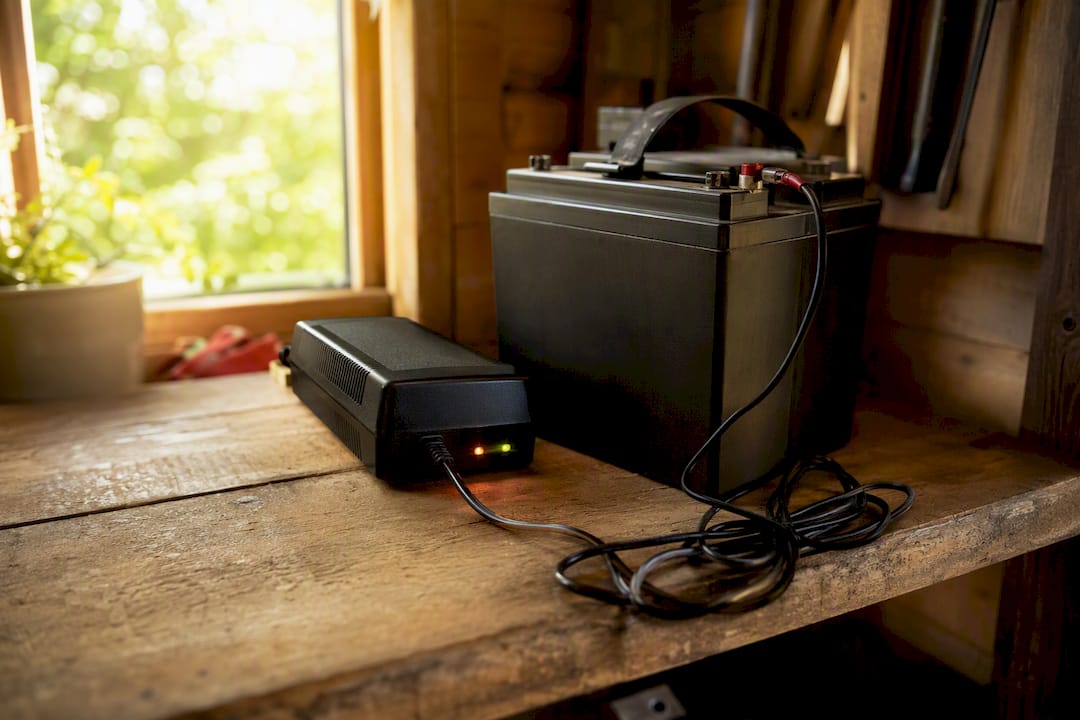
For SLA/AGM batteries, charge after every use regardless of how much range you used, and avoid letting the pack sit fully discharged for more than a day or two. Deep, prolonged discharge is the single fastest way to kill a lead-acid cell early. Lithium batteries behave differently. They tolerate partial discharge well and don't need a full top-up every night. Keeping a lithium pack in the middle of its charge range during storage, rather than fully charged or fully drained, preserves capacity better over time.
Storage temperature is one of the most overlooked factors in battery longevity. Keeping batteries in a range of roughly 15 to 25°C minimizes accelerated degradation; a battery left in a cold garage over winter or a hot shed in summer will lose capacity faster than one stored indoors at room temperature. If your battery pack is removable, bring it inside during extreme weather rather than leaving it on the scooter.
A few habits protect your investment beyond charging:
- Wipe terminals clean of corrosion or dust buildup every few months.
- Keep tires properly inflated. Underinflated tires make the motor draw more current, straining the battery.
- Avoid overloading the scooter beyond its rated weight limit, which forces the battery to work harder on every trip.
- Replace any charger that runs unusually hot, clicks on and off erratically, or fails to reach a full charge indicator. A faulty charger can degrade even a healthy battery quickly.
- For storage longer than a month, check and top up the charge roughly once a month rather than leaving the battery untouched.
Consumer guidance from RiDC notes that most mobility scooter batteries need replacing every 12 to 18 months under typical use, so treating storage and charging seriously can meaningfully stretch that window.
Disposing of and Recycling Old Scooter Batteries
Both lead-acid and lithium batteries count as hazardous waste and should never go in household trash. Improperly discarded batteries can leak corrosive material or, in the case of damaged lithium cells, pose a fire risk in landfill or recycling trucks that aren't equipped to handle them.
- Check whether your battery retailer offers a take-back program when you buy the replacement.
- Use a municipal hazardous-waste drop-off point if retailer take-back isn't available.
- Insulate exposed terminals with electrical tape before transport to prevent short circuits.
- Keep batteries upright during transport, especially older AGM units that can leak if tipped.
Most jurisdictions also route mobility scooter batteries through certified electronics or battery recyclers, so a quick call to your local waste authority will confirm the nearest accepted drop-off site.
A Note on Product Expertise and Getting the Right Fit
Akkuplus, operated by AkkuPlus GmbH & Co. KG at akkuplus.de, maintains detailed spec pages for lead-acid, AGM, and specialty cell types, including exact dimensions, terminal photos, and Ah ratings for each listing. That level of detail matters when you're trying to match a scooter battery without pulling the old one out first.
- Product pages list voltage, Ah, terminal style, and physical dimensions side by side.
- Photos help confirm terminal type before you order, avoiding a mismatched delivery.
- Customer support is available for compatibility questions when spec sheets alone leave doubt.
What Actually Matters When You're Buying a Replacement
Most guides on this topic spend too much time on brand comparisons and not enough on the two things that actually determine whether your purchase works: exact spec matching and honest assessment of your usage pattern. A battery that's a perfect chemistry match but the wrong Ah rating or terminal type is still the wrong battery.
The conventional advice to "just buy the same brand as before" misses that many scooters ship with generic OEM batteries rebranded under the scooter manufacturer's name. The real spec, not the label, is what you need to match. That's why voltage, Ah, and physical dimensions deserve more attention than brand loyalty.
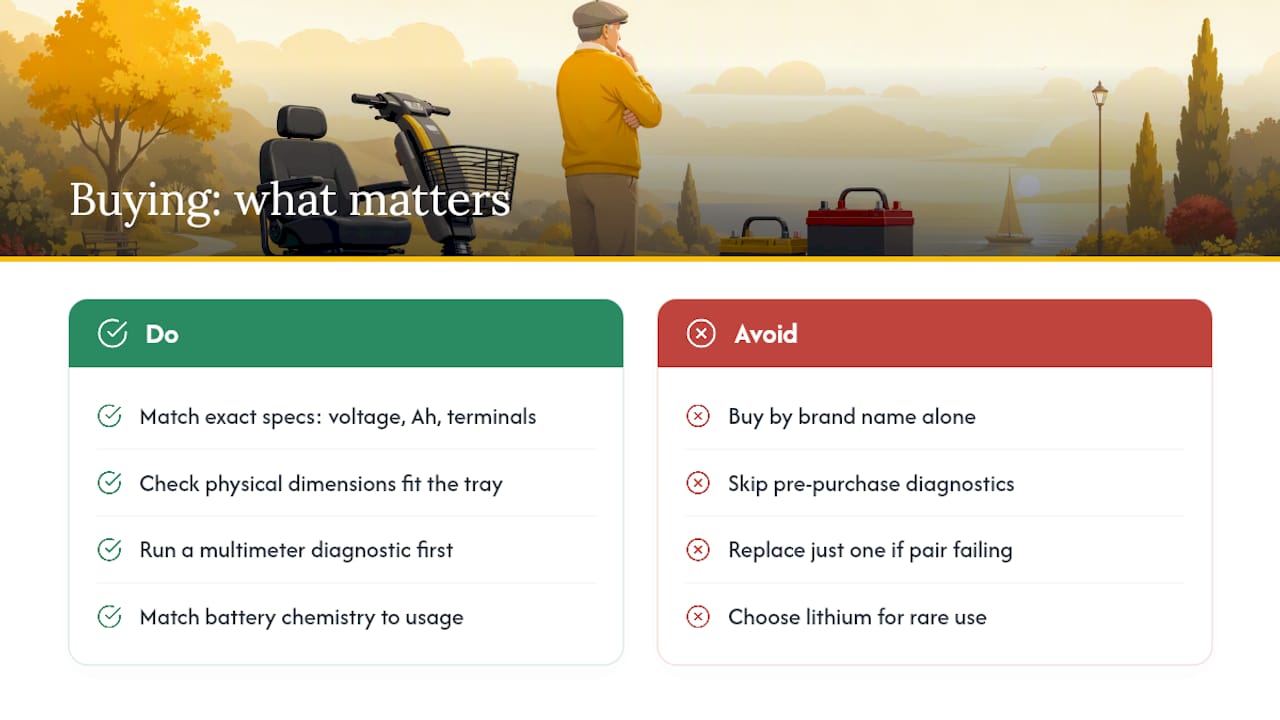
If there's one place buyers underinvest, it's diagnostics before purchase. A five-minute multimeter check can tell you whether you're dealing with one weak cell or two, whether the charger is actually the problem, or whether the batteries just need a proper conditioning charge. Skipping that step leads to replacing parts that didn't need replacing, or worse, buying a single battery when the paired one needed to go too.
Lithium's rising popularity is deserved for frequent riders, but it's not automatically the better buy for someone who takes their scooter out twice a week. Match the chemistry to how you actually live, not to what sounds more advanced.
— Waldemar
Where to Buy Mobility Scooter Batteries That Actually Fit
Akkuplus built its catalog around exact spec matching, not vague category listings, which is the biggest headache for anyone trying to replace a mobility scooter battery without guesswork. Every product page lists voltage, Ah rating, terminal style, and physical dimensions together, so you can compare your old battery's nameplate against the listing before you spend a cent.

If your scooter runs a common 12V configuration, the Panasonic LC-P1224APG 12V 24Ah is a solid example of the detailed listings available, with full dimensions and terminal specs on the page itself. For 6V pairs common in smaller travel scooters, the EnerSys Hawker Cyclon 6V 5000mAh line covers that footprint. And if you're unsure which battery your scooter actually needs, Akkuplus's support team can help confirm compatibility before you order rather than after a return. Browse the full battery catalog to find your exact match and get your scooter back on the road.
Key Takeaways
Matching voltage, Ah rating, and terminal type is the single biggest factor in a successful mobility scooter battery replacement, more than brand or chemistry choice alone.
| Point | Details |
|---|---|
| Check specs before buying | Confirm voltage, Ah rating, and terminal type from the label or manual, not from memory. |
| Choose chemistry by usage | SLA/AGM suits occasional riders on a budget; LiFePO4 suits daily users who want lighter, longer-lasting power. |
| Test before you replace | A resting voltage check and load test can confirm whether one or both batteries actually need swapping. |
| Charge and store correctly | Keep batteries between 15 and 25°C, top up SLA after every ride, and avoid deep discharge cycles. |
| Buy from spec-detailed listings | Akkuplus lists exact voltage, Ah, and terminal specs on every product page, making compatibility checks straightforward. |