
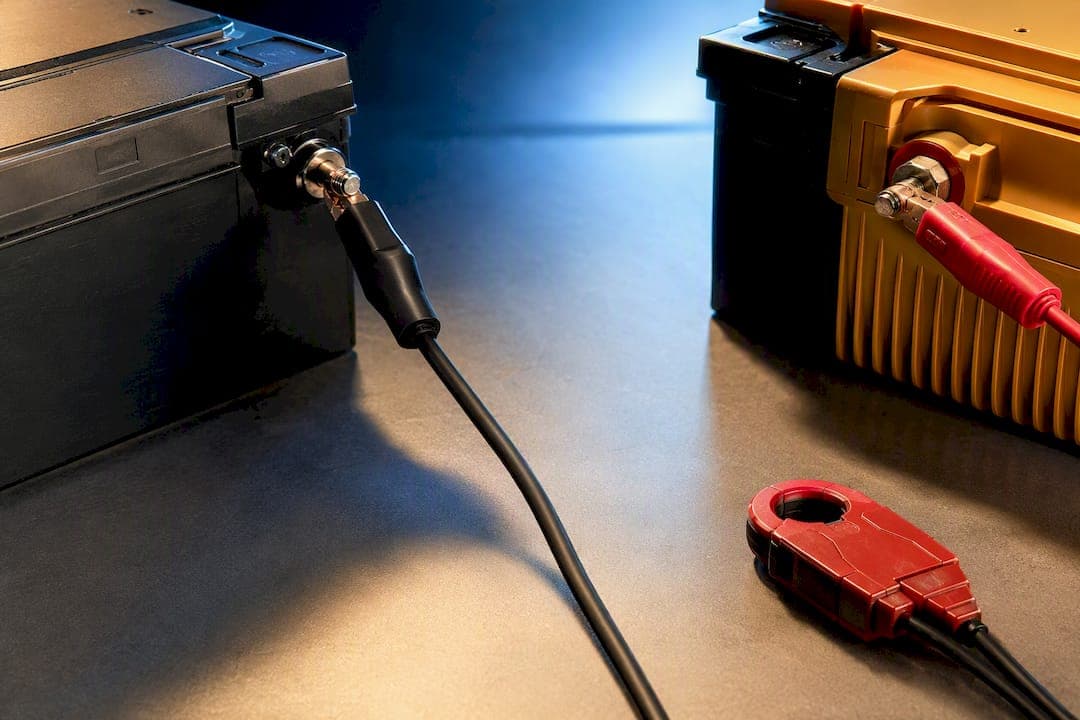
For daily‑cycled systems, from solar homes to RVs running fridges every night, LiFePO4 lithium batteries beat lead acid on usable capacity, cycle life, efficiency, and 10‑year cost. Lead acid still makes sense for rare‑use backup or the tightest upfront budgets. The one hard rule: never charge LiFePO4 below freezing without a heater or a battery management system built to block it.
TL;DR:
- LiFePO4 batteries can typically accept higher charge rates and have about 95% round-trip efficiency, reducing energy waste compared to lead acid.
- In cold temperatures below freezing, lithium batteries require a BMS with a heater to prevent capacity loss and internal damage, unlike lead acid.
- Lithium batteries deliver significantly more usable energy over their lifespan, with higher cycle counts and deeper discharge tolerances than lead acid.
- Lead acid remains more budget-friendly upfront and better suited for infrequent use or engine starting applications.
- Proper system integration requires compatible charge controllers, inverters, and accurate BMS communication to ensure safe and efficient operation of lithium batteries.
Table of Contents
- Lithium vs Lead Acid: Cycle Life and Usable Capacity
- How Do Voltage Curves Affect Real-World Power Delivery?
- Which Battery Charges Faster and Wastes Less Energy?
- Does Cold Weather Ruin Lithium Batteries?
- Installation Space, Weight, and Wiring Differences
- What Does a 10-Year Battery Actually Cost You?
- Safety, Maintenance, and Recycling Rules to Know
- Which Battery Chemistry Fits Your Use Case?
- What to Check Before Buying From Akkuplus.de
- Self-Discharge: The Cost of Doing Nothing
- How Depth of Discharge Affects Warranty Coverage
- Manufacturing Footprint and Resource Availability
- Making Sure Your BMS and Inverter Play Nice
- Betting on Lithium Without Ignoring the Fine Print
- Get the Right Battery From Akkuplus Instead of Guessing
- Sources
- FAQ
Lithium vs Lead Acid: Cycle Life and Usable Capacity
The number on the label is not the number you actually get to use. A 100Ah lead-acid battery and a 100Ah LiFePO4 battery are not the same product once you factor in depth of discharge, the percentage of rated capacity you can safely draw before recharging.
LiFePO4 tolerates 80 to 90% DoD without meaningfully shortening its life. Lead acid, whether flooded, AGM, or gel, needs to stay around 50% DoD to hit its rated cycle count, and pushing it deeper accelerates plate degradation.
Run the math on two 100Ah batteries used daily:
- LiFePO4 at 85% DoD: ~85Ah usable per cycle, rated for 3,000 to 6,000 cycles to 80% remaining capacity
- AGM lead acid at 50% DoD: ~50Ah usable per cycle, rated for roughly 300 to 800 cycles
That gap compounds fast.
How Do Voltage Curves Affect Real-World Power Delivery?
Lead acid voltage sags steadily as it discharges. LiFePO4 holds a nearly flat voltage across almost its entire usable range, then drops sharply near empty. That difference shows up the moment you plug in a load.
Run an inverter off a lead-acid bank and your lights dim gradually as the battery drains. Run the same inverter off LiFePO4 and the lights stay full brightness right up until the battery is nearly empty, then the system cuts out with little warning. Some inverters and low-voltage cutoffs need reconfiguring to match that lithium behavior.
- Energy density: LiFePO4 typically packs 90 to 160 Wh/kg versus 30 to 50 Wh/kg for lead acid, meaning a lithium bank delivering the same usable energy weighs a fraction as much
- Power density: LiFePO4 handles higher continuous discharge rates relative to its size, which matters for inverters pulling heavy sustained loads
- Surge capacity: flooded and AGM starter batteries still deliver excellent cold-cranking amps for a fraction of a second, which is why AGM starter batteries remain the default for vehicle ignition rather than lithium starting packs
If your application is a quick, massive burst of current, cranking an engine, lead acid's chemistry still has an edge worth respecting.
Which Battery Charges Faster and Wastes Less Energy?
Charge speed and efficiency are where lithium separates itself most clearly from lead acid, and the numbers are concrete enough to plan a system around.
- Charge acceptance: LiFePO4 can typically accept charge rates up to about 1C (a full charge in roughly an hour under ideal conditions), while lead acid needs a slower, staged approach: bulk, absorption, and float phases that stretch a full recharge to several hours.
- Round-trip efficiency: LiFePO4 commonly reaches around 95% round-trip efficiency, while lead acid typically lands between 70 and 85%. On a daily 2 kWh cycle, that gap means lead acid wastes roughly 300 to 600 Wh more per day than LiFePO4, energy your solar panels or generator have to produce twice.
- Charger settings: switching chemistries almost always means reprogramming your charge controller or MPPT unit. LiFePO4 needs different absorption voltages, no equalization phase, and often a dedicated lithium profile; using a lead-acid charge profile on a lithium bank either undercharges it or trips the BMS.
Does Cold Weather Ruin Lithium Batteries?
Charging LiFePO4 below freezing can cause lithium plating on the anode, a form of permanent internal damage that quietly kills capacity and long-term safety margins. This is the single biggest technical trap for lithium buyers moving from lead acid, and it does not announce itself the way a dead lead-acid cell does.
A capable BMS built into LiFePO4 packs will disconnect the charging circuit automatically below roughly 0°C, protecting the cells at the cost of leaving you without charging capability until temperatures recover. At the other extreme, high heat accelerates lead-acid grid corrosion and water loss faster than it degrades LiFePO4 cells, which tolerate heat somewhat better but still age faster above roughly 45°C.
Pro Tip: If your battery bank lives in an unheated shed, garage, or boat locker, consider LiFePO4 models with an integrated self-heating function or provide an insulated, thermostatically controlled enclosure to protect charging performance. It's cheaper than replacing plated cells two winters from now.

Installation Space, Weight, and Wiring Differences
A lead-acid bank delivering the same usable energy as a lithium system often weighs two to three times as much and takes up considerably more floor or shelf space, a real constraint on boats, vans, and wall-mounted home battery setups.
- LiFePO4 packs typically arrive with an internal BMS that manages cell balancing automatically, so wiring batteries in series or parallel is largely plug-and-play within the manufacturer's stated limits.
- Lead-acid banks wired in series or parallel need manual attention to cable gauge and connection points to avoid uneven charging across cells.
- Flooded lead-acid batteries require ventilated enclosures and spill containment because they off-gas hydrogen and can leak electrolyte; sealed AGM and gel variants relax that requirement somewhat but still need airflow.
- Wall-mounted or vehicle installs favor lithium's lighter, sealed form factor, while flooded lead acid generally belongs in a ventilated utility space, not a living area.
What Does a 10-Year Battery Actually Cost You?
Sticker price is the wrong number to compare. What matters is cost per usable kWh delivered over the battery's life, calculated as purchase cost divided by usable kWh per cycle multiplied by total cycles.
- Set up the comparison: a 100Ah, 12V lead-acid AGM battery holds 1.2 kWh rated, 0.6 kWh usable at 50% DoD, and lasts roughly 500 cycles. A 100Ah, 12V LiFePO4 battery holds the same 1.2 kWh rated, but delivers about 1.0 kWh usable at 85% DoD across roughly 4,000 cycles.
- Calculate lifetime usable energy: the AGM delivers 0.6 kWh × 500 cycles = 300 kWh over its life. The LiFePO4 battery delivers 1.0 kWh × 4,000 cycles = 4,000 kWh, more than thirteen times the total energy throughput from the same rated capacity.
- Add replacement cycles: to match the LiFePO4 unit's lifespan cycling daily, you'd replace the AGM battery roughly seven to eight times, each replacement adding purchase cost, labor, and disposal fees.
- Factor in hidden costs: every lead-acid swap means physically removing a heavy battery, handling electrolyte or lead safely, and paying recycling or core-charge fees. LiFePO4's far longer service life means most of that labor and disposal cost simply doesn't recur.
- Compare the totals: even though a LiFePO4 battery often costs two to four times more upfront than an equivalent AGM unit, its dramatically higher usable kWh and cycle count typically bring its cost per delivered kWh well below lead acid's over a decade of regular cycling, a pattern industry cost comparisons confirm repeatedly for solar and daily-use applications.
Safety, Maintenance, and Recycling Rules to Know
Flooded lead-acid batteries need periodic water top-ups and terminal cleaning; AGM and gel variants are sealed and maintenance-free but still benefit from a voltage check every few months. LiFePO4 packs need essentially no manual maintenance beyond occasionally confirming the BMS firmware is current and connections are tight.
- Flooded lead acid vents hydrogen gas during charging, so ventilation and a spill kit are non-negotiable in enclosed spaces.
- LiFePO4 is chemically far more thermally stable than older lithium chemistries like NMC, but a damaged or poorly made pack can still overheat, which is why a certified BMS and enclosure matter.
- Lead-acid recycling infrastructure is mature and widespread across Europe; lithium recycling is expanding quickly under the EU Battery Regulation's stricter collection and recovery targets.
- Life-cycle studies find lead acid carries notably higher mineral and metal resource use per delivered kWh than lithium chemistries, a gap that shows up before either battery reaches end of life.
Which Battery Chemistry Fits Your Use Case?
Match the chemistry to how often the battery cycles, not just what it costs on day one.
- Solar home daily cycling: LiFePO4, for the DoD and cycle-life advantages alone.
- Backup or UPS power, rarely discharged: lead acid can be perfectly adequate if budget is tight and cycling is occasional.
- RV and marine house banks: LiFePO4, primarily for the weight savings and deeper usable capacity in a fixed space.
- Engine starter batteries: AGM or flooded lead acid remains the practical standard for cold-cranking surges.
- Very low upfront budget, infrequent use: lead acid keeps the initial outlay lowest.
Three questions settle most decisions: How often will this battery actually cycle? Is weight or space a hard constraint? What's your budget horizon, upfront cost or 10-year cost?
| Use case | Recommended chemistry | Key reason |
|---|---|---|
| Daily solar cycling | LiFePO4 | Higher DoD, longer cycle life |
| Rare-use backup/UPS | Lead acid | Lower upfront cost |
| RV/marine house bank | LiFePO4 | Weight and space savings |
| Vehicle starter battery | AGM lead acid | Superior cold-cranking surge |
Grid-tied systems, higher-voltage battery banks, or any installation touching your home's electrical panel should involve a licensed installer, both for safety and to satisfy local code.
What to Check Before Buying From Akkuplus.de
Some battery retailers stock both lithium and lead-acid options across capacities and form factors, from small primary cells to AGM starter batteries, allowing buyers to translate comparisons into product choices.
Before buying, check the product page for: chemistry and cell type, cycle rating, usable DoD, BMS features (including low-temperature protection), warranty length, and recycling guidance. Compare listings by usable kWh, not just Ah or price.
Self-Discharge: The Cost of Doing Nothing
Every battery loses charge sitting on a shelf, but the rate differs enough to matter for backup systems that sit idle for months.
Lead-acid batteries typically self-discharge at around 3 to 5% per month, meaning a fully charged backup battery left alone for six months could drop to roughly 70 to 80% state of charge before you ever draw a load from it. That loss accelerates in warm storage conditions, which is part of why lead-acid backup units need periodic maintenance charging even when nobody uses them.
For a solar backup system or a boat battery that sits through an off-season, that difference means less time spent topping off before the battery is ready to work, and less risk of a lead-acid bank sulfating from prolonged low charge.
Standby losses matter most for float applications: emergency lighting, alarm systems, or RVs stored over winter. If a battery sits unused for long stretches, lithium's lower self-discharge translates into fewer maintenance visits and less risk of showing up to a dead battery when you actually need it. For batteries cycled daily, self-discharge is close to irrelevant since the battery rarely sits idle long enough for it to matter.
How Depth of Discharge Affects Warranty Coverage
Most manufacturer warranties are written around an assumed depth of discharge, and exceeding it voids coverage faster than people expect.
Lead-acid warranties are stricter about this relationship. Lead-acid warranties rarely cover degradation tied to habitual deep discharge, since the plates suffer irreversible sulfation faster outside the recommended range.
The practical takeaway: buy more usable capacity than you think you need, on either chemistry, so your typical daily draw stays comfortably inside the DoD the warranty assumes. The same logic applies to lead acid, just at a lower ceiling. Warranty terms vary by manufacturer, so confirm the assumed DoD and cycle rating on the specific product page before you buy, not after a claim is denied.
Manufacturing Footprint and Resource Availability
Recycling gets most of the environmental attention, but the manufacturing side of the comparison tells a different part of the story.
Lead-acid production draws on a well-established global lead supply chain with mature mining and refining infrastructure, but lead is a toxic heavy metal, and extraction and smelting carry established occupational and environmental hazards that regulators have spent decades managing. Lithium-ion production depends on mining lithium, along with cobalt, nickel, or iron and phosphate depending on chemistry. LiFePO4 specifically avoids cobalt and nickel entirely, relying on iron and phosphate, both considerably more abundant and less geopolitically concentrated than cobalt supply chains tied to other lithium chemistries.
Life-cycle assessments comparing the two technologies cradle-to-grave find that lead acid requires substantially more mineral and metal resource extraction per delivered kWh, largely because its lower energy density means more total material mass is needed to store and deliver the same amount of usable energy. Lithium chemistries generally show a lighter footprint in that category, though results vary depending on which lithium chemistry is compared and how the assessment accounts for mining impacts.
One nuance worth flagging: lithium's environmental advantage grows over time as electricity grids add more renewable generation, since a meaningful share of a battery's lifetime footprint comes from the energy used to charge and discharge it, not just the energy used to manufacture it. A battery charged mostly from coal power looks different on paper than the same battery charged from solar, regardless of chemistry.
Making Sure Your BMS and Inverter Play Nice
Compatibility problems between batteries and existing electronics are one of the most common, and most avoidable, mistakes in a chemistry switch.
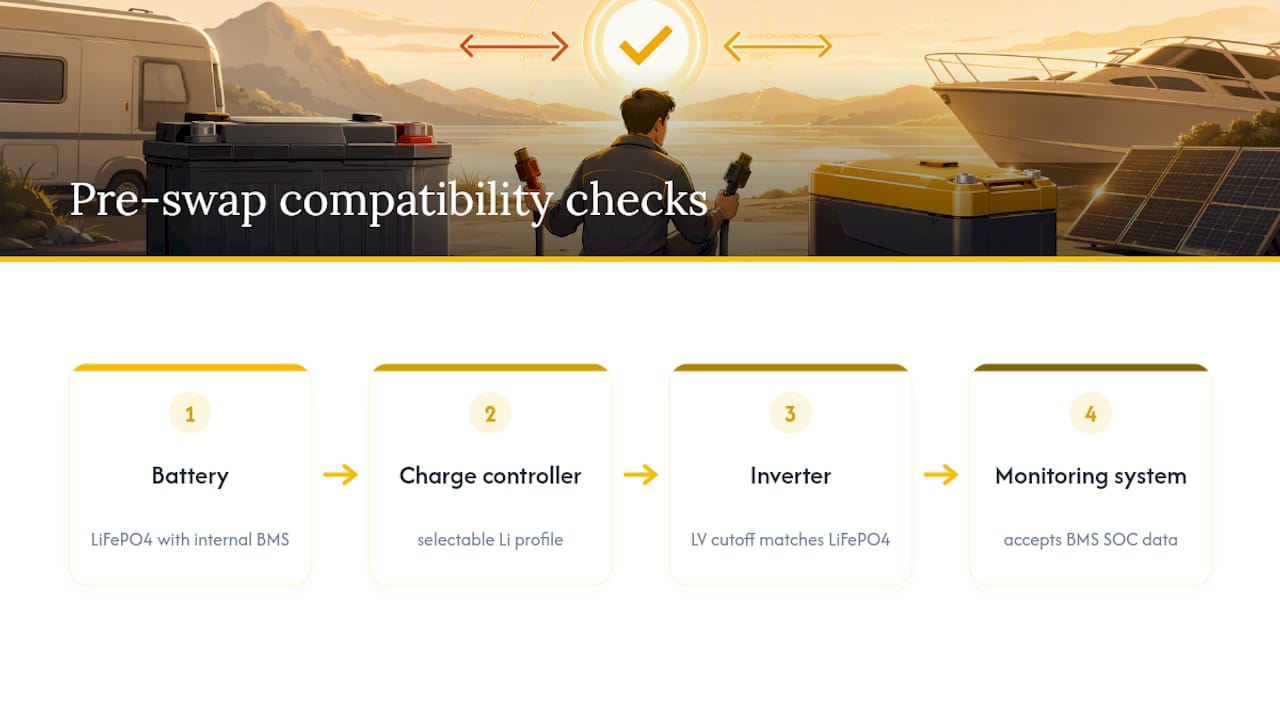
LiFePO4 batteries almost always ship with an internal BMS handling cell balancing, over-discharge protection, and often low-temperature charge lockout. That BMS needs to communicate correctly with your charge controller, inverter, and any monitoring system, either through a simple voltage-based setup or, in more sophisticated installs, a communication protocol like CAN bus or RS485. Mismatched communication protocols are a common reason a technically compatible lithium battery fails to charge correctly on a system originally wired for lead acid.
Most inverters and MPPT solar charge controllers sold in the last several years include a selectable "lithium" or "LiFePO4" profile alongside the standard lead-acid settings, adjusting absorption voltage, disabling equalization cycles, and tightening low-voltage cutoffs to match lithium's flat discharge curve. Older inverters and charge controllers built exclusively for lead acid may lack this option entirely, which means either a firmware update, if the manufacturer offers one, or a hardware replacement before a lithium upgrade makes sense.
Before swapping chemistries in an existing system, confirm three things: whether your charge controller has a lithium-specific charge profile, whether your inverter's low-voltage cutoff matches LiFePO4's discharge behavior, and whether the new battery's BMS can communicate its state of charge to your existing monitoring setup. Skipping that check is how people end up with a battery that charges but never reports accurate capacity.
Betting on Lithium Without Ignoring the Fine Print
The lifecycle math on LiFePO4 is hard to argue with. Longer cycle life, higher usable DoD, and better round-trip efficiency add up to lower cost per delivered kWh in almost any application that cycles regularly. That said, safety and correct installation matter more than chasing the newest chemistry.
Watch how quickly LiFePO4 pricing keeps falling and keep an eye on solid-state battery development, still early, but worth tracking if you're planning a system with a decade-plus horizon. For most buyers today, matching the battery to how it will actually be used matters more than betting on what comes next.
— Waldemar
Get the Right Battery From Akkuplus Instead of Guessing
Akkuplus carries both lithium and lead-acid batteries side by side, so you can compare usable capacity and specs on the actual product page instead of relying on marketing claims from a manufacturer site. That matters most for buyers replacing an existing lead-acid bank with LiFePO4, where getting the cell type, voltage, and BMS features right the first time saves a return shipment.

If you're weighing a starter battery upgrade, the Optima Red Top AGM starter battery page lists cold-cranking specs directly, while the EnerSys Cyclon lead-acid cell page covers a compact sealed option for smaller installs. Compare usable kWh across listings before you decide.
Sources
- LiFePO4 Battery vs Lead‑Acid Battery: Complete Guide (Safecloud)
- LiFePO4 vs Lead Acid Batteries (PowerStationPicker)
- Battery technologies compared: lithium, lead and solid‑state (PV‑Calor)
FAQ
What Are the Disadvantages of a Lithium-Ion Battery?
LiFePO4 batteries cost more upfront, cannot safely charge below roughly 0°C without a heater or BMS lockout, and require compatible chargers and inverters, which can mean replacing older lead-acid-only equipment.
Will Lithium Replace Lead Acid Completely?
Not entirely. LiFePO4 is steadily displacing lead acid in solar, RV, and marine house banks due to superior cycle life and efficiency, but lead acid remains standard for vehicle starter batteries and low-budget, rarely cycled backup applications.
Is Lead Acid Safer Than Lithium-Ion?
Lead acid poses different risks, corrosive electrolyte and hydrogen gas venting, rather than fewer risks. LiFePO4 is one of the more thermally stable lithium chemistries available, but any battery needs a proper enclosure, ventilation where applicable, and a certified BMS to operate safely.
How Do I Know If I Have a Lead-Acid or Lithium Battery?
Check the battery label for chemistry markings like "LiFePO4," "Li-ion," "AGM," "Gel," or "Flooded Lead Acid." Lithium batteries also weigh noticeably less than a lead-acid battery of the same rated capacity, a quick physical clue if the label is missing or worn.