

Most riding mower owners should buy a 12V lead-acid or AGM battery in the group size their manual specifies. Walk-behind cordless owners need the lithium pack the manufacturer sells for that model, not a generic swap. Three things make this the right call almost every time: it matches what the mower's charging system was built for, it delivers enough cold cranking amps (CCA) to spin the starter reliably, and lead-acid or AGM handles the seasonal on-off use pattern most mowers actually see better than exotic alternatives.
There are two exceptions worth knowing before you order. If you run a zero-turn or commercial mower that vibrates hard for hours at a time, AGM is worth the extra cost because it resists plate damage that kills standard flooded batteries early. And if your mower's electrical system already supports LiFePO4, switching can lower your long-term cost even though the sticker price stings upfront.
Before you click "buy," confirm these three things:
- Voltage matches exactly (almost always 12V for riding mowers, 6V for some smaller or older equipment)
- Physical group size and terminal orientation match your old battery or your owner's manual
- CCA meets or exceeds the original equipment manufacturer (OEM) spec, not just "close enough"
Pro Tip: Buying a battery with higher CCA than your mower needs rarely hurts, but buying one with lower Ah than the OEM spec can starve accessories like electric decks or lights during long mowing sessions.
Key Takeaways
Matching voltage, physical group size, and terminal orientation exactly, while meeting or exceeding OEM CCA, is what determines whether a replacement battery actually works.
| Point | Details |
|---|---|
| Confirm specs before buying | Check voltage, group size, and terminal orientation against your manual or old battery's label. |
| Chemistry depends on use | Standard flooded lead-acid suits weekend riding mowers; AGM or LiFePO4 suits zero-turns and heavy use. |
| Winter storage protects lifespan | Store the battery cool, dry, and frost-free around 10 to 15°C, and keep it charged during downtime. |
| Not every dead battery needs replacing | Shallow discharge often responds to a conditioning charger, but cracked cases or swollen units don't. |
| Keep your receipt | Some regions charge a deposit on starter batteries that refunds when you return the old unit for recycling. |
| Shop with datasheets, not guesswork | Akkuplus product pages list full specs for SKUs like the Panasonic LC-P1224APG and Optima Red Top RT S so you can confirm fit before ordering. |
Table of Contents
- Which Battery Chemistry Is Right for Your Mower?
- What Specs Do You Need to Match Before You Order?
- What Group Size Does Your Mower Use?
- How Do You Safely Replace a Mower Battery?
- How Long Should Your Battery Last, and What Kills It Early?
- How Should You Charge and Store Your Battery Over Winter?
- Can a Dead Mower Battery Be Revived?
- What Should You Check Before You Buy?
- Price, Weight, and Longevity: What Actually Matters Most?
- Where Akkuplus Makes This Purchase Easier
- Sources
Which Battery Chemistry Is Right for Your Mower?
Four chemistries show up in lawn equipment, and each one trades off differently between price, maintenance, and durability. Picking the wrong one is not usually a safety issue. It is a money and hassle issue that shows up eighteen months later.
Flooded lead-acid is the default in most riding mowers because it is cheap and simple. It needs occasional water top-ups, tolerates a wide temperature range poorly, and can spill acid if tipped. AGM (Absorbent Glass Mat) batteries seal the electrolyte in a glass mat instead of leaving it liquid, which makes them spill-proof and notably more vibration-resistant than flooded designs. That construction also lets AGM units squeeze higher CCA into the same physical case. Gel batteries use a thickened electrolyte that also resists leakage, but they carry higher internal resistance and weaker cold-cranking output than AGM, so they suit deep-cycle accessory use better than starting duty. LiFePO4 (lithium iron phosphate) shows up in cordless push mowers and increasingly in premium riding models, offering a longer service life at a much higher purchase price.
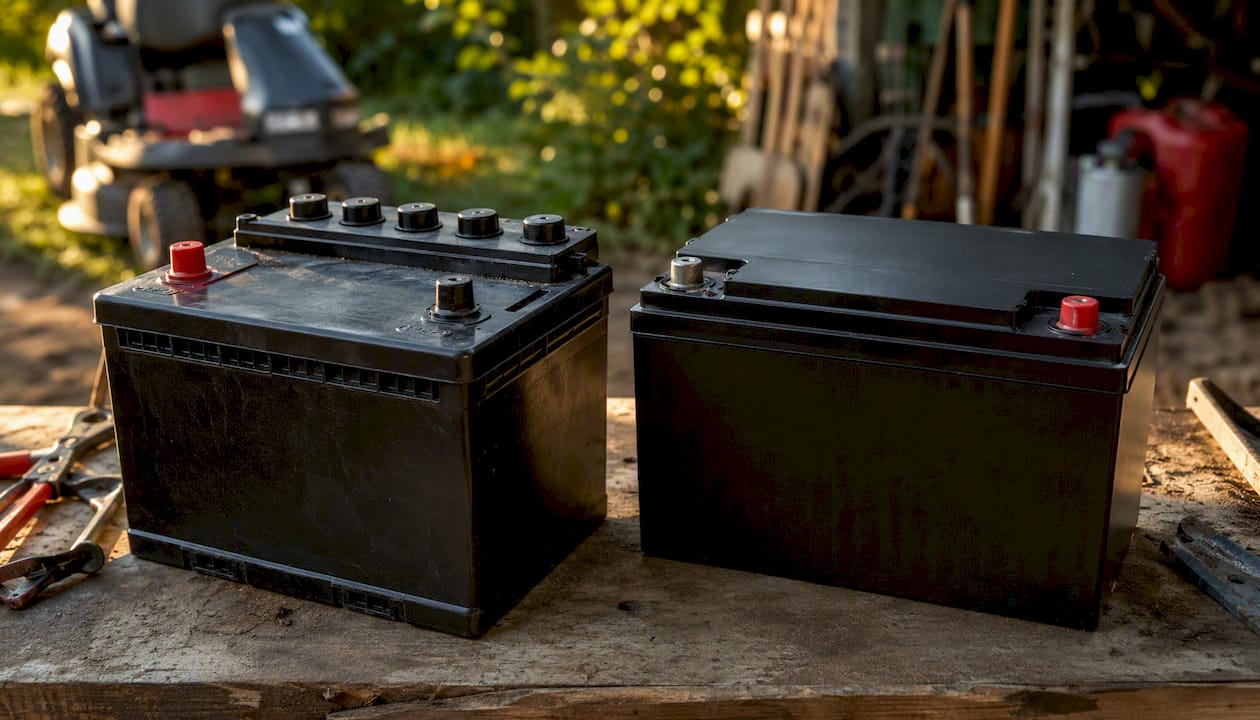
| Chemistry | Maintenance | Spill risk | Typical lifespan | Self-discharge | Cost tier |
|---|---|---|---|---|---|
| Flooded lead-acid | Periodic water top-up | Higher (liquid electrolyte) | 3 to 5 years | Moderate to high | Low |
| AGM | Sealed, none required | None | 3 to 6 years, often longer under vibration | 1 to 3% per month | Medium |
| Gel | Sealed, none required | None | 3 to 5 years | Low to moderate | Medium |
| LiFePO4 | Sealed, none required | None | Often 5 to 7+ years | Very low | High |
The purchase-relevant differences boil down to a short list:
- Flooded lead-acid costs the least but demands occasional maintenance and handles vibration worst.
- AGM is sealed, vibration-resistant, and holds charge in storage far better than flooded designs.
- Gel resists leakage but underperforms AGM for high cranking loads.
- LiFePO4 costs more upfront but often wins on total lifetime cost thanks to cycle life and near-zero self-discharge.
If you are thinking about swapping chemistries, not just replacing like-for-like, check two things first: whether your mower's charging system outputs a voltage compatible with the new chemistry (AGM and lithium both want tighter voltage control than old flooded systems), and whether the new battery's physical dimensions actually fit the tray and hold-down bracket. A 12V lead-acid unit like the Long WP1250 is a straightforward like-for-like swap for many riding mowers, while stepping up to an AGM starter battery such as the Optima Red Top RT S usually requires nothing more than confirming your charger can handle its higher recommended charging voltage.
What Specs Do You Need to Match Before You Order?
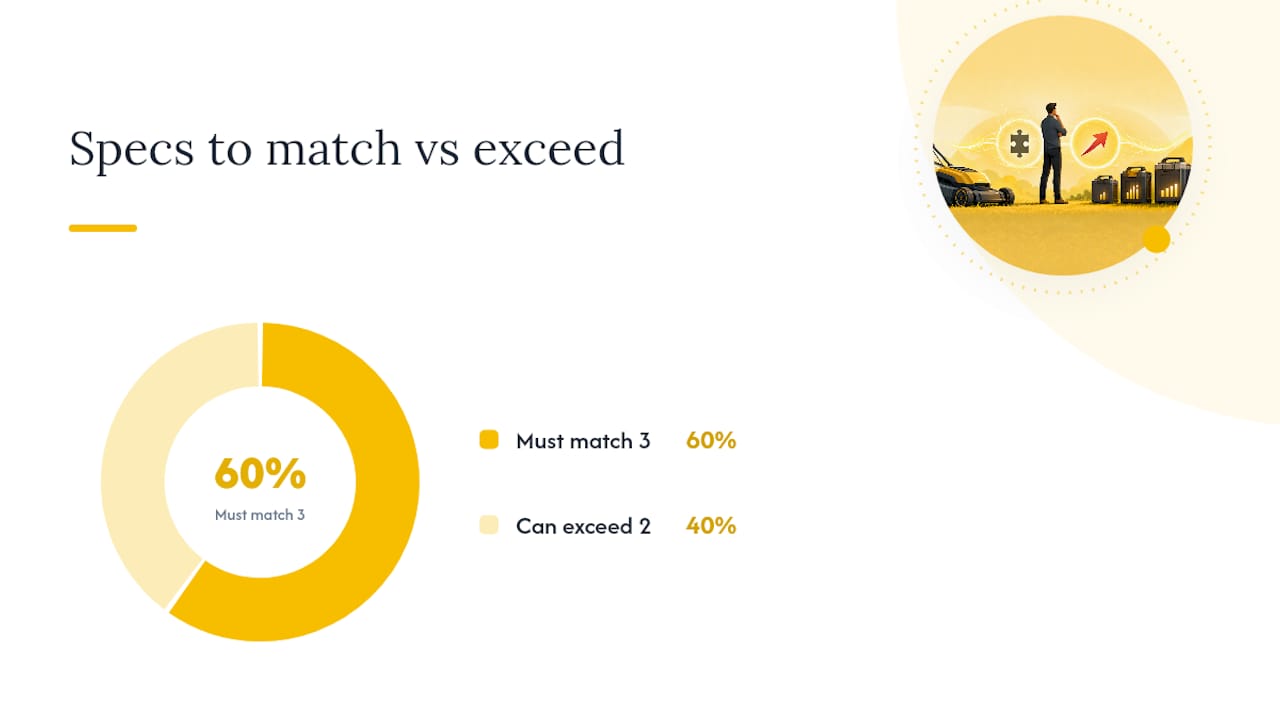
Confirm three facts before you buy anything: voltage, physical group size (BCI dimensions), and terminal type and polarity. Get any one of these wrong and the battery either won't fit the tray, won't connect to your cables, or won't deliver the power your starter motor needs.
Your owner's manual lists the exact group size and voltage the manufacturer specified. If you've lost the manual, check the sticker on your old battery, which usually prints the group number, voltage, and Ah rating directly on the case. Most riding mowers run on 12V systems, though some older or smaller equipment still uses 6V batteries.
Two specs get confused constantly: CCA (cold cranking amps) measures how much current the battery can deliver for a few seconds in cold conditions, which is what actually spins your starter. Ah (amp-hours) measures total energy capacity, which matters more if your mower runs lights, an electric deck lift, or other accessories that draw power over time. For a simple riding mower with no extras, CCA is the number to prioritize. For a mower loaded with electric accessories, Ah deserves equal attention.
| Spec | Match exactly | Can exceed with caveats |
|---|---|---|
| Voltage | Yes, always | No |
| Physical group size / dimensions | Yes, must fit tray and hold-down | No |
| Terminal type and polarity | Yes, must match cable routing | No |
| CCA | No, minimum requirement | Yes, higher CCA is generally fine |
| Ah | No, minimum requirement | Yes, higher Ah rarely causes problems |
Before ordering, measure your old battery's length, width, and height, and note which terminal sits on which side when the battery is oriented as it sits in the mower. A datasheet like the one for the Panasonic LC-P1224APG lists these exact physical dimensions alongside voltage and Ah, which makes cross-checking against your old unit a five-minute job instead of a guessing game.
What Group Size Does Your Mower Use?
Group size notation tells you the physical case dimensions and terminal layout a battery uses, and matching it correctly is what actually determines whether a replacement drops into your mower's tray without modification.
The group size is usually stamped or printed directly on the battery case, often near the terminals or on a side label. If that label has worn off, cross-reference the dimensions against a parts manual for your mower's exact model year, since manufacturers occasionally shift group sizes between production runs.
Garden tractors and some commercial-grade zero-turns sometimes use oversized or less common battery cases that don't map cleanly to a standard BCI group number. When that happens, don't guess. Pull up your mower's parts manual or check with a dealer, because ordering the wrong oversized unit usually means paying return shipping on something too big for the tray.
How Do You Safely Replace a Mower Battery?
Shut off the mower, remove the key, disconnect the negative terminal first, then the positive, lift the old battery out, install the replacement, and reconnect positive before negative. That sequence matters because disconnecting negative first eliminates the risk of your wrench arcing against grounded metal while the positive terminal is still live.
- Park the mower on level ground, engage the parking brake, and remove the ignition key.
- Put on gloves and eye protection. Battery acid burns skin and eyes on contact.
- Locate the battery, usually under the seat on riding mowers or behind an access panel on larger units.
- Disconnect the negative (black) cable first, then the positive (red) cable.
- Remove any hold-down bracket or strap, then lift the battery straight out.
- Set the new battery in the tray, orienting terminals to match the original layout.
- Reconnect the positive cable first, then the negative, tightening bolts to the torque your manual specifies (overtightening cracks terminal posts).
- Coat terminals with a dielectric grease or terminal protector spray, then secure the hold-down bracket.
Safety callouts: Charging any lead-acid or AGM battery produces hydrogen gas, so charge in a ventilated area away from open flame or sparks. If acid spills from a damaged flooded battery, neutralize it with baking soda and water before cleanup, and never let it touch skin or fabric without rinsing immediately. Old starter batteries count as hazardous waste in most places and need to go to a proper recycling point rather than the trash, and most sellers or service shops will take the old unit off your hands when you buy the replacement.
Once installed, test with a multimeter across the terminals. A fully charged 12V lead-acid or AGM battery should read between 12.6V and 12.8V at rest. Start the mower and confirm the engine cranks smoothly without hesitation or clicking, which would signal a bad connection or an undersized battery.
Pro Tip: Torque terminal bolts snug but not aggressive. Cracked posts are one of the most common warranty claims on new mower batteries, and it's almost always from overtightening during install.
How Long Should Your Battery Last, and What Kills It Early?
Lead-acid batteries typically last 3 to 5 years, AGM often matches or slightly beats that range, and LiFePO4 units can run 5 to 7 years or longer with proper care. Those numbers assume normal seasonal use, not daily commercial duty, which shortens all of them.
A handful of factors do most of the damage over a battery's life:
- Repeated deep discharges (letting the battery sit dead for weeks) accelerate sulfation and permanently reduce capacity.
- Storing the mower with a low state of charge over winter is one of the single biggest causes of early failure.
- High heat speeds up internal chemical degradation, while extreme cold reduces the CCA a battery can actually deliver when you need it.
- Constant vibration from rough terrain or an unbalanced deck loosens internal plate connections over time, which is why AGM's sealed construction holds up better in zero-turns.
- Charging with the wrong voltage or amperage, especially using a high-amp automotive charger on a small AGM unit, cooks the battery from the inside.
AGM's 1 to 3% monthly self-discharge rate compares favorably against flooded lead-acid batteries, which typically lose charge faster in storage, meaning an AGM battery sitting in your garage over winter needs less frequent top-off charging to stay healthy.
Warranty length is a decent proxy for what a manufacturer expects from a battery. A two-year warranty usually signals a standard flooded unit built for average use, while a longer warranty on an AGM or lithium battery reflects the manufacturer's confidence in higher cycle counts and better vibration tolerance.
How Should You Charge and Store Your Battery Over Winter?
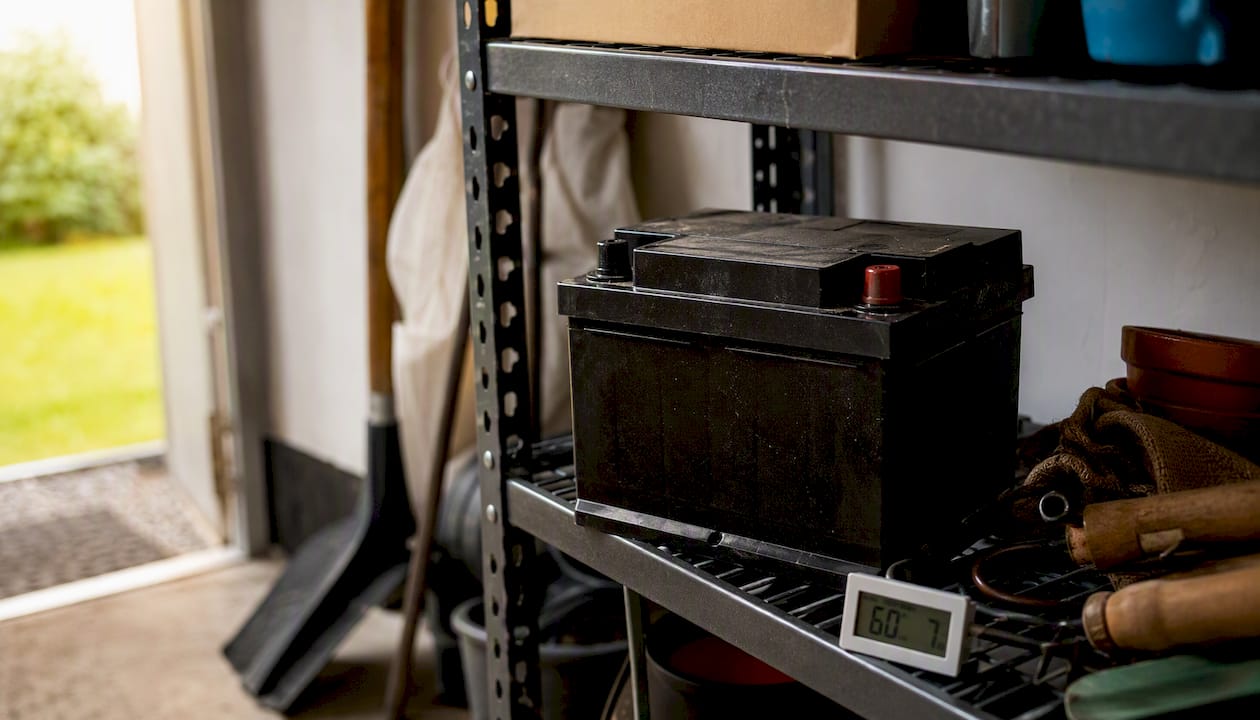
Keep your battery charged year-round, and if the mower sits idle for more than a few weeks, remove the battery and store it somewhere cool, dry, and frost-free, ideally around 10 to 15°C. Heat and hard freezes both accelerate internal degradation, and a battery left in an unheated shed through a hard winter often loses more capacity in three months than it would in a full year of normal use.
Match your charger to your chemistry. AGM batteries want a smart charger with a dedicated AGM setting, charging in the 14.4V to 14.8V range at a moderate current, generally under 2 amps for mower-sized units. Flooded lead-acid batteries do fine on a low-amp trickle charger. Never put a high-output automotive charger on a small AGM battery. The excessive current generates heat that damages the internal glass mat structure. Lithium packs need their manufacturer's dedicated charger, full stop. Improvising here voids warranties and risks damaging the battery management system.
A short seasonal maintenance routine covers most of what matters:
- Top up water levels on flooded batteries before storage (never on sealed AGM or gel units).
- Clean corrosion off terminals with a wire brush and baking soda solution.
- Connect a float or maintenance charger for long-term storage instead of leaving the battery fully disconnected.
- Load-test the battery each spring before the first mow to catch a weak unit before it strands you mid-lawn.
Pro Tip: Check state of charge roughly once a month during winter storage. A cheap multimeter costs less than a single replacement battery and catches a slow-draining unit before it sulfates beyond saving.
Can a Dead Mower Battery Be Revived?
Sometimes. Shallow discharge and early-stage sulfation often respond to a proper conditioning charge, but a physically damaged battery or one that's been deeply discharged for months usually needs replacing outright.
Worth trying before you write it off:
- A trickle or conditioning charger left on for 24 to 48 hours can bring back a battery that's simply been sitting too long.
- Desulfation chargers use pulse charging to break down early crystal buildup on the plates, which sometimes restores lost capacity.
- A professional load test at a repair shop tells you definitively whether the battery holds voltage under real starting demand, rather than just resting voltage.
Some signs mean stop trying and replace instead: a swollen or bulging case, a rotten-egg smell, visible cracks or leakage, or a battery that won't hold above 10V even after a full charging attempt. Those point to internal cell damage that no charger fixes.
Lithium packs play by different rules. Don't attempt standard lead-acid desulfation techniques on a LiFePO4 battery. Follow the manufacturer's specific guidance, and if a lithium pack won't accept a charge or shows a fault code, replacement is almost always the answer rather than DIY revival.
What Should You Check Before You Buy?
Run through this list before you check out, whether you're buying online or in a store:
- Voltage matches your mower's system exactly (12V or 6V).
- Physical group size and case dimensions match your tray and hold-down bracket.
- Terminal orientation and polarity match your existing cable routing.
- CCA meets or exceeds the OEM specification listed in your manual.
- Warranty length is clearly stated and reasonable for the chemistry (longer for AGM and lithium).
- The seller has a clear return policy in case the battery doesn't fit.
- You know whether the new chemistry needs a different charger setting than your old battery.
Price versus lifespan is a real tradeoff worth thinking through before you default to the cheapest option. A basic flooded battery costs less upfront but may need replacing sooner, especially in a high-vibration mower. Paying more for AGM or LiFePO4 makes sense when you run a zero-turn, use the mower commercially, or simply want to skip maintenance entirely.
Product pages with full datasheets make this comparison easier than guessing from a store shelf. A listing like the Panasonic LC-P1224APG spells out exact Ah, voltage, and dimensions so you can match it against your old unit before ordering, rather than hoping it fits when the box arrives.
Pro Tip: Keep a photo of your old battery's label on your phone before you toss it. It saves you from digging through a dead mower's undercarriage a second time if the first replacement doesn't match.
Price, Weight, and Longevity: What Actually Matters Most?
Most homeowners running a simple riding mower on the weekends get the best value from a standard 12V lead-acid battery. It costs less, does the job, and a 3 to 5 year lifespan is perfectly reasonable when you're mowing a quarter-acre lot twice a week. Where the math changes is vibration and frequency of use. Commercial crews and zero-turn owners running hours a day put enough stress on a flooded battery's internal plates that AGM's sealed, vibration-resistant build pays for itself in avoided early failures.
Here's how I'd prioritize the decision based on the situations that come up most often:
- Budget replacement, simple riding mower, weekend use: standard flooded 12V lead-acid in the correct group size.
- Low-maintenance priority, garage storage over winter: AGM, because it tolerates storage and low-charge periods better without water top-ups.
- Frequent or professional use, zero-turn, rough terrain: AGM or LiFePO4 depending on whether the mower's system supports lithium charging.
The mistake I see buyers make most often is anchoring entirely on sticker price. A pro tip worth internalizing: calculate total cost of ownership by dividing the battery's price by its expected number of years or cycles, then compare that number against the warranty length the manufacturer is willing to stand behind. A $120 AGM battery backed by a 3-year warranty that survives 5 years of hard use often beats a $60 flooded battery you replace twice in that same span.
Where Akkuplus Makes This Purchase Easier
Akkuplus lists full datasheets and common SKUs on every product page, so you can confirm fit against your old battery's exact specs before you spend a dollar, instead of guessing from a vague store description.

That matters more than it sounds. A generic "12V mower battery" search turns up dozens of near-identical listings with no way to verify dimensions or terminal layout until the box shows up. Akkuplus product pages solve that by showing:
- Complete datasheet specs including voltage, Ah, physical dimensions, and terminal type for every listing
- Example SKUs covering common replacement needs, including the Panasonic LC-P1224APG for standard 12V riding mowers, the Long WP1250 for common starter applications, and the Optima Red Top RT S for owners upgrading to AGM
- Clear warranty and return information listed directly on each product page, so you're not left guessing what happens if the battery doesn't fit
If you're staring at your old battery's worn-off label and not sure which listing matches, pull up the Panasonic LC-P1224APG datasheet and compare the dimensions and Ah rating against what you measured off your old unit. If nothing lines up exactly, reach out to Akkuplus support before ordering rather than after, since fixing a mismatched order before it ships is always simpler than a return.
Sources
- How to maintain a lawn mower battery for winter — MachineFinder FAQ
- Engineerskill
- Lawn mower battery types explained: Complete 2025 guide — Yarbo
- Autobattery disposal guidance — ADAC
Disposal and deposit rules for starter batteries vary by country, so check your local environmental agency or point of sale for the exact process where you live.