
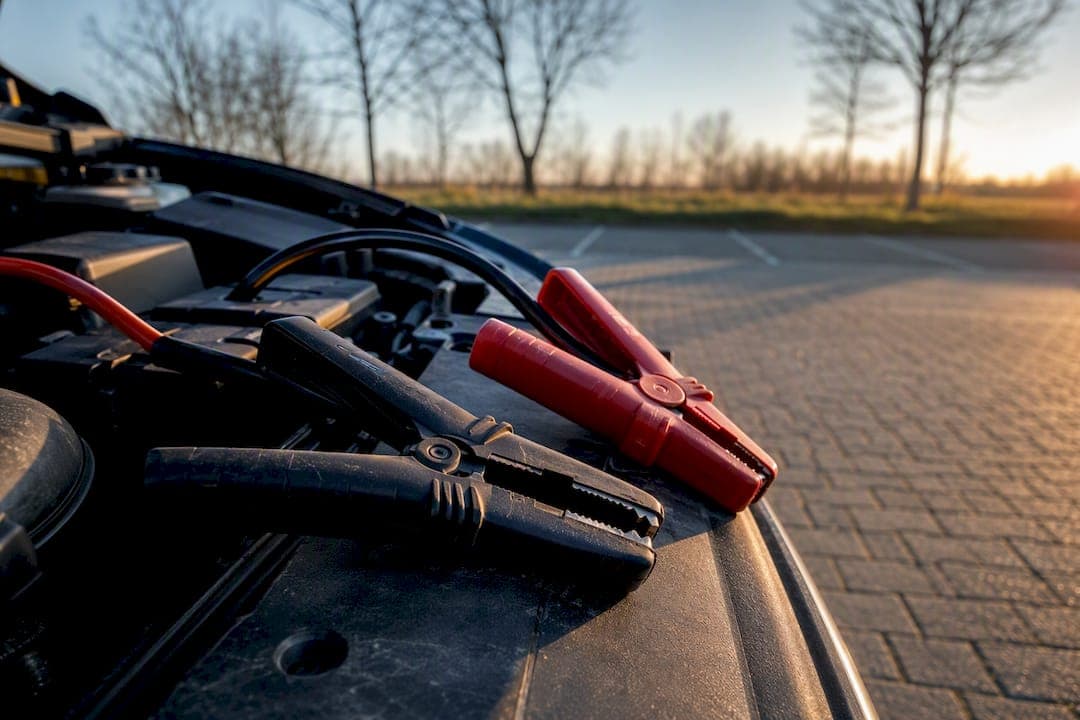
Yes, a portable jump starter will start most vehicles with a dead battery, as long as it's rated for your engine size and fully charged before you connect it. The two rules that matter most: get polarity right (red to positive, black to a grounded metal point, never the negative terminal) and never trust a unit you haven't charged recently. Size up for diesel engines or cold climates.
TL;DR:
- A jump starter must be fully charged and rated for your engine's size, with CCA and peak amps matching your vehicle type.
- Always connect the positive clamp to the positive terminal or unpainted engine ground, and ensure your unit's charge indicator is sufficient before use.
- Test the jump starter monthly, inspect clamps for damage, and store it in a dry place to ensure readiness and safety.
- For gasoline cars, a 1,000 peak amp unit generally suffices, but diesel engines or winter conditions require a 1,500 to 2,000 amp model.
- Repeated failures or odd smells indicate issues beyond a dead battery, requiring professional diagnosis instead of repeated attempts.
Table of Contents
- Jump Starter Guide: What to Gather Before You Connect Anything
- Why Polarity and Ventilation Rules Actually Matter
- How Do You Connect a Jump Starter Correctly?
- What Size Jump Starter Do You Actually Need?
- Keeping Your Jump Starter Ready When You Need It
- Jump Starter Troubleshooting: When the Engine Still Won't Start
- Where Akkuplus Fits Into This Picture
- A Few Honest Words on Jump Starter Safety
- Find the Right Battery and Accessories at Akkuplus
- Sources
Jump Starter Guide: What to Gather Before You Connect Anything
Before you touch a single clamp, lay out your gear. A rushed setup in a dark parking lot is how people cross wires they shouldn't.
Your minimum kit should include:
- A rated jump starter with reverse-polarity and short-circuit protection
- Insulated clamps in good condition, no exposed metal or cracked housing
- Work gloves and eye protection
- A flashlight or headlamp if you're doing this after dark
- Your vehicle's owner's manual, which sometimes flags a non-standard grounding point
Before connecting, look the battery over. Check for corrosion on the terminals, cracks or bulging in the case, or any sign of leaking. A battery that looks damaged shouldn't be jumped at all. Also confirm the car is parked safely, in neutral or park, with the emergency brake set. If you're stuck without a portable unit, jumper cables and a second car work too, but a jump starter is the better call when you're alone or the donor car isn't handy.
Why Polarity and Ventilation Rules Actually Matter
Lead-acid batteries release hydrogen gas, especially under load, and that gas is flammable in an enclosed space. Manufacturer manuals consistently warn drivers to charge the jump starter fully before first use and work in a ventilated area for exactly this reason. Skip the ventilation advice and a stray spark near the terminals becomes a real hazard, not a theoretical one.
Polarity mistakes are the other big risk. Connect the clamps wrong and you can fry a car's onboard computer or damage the jump starter itself. Most manuals are explicit that the black clamp should never touch the negative battery terminal directly; instead, it goes on an unpainted metal point on the engine block or chassis, away from the battery and moving parts.
Pro Tip: If your unit beeps or flashes when you connect the clamps, stop immediately. That's the reverse-polarity alarm doing its job, not a glitch to ignore.
A few more non-negotiables:
- Never jump a battery that's frozen or visibly swollen
- Remove rings, watches, and metal jewelry before working near the terminals
- Recharge the jump starter monthly even if it sits unused, since most warranties assume regular maintenance charging
How Do You Connect a Jump Starter Correctly?
Once your gear checks out, the sequence itself is straightforward if you follow it in order.
- Turn off the ignition, headlights, and any accessories in the car with the dead battery.
- Locate the battery and confirm the positive and negative terminals (usually marked with a plus and minus sign).
- Check your jump starter's charge indicator. A unit sitting at 20% isn't going to deliver the cranking amps you need.
- With the jump starter's power switch off, clip the red clamp to the positive terminal.
- Clip the black clamp to a solid, unpainted metal ground point, not the negative terminal itself.
- Turn the jump starter on now that both clamps are secure.
- Attempt to start the engine for five seconds or less.
- If it doesn't fire, turn the unit's power off, wait three to five minutes, and try again. This sequence mirrors what breakdown services recommend for safe cranking and retry timing.
- Limit yourself to a handful of attempts. Repeated cranking without success usually points to a bigger problem than a dead battery.
Once the engine catches, don't just yank the clamps off. Power down the jump starter first, remove the black (ground) clamp, then the red one. That order keeps you from accidentally shorting anything while the engine is running and drawing current. Plug the unit back in to recharge as soon as you're home. Running it dead and tossing it in a drawer is the fastest way to shorten its lifespan.
What Size Jump Starter Do You Actually Need?

This is where most people either overspend or, worse, buy something that leaves them stranded anyway. Two numbers matter: peak amps and cold cranking amps (CCA). Peak amps tell you the burst of power the unit can deliver; CCA reflects how much current a battery can supply at 0°F, which is why it becomes the more important spec once temperatures drop.
Sizing guidance from automotive technical sources generally breaks down like this:
| Vehicle type | Recommended peak amps |
|---|---|
| Small gasoline car (4-cylinder) | 800 to 1,200A |
| Mid-size sedan or SUV (6-cylinder) | 1,200 to 1,500A |
| Large truck or V8 engine | 1,500 to 2,000A |
| Diesel engine or extreme cold | 2,000A and up |
A separate consensus among buying guides puts it simply: 1,000 peak amps covers most everyday gasoline cars, but diesel engines and freezing climates call for something closer to 1,500 to 2,000A. If your battery is older or you live somewhere winters get brutal, buy a size above your calculated minimum rather than the bare minimum.
Chemistry matters too. Lithium-ion packs dominate the everyday market because they're light and hold a charge for months, but output can drop in very cold weather. Lead-acid units are heavier and bulkier but handle repeated diesel cranking without the same cold-weather drop-off. LiFePO4 sits in between, trading some weight savings for a longer service life and a safer chemistry under stress.
When you're comparing product pages, look for:
- Listed CCA rating, not just peak amps
- Reverse-polarity and short-circuit protection
- A clear diesel or engine-displacement rating if you drive a diesel vehicle
Keeping Your Jump Starter Ready When You Need It
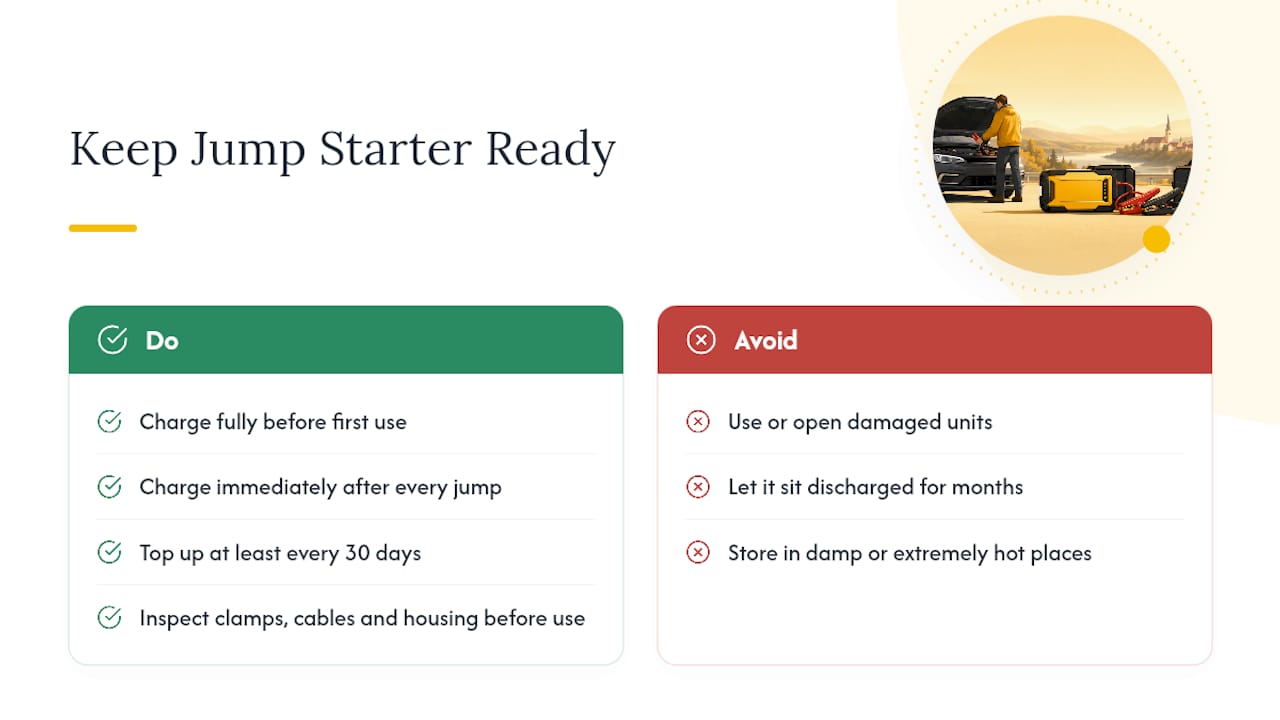
A jump starter that's been sitting dead in the trunk for six months is just dead weight. Charge it fully before first use, immediately after every jump, and at least once every 30 days even if it never leaves the shelf.
Most units use LED indicators to show charge level, usually a simple red, yellow, green scale, and a full AC charge typically takes a few hours depending on the model. Before each use, inspect the clamps for corrosion, check the cable insulation for cracks, and confirm the housing isn't cracked or damaged. Manufacturer instructions are clear that damaged units should go to a qualified technician rather than being used or opened up at home. Store it somewhere dry, away from extreme heat, and it'll be ready when you actually need it.
Jump Starter Troubleshooting: When the Engine Still Won't Start
If the car doesn't turn over, don't just keep trying. Work through a few checks first:
- Confirm the jump starter is actually charged, not just plugged in and forgotten
- Check that both clamps have solid metal-to-metal contact, not corrosion or paint in the way
- Listen for a reverse-polarity alarm, which means you need to disconnect and re-check red versus black
- If the car cranks but won't fire, the issue may not be the battery at all
A clicking sound with no crank usually points to a bad connection or an undersized unit for the engine. Repeated failures, a burning smell, or any smoke from the clamps or battery mean you stop immediately and call a mechanic or roadside assistance rather than continuing to try.
Where Akkuplus Fits Into This Picture
Akkuplus specializes in batteries and related accessories, with detailed product pages covering starter batteries, battery testers, and clamp hardware. If repeated jump starts have you wondering whether the battery itself needs replacing, those pages list the specs, capacity, and chemistry details you'd want to compare before buying.
A Few Honest Words on Jump Starter Safety
The two things people skip are the two things that actually cause damage: checking polarity and checking charge. Everything else in this jump starter guide is secondary to those. Practice the connection sequence once in your own driveway with the engine already running, so the steps feel familiar before you're doing them stressed on the side of a road. Read your unit's manual, too. They're not all identical.
— Waldemar
Find the Right Battery and Accessories at Akkuplus
You can find starter batteries and accessories with detailed specs such as capacity, chemistry, and dimensions to help you match a replacement battery or accessory to your vehicle more easily.
If your battery keeps needing a jump, that's usually a sign it's on its way out rather than a fluke. A battery tester can confirm whether you're dealing with a charging issue or a battery that's simply done. And if you land on a starter battery replacement, Akkuplus's product catalog lets you check voltage, capacity, and terminal type against your current setup before you order. Browse the current lineup of starter batteries and accessories to find the match for your vehicle.
Sources
- Harbor Freight jump starter owner’s manual (example)
- How to jump start a car in 9 steps — The AA
- What size jump starter do I need? — Leadfoot Automotive
- What Amp Jump Starter Do I Need? – GOOLOO