
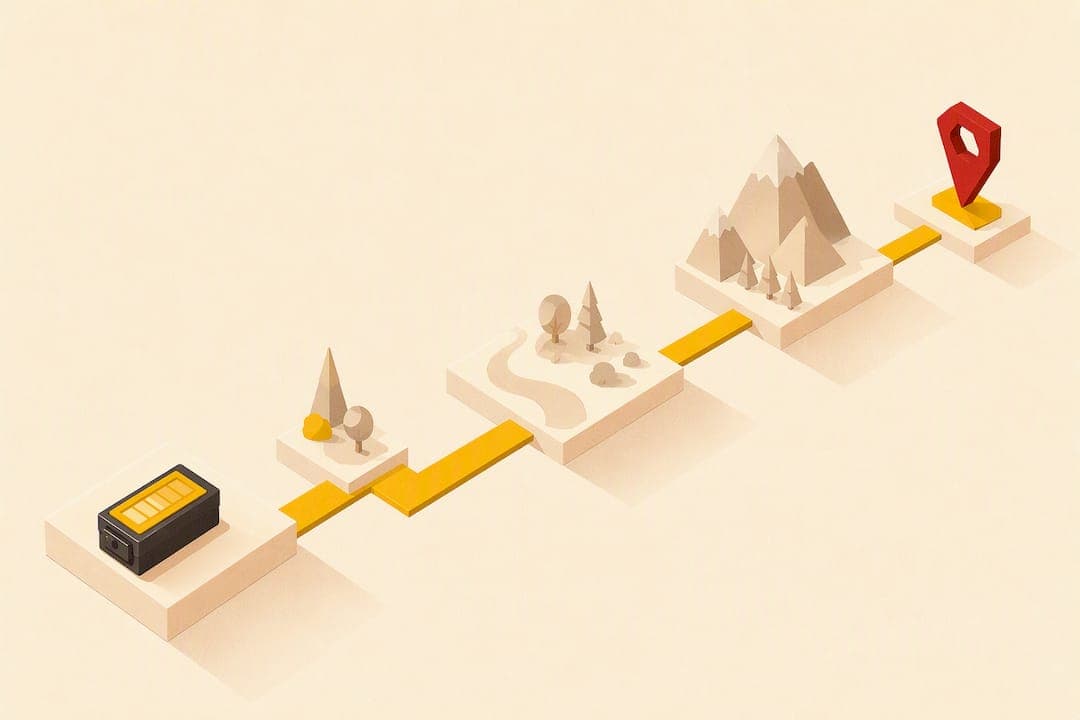
Expect roughly 30 to 70 km from a 400 Wh battery under mixed riding conditions, and up to 50 to 150 km from larger 500 to 750 Wh packs, depending heavily on terrain, rider weight, and assistance level. Bigger batteries help, but riding habits usually matter more than watt-hours alone. The sections below break down realistic ranges by battery size and show you how to calculate your own numbers.
TL;DR:
- Real-world e-bike range from 400 to 750 Wh batteries varies widely based on terrain, rider weight, speed, and assistance level, typically between 50 to 150 km.
- Higher assistance modes, heavier loads, and hilly terrain can significantly reduce range, especially for fast Pedelecs that consume about 50% more energy per kilometer.
- Cycling habits, tire pressure, and weather conditions are key factors that influence actual distance, with efficient riding saving more energy for longer trips.
- Batteries degrade over time and with use, losing capacity and reducing range, so proper storage, temperature management, and early testing help maintain optimal performance.
- Rain, mud, and cold weather increase resistance or decrease capacity temporarily, making gentle riding and regular maintenance crucial for safety and range extension.
Table of Contents
- Realistic range examples by battery capacity
- What affects eBike range, the variables you must account for
- How to estimate your personal range
- Practical tips to extend range while riding and preparing
- Battery care and lifespan, how age and charging affect range
- How rain and mud affect range and riding safety
- Motor type and efficiency differences that shape range
- What years of battery testing taught us about range claims
- Replacement packs, testing, and repair from AkkuPlus
- Sources
- FAQ
Realistic range examples by battery capacity
Battery size sets the ceiling for your range, but real-world conditions decide where you land inside that ceiling. According to ADAC, modern lithium-ion e-bike batteries typically hold between 400 and 750 Wh, and under mixed real-world use, that translates to roughly 50 to 150 km per charge, with results swinging widely based on load and terrain.
Here is how that breaks down by common battery size:
- A 400 Wh battery typically covers 30 to 70 km on mixed terrain with moderate assistance.
- A 500 Wh battery usually delivers 40 to 90 km under similar conditions.
- A 625 Wh battery often reaches 60 to 110 km.
- A 750 Wh battery can stretch to 75 to 130 km when ridden conservatively.
A flat daily commute in Eco mode sits at the high end of these bands. A hilly weekend tour with more Turbo use drops toward the low end. Fast road riding at higher average speeds burns through charge quickly regardless of battery size, and S-Pedelecs, which assist up to 45 km/h, consume noticeably more energy per kilometer than standard 25 km/h pedelecs.
Manufacturer figures often come from controlled test conditions: flat ground, light rider, low speed, mild weather. Treat those numbers as a starting point, not a guarantee for your specific rides.
What affects eBike range, the variables you must account for
Range is not fixed. It shifts with several factors working together, and some move the needle far more than others.
- Rider weight and cargo: heavier loads increase rolling resistance and motor effort on every climb.
- Terrain and elevation: climbing draws noticeably more energy than flat roads.
- Speed and assistance level: higher speeds and stronger support modes drain the battery faster than steady, moderate riding.
- Cadence: pedaling in a lower gear at a steady rhythm reduces the load on the motor.
- Tire pressure: under-inflated tires increase rolling resistance and shorten range.
- Wind and temperature: headwinds and cold weather both raise energy demand.
- Accessories: lights, phone chargers, and heated grips draw extra power from the same battery.
S-Pedelecs use roughly 50% more energy per kilometer than standard 25 km/h e-bikes, which explains why fast pedelecs in ADAC testing showed maximum-support ranges of only 38 to 54 km even with comparable battery sizes. That gap alone can matter more than choosing a slightly bigger battery.
How to estimate your personal range
The simplest formula is range in kilometers equals battery watt-hours divided by your consumption in watt-hours per kilometer. Consumption typically runs 6 to 12 Wh/km for easy, flat, assisted riding, and climbs to 12 Wh/km or higher for fast, hilly, or S-Pedelec riding, according to guidance from ADAC.
Here is a quick way to run the math yourself:
- Check your battery's Wh rating, printed on the pack or in the manual.
- Estimate your consumption based on terrain and assistance mode (start with 10 Wh/km for mixed riding).
- Divide Wh by your Wh/km estimate to get a rough range in kilometers.
- Subtract 20 to 30% as a safety margin for wind, cold, or unplanned detours.
Bosch's Range Control feature refines this by learning from your ride history and route profile, and adjusts assistance automatically to help you reach a chosen arrival charge. Its predictions get noticeably more accurate after about 20 recorded rides, so early estimates should still be treated with caution.
Pro Tip: Run the math with your worst-case Wh/km value, not your best, so your estimate holds up on a windy or hilly day.
Practical tips to extend range while riding and preparing
Small habits add up to real kilometers. Riding technique matters as much as equipment.
- Keep a steady cadence between 60 and 90 rpm rather than mashing pedals in a high gear.
- Accelerate gently and ease off before hills instead of relying on the motor to compensate.
- Keep tires at the correct pressure and choose efficient tread patterns for road riding.
- Maintain a clean, well-lubricated drivetrain to cut mechanical drag.
- Plan flatter routes when possible and charge at your destination rather than mid-ride.
- For long trips, a spare or swappable battery pack avoids range anxiety altogether.
Pro Tip: Choosing Eco or Tour mode instead of Turbo on flat stretches can add many extra kilometers without slowing you down much on a level road.
Battery care and lifespan, how age and charging affect range
Lithium-ion batteries lose capacity gradually with age and charge cycles, and a battery that has degraded will deliver less range even under identical riding conditions.
- Avoid storing a battery fully charged for long periods.
- Aim for a storage charge around 30 to 60% when the bike will sit unused for weeks, per Verbraucherzentrale guidance.
- Keep batteries in moderate temperatures, ideally 10 to 20°C, since heat and cold both accelerate wear.
- Use only the charger supplied or approved by the manufacturer.
- Cold weather temporarily reduces available capacity, so expect shorter range in winter even from a healthy battery.
If range drops noticeably even after accounting for weather and terrain, the pack may be aging past its useful capacity, which is worth checking before assuming a riding habit is the cause.
How rain and mud affect range and riding safety
Wet weather adds resistance in ways that are easy to underestimate. Water on the road increases rolling resistance slightly, and mud buildup on tires and around the drivetrain increases it considerably more, forcing the motor to work harder for the same speed. A muddy trail ride can use noticeably more energy per kilometer than the same route dry.
Rain also affects the rider indirectly: wet brakes, reduced visibility, and slippery surfaces often lead to lower speeds and more frequent braking and re-accelerating, both of which burn extra charge. Batteries and connectors on most e-bikes are sealed against splashing, but repeated exposure to heavy rain or pressure washing can degrade seals over time, so cleaning a bike after a muddy ride with a gentle hose or damp cloth is safer than a high-pressure spray directly at the battery compartment or motor unit.

From a safety standpoint, wet or muddy conditions also change how predictable the bike feels. Reduced tire grip means longer stopping distances, and a heavier, mud-caked bike changes handling on climbs and descents. Riding at a more moderate speed in poor weather protects both your safety margin and your battery, since gentler acceleration and braking use less energy than repeated hard stops and starts.
Motor type and efficiency differences that shape range
Not all e-bike motors use energy the same way, and the difference shows up directly in range. Hub motors, mounted in the front or rear wheel, tend to be simpler and can be efficient at steady speeds on flat terrain, but they generally work harder on climbs since they cannot take advantage of the bike's gearing.
Mid-drive motors, positioned at the pedals, use the bike's existing gears to stay in an efficient power band across varied terrain, which often makes them more economical on hilly routes despite similar battery sizes. This is one reason two e-bikes with the same Wh battery can deliver noticeably different real-world range: the motor's efficiency at a given speed and torque demand changes how many watt-hours are consumed per kilometer.
Assistance level also interacts with motor type. Pushing a hub motor hard on a climb in a high support mode can draw considerably more current than a mid-drive doing the same climb in a lower gear. Riders comparing bikes on paper should look at how the system performs across the terrain they actually ride, not just the battery's Wh rating, since the same battery paired with a different motor and drivetrain can produce very different ranges.

What years of battery testing taught us about range claims
Customers who bring in aging e-bike batteries for testing often expect the range they saw on day one, and the drop-off surprises them more than the reason behind it. Real-world range depends on so many overlapping factors, weight, terrain, weather, and battery health, that no single number ever tells the full story. Testing packs regularly is the only way to know whether a shorter ride is about riding style or a battery that has genuinely aged. For readers wanting to check a pack's real capacity or explore replacement options, AkkuPlus's product pages and blog cover both in practical detail.
— Waldemar Pelich
Replacement packs, testing, and repair from AkkuPlus
If your e-bike's range has quietly shrunk over the seasons, the fix is not always a new bike. Battery testing to confirm actual remaining capacity, cell-replacement and repair services for packs that no longer hold a charge, and ready-to-fit replacement packs for popular e-bike models are available.
Where it makes sense, our services include:
- Akkutests & -prüfungen to measure a pack's real remaining capacity before you decide anything.
- Akkureparatur with cell replacement for packs that charge poorly or drain fast.
- Akku- und Batteriepacks as ready-made or custom replacement options for e-bikes.
Start by checking your battery's Wh rating and age, then browse our battery pack options or visit our main services page to arrange a test or repair.
Sources
- E‑Bike‑Akku: Das sollten Sie zu Reichweite, Position und Preis wissen (ADAC)
- Range Control (Bosch eBike Systems)
- Akkus für E‑Autos, Pedelecs und Co.: das gilt es zu beachten (Verbraucherzentrale)
FAQ
How far does an eBike battery last?
Most e-bike batteries deliver 50 to 150 km per charge depending on capacity and riding conditions. Battery lifespan in terms of years typically spans several hundred charge cycles before capacity fades noticeably.
How far will an eBike go on a full charge?
The distance depends on battery size and how you ride, with common batteries covering 50 to 150 km under mixed conditions. Flat terrain, moderate speed, and lower assistance modes push you toward the higher end of that range.
How far will a 400 Wh eBike go?
A 400 Wh battery typically covers 30 to 70 km on mixed terrain with moderate assistance. Hilly routes, higher speeds, or Turbo mode will bring that closer to the lower end.
What electric bike has a 70 km range?
Range depends more on battery size, motor efficiency, and riding conditions than any single bike model. A bike with a 400 to 500 Wh battery ridden in Eco or Tour mode on moderate terrain can commonly reach around 70 km, based on the ranges documented by ADAC.
Recommended
- Battery Pack for eBike - 24 Volt for Self-Installation
- Battery Pack for KTM City Blitz Egston E-Bike MK II - 31.2 Volt
- Battery Pack for YAMAHA E-BIKEs - 24 Volt for Self-Installation
This article was created with the assistance of Artificial Intelligence (AI) and has been reviewed by our editorial team. Despite careful preparation, we assume no liability for the completeness, accuracy, or timeliness of the information provided. The technical data and specifications supplied by the respective manufacturer shall always prevail.