
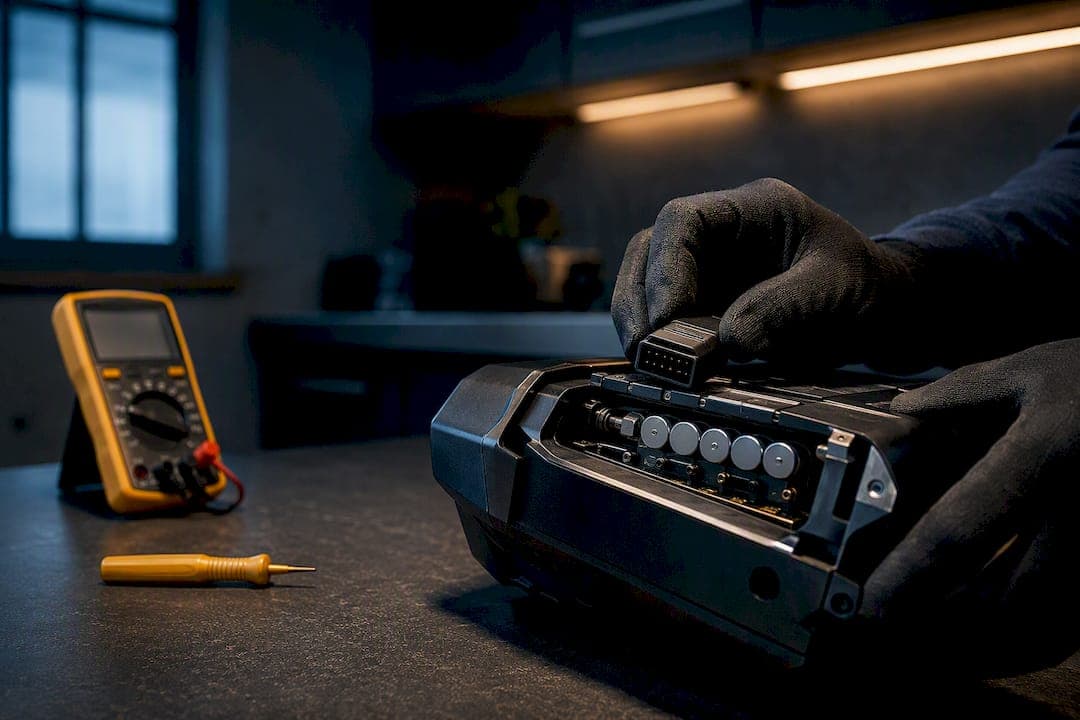
A replacement e-bike battery in Germany typically runs €300 to €900, with most mainstream packs landing between €400 and €700 depending on capacity and brand. If the housing and BMS are intact, get a cell-swap quote first, since repair often costs half the price of a new pack. If the casing is cracked or the battery won't hold any charge at all, skip straight to a new OEM or trusted refurbished unit.
TL;DR:
- Repair options are often more economical if the battery's housing and BMS are intact, with cell swaps costing around €250 to €450 versus up to €900 for a new pack.
- Battery capacity heavily influences price, ranging from approximately €250 for 250–400 Wh packs to €900 or more for capacities above 625 Wh, with midrange 400–500 Wh batteries typically costing €350 to €550.
- The €/Wh metric helps evaluate value; decent packs cost about €0.66/Wh, while premium OEM batteries can exceed €1.50/Wh, depending on brand and quality.
- Refurbished OEM batteries often cost 30 to 50 percent less than new units but may have shorter warranties and less predictable longevity, especially compared to full OEM replacements.
- Buying in Germany requires careful compatibility checks and understanding warranty, return policies, and CE certification, particularly when opting for used or third-party batteries.
Table of Contents
- How Much Does an Ebike Battery Cost by Capacity?
- What Actually Drives the Price of an Electric Bike Battery?
- Should You Buy New, Used, or Refurbished?
- Is It Cheaper to Repair or Replace the Battery?
- Where to Buy an E-Bike Battery in Germany
- How Can You Make Your E-Bike Battery Last Longer?
- What Does an E-Bike Battery Actually Cost You Per Month?
- A Practical Take on E-Bike Battery Costs in Germany
- How Akkuplus Can Help With Your Next Battery Decision
- Where This Pricing Information Comes From
- Sources
- FAQ
How Much Does an Ebike Battery Cost by Capacity?
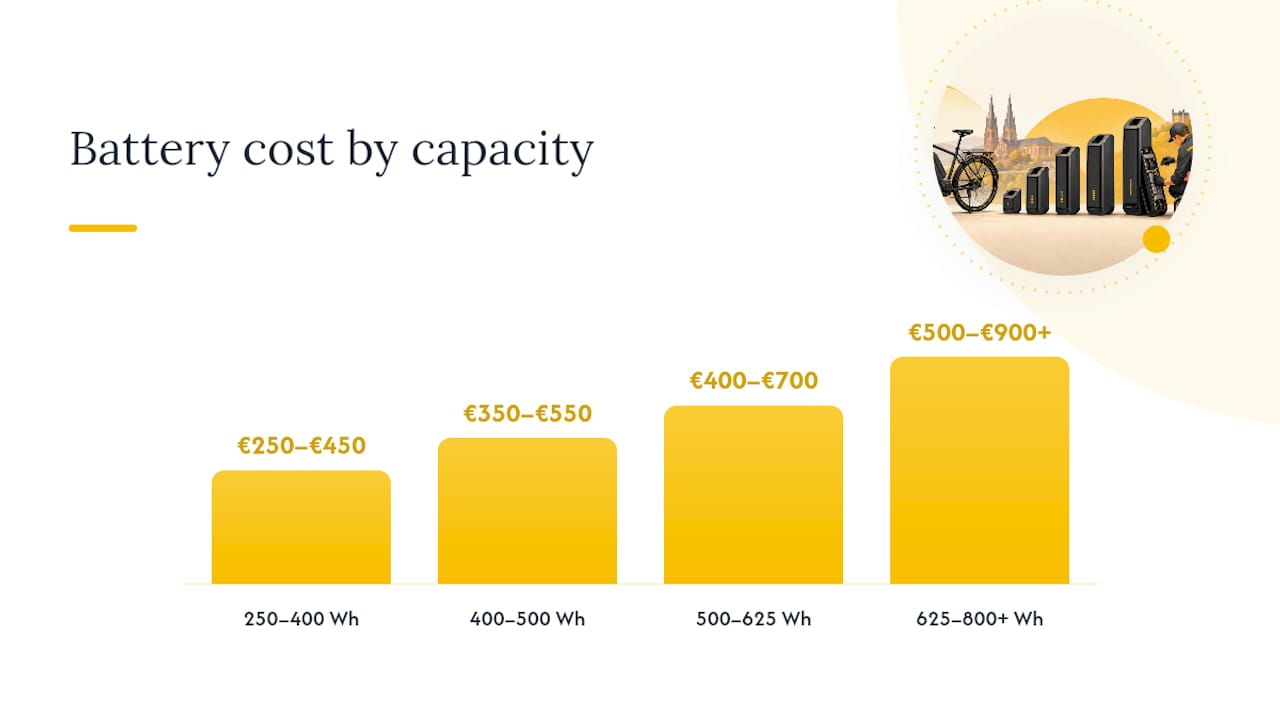
The single biggest driver of e-bike battery cost is watt-hour (Wh) capacity, not brand loyalty. A bigger pack means more cells, a beefier battery management system (BMS), and a higher price tag, but the relationship isn't perfectly linear. Here's roughly what German retailers and repair shops charge by capacity band:
- 250–400 Wh: around €250 to €450, common on older or entry-level city e-bikes.
- 400–500 Wh: typically €350 to €550, the range most commuter bikes from the last five years sit in.
- 500–625 Wh: usually €400 to €700, the current sweet spot for touring and trekking bikes.
- 625–800+ Wh: frequently €500 to €900 or more, found on cargo bikes and long-range touring builds.
Bosch's PowerTube line and Shimano's BT-series batteries are the two names you'll see most often on German price lists, and they roughly bracket the market. A Bosch PowerTube 625 replacement typically costs between €415 and €750 depending on where you buy it and whether it's the current generation. Shimano's BT-series packs tend to sit in a similar band for comparable capacity, though exact pricing varies by dealer stock and model year.
Statistic callout: Replacement battery costs in Germany span roughly €300 to €1,000, with midrange new units most commonly falling between €400 and €700. That's a wide enough spread that capacity and brand matter more than any single "average" figure.
What Actually Drives the Price of an Electric Bike Battery?
Wh capacity sets the baseline, but it doesn't explain the full price gap between two batteries with the same rated capacity. A useful shortcut here is calculating euros per watt-hour (€/Wh): divide the sticker price by the Wh rating, and you get a number you can compare across brands and listings without getting distracted by marketing.
German price comparisons put decent-value packs around €0.66/Wh, while premium OEM systems can run past €1.50/Wh. A few things explain that spread:
- Cell brand and quality. Name-brand cells (Panasonic, Samsung, LG) generally last more charge cycles than unbranded cells packed into cheaper third-party units.
- BMS complexity. A battery management system that actively balances cells and communicates with the bike's motor controller costs more to build than a basic protection circuit.
- Connector and integration type. Fully integrated, proprietary-shaped packs cost more to manufacture and replace than universal rack-mounted batteries.
- Warranty length. A two-year OEM warranty gets priced into the unit; a bargain pack with a 90-day return window usually reflects that shorter commitment.
- Service network availability. Batteries backed by wide dealer networks in Germany tend to hold their price better because parts and diagnostics are easier to source.
Should You Buy New, Used, or Refurbished?
New OEM batteries cost the most, but they also carry the strongest warranty and the most predictable performance. Used and refurbished packs can save real money, provided you understand what you're trading away.
- New OEM (Bosch, Shimano, or similar): Full price, typically €400 to €900, with a manufacturer warranty of one to two years and guaranteed compatibility with your existing motor system.
- Refurbished OEM packs: Often 30 to 50 percent cheaper than new, since a shop replaces degraded cells inside your original housing while keeping the certified BMS and connector intact.
- Third-party "no-name" replacements: Often priced €200 to €400, but they typically come with shorter guarantees and less reliable integration with your motor's software.
- Used batteries bought secondhand: The cheapest option upfront, but cycle count and storage history are usually unknown, which makes remaining capacity a guessing game.
The math isn't always in favor of the cheapest option. A third-party pack that dies in eighteen months costs more per year than a refurbished OEM unit that lasts four, even though the sticker price looked better on day one.
Is It Cheaper to Repair or Replace the Battery?
This is the decision that actually saves German e-bike owners the most money, and it hinges on one thing: are the housing and BMS still intact?
Professional cell-swap or refurbishment work commonly costs €250 to €450, against €300 to €900+ for a full new battery. When the exterior casing isn't cracked and the electronics still function, repair is almost always the better economic call. Shops generally recommend repair specifically when refurbishment costs less than half of what a comparable new OEM pack would run.
Before you commit to either path, budget for the extras that don't show up on the sticker price:
- Diagnostic fees commonly around several tens of euros, sometimes credited if repair is undertaken.
- Workshop labor for battery service usually adds a moderate charge, often in the range of tens of euros.
- Shipping if you're sending the battery to a specialist rather than a local shop.
- Occasional calibration or firmware updates after cell replacement.
Pro Tip: Get a diagnostics quote before you buy anything. Many shops apply that €49 fee toward the repair cost if you go ahead, so you're not paying twice, and you'll know the real number instead of guessing.
Where to Buy an E-Bike Battery in Germany
Local bike dealers and specialized online battery retailers each solve a different problem. A dealer who sold you the bike already knows your motor generation and can usually order the exact OEM part, but turnaround can run several weeks if it's not in stock. Specialized online shops tend to have wider selection and often better pricing, particularly for refurbished or third-party options, though you lose the in-person fitting help.
Whichever route you choose, run through this compatibility checklist before paying anything:
- Confirm the exact motor model and generation, since Bosch and Shimano both revise connector shapes across product generations.
- Match the connector type physically, not just by capacity rating.
- Check that the new pack fits your frame's physical mounting points, especially on integrated downtube designs.
- Ask whether the battery pairs with your existing display and software without a firmware update.
- Confirm warranty terms are transferable if you bought the bike secondhand.
Before you pay, ask the seller directly about the return window, warranty length in months, and whether the unit carries CE certification for safe transport and use in Germany. A seller who can't answer those three questions quickly is worth a second look.
How Can You Make Your E-Bike Battery Last Longer?
Battery replacement is expensive enough that stretching the life of the one you have is usually the cheapest "purchase" you'll make all year. A few habits make a measurable difference over a few thousand kilometers.
- Store the battery at roughly 30 to 60 percent charge if it's sitting unused for more than a couple of weeks, rather than leaving it full or empty.
- Avoid letting the battery sit fully depleted for extended periods, especially through a German winter in an unheated garage.
- Bring the battery indoors in cold weather before charging; charging a genuinely cold pack accelerates degradation.
- Keep it out of direct summer sun on the bike rack during long stops.
- Get a diagnostic check if range drops noticeably over a few months rather than waiting until it fails completely.
- Consider a second battery if you're commercially dependent on the bike or regularly riding beyond a single charge's range.
Pro Tip: If you're a high-mileage rider or run a delivery route, a second removable battery pays for itself faster than most people expect. It also means one pack ages while the other rests, which stretches total service life on both.
What Does an E-Bike Battery Actually Cost You Per Month?
Sticker price only tells part of the story. Spreading the cost across the battery's realistic lifespan, plus adding charging costs, gives a clearer monthly figure.
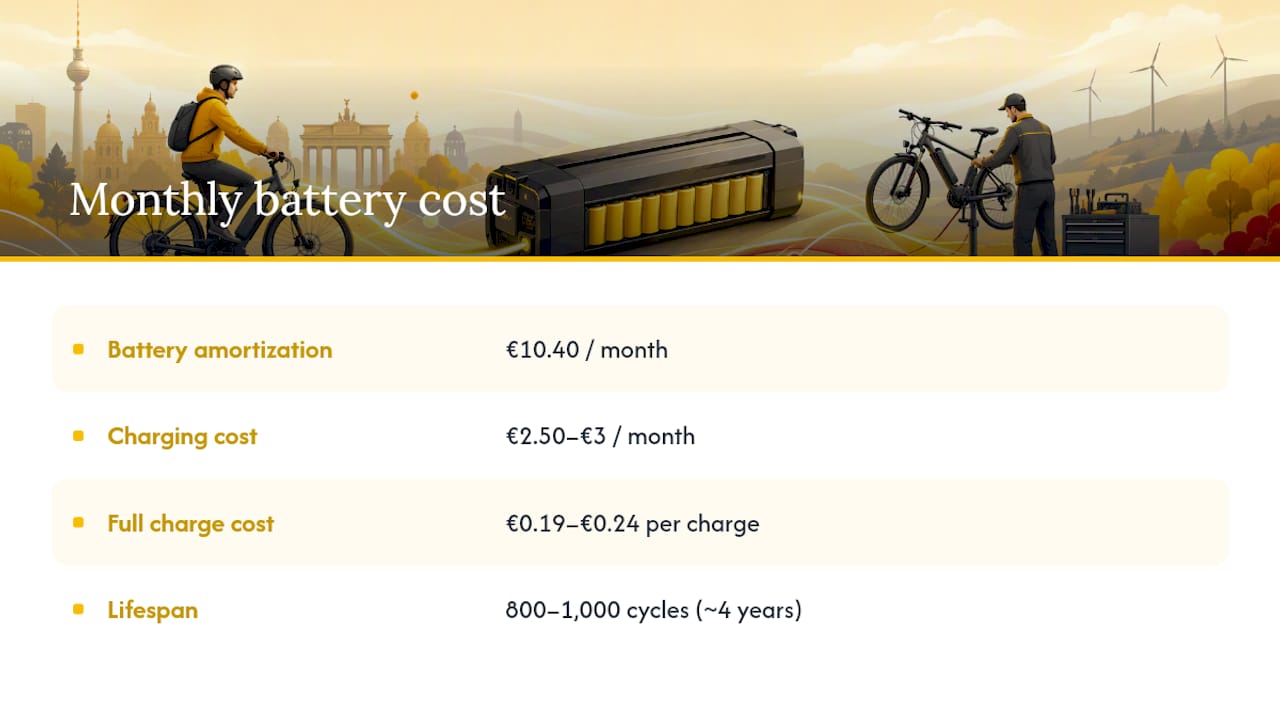
Take a commuter with a 500 Wh battery bought for €500, expected to last around four years (roughly 800 to 1,000 charge cycles at typical use). That amortizes to about €10.40 per month before you even plug it in. German household electricity runs roughly €0.35 to €0.38 per kWh, which puts a full charge of a 500 Wh pack at about €0.19 to €0.24. Charge three times a week and you're adding roughly €2.50 to €3 a month, a rounding error next to the battery's own amortized cost.
A second removable battery, costing €400 to €900, often pays for itself within months for commercial riders simply by cutting downtime between shifts. The math flips in favor of a spare the moment lost riding hours cost more than the battery itself.
A Practical Take on E-Bike Battery Costs in Germany
Most riders overcorrect in one direction: either they replace a battery that could have been repaired for half the price, or they nurse along a genuinely dead pack because repair sounds cheaper than it is. The honest default is diagnose first, repair if the housing and BMS check out, and only go OEM or refurbished when the numbers say replacement wins. If you're unsure which side of that line your battery sits on, a quick quote from a specialist can settle it faster than guessing.
— Waldemar
How Akkuplus Can Help With Your Next Battery Decision
Specialist service providers offer practical alternatives to guessing whether your pack is worth saving. Rather than choosing blindly between a full replacement and a repair you're not sure will hold, you get a straight answer on both, plus the parts to act on it.
Some providers offer replacement battery packs, DIY Akkupacks for self-installation, and cell-replacement or refurbishment services for e-bike and other electronic batteries, alongside diagnostics to tell you which route actually makes financial sense for your situation. Before reaching out, have your bike model, motor type, and the battery's part number or a clear photo ready. That alone usually cuts the back-and-forth down to one message. If you're weighing a self-install option, the DIY eBike battery pack for self-installation page is a reasonable place to start comparing against a workshop quote.
Whether your pack needs new cells or a full swap, request a diagnostics quote through Akkuplus before spending anything on a replacement.
Where This Pricing Information Comes From
- Homeandsmart covers typical German replacement price ranges by capacity.
- E-bike-ratgeber details refurbishment costs and hidden fees like diagnostics and labor.
- Zweiradfachhandel explains the €/Wh metric with OEM pricing examples.
- Jobobike supplies German electricity pricing for charging estimates.
Sources
- E-Bike Akku Kosten: Wie viel muss ich beim Tausch investieren?
- E-Bike Akku tauschen: Kosten, Ablauf und wann es lohnt
- E‑Bike Akku Kosten: Neu kaufen, reparieren oder ersetzen?
- Was kostet ein Elektrofahrrad in Deutschland 2026 wirklich pro Monat?
FAQ
How much does an e-bike battery cost in Germany?
A replacement e-bike battery in Germany typically costs between €300 and €1,000, with most midrange new batteries falling between €400 and €700 depending on capacity and brand.
How much does it cost to replace an e-bike battery?
Full replacement generally runs €300 to €900+ depending on Wh capacity and brand, while professional cell-swap repair costs about €250 to €450 when the housing and BMS are still intact.
How much does an e-bike cost in Germany?
Complete e-bikes in Germany span a wide range depending on motor, frame, and battery capacity, but the battery itself typically represents €300 to €900 of that total cost, making it one of the largest single components after the motor and frame.
Is it worth replacing an e-bike battery?
Replacement is worth it when the battery is several years old, no longer holds a usable charge, or the housing is damaged; if the casing and BMS are fine, a cell-swap repair around €250 to €450 is usually the cheaper and more sustainable choice.
How is €/Wh used to compare battery prices?
Divide the battery's price by its Wh rating to get a euro-per-watt-hour figure; German comparisons show decent value around €0.66/Wh and premium systems above €1.50/Wh, which makes it easier to spot an overpriced listing.