
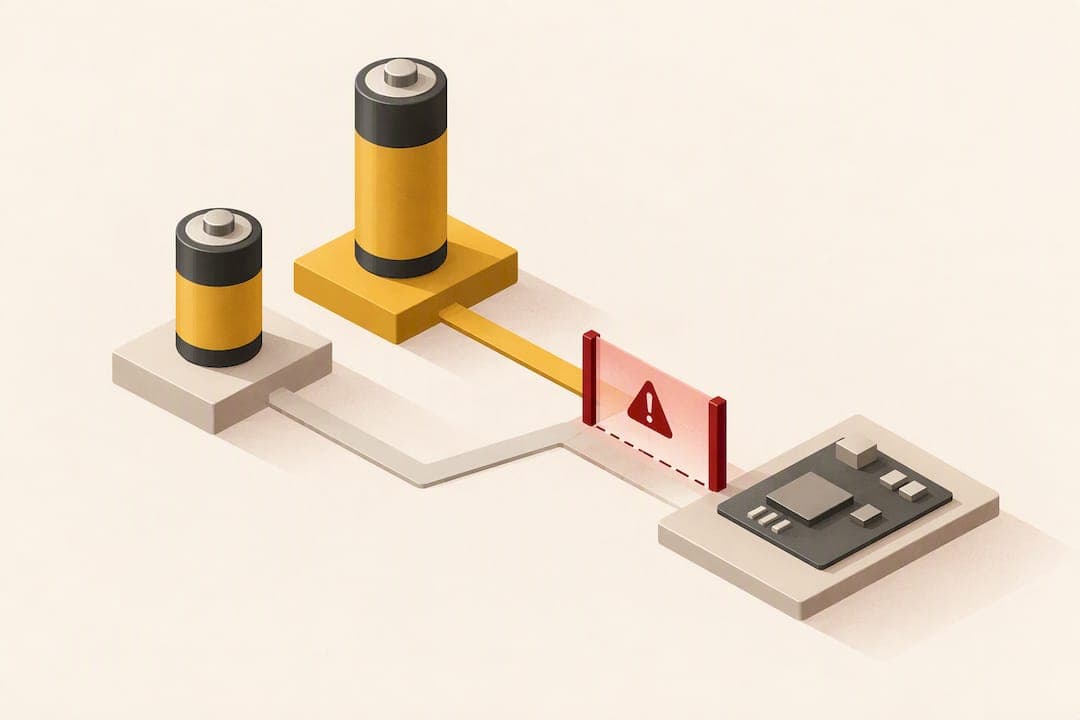
No, CR123A and 16340 cells are not safely interchangeable in most devices. CR123A is a 3.0-volt primary lithium cell, while 16340 (also sold as RCR123A) is a rechargeable lithium-ion cell that runs at a higher nominal voltage. Never charge a primary CR123A, and always confirm your device explicitly supports rechargeable cells before swapping one in.
TL;DR:
- A 16340 battery can deliver higher voltage and brightness but may cause overheating or false triggers in devices designed for a steady 3.0-volt CR123A.
- Many devices with unregulated circuits risk damage or reduced lifespan if a rechargeable 16340 exceeds its recommended voltage, especially without proper circuitry.
- Always verify device compatibility by checking for explicit support, voltage tolerance, or using a battery tester before inserting a rechargeable cell.
- Never recharge a primary CR123A, and always use a charger rated specifically for lithium-ion 16340 cells to ensure safety.
- Choosing between the two depends on usage frequency, device support, and whether your device's circuit can handle the higher voltage of a rechargeable 16340.
- ✓Battery testing services
- ✓Battery and battery packs
- ✓Battery repair and cell replacement
Table of Contents
- Quick specs at a glance
- Why the voltage difference actually matters inside your device
- How to check your device before using a 16340
- Safe charging, storage, and handling for 16340 and CR123A cells
- When to pick CR123A and when 16340 makes more sense
- Publisher perspective and practical tips from AkkuPlus
- What actually matters when you choose between these cells
- Find the right cell and accessories for your device
- FAQ
- Sources
Quick specs at a glance
The two cells share a case size but not an electrical profile, and that gap is the whole story. CR123A is a primary lithium-manganese dioxide cell with a nominal voltage of about 3.0 volts and dimensions near 17 by 34.5 millimeters. The 16340, sometimes labeled RCR123A, is a lithium-ion rechargeable cell with a nominal voltage around 3.6 to 3.7 volts and a maximum charge voltage near 4.2 volts.
Naming adds confusion on top of the voltage gap. You will see CR123A sold as "123," "123A," or under reference codes like IEC CR17345 and ANSI 5018LC, all pointing to the same physical format. A standard primary CR123A from a brand like Duracell typically lists around 1,400 mAh, while rechargeable 16340 cells on the market range from roughly 700 to 1,150 mAh depending on the model.
| Attribute | CR123A (primary) | 16340 / RCR123A (rechargeable) |
|---|---|---|
| Chemistry | Lithium-manganese dioxide | Lithium-ion |
| Nominal voltage | 3.0 V | 3.6 to 3.7 V |
| Max voltage | 3.0 V (fixed) | Up to 4.2 V when charged |
| Typical capacity | Around 1,400 mAh | Roughly 700 to 1,150 mAh |
| Rechargeable | No | Yes |
| Common names | CR123A, 123, 123A, CR17345, 5018LC | 16340, RCR123A |
The capacity and voltage numbers above come from retail and technical references rather than a single standard, so expect some variation between brands.
Why the voltage difference actually matters inside your device
A 16340 pushing 3.6 to 4.2 volts into a circuit designed around a steady 3.0 volts is not a small rounding error. Many compact flashlights, laser sights, and electronic locks use simple, unregulated circuits that assume a CR123A's fixed output. Feed one of those a 16340 and the extra voltage has to go somewhere, usually into the LED driver, the sensor, or whatever protection circuitry exists.
The practical effects show up in a handful of predictable ways:
- Overheating: components rated for a lower voltage window dissipate the excess as heat, which shortens their life or triggers thermal shutdown.
- False triggers: sensors and logic circuits tuned to a narrow voltage band can misread the higher input as a fault or a different signal entirely.
- Shortened component life: LED drivers and voltage regulators pushed above their rated input age faster, even if nothing fails immediately.
- Reduced runtime despite higher output: a 16340's smaller typical capacity can mean brighter initial output but a shorter session than a CR123A delivers.
Not every device reacts badly. Flashlights and other gear built with a buck or boost regulator, or with input tolerance specifically engineered for a wider voltage range, can handle an RCR123A without issue. These designs convert whatever voltage comes in in into whatever the LED or circuit needs, which is why some manufacturers explicitly list RCR123A as supported alongside CR123A. The difference between "tolerates it" and "is damaged by it" almost always comes down to whether that conversion circuitry exists, not to luck.
How to check your device before using a 16340
Before you drop a rechargeable cell into anything built for CR123A, work through this short checklist.
- Read the label or manual. Look specifically for the word "rechargeable" or an explicit mention of RCR123A or 16340; absence of that wording usually means the device was designed around the fixed 3.0-volt primary cell.
- Check for stated voltage tolerance. Some manuals list an input voltage range rather than a single number; a range that comfortably covers 4.2 volts is a good sign.
- Test cautiously if you are unsure. Use a fresh, protected 16340, run the device at a low duty cycle, and monitor both cell and device temperature for 10 to 15 minutes, stopping immediately if you notice unusual warmth.
- Default to CR123A when in doubt. If the manual is silent and you cannot reach the manufacturer, a fresh primary cell is the safer bet every time.
Pro Tip: Keep a cheap battery tester on hand, like the kind sold for standard and photo cells, so you can confirm a cell's actual voltage before it ever goes into an expensive device.
Safe charging, storage, and handling for 16340 and CR123A cells
The single most important rule here has nothing to do with device compatibility: never attempt to recharge a primary CR123A. These cells are not built to accept a charge, and forcing current back into one generates heat and can lead to fire. Charging is for rechargeable 16340 and RCR123A cells only, and even then, the charger matters.
A handful of habits separate safe handling from a genuine hazard:
- Use a charger rated for lithium-ion 16340 cells specifically, with proper charge termination, rather than a generic or unmarked charger.
- Cover the terminals of spare cells before tossing them in a bag or drawer to prevent accidental short circuits.
- Keep new and used cells separated so you never accidentally mix a depleted cell with a fresh one in the same device.
- Store lithium-ion cells at roughly 30 to 50% state of charge for long-term storage rather than fully charged, which balances capacity retention against safety risk.
Active charging of lithium-ion cells generates meaningful heat and raises thermal-runaway risk, which is why professional guidance separates active charging from passive storage. Active charging is best done in a monitored setting, ideally a dedicated safety cabinet with fire-suppression capability, while passive storage calls for simple separation of cells and a cool, dry environment rather than specialized equipment.
The regulatory backdrop reinforces why this matters beyond your own garage. EU Regulation 2023/1542 tightened lifecycle, labeling, and end-of-life requirements for batteries placed on the EU market, which is one more reason to buy cells with clear markings and to dispose of damaged or swollen cells immediately rather than storing them indefinitely.
When to pick CR123A and when 16340 makes more sense
The right cell depends on how you actually use the device, not on which one sounds more modern.
CR123A tends to win when:
- You need long shelf life for a device that sits unused for months, like an emergency flashlight or a smoke detector backup.
- The device is explicitly rated for 3.0 volts only, with no mention of rechargeable support.
- You want one-and-done reliability without worrying about charge state before you need the device.
A 16340 earns its place when:
- You cycle the device frequently and at high current, where the lower cost per use over many cycles outweighs the higher upfront price.
- Your flashlight or device has a driver built to handle the extra voltage, and you want the brighter initial output a higher-voltage cell can deliver.
- You are comfortable with the charging and storage discipline rechargeable lithium-ion cells require.
The trade-off between the two is really a trade-off between capacity and voltage. A 16340's smaller typical capacity can mean a shorter runtime even as its higher voltage pushes an LED harder, so a device might look brighter on a rechargeable cell but run out sooner than it would on a primary CR123A. If you are regularly draining cells and want more runtime headroom without juggling voltage concerns, it is often simpler to step up to a device built around a larger format like 18650 rather than pushing a 16340 past what it was designed for.
Publisher perspective and practical tips from AkkuPlus
We spend our days helping customers match the right cell to the right device, and the CR123A versus 16340 question is one we field constantly. A few habits consistently separate safe purchases from problem ones.
When you are shopping for a rechargeable 16340, prioritize protected cells, which include a small circuit board that guards against overcharging and short circuits. Check the listing for a stated maximum charge voltage, usually 4.2 volts, and look for transport and UN markings that indicate the cell has passed shipping safety testing rather than being an unlabeled generic.
Our battery category covers primary cells like CR123A, while our single-cell rechargeable section is where protected 16340 and related formats live. A basic battery tester is worth keeping on your bench if you regularly swap cells between devices, since it takes the guesswork out of confirming a cell's actual voltage before it goes anywhere near an expensive piece of gear.

What actually matters when you choose between these cells
The conventional advice on this topic tends to stop at "check your manual," which is correct but incomplete. The bigger blind spot is that most people assume a cell that physically fits is a cell that electrically belongs, and that assumption is where damage happens, not from some rare manufacturing defect.
If I had to prioritize one thing, it would be this: treat voltage tolerance as a spec you verify, not a feature you assume. A device that never mentions rechargeable cells was almost certainly never tested against one, regardless of how well a 16340 fits in the tube. The second priority is storage discipline, since far more cells get damaged sitting in a drawer at full charge for months than during actual use. Runtime and brightness comparisons matter far less than most buying guides suggest once you account for how a cell is stored and charged over its life.
— Waldemar Pelich
Find the right cell and accessories for your device
We carry both sides of this comparison, so whichever way your device points, you do not have to guess your way through a parts catalog. Our battery category covers fresh primary CR123A cells for devices that call for a fixed 3.0-volt source, and our single-cell rechargeable section stocks protected 16340 options along with compatible chargers for devices built to handle them.
If you are not sure which category applies to your device, a battery tester lets you check a cell's actual voltage before it goes anywhere near your gear. Browse our batteries to find the right fit for your device today.
FAQ
Are 16340 and CR123A the same?
No, they are not the same cell despite sharing a similar size. CR123A is a 3.0-volt primary lithium cell, while 16340 is a rechargeable lithium-ion cell with a higher nominal voltage around 3.6 to 3.7 volts.
What can I use as a substitute for a 16340 battery?
A fresh primary CR123A is the safest substitute when your device does not explicitly support rechargeable cells. If your device's manual confirms it tolerates higher voltage input, a protected RCR123A from a reputable brand is the closer rechargeable match.
Is a CR123A battery the same as a CR123?
Yes, CR123 and CR123A refer to the same primary lithium cell, and you will also see it labeled "123" or "123A" depending on the manufacturer. Reference codes like IEC CR17345 and ANSI 5018LC describe the same standardized format.
What size is a 16340 battery?
A 16340 cell measures roughly the same physical footprint as a CR123A, close to 17 millimeters in diameter and 34.5 millimeters in length. The name itself follows a common battery-naming convention, with the first two digits indicating diameter and the remaining digits indicating length in millimeters.
Sources
- CR123A vs 123A Batterieleitfaden: Größe, Spannung und Kompatibilität
- CR123A Batterien kaufen? Getestet und vorrätig auf Lager
- Battery safety library — University of Illinois
- VERORDNUNG (EU) 2023/1542 DES EUROPÄISCHEN PARLAMENTS UND DES RATES
Recommended
- Ansmann - CR123 A - 3 Volt 1400mAh Lithium
- Varta - CR123 / 6205 / CR123A - Photobatterie - 3 Volt 1480mAh Li
- Panasonic - CR123A - 3 Volt 1600mAh - Photo Lithium-Batterie
This article was created with the assistance of Artificial Intelligence (AI) and has been reviewed by our editorial team. Despite careful preparation, we assume no liability for the completeness, accuracy, or timeliness of the information provided. The technical data and specifications supplied by the respective manufacturer shall always prevail.