

A fully charged 12V car battery typically reads around 12.6 to 12.9 volts at rest, and about 13.5 to 14.7 volts when the engine is running. Voltage above the mid-12-volt range indicates sufficient charge. Lower readings suggest the need for recharging or further testing.
TL;DR:
- A resting voltage below 12.4V indicates the battery is partially discharged and needs recharging before further evaluation.
- During cranking, a healthy battery should drop no lower than 9.6V, with deeper sags suggesting insufficient current delivery.
- Charging voltage should stay between 13.5 and 14.7V; readings outside this range signal possible alternator issues or overcharging problems.
- Voltage alone cannot confirm battery health; a load or conductance test provides a more accurate assessment of internal condition.
- Cold weather and surface charge can skew voltage readings, making timing and proper technique essential for reliable diagnosis.
Table of Contents
- What "normal" car battery voltage actually looks like
- How to test car battery voltage step by step
- Reading the numbers: what to actually do next
- Why your reading might be off
- Where AkkuPlus fits into diagnosing your battery
- What actually matters when you check your battery
- Get the right tester or battery without the guesswork
- Sources
- FAQ
What "normal" car battery voltage actually looks like
Three different numbers matter here, and mixing them up is the number one reason people misdiagnose a battery. There's resting voltage, cranking voltage, and charging voltage, and each tells you something different.
Resting (open-circuit) voltage is what you get with the engine off and no accessories running, ideally a few hours after the car was last driven. A fully charged 12V lead-acid battery sits around 12.6 to 12.9 volts. From there, the state of charge drops fairly predictably:
- About 12.88V indicates a full charge
- Around 12.6V indicates partial charge
- Near 12.4V suggests the battery should be recharged
- Lower voltages indicate decreasing charge, with very low readings reflecting deep discharge
That range comes from a standard state-of-charge chart used across the battery industry, and it's worth keeping on your phone the next time you're standing over an open hood wondering what a number means.
Cranking voltage is the dip you see the instant you turn the key. A healthy battery temporarily drops to somewhere in the 9.6 to 11 volt range during cranking before bouncing back once the engine catches. That dip is normal. It's the depth and duration that matter: a battery that sags below 9.6V for more than a couple of seconds, or that struggles to recover, is telling you it can't deliver enough current under load, even if its resting voltage looked fine an hour earlier.
Charging voltage is different again. Once the alternator kicks in, the system should show about 13.5 to 14.7 volts. That's higher than resting voltage on purpose, since the alternator has to recharge the battery while also running the electronics, lights, and ignition all at once.
How to test car battery voltage step by step
You need two things: a digital multimeter (a $15 model works fine for this) and, optionally, a dedicated battery or load tester if you want to go a step further. Skip analog meters. They're harder to read precisely and that precision is the whole point here.
Before you touch a probe to a terminal, check that the battery case isn't swollen, cracked, or leaking, and that the terminals aren't caked in corrosion. A dirty connection will throw off your reading before you even start.
- Let the battery rest. If you drove the car recently, wait at least 30 minutes, ideally a few hours, before testing. Driving and charging leave a temporary surface charge on the plates that inflates your reading and hides the real number underneath.
- Set your multimeter to DC volts (usually the 20V range) and touch red to positive, black to negative, with everything in the car switched off.
- Record the resting voltage. This is your baseline state-of-charge number, and VARTA's own testing guidance treats about 12.8V as the ideal open-circuit reading, with anything under 12.4V flagged for a recharge before you evaluate anything else.
- Start the engine and re-test with the meter still connected. You're looking for that 13.5 to 14.7V charging range. A number stuck at 12.6V with the engine running usually points to an alternator or charging-system problem, not the battery itself.
- Have a helper crank the engine while you watch the meter (or use the "min" function most digital meters have) to catch the lowest point of the dip.
- If resting voltage sits at 12.2V or below, recharge the battery fully, then retest. If it still can't hold voltage or won't crank properly, that's when a load test or conductance test earns its keep. Voltage alone can't confirm battery health. It only shows the charge level at that moment. A load tester or conductance tester applies an actual electrical demand and measures how the battery responds, which is the closest a driveway test gets to a real health verdict.
Pro Tip: Keep a cheap multimeter in your glovebox. Testing voltage takes under two minutes, and catching a battery at 12.2V on a Tuesday beats getting stranded by one at 11.7V on a Saturday morning.
Reading the numbers: what to actually do next
Voltage numbers only matter if you know what action they call for. Here's the practical breakdown:
- 12.6–12.9V: Charge looks good. This doesn't guarantee the battery is mechanically healthy, just that it's currently full.
- 12.4–12.5V: Partial charge. Recharge with a proper charger rather than just driving around and hoping the alternator catches up.
- ~12.2V: Low. Recharge fully, then follow up with a load or conductance test before assuming the battery is fine.
- 11.7V or below: Deep discharge. At this point the battery has likely sustained damage, and a full recharge followed by a professional test is the responsible next move rather than just trusting the number after a charge.
Charging-system readings change the calculus too. If resting voltage looks normal but running voltage sits below 13.5V, the alternator may not be charging enough, and the battery will keep drifting toward failure no matter how many times you recharge it. If running voltage climbs past 14.7V consistently, that's overcharging, which cooks the electrolyte and shortens battery life fast.
The core caution here bears repeating in plain terms: a voltage reading is a snapshot of state of charge, not a certificate of health. A battery can rest at 12.6V and still fail a load test because its internal plates have degraded. If replacement seems likely, a shop-grade load or conductance test, or the manufacturer-standard 15-second load test measured against a 9.6V threshold at roughly 70°F, gives you a far more reliable answer than the multimeter alone.
Why your reading might be off
A few things skew voltage numbers even when your technique is correct.
- Surface charge lingers after driving or charging, temporarily inflating the reading by a few tenths of a volt. That's exactly why waiting before testing matters.
- Cold weather thickens the electrolyte and slows the chemical reaction inside the battery, which lowers both resting voltage and cranking power. A battery that seems fine in July can struggle in January at the exact same charge level.
- Chemistry matters. Standard flooded lead-acid, AGM, and lithium (LiFePO4) batteries all show slightly different resting and charging voltage curves, so a number that's alarming on one chemistry can be normal on another.
- Smart alternators on newer vehicles vary their output based on driving conditions and battery state, so running voltage isn't always a flat number. It's worth comparing your reading against the manufacturer's spec rather than assuming one universal range fits every car.
Where AkkuPlus fits into diagnosing your battery
Getting an accurate reading starts with the right tool. AkkuPlus carries battery testers built for exactly this kind of check, along with a range of 12V replacement batteries across lead-acid and AGM chemistries.
If your test points to a battery that needs replacing, product pages listing capacity in amp-hours, chemistry type, and terminal layout make it easier to match a new battery to your vehicle's actual requirements instead of guessing. A battery like the Panasonic 12V 6400mAh Pb shows exactly the kind of spec detail worth checking against your vehicle's original battery before buying: capacity, voltage, and case dimensions all need to line up.
What actually matters when you check your battery
Most guides bury the useful numbers under paragraphs of chemistry lessons nobody asked for. The thresholds matter more than the theory: 12.4V, 12.2V, and 11.7V are the three numbers worth memorizing, because they tell you whether to shrug, recharge, or start shopping for a replacement.
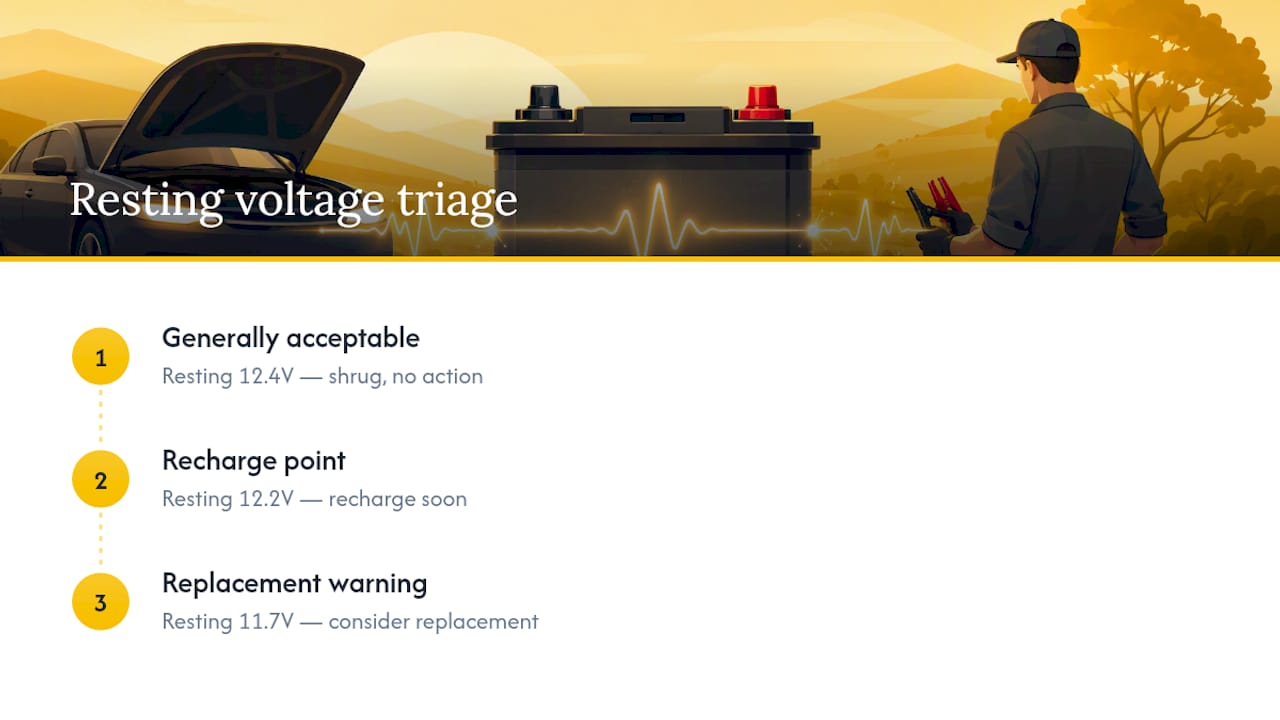
Where conventional advice falls short is treating voltage as a final verdict. It isn't. It's a fast, useful triage tool that tells you where to look next, not a diagnosis on its own. Too many drivers see a decent resting number, assume the battery is healthy, and get stranded a week later when a load test would have caught the weak cell that voltage alone missed.
If you take one thing from this, prioritize the habit over the tool. A five dollar multimeter used consistently, tested at rest and under load, beats an expensive tester used once a year after something already went wrong.
— Waldemar
Get the right tester or battery without the guesswork
Online retailers provide a practical next step once you know your number. Instead of driving to multiple auto parts stores hoping one has the right battery in stock, you can check exact specs, chemistry, and pricing from your phone and get it shipped.

Start with a battery tester if you don't already own one. If your test points to replacement, AkkuPlus stocks 12V starter batteries and AGM options across a range of capacities, including the Panasonic 12V 42Ah for vehicles needing higher capacity. Match amp-hours and terminal layout to your current battery before ordering, and if you're not sure which spec fits your car, AkkuPlus's product filters and customer support can help narrow it down. Head to Akkuplus to browse testers and batteries by voltage, capacity, and chemistry, and get the part that actually fits your car instead of the one that happened to be on the shelf.
Sources
- Normal Car Battery Voltage: Off, Cranking & Running - BLUETTI US
- Testing the battery - Step-by-step - VARTA Automotive
FAQ
Is a car battery 12V or 24V?
Most passenger cars run on a 12V battery; 24V systems show up mainly in heavy trucks, buses, and some specialty commercial vehicles.
What voltage is too low for a car battery?
Anything under 12.4V at rest signals a partial discharge that needs recharging, and readings at or below 11.7V indicate a deep discharge that has likely damaged the battery.
Is 12.2V low for a car battery?
Yes.
Is 11.7 volts a dead battery?
Not necessarily dead, but 11.7V represents a near-zero state of charge that typically causes lasting damage to a lead-acid battery, so a full recharge and professional test are the next steps rather than assuming a jump start fixes the underlying issue.