

Most car batteries last about 5 to 7 years, though AGM and EFB batteries in Start-Stop vehicles often last longer, and standard lead-acid units may wear out sooner under harder conditions. Start testing yours annually once it hits year 3, and treat repeated failed tests, not just age, as your replacement trigger. Battery chemistry matters, and any car with a battery management system deserves a professional hand at swap time.
TL;DR:
- Most car batteries last 5 to 7 years, with AGM and EFB types often exceeding that, especially in Start-Stop vehicles requiring specific chemistries.
- Signs of battery failure include slow engine cranking, dim lights, warning indicators, and repeated jump-starts, often preceded by warning signals.
- Short trips, extreme heat, parasitic drains, and deep discharges significantly shorten battery lifespan, emphasizing the need for regular testing and maintenance.
- Regular voltage checks and annual load tests after three years help identify weakening batteries before failure, considering both age and test results.
- Newer batteries, especially in modern cars with management systems, require proper registration and professional installation to avoid premature failure.
Table of Contents
- Average Car Battery Lifespan by Type
- What Are the Signs of a Failing Car Battery?
- What Causes a Car Battery to Wear Out Faster?
- How Do You Test a Car Battery's Charge and Health?
- How to Extend Your Car Battery's Lifespan
- When Should You Replace Your Car Battery?
- Where to Find the Right Replacement Battery
- A Practical Weekly Checklist for Busy Drivers
- Get the Right Battery and Tools From Akkuplus
- Sources
- FAQ
Average Car Battery Lifespan by Type
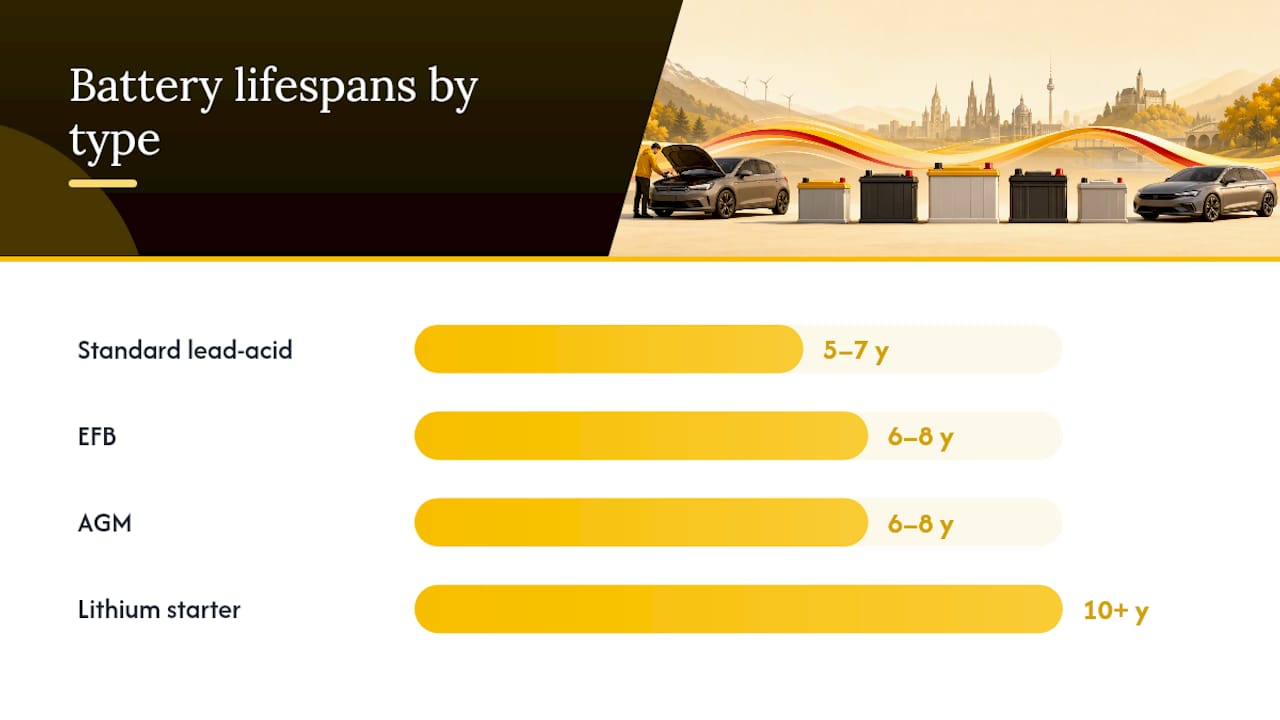
The "3 to 5 years" figure that circulates on most general advice sites is not wrong. It is just the lower bound, not the average. According to ADAC's battery testing guidance, standard 12V starter batteries typically last about 5 years, with well-maintained lead-acid units sometimes reaching 6 to 8 years. AGM and EFB batteries are similar, and lithium starter batteries can last more than 10 years.
The difference in chemistry is not marketing fluff. It changes how the battery handles daily punishment.
- Standard lead-acid: the baseline chemistry found in older or lower-electrical-load vehicles, typically 5 to 7 years with routine care.
- EFB (Enhanced Flooded Battery): built for light Start-Stop duty, tolerating more frequent cycling than standard lead-acid, usually 6 to 8 years.
- AGM (Absorbent Glass Mat): sealed, vibration-resistant, and the standard choice for cars with heavy electrical loads or aggressive Start-Stop systems, also 6 to 8 years.
- Lithium starter batteries: lighter and more cycle-tolerant, often exceeding 10 years, though they remain less common in mainstream passenger vehicles.
- GEL batteries: less common in modern starter applications but still found in some deep-cycle and specialty setups, valued for deep-discharge tolerance.
Statistic Callout: ADAC's data shows a real spread between chemistries: standard lead-acid averages 5 to 7 years, AGM/EFB average 6 to 8 years, and lithium starter batteries can last 10 years or more.
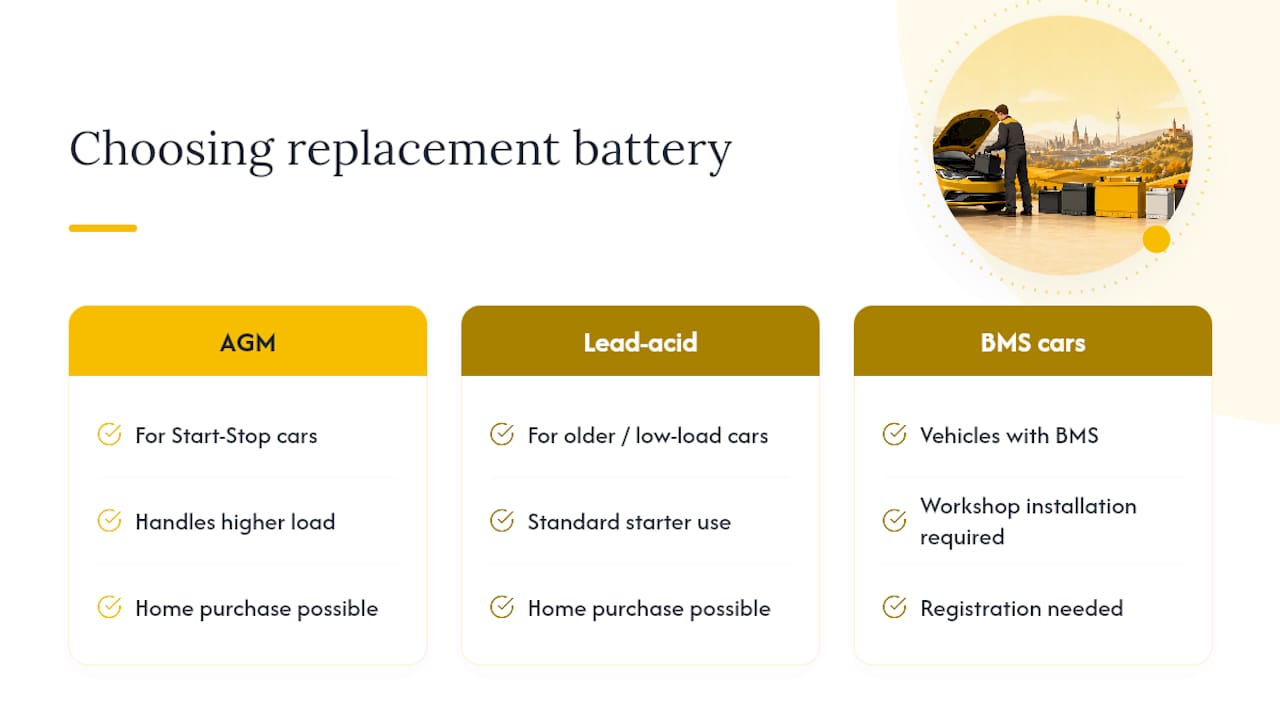
Start-Stop systems push manufacturers toward EFB and AGM because those chemistries handle the constant stop-start cycling without degrading as fast. Cold cranking amps (CCA) ratings also matter; a battery with a lower CCA than your car requires may struggle in cold weather regardless of its age. If your car came with Start-Stop from the factory, check the AGM starter battery options built for that duty cycle rather than defaulting to a standard replacement.
What Are the Signs of a Failing Car Battery?
A dying battery rarely fails without warning. It usually tells you first, if you know what to look for.
- Slow or labored engine cranking. The starter turns over sluggishly instead of firing right away, especially noticeable on cold mornings.
- Dimming headlights or interior lights, particularly when you try to start the engine and everything else dims briefly.
- A battery-shaped warning light on the dashboard. This can mean the battery itself is weak, but it often points to a charging-system fault (alternator, voltage regulator) rather than the battery alone.
- Needing jump-starts more than once in a short period. A single jump after leaving lights on is normal. Needing two or three in a month is not.
- Visible corrosion, bulging, or leaking around the terminals or case, which signals internal breakdown that no amount of charging fixes.
According to ADAC's guidance on dead batteries, a persistent dashboard warning combined with a battery that tests fine on voltage often means the alternator or charging system is the real problem. Don't assume a new battery will solve an issue your alternator is causing.
What Causes a Car Battery to Wear Out Faster?
Age alone rarely kills a battery. Usage patterns do most of the damage, and one insight worth remembering: how you drive matters more than how old the battery is.
- Short trips under about 20 minutes. ADAC flags this as a leading cause of premature failure, because the alternator never gets enough time to fully recharge what the starter used, leaving the battery chronically undercharged and prone to sulfation.
- Extreme heat. High temperatures accelerate corrosion and electrolyte loss inside the battery, and some estimates suggest lifespan can roughly halve with each significant jump in ambient temperature during extreme conditions.
- Deep discharge events. Letting a battery drop below roughly 10.5 volts, say from leaving lights on overnight, causes damage to the lead plates that charging cannot fully reverse.
- Parasitic drain. Aftermarket alarms, dash cams, or a poorly wired accessory can quietly drain a parked car's battery over days or weeks.
- Long storage without charging. A car sitting unused for weeks lets self-discharge and drain compound each other.
Pro Tip: If you mostly drive short errands, a battery maintainer that trickle-charges overnight once every few weeks does more for lifespan than any additive or "conditioning" product on the market.
How Do You Test a Car Battery's Charge and Health?
A resting voltage check takes a couple of minutes and provides useful information. Let the car sit for several hours (overnight is best) to get a true resting voltage that is not affected by recent driving.
| Resting voltage | Approximate charge state |
|---|---|
| ≈12.6 volts | Nearly full charge |
| Around 12.4V | Partial charge |
| ≈11.9 volts | Low charge, should be recharged soon |
| Below about 10.5V | Deeply discharged, possible permanent damage |
These figures come from ADAC's published voltage reference, and they're the same ones most workshops use as a first pass.
To check it yourself:
- Set a multimeter to DC volts, touch red to positive and black to negative, and read the display with the engine off.
- Compare the number to the table above.
- Recheck after charging if the number looks low, to confirm it's holding the charge rather than just accepting one.
Here's the catch: a multimeter only tells you the state of charge, not the battery's real ability to deliver cranking power. A battery can read 12.8 volts and still fail the moment you ask it to turn over a cold engine. That's what a professional load test, or CCA test, measures. It applies a simulated starter draw and checks whether the battery can maintain voltage under that load. If your battery is over 3 years old, an annual load test at a workshop catches failures a voltmeter alone would miss.
How to Extend Your Car Battery's Lifespan
Most of what shortens battery life is preventable, and none of it requires special skills.
- Use a smart maintainer if you drive short trips or park for long stretches. A float charger that automatically stops once the battery is full prevents the chronic undercharging that short commutes cause. Plug it in every few weeks if the car sits for more than a week at a time.
- Take one longer drive a month. A 30 to 40 minute highway run, or an equivalent stretch of steady driving, gives the alternator time to fully recharge what short trips never replace.
- Clean the terminals twice a year. Corrosion buildup increases resistance and forces the alternator to work harder just to maintain charge. A wire brush and a baking soda solution handle most buildup.
- Audit parasitic drains. If you've added an alarm, dash cam, or aftermarket stereo, confirm it powers down fully when the car is off rather than sipping current for days.
- Test before winter. Cold weather exposes a weak battery faster than any other season, so a voltage check in October beats a dead battery in January.
Pro Tip: Store a battery maintainer in the trunk if you own a second vehicle that sits idle for weeks at a time. Ten minutes of plugging it in monthly beats buying a new battery every 3 years.
When Should You Replace Your Car Battery?
Replace your battery when any of these signs appear: resting voltage consistently below about 12.4V after a full charge, a failed load test, cold cranking amps output significantly below the rated specification, or if the battery is over 5 to 7 years old and shows signs of weakness such as slow cranking.
Before buying a replacement, check these four things:
- Physical size and hold-down fit match your vehicle's battery tray.
- Capacity (Ah) and CCA rating meet or exceed the manufacturer's minimum.
- Chemistry matches your car's needs. Start-Stop vehicles generally require AGM or EFB, not standard lead-acid.
- Warranty length, since a longer warranty often reflects the manufacturer's confidence in that chemistry's durability.
Cars with battery management systems often need the new battery registered with the vehicle's onboard computer, per ADAC's installation guidance, so the charging profile tracks correctly. Skipping that step on a modern car can shorten the new battery's life before it even gets going.
Where to Find the Right Replacement Battery
Starter batteries across lead-acid, AGM, and EFB chemistries, along with battery testers and maintainers are available for drivers who want to track charge state at home. If you're shopping for a Start-Stop replacement, the AGM starter battery lineup covers the higher-load demands those systems create, while a standard lead-acid option fits older or lower-load vehicles. Vehicles with a battery management system still call for workshop installation and registration.
A Practical Weekly Checklist for Busy Drivers
Here's what I'd actually do if this were my car: check resting voltage on a Saturday morning, wipe down the terminals if they look chalky, take one longer drive that week instead of five short ones, and plug in a maintainer if the car's been sitting. Past year 3, book a professional load test before winter rather than after the first cold-morning no-start.
— Waldemar
Get the Right Battery and Tools From Akkuplus
Parts related to battery testing and replacement are available, not just batteries. If a resting-voltage check leaves you unsure whether you're looking at a weak battery or a full-blown failure, a battery tester settles it in under a minute, and it's a one-time purchase you'll use for years instead of guessing every time the dash light flickers.

Browse the full Akkuplus catalog for starter batteries across lead-acid, AGM, and EFB chemistries, plus maintainers for anyone doing mostly short drives. If your vehicle runs Start-Stop or a battery management system, pick your replacement by chemistry and CCA rating first, then arrange professional installation so the registration and charging profile carry over correctly.
Sources
- Autobatterie testen: So prüft man die Spannung der Autobatterie (ADAC)
- ADAC press: battery purchase and installation guidance
- Autobatterie Lebensdauer (Elektronik-Zeit)
FAQ
How do I know if my car needs a new battery?
Watch for slow cranking, dimming lights at startup, a dashboard battery warning, or needing more than one jump-start in a short span. A resting voltage consistently below 12.4V or a failed load test confirms it.
Should I replace a 7-year-old car battery?
If it's a standard lead-acid battery, 7 years is near or past its typical range, so a load test is worth scheduling even if it still starts the car fine. AGM and EFB batteries can often run closer to 8 years before the same caution applies.
Can a 10-year-old car battery still be good?
It's uncommon for standard lead-acid or AGM batteries, but lithium starter batteries are built for that range and can still test healthy at 10 years. Any battery that old deserves a load test rather than an assumption either way.
Do car batteries give warning before dying?
Usually, yes. Slow cranking, dimming lights, and a dashboard warning tend to show up days or weeks before a full failure, though a sudden short in the internal cells can occasionally cause a battery to die with no warning at all.