
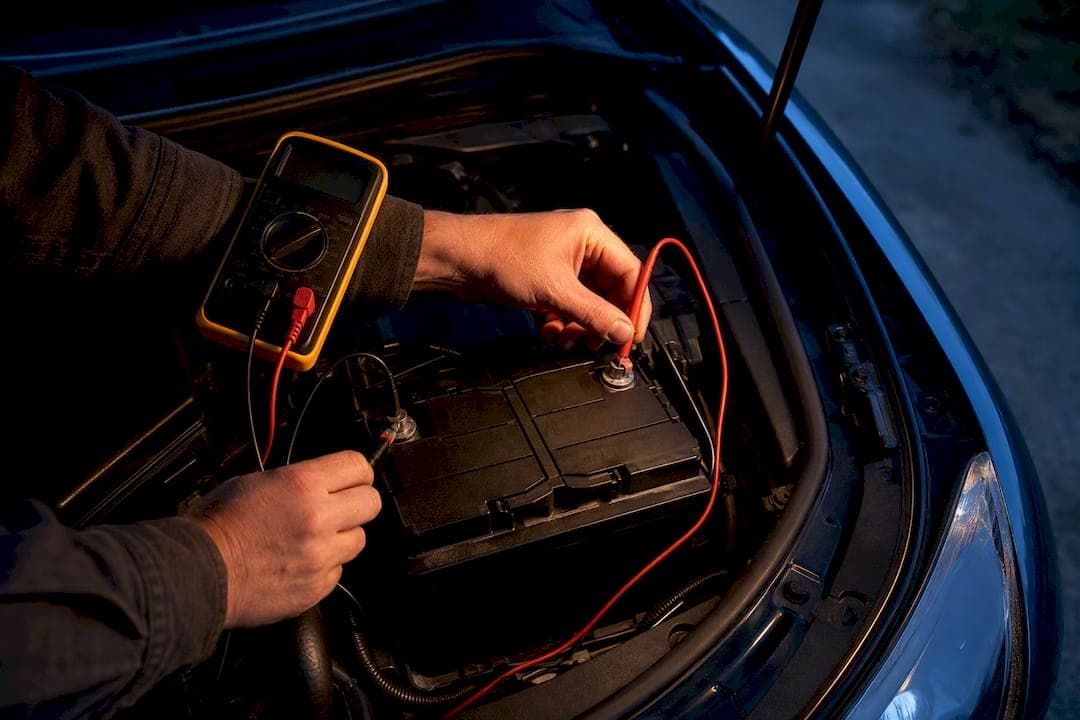
If your battery is dead every morning, it's almost always one of three things: a parasitic drain, an aging battery that can no longer hold a charge, or a charging system that isn't topping it off properly. Check resting voltage first, then try a full charge or a jump-start. If it dies again within a day or two, move on to parasitic-draw testing.
TL;DR:
- Ensuring the battery is fully charged and healthy requires resting voltage readings between 12.6 and 12.8 volts, and a charging voltage above 13.8 volts when the engine runs.
- Parasitic drain, which can cause overnight battery failure, is usually above 100 milliamps or more, and is identified by pulling fuses to locate the culprit circuit.
- Cold weather exposes marginal batteries by reducing capacity and cranking power, often revealing issues that seemed minor in warmer months.
- A battery that fails to regain full charge after a proper external recharge is likely past its useful life and needs replacement.
- Regular maintenance, such as checking battery age, cleaning terminals, and avoiding short trips, can prevent common causes of overnight battery drains.
Table of Contents
- Quick Checklist: The Likeliest Causes To Check First
- How To Test The Battery And Charging System Safely
- How To Find A Parasitic Drain Step By Step
- Immediate Fixes And When To Call A Workshop
- Prevention And Maintenance To Avoid Repeat Overnight Drains
- Differences In Battery Drain Issues Between Conventional And Hybrid Or Electric Vehicles
- How Modern Car Electronics And Modules Contribute To Battery Drain
- Impact Of Extreme Temperatures On Battery Drain And Lifespan
- Publisher Perspective: What Actually Predicts A Repeat Failure
- Get The Right Tools And The Right Battery, Not Guesswork
- Sources
Quick Checklist: The Likeliest Causes To Check First
Before pulling out a multimeter, run through the obvious stuff. Half the "mystery" overnight drains turn out to be something you can spot in thirty seconds with a flashlight.
- Walk around the car and check for interior lights, glovebox lights, or trunk lights staying on, and confirm every door and the trunk are fully latched.
- Think about whether you left anything plugged in or running, like a phone charger, dashcam, or aftermarket amp.
- Note the battery's age and any recent warning signs, like slow cranking, dim headlights, or clicking when you turn the key.
- Recall whether the dashboard battery or charging light flickered on while driving, even briefly.
- Consider your driving pattern lately. A string of short trips or a cold snap can leave a battery chronically undercharged even with no drain at all.
If nothing on that list explains it, the problem is either a genuine parasitic draw or a charging system that's falling short. Both are testable with a $15 multimeter.
How To Test The Battery And Charging System Safely
Two numbers tell you almost everything: resting voltage and charging voltage. Both are measured directly at the battery posts with the engine off, then on.
With the car sitting overnight (no engine, no accessories running), touch a multimeter's probes to the positive and negative terminals. A healthy battery rests at about 12.6 to 12.8 volts. Drop below roughly 12.2V and the battery has already lost a meaningful chunk of its charge, even if it still cranks the engine.
| Reading | What it means |
|---|---|
| 12.6–12.8V (resting) | Battery is fully charged and healthy |
| 12.2V or below (resting) | Substantial discharge, likely drain or aging cell |
| 13.8–14.8V (engine running) | Alternator charging correctly |
| Below 13.8V (engine running) | Alternator, regulator, or belt problem |
Pro Tip: Take the resting voltage reading before your first drive of the day. Even a five-minute engine run adds surface charge that will mask a genuinely weak battery.
Start the engine and measure again at the same posts. A working alternator should push 13.8 to 14.8 volts once the engine is running above idle. Anything lower points to the alternator, a slipping belt, or a bad connection at the alternator plug, not the battery itself. A dashboard battery warning light usually means the same thing, a charging fault rather than a simple dead cell, so don't assume a new battery will fix it.
If you give the battery a full charge with an external charger and the resting voltage still won't climb back to 12.6V or higher, the battery has reached the end of its useful life and needs replacing rather than repeated charging.
How To Find A Parasitic Drain Step By Step
A parasitic drain means something is pulling current after you've locked the car and walked away. Finding it takes patience more than skill.
- Let the car sleep first. Modern vehicles have a dozen or more control modules that stay briefly awake after you lock the doors. Measuring current too soon gives a falsely high reading. Wait at least 20 minutes, ideally closer to 45, before you take any reading.
- Disconnect the negative terminal and insert a multimeter in series, or clamp an inductive ammeter around the negative cable. Fluke's own testing guidance recommends the clamp method specifically because it avoids breaking the circuit and risking a false reset.
- Read the draw. Normal standby current after sleep runs about 20 to 80 milliamps; anything sustained above 100 mA is enough to flatten a starter battery within a few days. Real-world ADAC testing found most cars settle closer to 5 to 40 mA once everything is truly asleep, so anything noticeably above that range deserves attention.
- Pull fuses one at a time, watching the meter after each pull. When the current drops sharply, you've found the circuit.
- Check the usual suspects first: aftermarket alarms, dashcams that never fully power down, sticking relays, and corroded ground straps are the repeat offenders.
If the drain only shows up occasionally, a simple fuse pull won't catch it. That calls for a data logger left on the battery overnight or a shop with CAN-bus diagnostic equipment.
Immediate Fixes And When To Call A Workshop
Some of this you can handle in the driveway. Some of it you shouldn't try to fix yourself.
- If the battery is dead now, jump-start it, then either drive for 30 minutes or more or hook up a proper charger. A jump alone just borrows charge; it doesn't replace what was lost.
- Clean the terminals with a wire brush and check that the hold-down bracket is actually tight. Corrosion adds resistance and can mimic a weak battery.
- If resting voltage stays below 12.6V after a full, proper charge, the battery is done. Replacing it is cheaper than repeating this diagnosis every few weeks.
- Alternator output below 13.8V, a flickering charge light while driving, or a battery that seems fine on the bench but dies in the car all point to a charging-system fault that belongs with a workshop that can test the alternator and regulator directly.
- If the battery warning light comes on while you're actually driving, don't wait. That's a live charging failure, not an overnight-parasitic issue, and continuing to drive can leave you stranded.
Prevention And Maintenance To Avoid Repeat Overnight Drains
Fixing the immediate problem is one thing. Stopping it from happening again next month is the part most owners skip.
- Hook up a smart trickle charger during long parking stretches or winter storage instead of just letting the battery sit.
- Break up strings of short trips with an occasional 30 to 40 minute drive so the alternator gets a real chance to finish charging the battery.
- Test any aftermarket accessory, alarm, or dashcam for how it behaves after the car sleeps. A unit that never fully powers down is a slow bleed you'll rediscover every winter.
- Get the battery and charging system checked once it's 3 to 4 years old, and clean the terminals during that same visit.
Pro Tip: Set a phone reminder for battery age, not mileage. A battery that's rarely driven hard can still fail from age alone, since sulfation builds up on the plates whether the car moves or not.
Differences In Battery Drain Issues Between Conventional And Hybrid Or Electric Vehicles
A conventional car has one 12V battery doing double duty: starting the engine and running everything electrical while parked. Drain it overnight and the car simply won't start.
Hybrids and EVs still carry a separate 12V battery, and it still handles the same jobs, locks, infotainment memory, alarm systems, and the low-voltage electronics that wake the high-voltage system. That 12V battery can drain overnight for the exact same reasons a conventional one does: a stuck relay, an aftermarket accessory, corrosion. The difference shows up in the consequence. In many hybrids and EVs, a dead 12V battery means the car won't power up at all, even though the large traction battery pack sitting behind it is fully charged. You can be sitting on 300 miles of range and still need a jump-start.
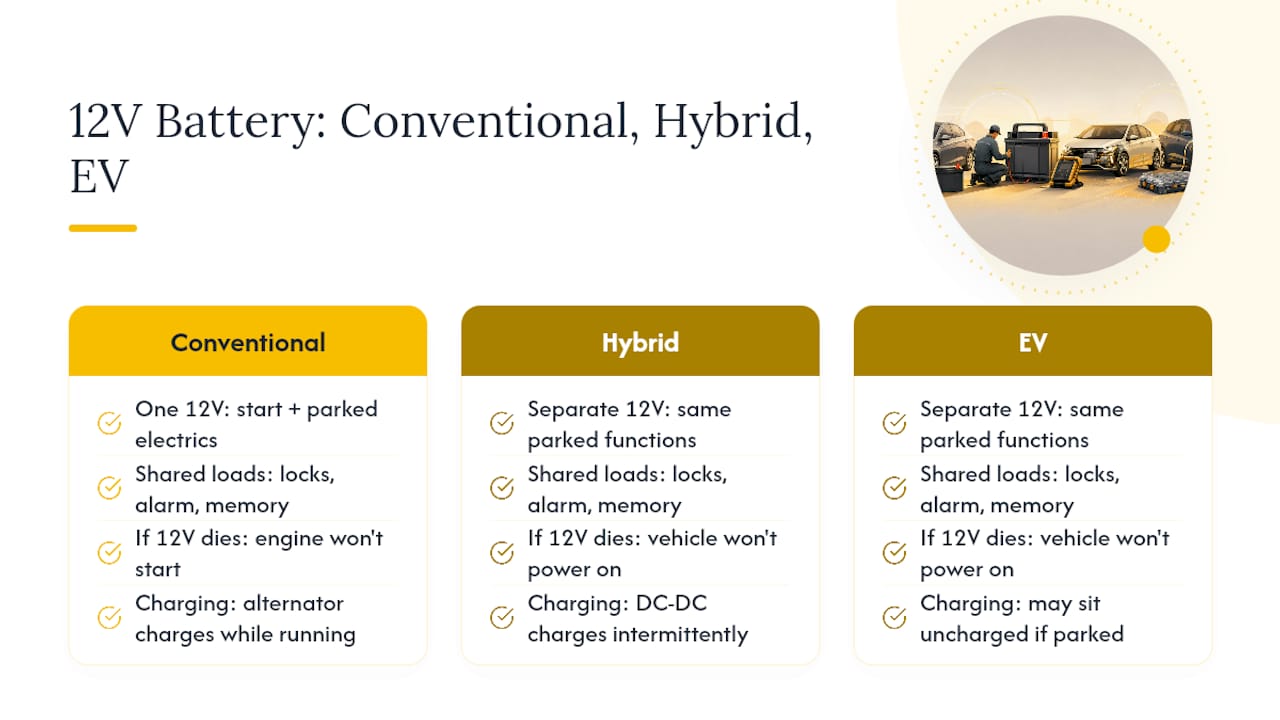
The other wrinkle is charging behavior. A conventional alternator runs constantly while the engine is on. Hybrids often charge the 12V battery through a DC-DC converter that only activates the gas engine or draws from the traction pack intermittently, which means a marginal 12V battery in a hybrid can go longer without an obvious warning sign before it finally fails. EV owners sometimes discover the same thing after letting the car sit unplugged for a couple of weeks. The high-voltage pack manages itself fine; the small 12V battery underneath the frunk or trunk is the one that quietly dies.
How Modern Car Electronics And Modules Contribute To Battery Drain
Cars built even a decade ago had a handful of control modules. Current vehicles routinely carry a dozen or more, handling everything from keyless entry polling to telematics, infotainment memory, and driver-assist cameras that stay in a low-power listening state waiting for the next unlock signal.
Each module is supposed to drop into sleep mode within minutes of the car locking, which is exactly why testing too early gives a misleadingly high reading. The 20-minute wait before measuring current isn't a suggestion, it's accounting for real hardware behavior. Most of the time that staggered sleep sequence works fine, and ADAC's measurements confirm cars typically settle to a very low standby draw once everything has powered down correctly.
The problem shows up when one module refuses to sleep, a software glitch keeps a camera or radio module half awake, or an aftermarket alarm or tracker was wired without proper sleep logic. Telematics units and remote-start systems are frequent offenders because they're specifically designed to stay partially alert, listening for a signal, which by design costs a small but continuous current draw. Add a marginal ground connection or a corroded module connector and that small draw becomes the sustained pull that empties a battery by morning. This is also why intermittent drains are so frustrating to chase. A module that only misbehaves under certain conditions, like a specific ambient temperature or a particular lock sequence, won't show up in a single 20-minute test, which is exactly the scenario that calls for logging equipment or a shop's CAN-bus diagnostic tools.
Impact Of Extreme Temperatures On Battery Drain And Lifespan
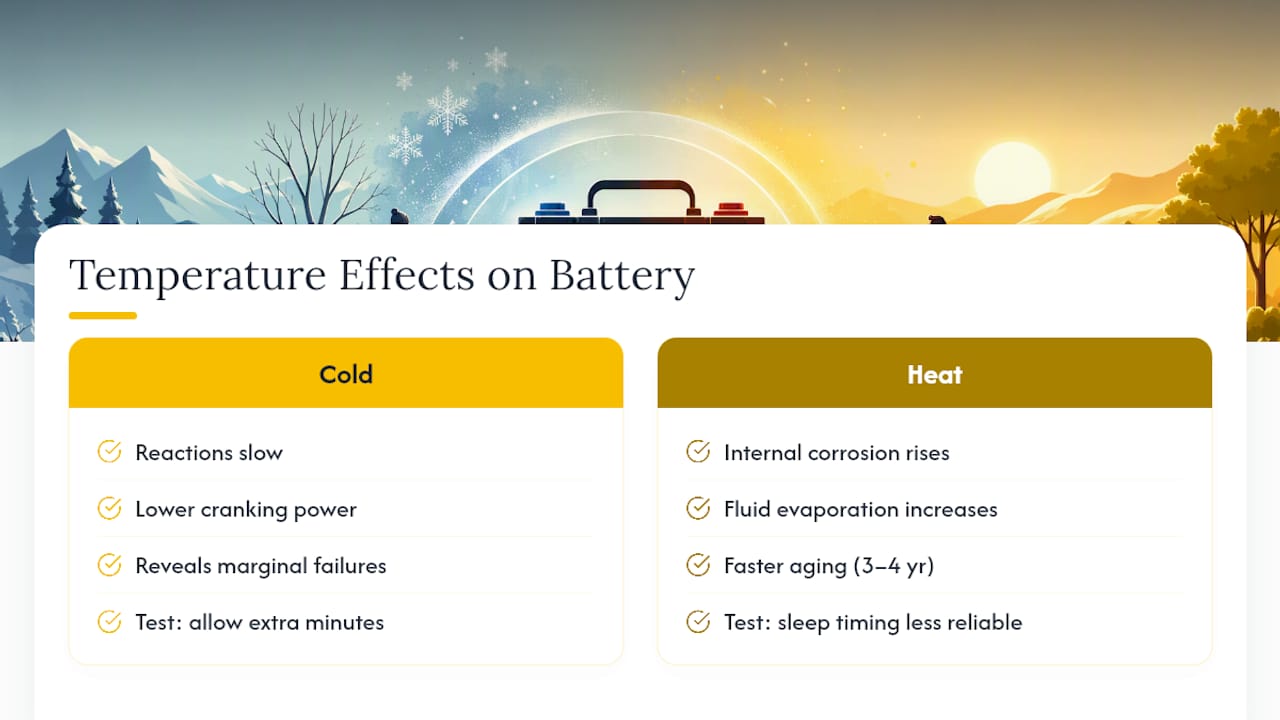
Cold weather doesn't create a parasitic drain, but it exposes one ruthlessly. A lead-acid battery's ability to deliver current drops sharply as temperature falls, so a battery that was barely getting by in September can fail outright in January with the exact same underlying drain it's had all along.
The chemistry is straightforward: the reactions inside a battery slow down in the cold, cutting available cranking power right when the engine needs more of it to turn over a thicker, colder oil. A battery at 60% capacity might start the car fine in summer and fail to start it at all once temperatures drop toward freezing. That's also why so many drain complaints cluster in early winter. It's rarely a coincidence. Marginal batteries have been quietly losing capacity for months, and cold weather is just the trigger that finally reveals it.
Heat causes a different kind of damage. High summer temperatures accelerate the internal corrosion and fluid evaporation that shorten a battery's working life, so a battery that spends its summers in a hot engine bay tends to age faster than one in a milder climate, even with identical driving habits. That's part of why the 3 to 4 year checkup window matters more in hotter regions.
Either extreme also makes the 20-minute sleep rule slightly less reliable, since some modules adjust their sleep timing based on ambient temperature. If you're testing for a drain in the middle of a cold snap, give it a few extra minutes before you trust the reading.
Publisher Perspective: What Actually Predicts A Repeat Failure
Most drain complaints get treated as a single mystery to solve. They're usually a pattern to notice instead. The battery that fails twice in one winter is telling you something the battery that fails once isn't. Waldemar has looked at enough of these cases to say the second failure is the one that matters. Owners chase the parasitic drain, find nothing dramatic, and assume they're clear. Then it happens again a few weeks later because the real issue was a battery already past its useful life, not a stray milliamp somewhere in the wiring. Test the battery's actual charge-holding capacity before you spend a weekend pulling fuses.
— Waldemar
Get The Right Tools And The Right Battery, Not Guesswork
Diagnosing an overnight drain gets a lot easier once you're not relying on a mechanic's schedule to find out. A handheld battery tester gives you the resting-voltage and load-test numbers this article walks through, on your own driveway, in a few minutes.

If testing confirms the battery itself is the problem, rather than the charging system or a parasitic draw, Akkuplus carries replacement starter batteries sized for the resting and charging voltage ranges covered above, including the Optima Red Top AGM starter battery for drivers who need stronger cold-cranking performance, and standard lead-acid options like the Long WP1250 for lighter-duty applications. Check your vehicle's required cold-cranking amps and physical size before ordering, since a mismatched battery won't solve a charging problem and can create a new one. For cars that sit for extended periods, an Ansmann Energy 8 plus smart charger keeps the battery at full charge without overcharging it during storage. Buy the tester first, confirm the diagnosis, then order the exact battery your car needs.
Sources
- Car battery voltage: what do the numbers mean? | Firestone Complete Auto Care
- Batterie über Nacht leer? Kriechstrom finden (Anleitung) | KFZ-Dietrich
- How to find parasitic battery drain with a multimeter | Fluke
- Ruhestrom test (ADAC)