

A 50Ah battery wants roughly 2.5 to 5 amps for maintenance, 5 to 10 amps for a standard recharge. Going up to 20% of capacity is fine only briefly, only if your battery's datasheet allows it, and only with a smart charger that tapers current on its own. Push past that and you're trading battery life for speed, risking heat and gassing you won't notice until the damage is done.
TL;DR:
- Charging a 50Ah lead-acid battery at 5A typically takes 12 to 14 hours, following the standard 0.1C rate recommended for practical fast charging.
- Current tapers during absorption, so relying solely on charging hours or constant current calculations can underestimate actual charge time.
- Using a charger with automatic multi-stage (CC-CV or IUoU) functions ensures proper voltage tailoring to battery chemistry, reducing the risk of damage.
- Charging from a car's alternator differs from dedicated chargers, often resulting in incomplete absorption and extended recharge times for deeply discharged batteries.
- Monitoring the charger’s amp taper to 1-3% of Ah rating is a better indicator of full charge than fixed time estimates.
Table of Contents
- Quick Reference: Amps by Battery Size and Situation
- Why Amps Change During Charging
- How to Calculate Estimated Charging Time
- Choosing a Charger and Setting the Right Amps
- Safety Checklist and Troubleshooting
- Where to Check Manufacturer Specs and Compatible Gear
- The Amp Number Everyone Gets Wrong
- Get the Right Battery and Charger Setup from Akkuplus
- Sources
Quick Reference: Amps by Battery Size and Situation
The math behind these numbers comes from the C-rate, a way of expressing charge current as a fraction of the battery's amp-hour (Ah) capacity. A common industry rule of thumb charges lead acid starter batteries at about one tenth of their rated capacity, written as 0.1C. Maintenance charging runs slower, around 0.02C, while a manufacturer-approved fast recharge might reach 0.2C for short stretches.
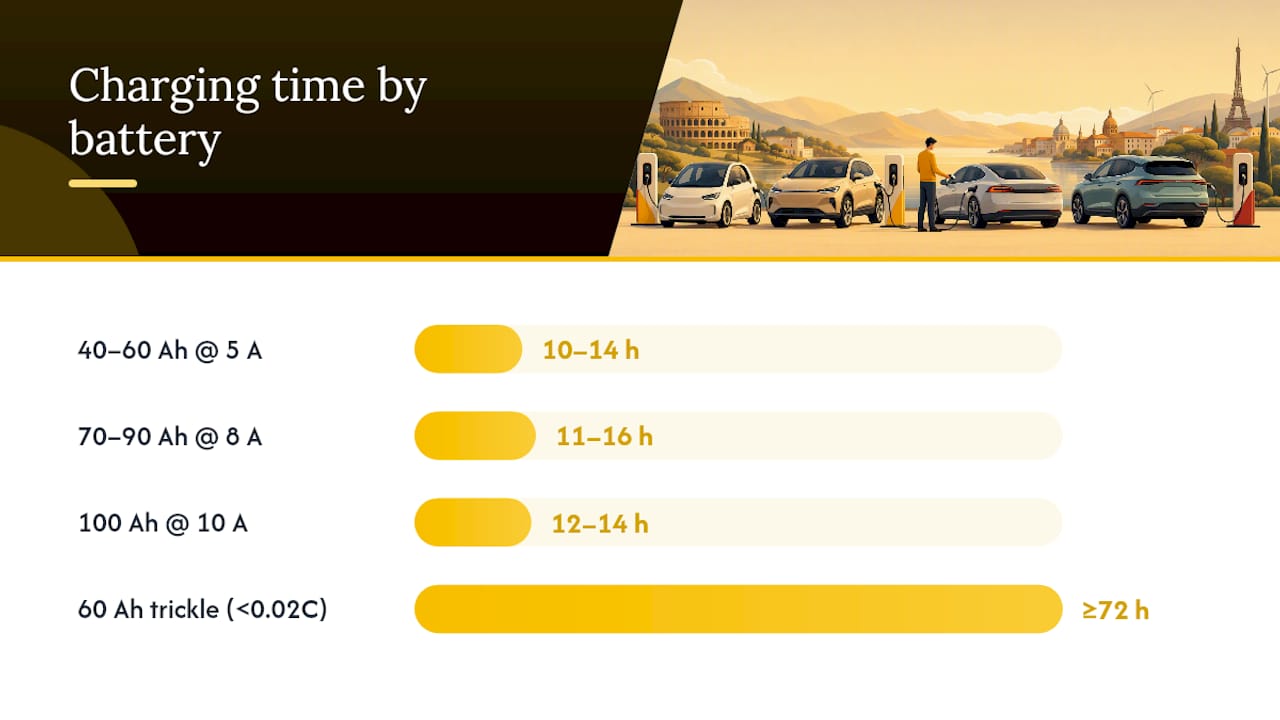
Here's how that breaks down for the battery sizes you'll actually encounter:
Charging time follows the Ah ÷ A × 1.2 to 1.4 formula, where the multiplier accounts for the slower absorption phase near the end. A few worked examples make this concrete:
- A 40 to 60Ah battery charging at 5A typically needs 10 to 14 hours for a full recharge from a moderately discharged state.
- A 70 to 90Ah battery at 8A lands around 11 to 16 hours depending on how deep the discharge was.
- A 100Ah battery at 10A usually needs 12 to 14 hours, longer if it sat dead for a while.
Trickle charging below 0.02C has its place. It's the right call for long-term storage maintenance, keeping a battery topped off over winter without stressing it. But use it as a primary recharge method after a deep discharge and you're asking for trouble: at those low currents, a fully dead 60Ah battery could take three days or more to recharge, and the extended time at low state of charge raises the risk of sulfation, the crystal buildup on the plates that permanently robs a battery of capacity.
Why Amps Change During Charging
A charger doesn't hold one current level from start to finish, and understanding why explains a lot of confusion around charge times. The process runs through three distinct phases.
Bulk is the fast part. The charger pushes constant current, at whatever amp setting you chose, and the battery voltage climbs steadily. Absorption kicks in once voltage hits a target threshold, usually around 14.4 to 14.8V for flooded and AGM batteries. Here the charger holds voltage steady and lets current taper down on its own as the battery becomes less willing to accept charge. Float is maintenance mode, a low steady voltage that keeps a full battery topped off without overcharging it.

This is where a lot of people get their time estimates wrong. Practitioner experience backs this up directly: absorption is slow, and the final 10 to 15% of charge can take nearly as long as the first 85%. Simple Ah divided by amps math assumes constant current the whole way through, which almost never happens once absorption starts.
Modern multi-stage chargers handle this transition automatically, often called CC-CV or IUoU charging. Cold temperatures slow acceptance further, since chemical reactions inside the battery run sluggishly below freezing.
Pro Tip: Watch the amp readout instead of the clock. When current tapers down to 1 to 3% of the battery's Ah rating, it's essentially full. That's a far better stop signal than any fixed time estimate.
How to Calculate Estimated Charging Time
The formula you need is straightforward: Estimated time (hours) ≈ Ah ÷ charger amps × 1.2 to 1.4. That multiplier isn't padding. It covers charging inefficiency and the slower absorption taper that pure current math ignores.
Three examples show how this plays out in practice:
- A 50Ah battery charging at 5A: 50 ÷ 5 = 10 hours, times 1.2 to 1.4 gives you 12 to 14 hours for a realistic full charge.
- A 60Ah battery at 6A: 60 ÷ 6 = 10 hours, adjusted to 12 to 14 hours.
- A 100Ah battery at 10A: 100 ÷ 10 = 10 hours, adjusted to 12 to 14 hours.
Notice the pattern. Charging at roughly 0.1C consistently lands you around 12 to 14 hours regardless of battery size, which is exactly why that rate has become the standard recommendation.
Two exceptions matter. A heavily sulfated or deeply discharged battery can take considerably longer, or may need a dedicated desulfation or conditioning cycle before it accepts a normal charge at all. And charging from your car's alternator during driving works differently than a dedicated charger. The alternator delivers a higher, less controlled current early on and rarely completes the absorption phase during a short drive, which is why a battery that's been deeply discharged usually needs bench charging rather than just driving around.
Choosing a Charger and Setting the Right Amps
Skip the basic unregulated chargers if you can. A smart multi-stage charger with selectable battery chemistry settings (flooded, AGM, gel, or lithium iron phosphate) adjusts its voltage targets automatically, which matters because AGM and gel batteries need different absorption voltages than standard flooded lead acid. VARTA's own guidance notes that quality modern chargers handle multiple battery types and shut off automatically once charging finishes.
When comparing charger specs, look for a few things specifically:
- Maximum output amps that comfortably cover your battery's Ah rating without forcing you to the top of its safe range.
- A selectable or adjustable amp setting rather than a single fixed output.
- Correct voltage profiles for your battery chemistry, not a generic one-size-fits-all setting.
- Low output ripple, since dirty or noisy current generates extra heat and stresses the plates.
Setup order matters too. Connect the charger's positive clamp to the battery's positive terminal first, then negative to negative or to a grounded chassis point away from the battery if you're charging in-vehicle. Confirm your cables are rated for the amp output you're planning to use. Thin cables on a 10A charge will heat up and waste energy as resistance. Products like a 12V AGM starter battery list their recommended charge current directly on the spec sheet, which is the number you should defer to over any generic rule.
Pro Tip: If your charger has no amp display, check the manual for its fixed output rating before assuming it matches your battery's needs. Plenty of budget chargers only offer one speed, and it might be wrong for a small battery.
Safety Checklist and Troubleshooting
Before connecting anything, clean corroded terminals, check that vents aren't blocked on serviceable batteries, and charge in a ventilated space. Hydrogen gas released during charging is flammable, and eye protection is worth the ten seconds it takes to put on.
Watch for these warning signs during charging:
- Heavy gassing or a bubbling sound means stop immediately and ventilate the area before touching anything.
- A hot battery case means stop and let it cool before checking connections or amp settings.
- Visible swelling or electrolyte leakage means the battery is compromised and should be replaced, not recharged.
Excessive heat from unregulated high current causes irreversible plate damage, which is why catching these signs early actually protects your wallet.
If a battery isn't accepting charge normally, work through it methodically:
- Measure open-circuit voltage first. Anything below 12.4V suggests a partial discharge; below 12V suggests deep discharge.
- Watch whether voltage climbs steadily once charging starts. A battery that stays flat under charge for an extended period may have internal damage.
- Follow up with a load or cranking test, or have a workshop check it, before assuming a longer charge will fix the problem.
Where to Check Manufacturer Specs and Compatible Gear
Every battery ships with a manufacturer-recommended maximum charge current, and it's always worth checking against the C-rate guidance above rather than assuming. Product listings on Akkuplus include technical specifications for both batteries and chargers, alongside country-based availability for shoppers across Europe.
A few product pages worth bookmarking if you're matching a charger to a specific battery:
- The Panasonic LC-P1242AP, a 42Ah lead-acid battery with published charge recommendations, useful for seeing how Ah rating and safe amp range line up on a real spec sheet.
- The Long WP5-12, a small 5Ah battery that shows why low-amp charging matters more as capacity drops. Even a modest 2A charger is aggressive at that size.
- The Multipower MP12-12, a mid-size 12Ah AGM battery for comparing charger settings against a middle-ground capacity.
If your battery's datasheet doesn't spell out a maximum recharge current, product datasheets and support resources are the place to check before guessing at a number.
The Amp Number Everyone Gets Wrong
Most charging advice online treats the amp setting as the whole story, and that's the mistake. The real variable that determines whether a battery survives five years or two isn't the number stamped on the charger. It's how much time that battery spends at the wrong voltage while current tapers during absorption, a phase most guides skip entirely because it doesn't fit neatly into a simple Ah divided by amps calculation.
The 0.1C rule earns its reputation for a reason: it lands you in a sweet spot where bulk charging is fast enough to be practical, but absorption doesn't drag on for days. Faster charging at 0.2C isn't dangerous by default, but it shifts more of the thermal load onto a shorter window, which is exactly when unregulated chargers do the most damage. If you take one thing from this, prioritize a charger that shows you live current and tapers automatically over one that promises a bigger number on the box.
— Waldemar
Get the Right Battery and Charger Setup from Akkuplus
Guesswork about amps usually comes from not knowing your battery's actual spec sheet. Product pages can provide technical details including Ah rating, recommended charge current, and chemistry type, helping you match a charger to actual battery specifications rather than a generic rule.

If you're shopping for a replacement starter battery or want a tester to confirm your current setup is holding charge, some retailers carry both. A battery tester for standard and button cells is a cheap way to confirm your charging results before you trust the battery on a cold morning. For readers replacing a tired starter battery outright, the AGM starter battery lineup ships with the exact Ah and charge current specs this guide recommends checking. Browse the full catalog at Akkuplus to find the model that matches your vehicle, then set your charger's amps with confidence instead of a guess.
Sources
- Starterbatterie — Wikipedia (German)
- Ladezeit berechnen — Elektronik-Zeit (2026-04-02)
- Battery charger — Wikipedia (English)
- Battery charging and storage guidelines — Waghorn's manual (pdf)