
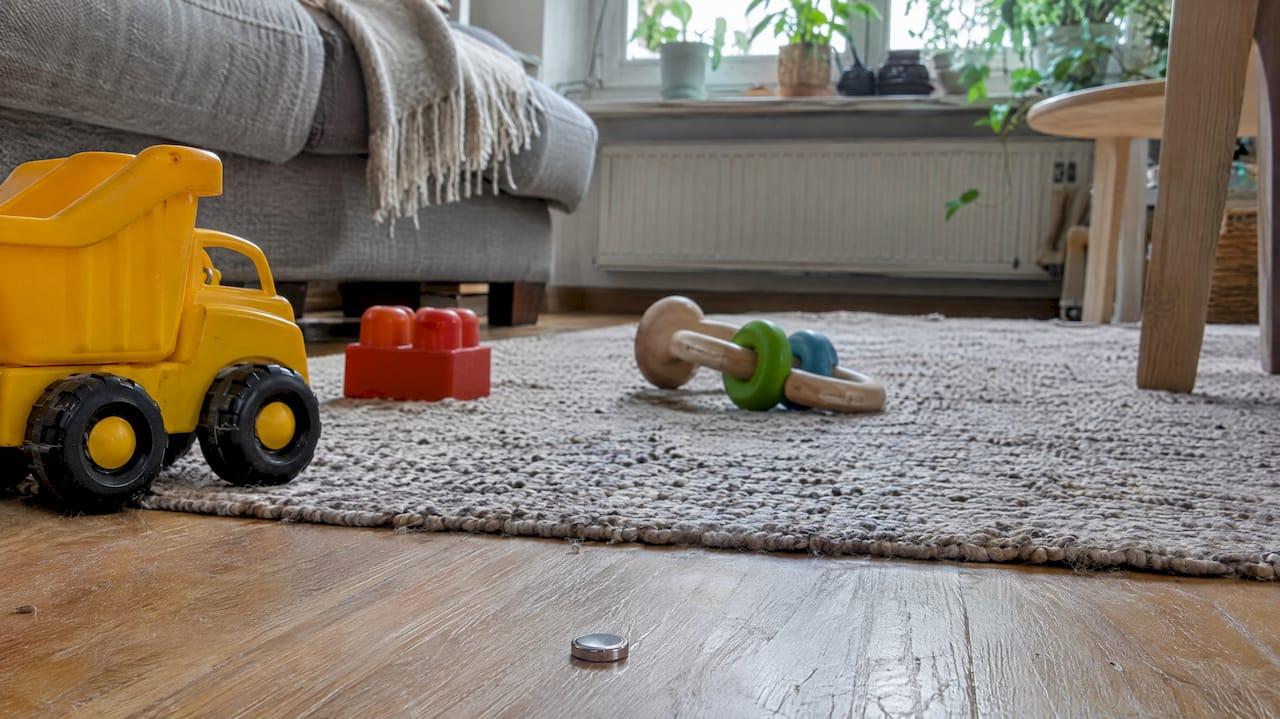
A swallowed button battery is a medical emergency, even when the child seems fine. Coin-sized cells, especially lithium ones, can cause severe chemical burns in the esophagus, so the safest household is one where children never get hold of them. That means choosing devices with screwed battery compartments, keeping spare and used cells locked away, and knowing what to do in Germany if a cell goes missing: go to a children's hospital or call 112. This guide gives you the routine, step by step.
TL;DR
- Button cells, above all lithium coin cells of 20 mm and larger, can stick in a small child's esophagus and cause serious burns within about two hours.
- If you suspect a swallowed or inserted battery, go straight to a children's hospital or emergency room, or call 112. Do not wait for symptoms, and do not induce vomiting.
- Prevention starts at purchase: screwed battery compartments, fixed rechargeable packs where possible, and no loose cells in drawers or handbags.
- Store new and used cells out of sight and reach, and take used ones to a collection point instead of the household trash.
- In the EU, toys with button cells must be built so that children cannot reach the battery directly.
Table of Contents
- Why button batteries are dangerous for small children
- Where children find button batteries at home
- What to do if a child may have swallowed a button battery
- Buying: choose devices that keep cells out of reach
- Storing and handling at home
- Disposing of used cells properly
- What the rules say in Germany and the EU
- Our perspective
- Where to find the right cell and battery solution
- FAQ
- Sources
Why button batteries are dangerous for small children
A button battery looks harmless. It is small, shiny and about the size of a coin, which is exactly why a toddler puts it in their mouth. Small children explore with their hands and mouths, and the German child-safety association Bundesarbeitsgemeinschaft Mehr Sicherheit für Kinder points out that a button cell can be swallowed quickly for exactly that reason.
The danger is not poison. The German Federal Institute for Risk Assessment (BfR) explains that when a cell lodges in the esophagus, contact with moist tissue lets current flow, and at the boundary between battery and tissue hydroxide ions form that can cause severe chemical burns. In plain terms, the battery creates a caustic substance on the spot, and the tissue burns where the cell sits.
Three factors decide how bad the damage gets:
- Size. Cells with a diameter of 20 mm or more are the most hazardous because they are more likely to get stuck in the narrow child esophagus.
- Charge and chemistry. The BfR notes that the stronger the charge, the worse the harm. Lithium button cells are especially problematic because their voltage is comparatively high, as BfR department head Prof. Matthias Greiner explained in 2025.
- Time. The longer the cell stays in place, the more serious the injury. After only two hours of contact, the burn can reach deep tissue layers. Later complications can include perforations toward the aorta and the airways, inflammation and bleeding that is hard to control, which in rare cases ends fatally.
The esophagus is not the only risk. The BfR says button cells in the nose or ear can also cause serious tissue damage. That matters because toddlers do not only swallow things: they push them into noses and ears too.
How common is it?
The BfR reports that clinics and poison information centers in Germany have notified it of several hundred cases of swallowed button cells over the past ten years, with fatal outcomes possible in rare cases. Most children recover. The reason to take it seriously is not that it happens every day, but that the injury can be severe and silent at the start.
What about the metals inside?
Parents often worry about mercury or cadmium. According to the BfR, the use of mercury, cadmium and lead in button cells is very strictly limited by EU law, and serious poisoning is not expected if the casing is attacked by stomach acid. The urgent problem is the burn in the esophagus, not poisoning from the contents.
Where children find button batteries at home
The hard part is that button cells sit in everyday objects nobody thinks of as hazardous. The BfR names wristwatches, remote controls and children's toys as typical examples. In practice, the list in most homes is longer:
- Key fobs and car remotes
- Kitchen scales and bathroom scales
- Thermometers, including some digital baby thermometers
- Greeting cards that play music
- LED tea lights and fairy lights
- Small flashlights and bike lights
- Hearing aids and blood sugar meters
- Tracker tags and small electronic gadgets
- Calculators, toys with sound modules and books with buttons
The BfR has highlighted the Christmas season in particular, when LED tea lights, string lights, musical greeting cards and remote controls multiply in the house, as reported by Thieme Natürlich. Birthdays, holidays and visits to relatives' homes are the moments when your usual routine is not in place.
Two hiding places deserve a specific check: the loose cell itself (in a drawer, a handbag, on a nightstand next to a hearing aid) and the used cell you have just swapped out and left on the counter. A dead cell can still carry enough charge to cause harm, which is why used batteries need the same care as new ones.
What to do if a child may have swallowed a button battery
Speed matters more than certainty. The BfR advises bringing the child to a children's hospital or emergency room immediately when swallowing is only suspected, because symptoms often appear only after several hours. The BfR's poisoning commission goes further: it recommends an immediate X-ray examination and calling an ambulance, because fast diagnosis and, if needed, endoscopic removal are decisive.
The steps
- Stay calm and watch the child. Check breathing and alertness. The head of the Giftnotruf at Berlin's Charité, Dr. David Steindl, names this as the most important first step, according to a BfR release from March 2026.
- Call 112 if there are life-threatening signs, such as breathing trouble or unresponsiveness. In other cases, go to a children's hospital or emergency room at once, or call your regional poison emergency line for a medical assessment. The BfR says that with swallowed button cells, a medical assessment should always be sought immediately.
- Go even if the child has no symptoms. The child-safety association states clearly that a suspected case means driving to the hospital even without complaints.
- Give nothing to eat or drink, and do not induce vomiting. This is the advice of the regional authority in Tübingen, relaying an EU-wide information campaign. Dr. Steindl adds that making a child vomit by hand can itself injure the throat.
- Bring the packaging or the device, or a matching battery if you have one. The doctors can then identify the type and size of cell faster.
What happens at the hospital
The BfR describes the usual course. A cell lodged in the esophagus, nose or ear must be removed as quickly as possible, usually with an endoscope (a thin flexible camera tube). A cell that has already passed into the stomach or intestines is generally monitored under medical supervision. Clinics unsure about a case can consult a poison information center.
This section is general safety information based on the cited German authorities. For your own child, the person to follow is the emergency doctor or hospital team.
Buying: choose devices that keep cells out of reach
The best protection happens before the battery ever enters your home. The child-safety association recommends preferring products without batteries or with a permanently built-in rechargeable battery, and making sure battery compartments are screwed shut.
A short buying checklist:
| Check | Why it matters |
|---|---|
| Battery compartment closed with a screw | A child cannot open it with fingernails or by pressing on it |
| Cover and compartment undamaged | Cracked covers can open after a drop |
| Fixed rechargeable pack instead of a loose coin cell | No small cell to fall out or be swallowed |
| Toys marked for the right age group | Toys in the EU must prevent direct access to the battery |
| Single packs that are hard to open | Some manufacturers use packaging that needs scissors, or a bitter coating, according to the BfR |
If you are replacing a cell in a watch, key fob or scale, buy the correct type and size for the device, and do the swap yourself while the child is out of the room. Our Batterien category lists button cells by type, for example the Varta CR1616 3 V lithium cell or the LR50 alkaline-manganese cell. Use the type printed in your device's manual or on the old cell, and handle the removed cell as described below.
For gadgets you use every day and that a child could reach, a rechargeable battery pack is often the more child-friendly design, because it sits inside a closed housing. If a device with a built-in pack stops holding charge, replacing the cells is a task for our battery repair service, and household battery needs are gathered under Haushalt & Büro.
Storing and handling at home
The rules are simple, and they work only if everyone in the household follows them:
- Keep new batteries in their original packaging, out of sight and out of reach, ideally in a high, closed cabinet or a locked box.
- Keep used batteries in the same place. The child-safety association advises storing spare and used cells locked away and out of children's reach.
- Never leave a loose cell on a table, windowsill or in an open drawer, even for a minute while you change a battery.
- Inspect battery compartments regularly. Check that covers are intact and screws are tight, especially on toys, remote controls and anything a child plays with.
- Tell visitors. Grandparents' handbags, guests' key fobs and hearing aids are common sources.
- Cover the batteries in remotes with tape if the compartment does not lock. It is not a substitute for a screw, but it adds a barrier, and it keeps the remote out of toddler hands anyway.
A five-minute home check
Walk through your home once, at a toddler's eye level and then at a climbing toddler's reach. Open every remote, toy, card and candle that takes a coin cell. Does the compartment have a screw? Is the cover intact? Is there a spare cell in a drawer within reach? Fix those three things and you have removed the most common routes.

Do this check again before the holidays. Seasonal decorations are among the items the BfR specifically flags.
Disposing of used cells properly
Used button cells should not go in the household trash. They can cause fires, and a loose cell in a bin is still reachable for a child. In Germany, consumers can hand in old device batteries, including button cells, at collection points nationwide in household quantities free of charge, and retailers must take back old batteries without charge, even without a new purchase.
For lithium cells, tape over the poles before handing them in so they cannot short-circuit. Take the cell to the collection point in a closed container, and keep it out of reach until then. Do not let a child carry the cell or the bag.
What the rules say in Germany and the EU
Product rules already target the problem. According to the BfR, toys sold in the EU that contain button cells must be secured so that there is no direct access to the battery, for example with a screwed battery compartment. Authorities also check the market: the Tübingen regional authority ran spot checks in 2019 on button cells for prohibited substances and labeling, and on toy battery compartments for child safety, and reports of unsafe products in Baden-Württemberg can be sent to its market surveillance department.
For disposal, a newer rule applies. Since 18 August 2025, the EU Battery Regulation (Regulation (EU) 2023/1542) applies in Germany. As summarized by the take-back operator Interzero, it extends take-back obligations to all battery categories and requires retailers to give consumers more complete information on return options. The practical takeaway for you does not change: used batteries go to a collection point, never in the trash.

A rule on the box does not replace your own routine, though. Toys are regulated, but remote controls, scales, key fobs and greeting cards are not toys, and those are the items where a compartment may simply clip shut.
Our perspective
Most battery accidents with small children do not happen because someone was careless. They happen in the gap between the moment a cell is swapped and the moment it is put away. We think about that gap a lot, because batteries are our daily work.
Our advice follows from the evidence the German authorities give: reduce the number of loose coin cells in your home, and keep the ones you need under control. Where a gadget is used every day and a child can reach it, a device with a closed, fixed rechargeable pack is a calmer design than one that depends on a coin cell. That is one reason we offer battery packs, individual cells and cell replacement for devices whose rechargeable battery has worn out, so that a good device can stay in use with its compartment closed.
When you do need a button cell, buy the exact type for the device, change it away from the children, and put the old one straight into a closed container for the collection point. Treat a used cell as seriously as a new one. And if a cell goes missing, do not search the house first: go to a children's hospital or call 112.
Waldemar Pelich
Where to find the right cell and battery solution
At AkkuPlus you can find button cells, household batteries, rechargeable cells and ready-made battery packs in one place, and our site offers its catalog to customers in Germany and other European countries. For button cells in watches, scales, key fobs and similar devices, start with our Batterien category. If a rechargeable device in your home has a worn-out pack, our battery pack range and the cell replacement and repair services on our homepage are the places to look.
Whatever you order, keep the delivery out of children's reach until the cells are installed and the packaging is stored or disposed of.
FAQ
Are button batteries safe for children?
No. According to the BfR, button cells are dangerous for small children because a cell stuck in the esophagus can cause severe chemical burns, which can be fatal in the worst case. Lithium cells and cells of 20 mm or more are the most problematic. Keep all button cells, new and used, out of children's reach.
What happens if a child swallows a button battery?
The cell can lodge in the esophagus, where contact with moist tissue triggers a chemical reaction that burns the tissue. Deep damage can occur after about two hours, and symptoms often appear late. Go to a children's hospital or emergency room immediately, or call 112 if there are life-threatening signs.
What should I do if my child swallows a button battery?
Bring the child to a children's hospital or emergency room at once, even without symptoms, and call 112 in an emergency. Give nothing to eat or drink and do not induce vomiting. Take the battery packaging or the device with you so the doctors can identify the cell.
How many children are affected in Germany?
The BfR reports that clinics and poison information centers notified it of several hundred cases of swallowed button cells in Germany over ten years. Severe complications are rare but can be fatal. The BfR's figures cover Germany and that period, so they should not be read as a worldwide total.
Which devices at home contain button batteries?
Typical examples include wristwatches, remote controls and toys, according to the BfR. Also check key fobs, scales, thermometers, greeting cards, LED tea lights and hearing aids. Look for a screw on every battery compartment.
Sources
- BfR: Gefährliche Verätzungen im Hals, Fragen und Antworten zu Knopfzellen
- BfR: Gifts and fairy lights, button cells can cause serious health damage
- BfR: Knopfzellen, schwere Gesundheitsschäden bei Kleinkindern
- BfR: Kinder vor gefährlichen Verätzungen schützen
- BfR: Vergiftungsunfälle bei Kindern, was im Ernstfall zu tun ist
- Mehr Sicherheit für Kinder: Batterien und Knopfzellen
- Regierungspräsidium Tübingen: Knopfzellen, potentielle Gefahr für Kinder
- Thieme Natürlich: Knopfzellen, Gefahr für Kleinkinder durch Verschlucken
- Interzero: Batterie-Annahmestellen
Recommended
- 7 Examples of Batteries in Everyday Life
- Best 9V Rechargeable Battery: Tested Options and How to Choose
This article was created with the assistance of Artificial Intelligence (AI) and has been reviewed by our editorial team. Despite careful preparation, we assume no liability for the completeness, accuracy, or timeliness of the information provided. The technical data and specifications supplied by the respective manufacturer shall always prevail.