
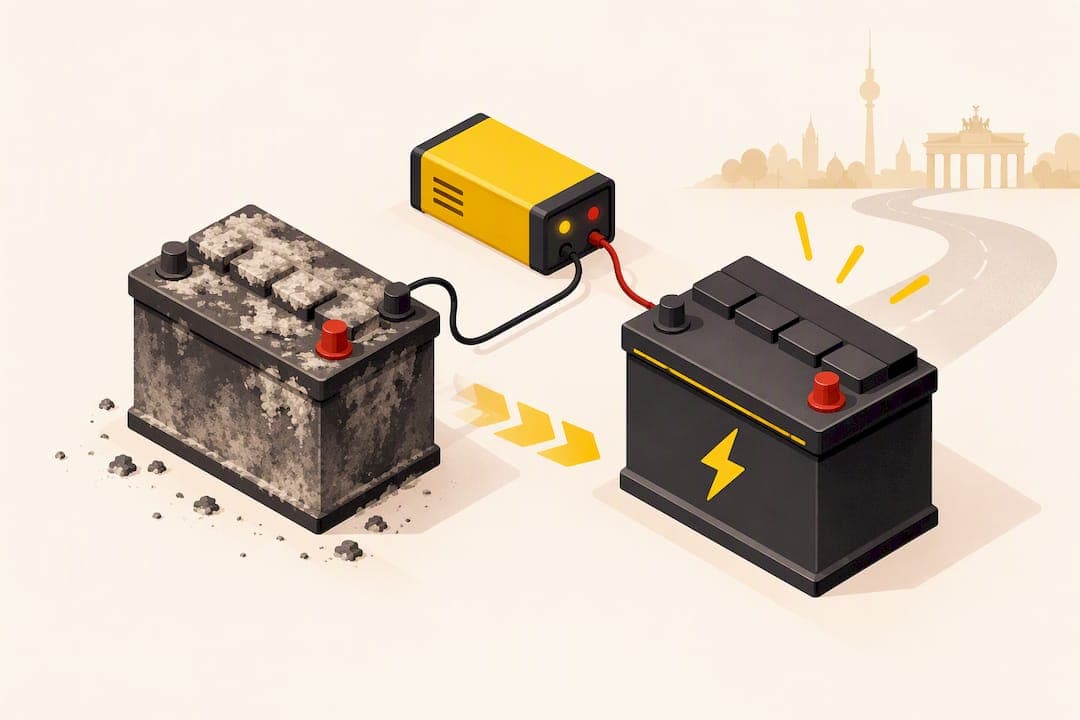
Battery desulfation is worth trying on a moderately sulfated lead-acid battery that still holds voltage, but it will not revive a battery that is mechanically damaged or truly dead. The main qualifier: test the battery first, because desulfation only helps a specific type of aging, not every cause of battery failure. If your battery rests well below normal voltage or won't hold a charge at all, skip straight to testing and likely replacement.
TL;DR:
- After a full charge and several hours disconnected, about 12.8V suggests a candidate; readings below 12.4V call for testing before recovery.
- A laboratory study raised capacity from about 60% to 90% over five cycles, but consumer devices may not match its protocol.
- Skip pulsing and replace batteries with swelling, leaks, internal shorts, or voltage that stays near 12.0V after charging; aggressive cycles can worsen plate damage.
- For a seasonal or rarely driven vehicle, use a smart maintainer during storage; during recovery, disconnect electronics, ventilate, and monitor battery temperature.
Table of Contents
- How desulfation works: pulse charging and what sulfation actually is
- What research and authoritative sources say about effectiveness
- When desulfation is likely to be worth trying
- Risks, safety, and things that can go wrong
- Cost-benefit: device costs, realistic gains, and alternatives
- How to test and try a safe desulfation attempt
- A practical recommendation for everyday vehicle owners
- How we can help with testing, repair, and replacement batteries
- FAQ
- Sources
How desulfation works: pulse charging and what sulfation actually is
Every lead-acid battery forms lead sulfate crystals on its plates as part of normal discharge. When you recharge promptly, those crystals dissolve back into the electrolyte without trouble. Leave a battery sitting partially discharged for weeks, though, and the crystals harden into larger, denser deposits. Soft sulfation, the kind that forms recently, still responds to charging. Hard sulfation, built up over months of neglect, physically blocks the plate surface and resists most recovery attempts.

Desulfators use pulse or pulse-reverse charging: short bursts of current at specific frequencies meant to break up those crystal deposits and let more active material return to use. The theory is sound at the electrochemical level, which is why researchers keep testing it. The gap is between a controlled lab setup and a $40 clip-on device in your garage.
The more reliable fix is never letting hard sulfation form in the first place. A smart maintainer that keeps a seasonal or rarely driven vehicle topped up prevents the problem that desulfators try to reverse after the fact.
What research and authoritative sources say about effectiveness

The strongest evidence comes from a 2023 peer-reviewed study on lead-acid battery regeneration, which tested electric pulse injection during charging on aged cells. Across five charge and discharge cycles, researchers recovered charge capacity that rose from about 60% to roughly 90%, with state of charge improving by around 23% under the tested protocol. That is a real, measured gain, but the equipment and pulse parameters used in the study go beyond what most consumer desulfators can replicate.
On the prevention side, ADAC's battery testing guidance points out that sulfation mainly develops when a battery sits partially discharged for extended periods, and that regular charging during storage is the most effective way to avoid it. ADAC's practical thresholds are useful for anyone trying to judge their own battery:
- A fully charged 12V battery should rest around 12.8V.
- Readings persistently below about 12.4V suggest reduced charge and a rising risk of sulfation.
- Voltage and simple load checks come before any recovery attempt, never after.
Manufacturer guidance adds a caution the research doesn't fully address: desulfation attempts can sometimes do more harm than good, particularly on batteries that are already near end of life, because aggressive pulsing can accelerate plate damage rather than reverse it. The balanced takeaway: desulfation shows genuine promise for mild to moderate sulfation in a controlled setting, but the benefit shrinks and the risk grows as damage becomes advanced.
When desulfation is likely to be worth trying
Matching your situation to the right decision saves time and avoids wasted effort on a battery that was never going to recover.
- Seasonal or rarely driven vehicles that sat for weeks without a maintainer are good candidates, since sulfation here is often recent and soft.
- Batteries showing partial capacity loss but still holding a resting voltage near normal range are worth a desulfation attempt before replacement.
- Batteries that hold charge briefly, then drop fast may have soft sulfation combined with some aging, making them borderline candidates worth one try.
- Batteries with very low resting voltage (well under 12.4V even after a full charge cycle) point to deeper damage that pulsing is unlikely to fix.
- Batteries with signs of internal shorts, swelling, or acid leakage should go straight to replacement, since no desulfator reverses physical plate damage.
The simplest check is a rest test: charge fully, let the battery sit disconnected for a few hours, then read the voltage. A number near 12.8V with a history of disuse points to sulfation. A number that won't climb past 12.0V despite a full charge points to something charging alone won't solve.
Risks, safety, and things that can go wrong
Charging and pulsing a lead-acid battery produces hydrogen and oxygen gas, and aggressive desulfation cycles increase that output. Work in a ventilated space, keep sparks and flames away, and wear eye protection given the corrosive acid inside. Pushing current into a battery that has hard sulfation or early plate damage can accelerate shedding, overheating, or outright failure rather than fixing anything.
Stop a desulfation attempt if the case feels hot, if voltage climbs unusually fast, or if you see bubbling at the terminals that seem excessive. At that point, replacement or a professional check is the safer path forward.
Pro Tip: Never desulfate a battery indoors without ventilation, and always disconnect it from the vehicle's electronics first.
Cost-benefit: device costs, realistic gains, and alternatives
A basic desulfator or desulfating charger runs from roughly the price of a cheap maintainer up to significantly more for units with multiple charge profiles and temperature compensation. Cheaper units offer a single pulse pattern with no feedback; pricier smart chargers combine desulfation modes with standard charging and tend to be gentler on borderline batteries.
Set your expectations against the research rather than marketing claims. The lab-measured recovery of capacity rising from about 60% to 90% came from controlled, multi-cycle conditioning, not a single overnight pulse session at home. A realistic outcome for a mildly sulfated battery is extending usable life by months rather than guaranteeing a full return to factory capacity.
- A smart maintainer used consistently during storage prevents sulfation and costs less over time than repeated recovery attempts.
- A single desulfation attempt makes sense for a battery that's inconvenient or expensive to replace immediately.
- Professional testing or cell-level repair is worth the cost when a battery is valuable or hard to source.
- Direct replacement is usually more cost-effective than repeated desulfation cycles on a battery already past half its expected lifespan.
How to test and try a safe desulfation attempt
Before connecting anything, measure resting voltage with a basic multimeter or an LCD battery tester after letting the battery sit disconnected for a few hours.
- Record resting voltage; a reading near 12.8V after a full charge indicates a reasonable candidate.
- Run a load test, in-vehicle or on a bench, to see if voltage holds steady under draw rather than collapsing.
- Connect the desulfator or desulfating charger in its dedicated mode, not standard charge mode.
- Monitor temperature and voltage periodically; stop if the case gets warm or voltage behavior looks erratic.
- Limit the session to the device's recommended time window, then retest capacity before repeating.
One documented result: peer-reviewed testing recovered charge capacity from about 60% to 90% across five cycles, a useful benchmark for what controlled conditioning can achieve, though home results typically fall short of lab conditions.
A practical recommendation for everyday vehicle owners
Test before you treat. A desulfator is worth trying on a battery that still holds reasonable voltage and lost capacity gradually, never on one that's already failed internally. My priority order: test, then maintain with a smart charger, then try limited desulfation if the numbers support it, then replace or repair if they don't.
— Waldemar Pelich
How we can help with testing, repair, and replacement batteries
We offer a straightforward path when a desulfation attempt doesn't pan out or you'd rather skip the guesswork entirely. Our battery testing and repair services cover diagnostics, cell-level repair through our Akkureparatur service, and professional checks that tell you definitively whether a battery is worth saving.
When a battery turns out to be past the point of recovery, we carry replacement options across our Batterien range, including lead-acid models sized for automotive and backup use.
- Battery testing and diagnostics to confirm sulfation versus deeper damage.
- Akkureparatur cell-level repair for packs worth saving.
- Replacement batteries across multiple chemistries and sizes.
| Situation | Better option |
|---|---|
| Battery holds voltage, mild capacity loss | Try desulfation, then retest |
| Battery won't hold charge, low resting voltage | Replacement |
| Specialty or hard-to-source pack | Professional repair or cell replacement |
FAQ
Do battery desulfators actually work?
They can work on batteries with mild to moderate sulfation that still hold voltage, based on peer-reviewed pulse-charging research. They are far less effective on batteries with hard sulfation or internal plate damage.
How long should you desulfate a battery?
Follow the specific device's recommended cycle time rather than guessing, since protocols vary by unit. Retest capacity afterward rather than assuming the session worked, and stop early if the battery heats up or behaves erratically.
Does car battery reconditioning really work?
Reconditioning, including desulfation, works best on batteries that lost capacity gradually but still hold a reasonable resting voltage. It rarely restores batteries with internal shorts, shedding, or very low voltage that won't climb after a full charge.
Do battery additives really work?
Evidence for additives is weaker and less consistent than for pulse-based desulfation, and manufacturer guidance generally urges caution around treatments that aren't part of the battery's original design. A simple voltage and load test remains the more reliable way to judge whether a battery is worth saving.
Sources
- Experimental Investigation of a Lead‑Acid Battery Regeneration Technique for Improved Energy Efficiency (IOPscience)
- Autobatterie testen: So prüft man die Spannung der Autobatterie (ADAC)
Recommended
- Optima Red Top RT S - 4.2, 12V 50Ah, AGM Starterbatterie
- Sonnenschein A512/6.5 S 12V 6,5Ah Lead Battery | End of Life
- Long - WP7-6 - 6 Volt 7000mAh Pb
- Long - WP20-6 - 6 Volt 20Ah Pb
This article was created with the assistance of Artificial Intelligence (AI) and has been reviewed by our editorial team. Despite careful preparation, we assume no liability for the completeness, accuracy, or timeliness of the information provided. The technical data and specifications supplied by the respective manufacturer shall always prevail.