

Battery cycle life is the number of equivalent full charge and discharge cycles a rechargeable battery can handle before its usable capacity drops below an industry end-of-life threshold, commonly set at 70 to 80 percent of original capacity. For anyone shopping for a replacement pack or planning when to budget for one, that threshold matters more than the raw cycle number printed on a spec sheet. Before trusting any cycle count, check the datasheet for the test conditions behind it. A "2,000 cycle" rating tested at 25°C and 50% depth of discharge behaves nothing like the same number tested at full discharge in a hot garage.
TL;DR:
- Battery cycle life ratings are highly dependent on test conditions like temperature, depth of discharge, and charge rate, which can cause significant performance variation in real-world use.
- Most devices do not undergo full discharges; real usage is better represented by equivalent full cycle calculations that account for partial discharges and environmental factors.
- Deep discharges and high operating temperatures accelerate capacity fade, often causing capacity loss to exceed expectations from labeled cycle counts.
- Chemistries like lithium iron phosphate offer the highest cycle durability, often exceeding 2000 cycles, while others like NMC or lead-acid generally have shorter lifespans.
- Practical lifespan estimates should adjust manufacturer-rated cycles based on actual usage patterns, storage conditions, and cycling habits for accuracy.
Table of Contents
- What Is Battery Cycle Life, in Plain Terms?
- How Is Battery Cycle Life Measured and Calculated?
- What Actually Shortens Cycle Life?
- How Many Cycles Do Different Battery Chemistries Actually Last?
- How Are Cycle Life Claims Actually Tested?
- How Do You Estimate Your Battery's Real Lifespan?
- What Actually Extends Battery Cycle Life?
- Why Trust This Guide on Battery Performance
- Cycle Life vs. Energy Density: Picking Your Priority
- Finding the Right Battery for Your Cycle Life Needs
- Sources
- FAQ
What Is Battery Cycle Life, in Plain Terms?
A "cycle" sounds simple until you try to measure it in the real world. Most devices don't drain from 100% to 0% and back in one clean sweep. They sip and top off all day, which is why engineers rely on a handful of specific terms to keep the math honest.
- Cycle: one full discharge and recharge, traditionally from 100% down to 0% and back.
- Equivalent Full Cycle (EFC): a way of adding up partial discharges into full-cycle equivalents, since real usage rarely hits a clean 0 to 100% swing.
- Depth of Discharge (DoD): the percentage of total capacity used in a given discharge, such as 50% DoD if you drain a battery from 100% to 50%.
- State of Charge (SoC): the current charge level expressed as a percentage of full capacity.
- Calendar aging: capacity loss that happens simply from the passage of time and storage conditions, regardless of how often the battery is used.
- Cycle aging: capacity loss driven specifically by charge and discharge activity.
Manufacturers typically define end of life at the point capacity falls to 80% of its original rating, though some consumer electronics push that to 70% before calling a battery "worn out." Both numbers show up across datasheets, so the specific threshold used matters when you compare two products.
How Is Battery Cycle Life Measured and Calculated?
Manufacturers don't test batteries under identical conditions, which is exactly why two products rated at "1,000 cycles" can perform very differently in the field. A cycle rating is only meaningful alongside three test parameters: depth of discharge, temperature, and charge/discharge rate (C-rate). A battery tested at 100% DoD and 45°C will show a far shorter cycle count than the same cell tested at 50% DoD and 25°C, even though it's the identical product.
This is where Equivalent Full Cycles earn their keep. Real-world usage rarely matches lab conditions. Your phone might drop from 100% to 60% twice a day rather than draining fully once. EFC accounting treats two 50% discharges as equal in throughput stress to one full 100% cycle, so you can track cumulative wear even when usage is fragmented.
Here's how the conversion typically works in practice:
- Track the Ah (amp-hour) throughput of each partial discharge rather than counting "cycles" as discrete events.
- Sum that throughput and divide by the battery's rated capacity to get a running EFC count.
- Compare cumulative EFCs against the manufacturer's rated cycle life at the DoD actually used, not the DoD printed on the box.
- Adjust for temperature and C-rate exposure, since both accelerate degradation beyond what throughput alone predicts.
Calculators and battery management systems that report "adjusted cycles" are applying this same logic: they weight throughput by the severity of the conditions it happened under, not just the raw count. The empirical models used in advanced cyclic testing combine Ah throughput, cycle duration, C-rate, and ambient temperature into a single fade prediction, which is more accurate than any single-variable estimate. The catch is that these models need lab-calibrated coefficients specific to a chemistry and cell design, so a generic formula applied to your specific battery will always be an approximation, not a certainty.
What Actually Shortens Cycle Life?
Four stressors do almost all the damage, and they don't act independently. Depth of discharge and elevated temperature are consistently identified as the leading contributors to capacity fade in a comprehensive review of lithium-ion aging mechanisms, but the mechanisms behind each are distinct enough to treat separately.
- Depth of discharge: deeper discharges cause greater mechanical strain on electrode materials each cycle, and the relationship isn't linear. Halving your typical DoD, from 100% to 50%, often multiplies achievable cycle count several times over rather than simply doubling it.
- Temperature: heat accelerates the side reactions that consume active lithium and thicken the solid electrolyte interphase layer. The effect compounds roughly like a chemical reaction rate, meaning every jump toward higher operating temperature costs disproportionately more life.
- C-rate and fast charging: charging or discharging faster than a cell is designed for increases the risk of lithium plating and mechanical stress on electrode structures, particularly at low temperatures.
- Calendar aging: even a battery sitting untouched loses capacity over time, especially when stored at high state of charge or in warm conditions.
Pro Tip: A battery stored at 100% charge in a hot car loses capacity faster from calendar aging alone than an identical battery cycled moderately in a cool room, even with zero cycles logged.
None of these stressors act in isolation. A battery fast charged in a hot environment at high DoD experiences all three mechanisms simultaneously, and the damage compounds rather than simply adding up. That combination is why a battery rated for 2,000 cycles under gentle lab conditions might deliver a fraction of that in a demanding real-world application.
How Many Cycles Do Different Battery Chemistries Actually Last?
Cycle life varies enormously by chemistry, and the trade-off is almost always tied to energy density. Materials engineered to pack more energy into a given size tend to be more chemically reactive, which accelerates the side reactions behind capacity fade, as detailed in research on lithium-ion side reactions.
- LiFePO4 (LFP): commonly rated 2,000 to 6,000+ cycles to 80% capacity, among the most durable lithium chemistries, though it trades some energy density for that longevity.
- NMC (nickel manganese cobalt): typically 500 to 1,500 cycles, favored for higher energy density in phones and EVs but shorter cycle life than LFP.
- Lead-acid: often 200 to 500 cycles at moderate DoD, dropping sharply if regularly discharged deeply, which is why shallow-cycling lead-acid packs like a 12-volt sealed unit last far longer than those run near empty.
- NiMH: generally 300 to 800 cycles, sensitive to overcharging and heat but tolerant of moderate abuse compared to lead-acid.
Converting a cycle rating into years depends entirely on how often you actually cycle the battery. A cell rated for around a thousand cycles used at approximately one EFC per day reaches end of life in a few years. The same battery used more lightly, at 0.25 EFC per day, stretches to roughly 11 years before hitting the same threshold. That gap explains why two owners of the same product model can report wildly different battery lifespans; usage intensity, not manufacturing variance, usually drives the difference. Datasheet numbers also assume controlled lab temperature and moderate C-rates, so field results running hotter or faster almost always land below the rated figure.
How Are Cycle Life Claims Actually Tested?
Cycle counts on a spec sheet come from standardized lab procedures, and knowing roughly how those tests work helps you judge whether a manufacturer's number is trustworthy or marketing fluff.
- Recommended practices like SAE J2288 define baseline test conditions and set end-of-life criteria, often 80% remaining capacity, so results can be compared across labs and products.
- Test matrices vary DoD, C-rate, rest periods, and temperature systematically, then feed the results into models that predict fade under different operating conditions, a method detailed in PMC's cyclic testing research.
- Accelerated aging tests compress years of use into weeks by running batteries harder or hotter than typical, which speeds up testing but can shift which degradation mechanism dominates versus normal use.
- IEC and similar international standards provide baseline procedures manufacturers reference, though not every consumer product datasheet specifies exactly which standard was used.
The biggest limitation with any lab number is disclosure. A cycle rating without its test conditions attached is close to meaningless for planning purposes, since the same cell can produce wildly different numbers depending on how hard the test pushed it.
How Do You Estimate Your Battery's Real Lifespan?
You can turn a rated cycle number into a realistic estimate of years with one formula: Estimated years = Adjusted cycles ÷ (daily EFC × 365).
- Start with the manufacturer's rated cycle count at a specified DoD and temperature, straight from the datasheet.
- Calculate "adjusted cycles" by correcting for your actual usage: if you run shallower cycles than the spec's test DoD, you can reasonably expect more usable cycles; if you run deeper or hotter, expect fewer.
- Estimate your daily EFC based on how much of the battery's capacity you actually use each day, not how many times you plug it in.
- Divide the adjusted cycle count by (daily EFC times 365) to get an estimated number of years.
Here's a worked example. If daily usage averages 0.5 EFC, the math runs: 4,500 ÷ (0.5 × 365) ≈ 24.7 years. That number assumes stable room temperature and moderate charge rates; add regular heat exposure or fast charging, and the real figure drops well below the estimate.
What Actually Extends Battery Cycle Life?
Small habits compound over hundreds of cycles, and the highest-leverage changes are usually the simplest to implement.
- Keep daily depth of discharge shallow when possible. Cycling between 20% and 80% instead of 0% and 100% meaningfully reduces mechanical and chemical stress per cycle.
- Rely on a quality Battery Management System with conservative charge-voltage limits and active cell balancing. A well-designed BMS materially extends usable life by preventing overvoltage, overcurrent, and thermal excursions before they cause damage.
- Store batteries at moderate charge, roughly 40 to 60% state of charge, in a cool location rather than fully charged in a hot space, since calendar aging continues even when a battery sits idle.
- Avoid unnecessary fast charging when a standard rate will do; high C-rates raise the risk of lithium plating, particularly in cold conditions.
- Run periodic capacity checks so you catch gradual fade before it becomes a surprise failure.
Pro Tip: *If a device will sit unused for months, charge it to roughly half capacity first.
Why Trust This Guide on Battery Performance
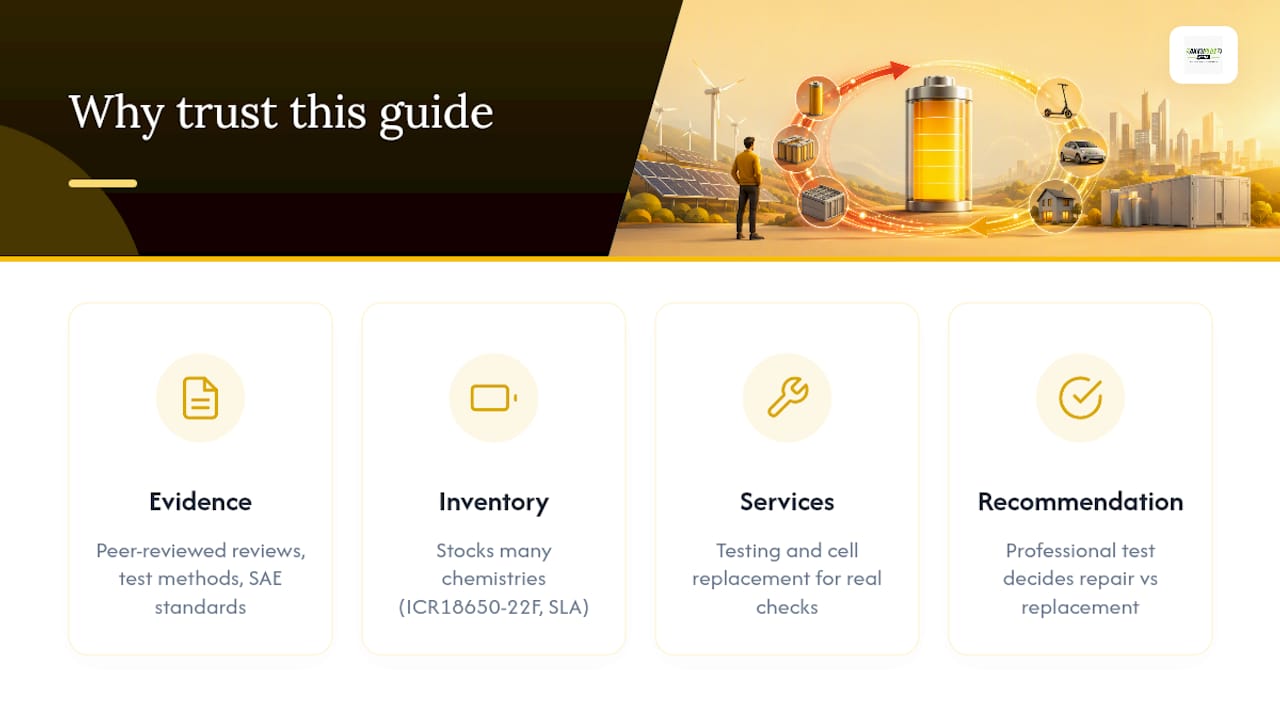
This explainer draws on peer-reviewed review articles covering lithium-ion aging mechanisms, published cyclic-test methodology, and SAE testing standards rather than marketing copy. AkkuPlus stocks batteries across chemistries, from lithium cells like the Samsung ICR18650-22F to sealed lead-acid packs, and offers testing and cell-replacement services for readers who need a real capacity check rather than a guess. If a device's runtime has dropped noticeably, a professional battery test tells you whether repair or replacement makes more financial sense.
Cycle Life vs. Energy Density: Picking Your Priority
If your device sits in one place and gets cycled daily, prioritize cycle life over energy density every time. If size and weight matter more than longevity, accept the trade-off, but track your EFC count and revisit that decision annually.
— Waldemar Pelich
Finding the Right Battery for Your Cycle Life Needs
AkkuPlus is the practical next step once you know what cycle count and chemistry your device actually needs, rather than the number a generic listing advertises. Its battery catalog covers automotive, household, and specialized electronic cells across lithium, lead-acid, and NiMH chemistries, so you can match a replacement to your actual usage pattern instead of guessing from a shelf label.
If you're not sure whether your current pack is genuinely failing or just needs recalibration, professional battery testing services that measure remaining capacity directly rather than estimating it from age can be used. For packs worth saving rather than replacing outright, cell replacement and refurbishment services are available that can be more affordable than purchasing a new pack. Browse the battery pack selection to compare assembled options with documented specifications, or head to the batteries category to check availability and pricing for your specific device.
Sources
- A comprehensive review on lithium-ion battery lifetime prediction and aging mechanism analysis
- Advanced cyclic tests and empirical modeling for lithium-ion cell capacity fade (PMC article)
- Side reactions/changes in lithium-ion batteries: mechanisms and strategies for creating safer and better batteries
- SAE J2288 life-cycle testing electric vehicle battery modules (recommended practice)
FAQ
What Is Battery Cycle Life?
The exact count depends heavily on the depth of discharge, temperature, and charge rate used during testing.
How Many Years Are 1,000 Battery Cycles?
It depends entirely on how often you cycle the battery. At roughly one Equivalent Full Cycle per day, 1,000 cycles works out to a few years, while lighter daily use around 0.25 EFC per day stretches the same battery to roughly 11 years.
How Long Will a 2,000 Cycle Battery Last?
Using the same logic, a 2,000 cycle battery cycled once per day lasts several years, while lighter daily use can push that well past a decade. Actual results shift with your depth of discharge, storage temperature, and charging habits, so treat this as a planning estimate rather than a guarantee.
What Does 400 Cycles Mean on a Battery?
This is typical for chemistries like NiMH or shallow-cycled lead-acid, and real-world life will vary based on actual depth of discharge and temperature exposure.
Can I Test My Battery's Remaining Cycle Life Myself?
You can get a rough estimate by tracking runtime decline over time, but an accurate capacity reading requires proper test equipment. Professional battery testing services are offered that measure actual remaining capacity rather than estimating it from age or symptoms alone.
Recommended
- EnerSys - Cyclon - DT Cell - 2 Volt 4,5Ah Pb
- EnerSys - Hawker - Cyclon - 0809-0012 - 6 Volt 5000mAh Pb - 3er R
- Sanyo - N-1700SCR - 1,2 Volt 1700mAh Ni-CD Fast Charge (R) - EOL
- Panasonic - LC-R064R5P - 6 Volt 4500mAh Pb
This article was created with the assistance of Artificial Intelligence (AI) and has been reviewed by our editorial team. Despite careful preparation, we assume no liability for the completeness, accuracy, or timeliness of the information provided. The technical data and specifications supplied by the respective manufacturer shall always prevail.