

Most RC hobbyists settle on a handful of power connectors: the XT30/XT60/XT90 family, Deans (T-plug), EC3/EC5, bullet connectors, and Tamiya. Balance connectors, almost always JST-XH style, are a completely separate system for charger monitoring and never carry propulsion current. Pick a power connector rated at least 20% above your expected continuous draw, match the cable gauge to that rating, and never confuse the two connector jobs on the same pack.
TL;DR:
- Choosing a power connector requires matching amperage ratings at least 20% above your continuous draw and ensuring proper cable gauge fit.
- XT60 connectors are the most widely used for balancing contact resistance, compactness, and safety features, making them suitable for most high-current RC builds.
- Deans connectors resist vibration but lack polarity protection, which can cause damage if plugged in incorrectly, especially for beginners.
- Avoid using balance connectors for propulsion current, as they are designed solely for cell monitoring and not to handle high power loads.
- Regularly inspect solder joints and connector fit for heat or discoloration, and keep spare plugs and proper tools handy to prevent failures during operation.
Table of Contents
- Battery Connector Types: A Field Guide to XT, Deans, EC, Bullet, and Tamiya
- Balance Plugs: The Connector That Never Touches Propulsion Current
- How to Choose the Right Connector for Your Build
- Soldering and Safety: Doing the Job Without Creating a Short
- Where AkkuPlus Fits Into Your Connector Decisions
- Standardize Your Fleet, or Keep a Few Adapters on Hand?
- Get the Right Connector, Pack, or Repair Without the Guesswork
- Reference Points Worth Bookmarking
- Sources
- FAQ
Battery Connector Types: A Field Guide to XT, Deans, EC, Bullet, and Tamiya
Every one of these connectors solves the same basic problem (moving current from pack to motor or ESC) but they land on different tradeoffs between amperage, weight, cost, and how easy they are to solder. Here's what each one actually does well.
- XT30/XT60/XT90: The number in the name roughly tracks continuous amperage, so XT30 suits micro quads and small planes, XT60 covers most 3S to 6S packs used in cars and mid-size aircraft, and XT90 handles high-power builds pulling well past 90A in short bursts. XT60 dominates because it balances low contact resistance with a compact housing, and its keyed shape makes reverse-polarity mistakes nearly impossible. A manufacturer spec for the XT60IE-M variant lists contact resistance at or below 1.0 milliohm with a 600V DC rating, numbers worth checking if you're buying loose connectors rather than pre-terminated leads.
- Deans (T-plug): This connector predates the XT series and still shows up on older cars and some competition packs. It has no keying, so it's physically possible to plug it in backward, and its flat gold contacts need a hot iron and steady hand to solder well. Compared with XT60, Deans grips tighter and resists vibration nicely, but the lack of polarity protection is a real liability for anyone new to soldering.
- EC3/EC5: EC3 shows up on smaller electric helis and park flyers, while EC5 scales up for large aircraft and high-current setups where XT90 is the usual alternative. The bullet-style contacts inside an EC housing spread current across a wider surface, which helps with heat, but the housings are bulkier than XT equivalents of similar rating.
- Bullet connectors: These simple round pins, commonly found in 2mm, 3.5mm, 4mm, and 5.5mm diameters, connect motors to ESCs rather than battery to system. They have no locking mechanism on their own, so vibration in a car or heli can walk them loose over time unless you add heatshrink or a mechanical clip.
- Tamiya: This is the connector most people cut off their first RC car battery. It's rated for modest current, tends to run hot under real load, and its flat blade contacts wear out faster than XT-style bullet pins. Anything beyond a basic entry-level pack should move to XT60.
Balance Plugs: The Connector That Never Touches Propulsion Current
A balance connector is not a smaller power connector. It's an entirely separate wiring path that lets a charger read and correct the voltage of every individual cell in a pack, which is essential for protecting cells from overcharge, undercharge, and the slow drift that happens when cells age unevenly.
- Pin count follows the S+1 rule. A 3S pack uses a 4-pin balance connector, a 4S pack uses 5 pins, a 6S pack uses 7 pins, and so on. Count the pins before assuming compatibility with your charger.
- JST-XH is the default hobby standard, typically appearing as an XH2.5-4P plug on 3S packs or XH2.5-5P on 4S packs. You'll also run into JST-EH, Thunder Power, and Polyquest formats on packs from specific manufacturers, and these are not interchangeable with XH without an adapter.
- Visually similar plugs can be electrically different. Two balance connectors can look nearly identical in pin spacing and still carry different pinouts, so mismatching brands is one of the fastest ways to damage a charger or a cell. If a plug doesn't seat with light, confident pressure, stop and check the pinout rather than forcing it.
How to Choose the Right Connector for Your Build
Selecting a connector comes down to matching electrical demand to hardware, then confirming the mechanical fit won't fail under vibration or heat.
- Size for headroom, not just average draw. Estimate your continuous current draw under full throttle, then add about 20% before picking a connector family and wire gauge. A pack that regularly pulls 45A deserves an XT60 rated well past that number, not one sitting right at its ceiling.
- Check contact resistance over headline amp numbers. Two connectors rated for the same current can behave very differently under sustained load, and bench measurements of resistance and cable cross-section tell you more than a printed amperage figure ever will.
- Match housing size to cable diameter. A connector that barely accepts your wire gauge will strain the solder joint every time the lead flexes, and a loose fit invites arcing under vibration.
- Account for moisture and heat. Outdoor cars and boats benefit from heatshrink over every joint and, where possible, a connector housing that isn't just friction-fit.
Pro Tip: Keep a spare set of your primary connector family (plugs and matching wire) in your field box. Swapping a damaged XT60 in the parking lot beats limping home on a taped-together joint.
Soldering and Safety: Doing the Job Without Creating a Short
Replacing or upgrading a connector is straightforward mechanically, but the sequence matters more than most guides admit.
- Solder one wire at a time. Pre-tin both the wire and the terminal cup, then join them, and fully insulate that first connection with heatshrink before you even touch the second wire. Working both leads simultaneously is how bare copper ends up touching and shorting the pack.
- Use the right iron for the job. Thick LiPo leads need a flat tip and enough wattage to heat the joint quickly, because a slow, low-power iron risks melting the connector housing before the solder flows properly.
- Confirm polarity before the first power-up. Mark positive and negative clearly on the housing or wire, and double-check against the pack label. A reversed connector on a fresh solder job is a common and entirely avoidable failure.
- Watch for adapter tradeoffs. Adapters like an EC5-to-XT60 connector solve a mismatch instantly, but every extra interface adds resistance and one more point that can fail. For a pack you'll fly or drive regularly, re-terminating to your standard connector beats living with an adapter long-term.
- Know the warning signs. A connector that's warm to the touch after a normal run, shows discoloration, or fits loosely is telling you something. Remove the battery, inspect the contacts, and replace the connector before the next flight or drive rather than after.
Where AkkuPlus Fits Into Your Connector Decisions
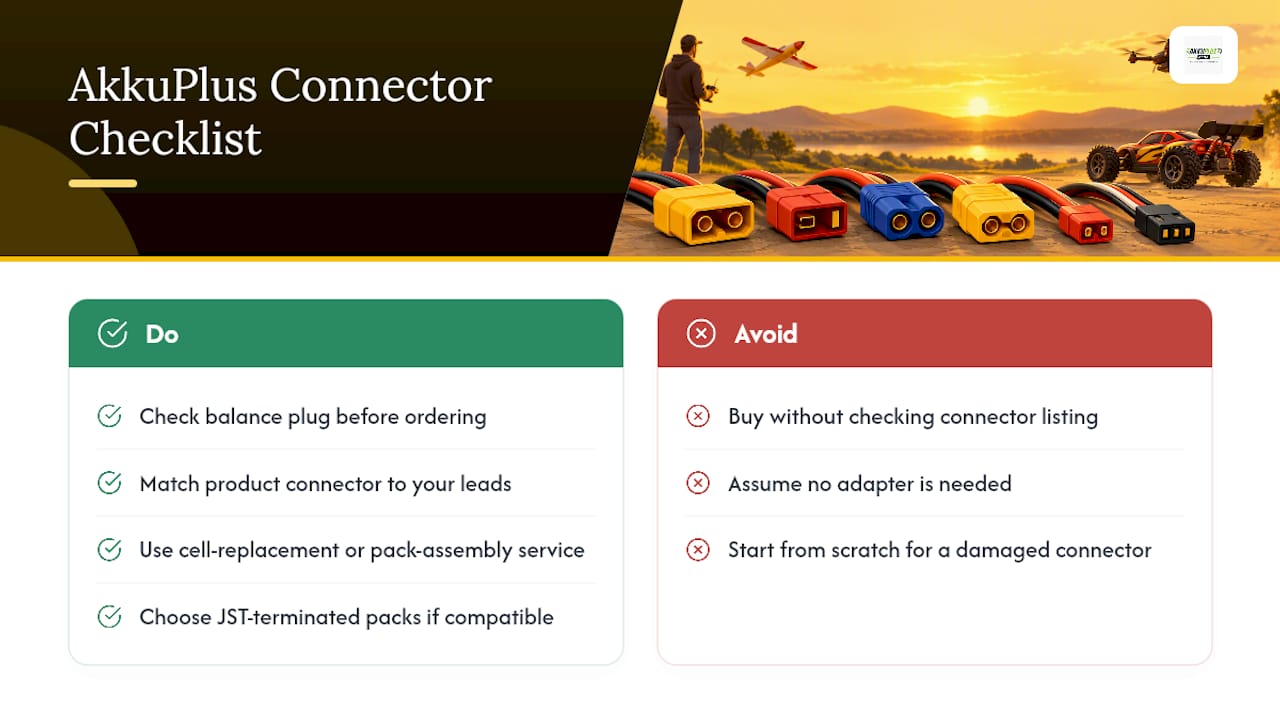
AkkuPlus stocks battery packs across the Modellbau & Hobby category with a range of terminal styles, including JST-terminated packs you can check against your charger's balance plug before ordering. For readers who'd rather not solder, cell replacement and pack assembly services are available, so a damaged connector or aging pack doesn't mean starting from scratch. Before buying a new pack, check the product page's connector listing against your existing power and balance leads to avoid needing an unplanned adapter.
Standardize Your Fleet, or Keep a Few Adapters on Hand?
Running one connector family across every pack cuts down on failure points and lets you swap batteries between models without a screwdriver. Adapters are fine for a one-off mismatch, but if you're reaching for one every session, the smarter move is re-terminating. Ask yourself four things: how often you fly or drive, how many different connector standards your models already use, your comfort soldering thicker gauge wire, and your typical current draw. If the answer to most of those points toward frequent, high-current use, standardize.
— Waldemar Pelich
Get the Right Connector, Pack, or Repair Without the Guesswork
Choosing between XT60 and EC5 doesn't need to feel like a coin flip, and neither does fixing a pack with a failing connector. RC hobbyists can find parts and services related to connectors without needing a separate hobby shop trip or a mail-order wait for a niche connector.
Browse Batterien for cells across common voltages and chemistries, or check Akku- und Batteriepacks for pre-built packs with clearly listed terminal types. If your current pack has a connector issue rather than a dead cell, AkkuPlus's repair and assembly services cover cell replacement and custom lead configuration for readers who'd rather not solder under pressure. Start by checking your pack's connector against your charger's balance plug on the product page, then order or request service directly from there.
Reference Points Worth Bookmarking
- RCSKY's balance connector glossary for pin-count conventions and JST-XH details.
- RCSKY's connector system overview for XT-series current ratings.
- Elektromodellflug for contact resistance data.
- TME's XT60IE-M datasheet for manufacturer-rated specs.
Sources
- Rcsky
- Rcsky
- Elektromodellflug
- XT60IE-M product specification - TME
- BenchCraft EC5 Male to XT60 Female Adapter BCT5061-041 - Motion RC
FAQ
Are EC5 and IC5 the Same Connector?
No. EC5 and IC5 share a similar bullet-style contact size but come from different manufacturers with slightly different tolerances, so fit can vary between brands. Treat them as compatible in a pinch but not guaranteed identical, and test the fit before relying on the pairing for a high-current run.
What Is the Most Common Battery Connector Type in RC?
XT60 is treated as the community standard for most RC power applications, covering everything from mid-size cars to multirotor packs. For balance charging, JST-XH is the de facto standard across nearly all hobby-grade chargers.
What Are the Main Types of Cable and Battery Connectors Hobbyists Encounter?
The core set includes the XT30/XT60/XT90 family, Deans (T-plug), EC3/EC5, bullet connectors in various diameters, Tamiya, and JST-XH balance plugs. Each fills a distinct role, either propulsion power, motor-to-ESC current, or cell monitoring, and they aren't interchangeable across those roles.
Do Car Batteries Use the Same Connector Types as RC Packs?
No. Full-size automotive batteries use screw terminals or heavy-duty clamp posts rather than the plug-style connectors found on RC LiPo packs. AkkuPlus lists automotive batteries with their terminal specifications directly on each product page, separate from the hobby connector types covered here.
Can I Use a Balance Connector Instead of the Main Power Lead?
No, and doing so can damage both the pack and your equipment. Balance connectors are wired for low-current cell monitoring only, while the main lead is built to carry the full propulsion current your motor or ESC demands.
Recommended
- Long - WP5-12 - 12 Volt 5000mAh Pb - Faston F1
- Multipower - MP0.8-12 - 12 Volt 800mAh Pb - JST Connector
- Battery Connector Cable Receiver - Futaba - 20 cm, 0.25 mm², PVC Wire Flat
- Long - WP7.2-12 - 12 Volt 7200mAh Pb - Faston 187 (F1)
This article was created with the assistance of Artificial Intelligence (AI) and has been reviewed by our editorial team. Despite careful preparation, we assume no liability for the completeness, accuracy, or timeliness of the information provided. The technical data and specifications supplied by the respective manufacturer shall always prevail.