

If your car won't start or the lights are acting strange, the fastest way to know whether it's the battery or the alternator is a resting voltage check: 12.6 to 12.8 volts means a healthy, charged battery, and anything lower points at the battery itself or a charging system that isn't keeping up. If the engine cranks slowly, clicks, or won't start at all, suspect the battery first. If it starts fine but the dashboard battery light comes on or lights dim while driving, the alternator or charging circuit is the more likely culprit.
Before touching anything, follow two safety rules: always check terminals with the engine off, and never let a metal tool bridge both battery posts at once. It causes a dead short and can burn you or damage electronics.
- Check the dashboard for a battery warning light right now, engine running.
- Try a jump start. If the engine dies once you disconnect the cables, that's a charging system red flag.
- Grab a multimeter and read resting voltage before you assume anything.
Key Takeaways
A resting voltage of 12.6 to 12.8 volts confirms a healthy battery, while charging voltage outside the 13.8 to 14.8 volt range confirms an alternator problem.
| Point | Details |
|---|---|
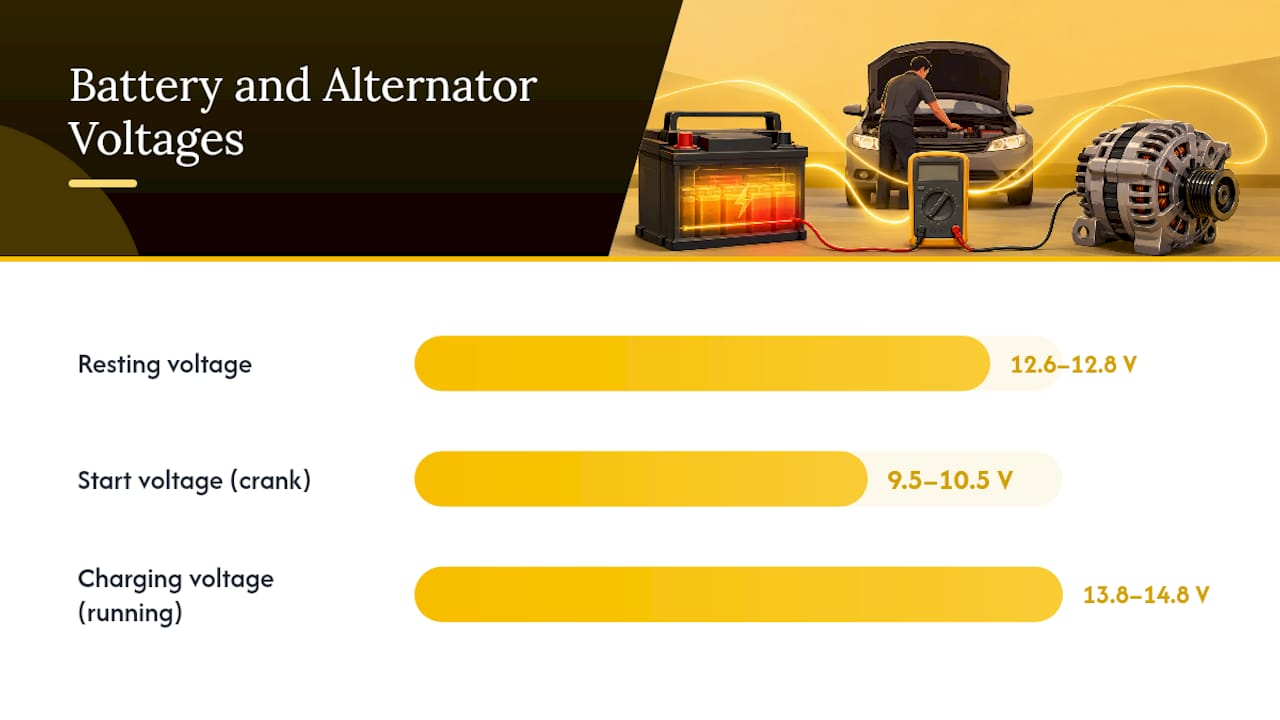
| Start with resting voltage | Test with the engine off for 30+ minutes; 12.6–12.8 V means the battery is charged. |
| Watch the start voltage drop | A healthy crank drops to 9.5–10.5 V; under 9 V means capacity loss. |
| Confirm charging output | 13.8–14.8 V at idle and under load means the alternator is working correctly. |
| Check for ripple before blaming a diode | Over 0.5 VAC on the AC setting signals a failed diode a DC reading would miss. |
| Rule out cheap mimics first | Fuses, belts, and corroded terminals cause charging symptoms more often than people expect. |
| Get equipped before you diagnose | Akkuplus sells testers and replacement batteries so you can run these checks and act on the results immediately. |
Table of Contents
- What the Battery and Alternator Actually Do
- What Are the Signs of Battery Failure?
- What Are the Signs of Alternator Failure?
- How Do You Test the Battery and Alternator at Home?
- Does Battery Type or Age Change the Diagnosis?
- What Else Can Mimic a Battery or Alternator Problem?
- When Should You Call a Shop or Tow Truck?
- Sources
What the Battery and Alternator Actually Do
Think of the battery as a reservoir and the alternator as the pump that refills it. The battery stores chemical energy for starting the engine and running accessories when the engine is off. Once the engine fires, the alternator takes over, generating electricity to run everything from headlights to the infotainment system, while also recharging the battery for the next start.
They're a team, which is exactly why symptoms overlap and confuse people. A weak alternator that can't keep up with demand will slowly drain even a brand new battery, making a perfectly good battery look defective. Two quick examples:
- A three-year-old battery that suddenly won't hold a charge after a failing alternator undercharged it for weeks.
- A five-year-old battery that starts the car fine every morning but can't survive a jump because its internal capacity is genuinely gone.
What Are the Signs of Battery Failure?
Slow cranking is the classic tell. The engine turns over sluggishly, almost like it's fighting through molasses, or you hear rapid clicking instead of a crank at all. Needing a jump after the car sat for a day or two, visible corrosion around the terminals, or a case that looks swollen or bulged all point to the battery.
- Slow or labored cranking, especially in cold weather.
- Repeated clicking when you turn the key.
- Needing jump starts after the vehicle sits overnight or over a weekend.
- Corrosion (white or blue crust) on the terminals, or a swollen battery case.
Battery Voltage Benchmark: A fully charged 12-volt lead-acid battery reads 12.6 to 12.8 volts at rest, measured with the engine off and no accessories running. Anything closer to 12.0 volts or below usually means a deeply discharged or failing battery.
Age matters more than people think. Most starter batteries last three to five years, and that window shrinks fast in extreme heat or cold, or if most of your trips are short hops that never let the alternator fully recharge what the starter just used.

What Are the Signs of Alternator Failure?
The battery warning light on your dashboard while the engine is running is the single clearest alternator symptom there is. Dimming or flickering headlights, especially when you turn on the AC or rear defroster, is another. If your radio cuts out or power windows slow down while you're driving, the charging system isn't supplying enough voltage.
- Battery light illuminated on the dash while driving.
- Headlights or interior lights dimming, brightening, or flickering.
- Accessories (radio, windows, climate control) acting sluggish or glitchy while the engine runs.
- A battery that keeps dying even after you replace it, especially within weeks.
- The engine stalling while driving, or a growling/whining noise from the alternator's bearing or belt.
Pro Tip: A multimeter can show a perfectly normal 14.0 volts at idle and still miss a failing alternator. Diode failures create AC ripple riding on top of the DC output, and a standard voltage reading won't catch it. That's why a reading over 0.5 volts AC at the battery posts, checked with your meter set to AC volts, means a diode has failed even if the DC number looks fine.
How Do You Test the Battery and Alternator at Home?
You need a digital multimeter (analog needles aren't precise enough for this), 20 to 60 minutes, and a way to safely rev the engine without anyone standing near moving belts. Set your meter to DC volts for most tests, and switch to AC volts only for the ripple check. Always clip the leads directly onto the battery posts, not onto the plastic battery cover terminals, and not onto a corroded clamp that could give you a false reading.
Before testing the alternator, make sure the battery itself reads normal and is fully charged. A weak battery skews every downstream test and is the number one reason people misdiagnose a good alternator as bad.
Testing Sequence
- Resting voltage. Let the car sit for at least 30 minutes with everything off, then read voltage at the posts. Expect 12.6 to 12.8 volts.
- Start voltage drop. Have a helper crank the engine while you watch the meter. A healthy drop is roughly 9.5 to 10.5 volts; anything under 9 volts signals lost capacity.
- Charging voltage at idle. With the engine running, read voltage again. You want 13.8 to 14.8 volts.
- Charging voltage under load. Turn on headlights, AC, and the rear defroster, and read again. It should stay within that same 13.8 to 14.8 volt band, not sag below it.
- AC ripple check. Switch the meter to AC volts with the engine running. Anything above 0.5 VAC means a bad diode.
- Voltage drop on cables and ground. Measure across the ground strap and positive cable while cranking; each should stay under roughly 0.2 to 0.5 volts.
- Parasitic draw (optional). If everything above checks out but the battery still dies overnight, a draw test with the meter in series on the negative cable, key off, can catch a circuit that won't sleep.
| Test | How to perform it | Expected range | Likely conclusion |
|---|---|---|---|
| Resting voltage | Engine off 30+ min, leads on posts | 12.6–12.8 V | Below this: weak or discharged battery |
| Start voltage drop | Crank engine, watch meter | 9.5–10.5 V | Under 9 V: battery capacity loss |
| Charging voltage (idle) | Engine running, leads on posts | 13.8–14.8 V | Under 13.8 V: weak alternator output |
| Charging voltage (loaded) | Add headlights/AC, engine running | 13.8–14.8 V | Sagging under load: alternator can't keep up |
| AC ripple | Meter set to AC volts, engine running | Under 0.5 VAC | Over 0.5 VAC: failed diode |
| Voltage drop (ground/cable) | Meter in series while cranking | Under 0.2–0.5 V | Higher: corroded connection or bad ground |
A jump-start test works as a quick field check too: connect jumper cables, start the car, then disconnect them. If the engine dies shortly after, the charging system is the problem; if it keeps running fine, the battery was the weak link all along. For anything that still looks ambiguous, a shop can run a load test or conductance tester in a few minutes, and a genuinely puzzling intermittent charging fault may call for an oscilloscope check, which shows the alternator's six-phase waveform in a way no multimeter can.
Pro Tip: The most common measurement mistake is testing on a discharged battery and blaming the alternator for a low charging reading. Always charge the battery fully first, and re-check terminal cleanliness before you condemn any part. A loose or corroded clamp can mimic almost every symptom on this list.
Does Battery Type or Age Change the Diagnosis?
AGM and EFB batteries, increasingly common in vehicles with stop-start systems, can read a nearly normal resting voltage while their actual capacity has quietly dropped. Conventional flooded lead-acid batteries tend to show voltage sag more honestly as they age, so a resting voltage test alone is less reliable on AGM units. That's why a load or capacity test matters more for these chemistries than the resting number does.
Seasonal extremes and short-trip driving both accelerate wear regardless of battery type. Cold weather thickens the oil the starter has to fight and reduces the battery's chemical efficiency at the same time, a rough combination.
- If a battery fails a load test even after a full charge, replace it. Recharging won't fix diminished internal capacity.
- If voltage looks fine and it just needed a boost after sitting, a simple recharge and cleaner terminals may be all it needs.
Pro Tip: If you're replacing an AGM or EFB battery, match the original chemistry. Putting a standard flooded battery where an AGM belongs can shorten its life and confuse the vehicle's charge monitoring system.
What Else Can Mimic a Battery or Alternator Problem?
A surprising number of "bad alternator" complaints turn out to be a blown charging fuse, a slipping serpentine belt, or a corroded terminal connection quietly starving the system of voltage. Inspecting these cheap components first before replacing an alternator saves money and frustration more often than not.
- Blown charging system fuse: check with a test light or multimeter continuity setting.
- Loose or glazed serpentine belt: look for cracking, glazing, or visible slack.
- Corroded terminals or ground straps: clean and re-torque, then retest voltage.
- High-resistance connections: a voltage drop test across any suspect joint reveals hidden resistance a simple voltage reading misses.
- Inspect the fuse box and belt visually before pulling any tools.
- Clean and tighten every terminal and ground connection.
- Retest charging voltage after cleaning; if it's now in range, you just saved yourself a new alternator.
- If the battery still drains overnight with no obvious cause, run a parasitic draw test. Normal key-off current on most modern vehicles stays under roughly 50 milliamps.
When Should You Call a Shop or Tow Truck?
Cleaning terminals, tightening clamps, and swapping a cheap fuse or belt are all fair DIY territory and cost next to nothing. Skip anything involving the alternator's internal wiring or forcing a jump repeatedly. A repeated jump on a truly dead alternator just risks stranding you somewhere worse.
- Clean corroded terminals with a wire brush and baking soda solution, then retighten clamps.
- Replace a cracked or glazed belt yourself if you're comfortable with basic tools.
- Don't keep jump-starting a car that dies again within minutes. Get it towed instead.
A shop diagnosis for ripple, regulator faults, or a parasitic draw typically takes 30 to 60 minutes and is worth the fee when your home tests come back ambiguous. Expect a battery replacement to run in the ballpark of a smaller repair bill, an alternator replacement to cost noticeably more given the labor involved in accessing it, and a full diagnostic visit to be quick if the shop has a load tester or oscilloscope on hand.
Why Most "Bad Alternators" Turn Out to Be Something Smaller
A lot of unnecessary alternator swaps happen because someone skipped the terminal and fuse check and went straight to the expensive part. A methodical 30 to 60 minute test sequence, done in order, catches the cheap fixes before they get misdiagnosed as something bigger.
Get the Right Tools and Parts Without the Guesswork
Diagnosing this yourself starts with having a meter you trust. Akkuplus carries a battery tester built for standard and button cells so you can run the resting voltage and load checks in this article without borrowing a neighbor's meter or guessing at accuracy.

If your battery already failed the tests, Akkuplus stocks direct replacements across capacities, including higher output options like the Optima Red Top AGM starter battery for vehicles with heavier accessory loads or stop-start systems. For anything electronic that needs a cell swap rather than a full replacement, Akkuplus also runs repair and refurbishment services for specialized battery packs. Pick up a tester, order the right replacement battery for your vehicle, or book a repair, whichever step you're on right now.
Sources
- Lichtmaschine oder Batterie? So erkennen Sie den Defekt
- Battery vs. Alternator: Which Is the Problem?
- AGT‑001 Alternator voltage and current (12 V) — Pico Technology
- Alternator troubleshooting