
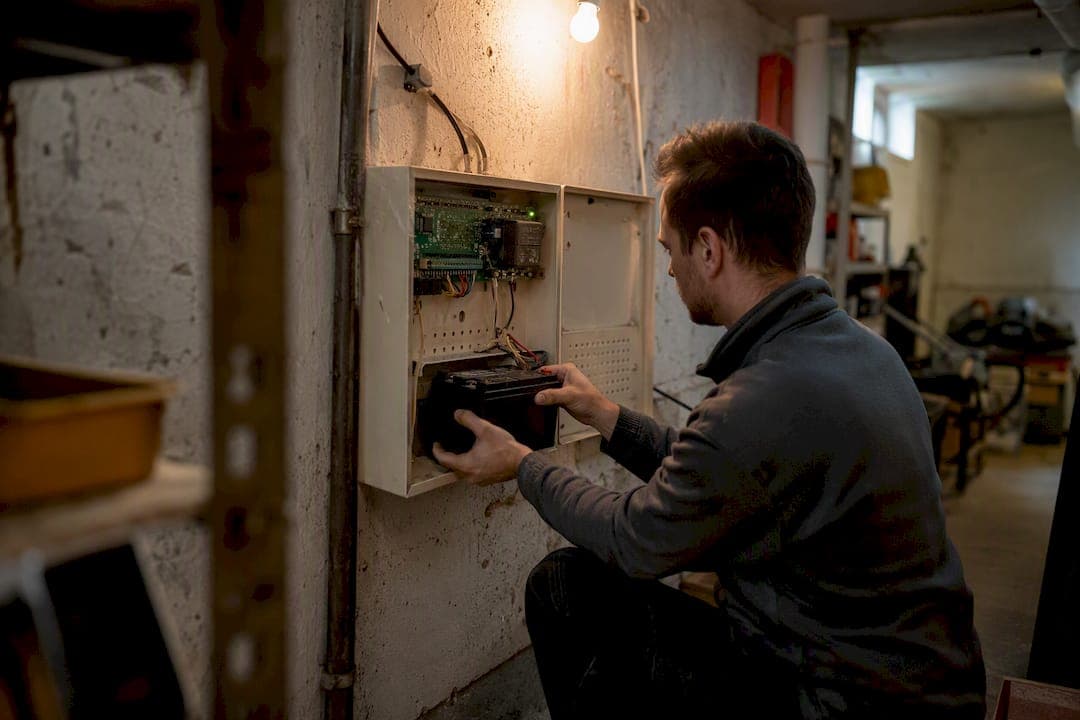
Most wired alarm panels run on a 12-volt sealed lead-acid (SLA) backup pack, typically rated between 4 Ah and 18 Ah depending on system size. Wireless sensors, keypads, and smoke detectors run on lithium coin cells or CR123A cells instead. When your panel starts beeping or your keypad flashes a "LOW BAT" message, you're usually looking at 24 to 72 hours of reserve power before the system goes dark during an outage.
That's not a lot of time to sit on the problem.
- Wired panel backup: 12 V SLA, commonly 4–18 Ah, spade or pigtail terminals.
- Wireless sensors: CR123A or lithium coin cells, sometimes AA lithium.
- Low-battery alert: treat it as a same-week task, not a someday task.
- DIY or pro? Swapping a labeled panel battery is usually a homeowner job; anything involving the bell box, tamper switches, or mains wiring calls for an electrician or alarm engineer.
Before you buy anything, check the label inside the panel door for voltage, Ah rating, and connector type. Sealed lead-acid backup batteries typically last 3 to 5 years, so if yours has never been replaced and the system is more than three years old, don't wait for the alert. Akkuplus stocks in-spec SLA and lithium replacement packs sorted by voltage and capacity, which makes matching your old battery to a new one a five-minute job instead of a guessing game.
Key Takeaways
Matching voltage, Ah rating, and terminal type exactly is the single factor that determines whether a replacement alarm battery works correctly.
| Point | Details |
|---|---|
| Know your chemistry | Wired panels use 12 V SLA batteries; wireless sensors use lithium CR123A, AA, or coin cells. |
| Replace proactively | SLA batteries last 3–5 years and lithium sensor cells last 3–7 years; don't wait for total failure. |
| Match specs exactly | Voltage, Ah rating, and terminal type must all match, since a close guess often won't connect or charge properly. |
| Respect tamper and mains risk | Tamper switches trigger sirens on opening; mains-adjacent wiring inside the panel calls for a qualified electrician. |
| Buy from a spec-transparent source | Akkuplus lists voltage, Ah, and terminal type on every product page, making it a straightforward source for in-spec panel and sensor batteries. |
Table of Contents
- Types Of Alarm System Battery Chemistry Explained
- How Long Do Alarm Batteries Last?
- How To Replace An Alarm Panel Or Sensor Battery
- Safety Risks And When To Call An Electrician
- Choosing The Right Replacement: Ah, Fit, And Connector Type
- Where To Buy Replacement Alarm Batteries
- What Actually Matters When You Replace An Alarm Battery
- Order The Correct Battery Without The Guesswork
- Sources
Types Of Alarm System Battery Chemistry Explained
Not every battery in your alarm system does the same job, and that's exactly why one home can have three completely different battery types running at once.
Sealed lead-acid (SLA) batteries power the main control panel. They're rechargeable, sit at a nominal 12 volts, and show up in capacities from 4 Ah on small residential panels up to 18 Ah or higher on commercial systems with more zones and longer required reserve times. Panel batteries commonly fall in the 4 to 8 Ah range for standard residential installs, though larger properties or systems with cellular backup often need more. SLA batteries almost always terminate in an F1 or F2 spade connector or a pigtail wire lead, and getting that connector type wrong is the single most common reason a "correct" replacement won't seat properly.
Lithium primary cells run your wireless sensors, door contacts, motion detectors, and often the keypad itself. CR123A cells are the workhorse here, alongside AA lithium cells like the Energizer Ultimate Lithium and small coin cells (CR2032, CR2450) for compact contact sensors. They're not rechargeable, but they carry a shelf life measured in years rather than months, and they hold voltage more consistently as they discharge than alkaline alternatives do, which is why alarm manufacturers spec them in the first place.

NiMH rechargeable packs show up in some older or specialty systems, usually as small multi-cell packs rather than single cells. They sit at lower voltages than SLA (often 3.6 V to 7.2 V in a pack configuration) and have their own charging curve. A NiMH pack like the ones used in cordless phone-style backup systems is not interchangeable with lithium or lead-acid without confirming the charger circuit matches.
Here's the part that trips people up: brand doesn't matter nearly as much as spec. A generic SLA battery from any manufacturer will work fine in your panel as long as the voltage, Ah rating, and terminal type match what's already there. What won't work is grabbing a battery with the right voltage but the wrong Ah rating and assuming "close enough" is fine, or buying a battery with the correct capacity but a screw terminal when your panel wants a spade connector.
Pro Tip: Take a photo of your old battery's label with your phone before you remove it. Voltage, Ah rating, terminal type, and even the manufacturer part number are usually printed right on the case, and that photo saves you a return trip to check specs later.
- SLA: 12 V, rechargeable, 4–18 Ah depending on system size.
- Lithium primary: CR123A, AA lithium, or coin cells, non-rechargeable, long shelf life.
- NiMH: rechargeable packs, lower voltage per cell, specific charging requirements.
- Match voltage, Ah, and terminal type exactly before checking anything else, including price.
How Long Do Alarm Batteries Last?
Expect your panel's SLA battery to last 3 to 5 years and your sensors' lithium cells to last 3 to 7 years, with temperature playing a much bigger role in that lifespan than most people realize. NiMH packs typically fall somewhere in between, though usage patterns affect them more than SLA batteries.
Heat is the real enemy of sealed lead-acid chemistry. A panel mounted in an uninsulated attic or an unconditioned garage will chew through its battery's usable life far faster than one installed in a climate-controlled utility closet, because elevated temperatures accelerate the internal chemical breakdown that limits SLA lifespan in the first place. If your panel lives somewhere that gets genuinely hot in summer, plan on replacing the battery closer to the three-year mark rather than the five-year mark.
A few other factors shorten battery life beyond what the calendar alone would predict:
- Frequent power outages force the battery to cycle more often, draining and recharging repeatedly instead of sitting in float mode.
- A degraded charging circuit inside an aging panel can undercharge or overcharge the battery, shortening its effective life regardless of how new it is.
- Heavy system draw, such as multiple sirens or a large number of hardwired zones, pulls more from the battery during any outage.
- Simple age. Even a battery that's never been called on to do real work loses capacity as its internal chemistry degrades over time.
Watch for these warning signs rather than waiting for a total failure: periodic chirping from the panel or keypad, an explicit "LOW BAT" or "BATT" message on the keypad display, sensors that respond sluggishly or drop out intermittently, and, on visual inspection, any swelling, bulging, or corrosion around the battery terminals. Swelling and corrosion in particular mean stop and replace immediately. Don't attempt to charge or reseat a battery that looks physically deformed.
Once a low-battery alert fires, you're typically working with a reserve window of one to three days before the system loses backup power entirely during an outage. That's not a deadline to plan around. It's a deadline to beat.
How To Replace An Alarm Panel Or Sensor Battery
Replacing a battery correctly takes about fifteen minutes once you know the sequence. Rushing it, or skipping the disarm step, is how people end up standing in their driveway waiting for a monitoring company to call back.
Before you touch anything:
- Locate the battery label inside the panel enclosure and confirm voltage, Ah rating, and connector type against your replacement.
- Disarm the system fully at the keypad.
- If your alarm is professionally monitored, call the monitoring center first and tell them you're doing maintenance. This prevents a false dispatch if the tamper switch trips.
- Gather a small flatblade screwdriver, the correct replacement battery, and a flashlight if the panel is in a dim closet or attic.
Swapping the panel battery:
- Open the panel enclosure carefully. Many panels have a tamper switch on the door that triggers the siren the instant the cover comes off, so move slowly and check for a service or engineer mode first if your system has one.
- Disconnect the negative (black) lead from the old battery before the positive (red) lead. This order matters. It reduces the chance of an accidental short if your tool touches the panel casing.
- Remove the old battery and set the new one in place, matching orientation exactly.
- Reconnect the positive lead first, then the negative lead. This is the reverse order from removal, and it's not arbitrary. It minimizes arcing risk.
- Close and reseal the panel enclosure, then clear any tamper indication at the keypad.
Swapping sensor batteries:
- If your system supports a sensor or service mode, activate it before opening the sensor housing. This tells the panel to ignore the brief signal loss during the swap.
- Note the sensor's model number and battery orientation before removing the old cell. Some coin cell holders are picky about polarity.
- Replace the CR123A, AA lithium, or coin cell, then close the housing.
- Test or re-enroll the sensor per your system's instructions if it doesn't automatically reconnect.
After you're done: force an AC power loss test if your panel supports it, or run the built-in battery diagnostic, to confirm the new battery is charging correctly. Check the keypad status screen and event log for any lingering fault codes. A persistent low-battery message after a fresh swap almost always means either a bad connection, a mismatched spec, or a charging circuit problem inside the panel itself.
Pro Tip: Keep a spare panel battery on the shelf once you know your system's exact spec. When the alert comes at 9 p.m. on a Sunday, you'll be glad you're not driving to three stores.
Safety Risks And When To Call An Electrician
The two hazards that catch people off guard are tamper switches and mains-adjacent wiring, and both deserve more respect than the average online tutorial gives them.
Alarm panels commonly place a tamper switch right on the cover, so opening the enclosure without disarming the system or entering service mode can set off the siren in your hallway and, if monitored, dispatch a false alarm response. If you don't have the engineer code and the alarm does trigger, closing the panel quickly or holding the tamper switch shut buys you time to sort things out without an extended siren blast.
The second hazard is more serious. Many panels sit close to a step-down transformer wired directly into your home's 230 to 240 volt mains supply. That's not the same circuit as your low-voltage battery leads, but it's often inches away inside the same enclosure.
Do not work near mains-adjacent transformer connections unless you are qualified to do so. Battery replacement itself is low-voltage and safe for most homeowners, but the wiring beside it is not something to troubleshoot casually.
Call a professional when any of the following applies:
- The battery is visibly swollen, leaking, or corroded, since damaged SLA cells can vent corrosive material.
- A fault persists on the keypad after you've correctly replaced the battery.
- The battery sits in a location you can't reach without triggering the tamper switch and you don't have the engineer code.
- You're not confident distinguishing the low-voltage battery leads from the mains-side transformer wiring.
When you do remove an old battery, don't toss it in household trash. Sealed lead-acid batteries and lithium cells both qualify for battery recycling at most municipal collection points and many electronics retailers, since both chemistries contain materials that shouldn't go into a landfill.
Choosing The Right Replacement: Ah, Fit, And Connector Type
Get three numbers right and you'll never buy the wrong alarm battery again: voltage, amp-hour (Ah) rating, and terminal type. The label on the battery itself typically lists all three, which makes matching a replacement far simpler than guessing from the panel model number alone. If the label has worn off, your panel's installation manual will list the exact spec required.
Going up in Ah capacity is usually fine and sometimes worth doing. A higher-Ah battery gives your system a longer reserve window during extended power outages, which matters if you live somewhere prone to multi-day outages or if your panel runs a lot of hardwired zones and accessories that draw extra current. Going up in physical size can be a problem if the enclosure doesn't have room, so check dimensions, not just Ah, before you order a bigger pack.
Where people get into trouble is the "lithium drop-in" claim you'll sometimes see marketed as a universal SLA replacement. Lithium replacement packs often need a different charging voltage profile and a battery management system (BMS) that the original lead-acid charger circuit was never designed to recognize. Swap in a lithium pack without confirming your panel's charger supports it, and you can end up with false low-battery errors, incomplete charging, or a battery the panel simply won't top off correctly. Unless the manufacturer explicitly certifies compatibility, stick with the same chemistry your panel shipped with.
- Match voltage, Ah, and terminal type before comparing price or brand.
- A higher Ah rating extends reserve time if it physically fits the enclosure.
- Don't switch chemistry (SLA to lithium) without confirmed charger compatibility.
- Buy from a supplier that lists production date, exact specs, and a clear returns policy.
Pro Tip: When in doubt between two Ah ratings, size up rather than down. A slightly larger battery that fits the case gives you more outage buffer with no downside.
Where To Buy Replacement Alarm Batteries
Buying the right alarm battery comes down to finding a supplier who documents specs clearly enough that you can match your old battery with confidence, not just a low price.
Look for listings that state voltage, Ah rating, and terminal type up front rather than burying them in a PDF datasheet. Akkuplus organizes its SLA battery catalog by exactly those three fields, so you can search by the numbers printed on your old battery's label instead of guessing from a model name. That matters more than it sounds like it should. Alarm panel manufacturers frequently source their SLA cells from whichever supplier had stock that quarter, so two panels of the same model can ship with batteries from different manufacturers as long as the spec matches.
For sensor cells, the same logic applies. A CR123A or AA lithium cell like the Energizer Ultimate Lithium performs consistently across brands as long as you're buying genuine lithium chemistry rather than a cheaper alkaline substitute mislabeled as compatible.
Two things separate a reliable supplier from a risky one: production date transparency (an SLA battery sitting on a shelf for two years before it reaches you starts its clock early) and a straightforward returns policy in case the connector type doesn't match your panel despite your best measuring. Both are worth checking before you check out, not after the battery arrives.
What Actually Matters When You Replace An Alarm Battery
Most guidance on this topic treats every alarm battery replacement the same way, and that's the first thing worth pushing back on. A coin cell swap in a door sensor and a panel battery swap next to a live transformer are not the same job with different difficulty levels. They're different risk categories entirely, and treating them identically is how people either overpay for professional help they didn't need or take on electrical risk they weren't ready for.
The spec-matching advice you'll find everywhere is correct, but it undersells how often "close enough" fails in practice. A battery with the right voltage and a slightly different Ah rating will usually work. A battery with the right Ah rating and the wrong terminal type won't connect at all. Terminal type deserves more attention than most guides give it, because it's the spec people skip when they're in a hurry.
My honest read: buy your replacement based on what's printed on the old battery, not on what the panel manufacturer's name suggests you should buy, and don't let a "universal lithium" listing talk you out of matching chemistry unless compatibility is explicitly confirmed.
— Waldemar
Order The Correct Battery Without The Guesswork
Once you know your panel's voltage, Ah rating, and terminal type, ordering the right replacement should take less time than finding your alarm's installation manual did. Akkuplus lists SLA panel batteries, lithium sensor cells, and battery testers with full specs on every product page, so you're matching numbers instead of matching brand names.

For a standard residential panel, the Long WP1250 12 Volt 2000mAh SLA pack covers many smaller systems, while the Panasonic LC-P1224APG 12 Volt 24 Ah pack suits larger installs needing extended reserve time. Systems running 6-volt configurations can check the Panasonic LC-R064R5P 6 Volt 4500mAh SLA battery. For wireless sensors, the Energizer Ultimate Lithium AA two-pack covers most lithium AA requirements, and a battery tester for standard and button cells lets you confirm charge state before you climb up to a sensor a second time.
Confirm your model and spec against the Akkuplus product pages, order a spare while you're at it, and jot the install date on the new battery with a marker. Your next replacement will take you two minutes to plan instead of twenty.
Sources
- Alarm System Battery: Your Complete Guide to Powering Home Security in 2026 - Ridgeroam
- Battery charging and chemistry compatibility notes - PMC
- Alarm systems (practical safety notes) - Leipziger Schlüsseldienst