

Amp-hours (Ah) measure electrical charge; watt-hours (Wh) measure actual energy, and the two connect through one formula: Wh = Ah × Voltage. When you're comparing batteries at the same voltage, Ah works fine. The moment voltages differ, Wh becomes the only fair comparison, which is why groups from the IEA to battery makers lean on it, and why product listings often include both specs on every product page.
TL;DR:
- Comparing batteries with different voltages requires focusing on watt-hours, as amp-hours alone do not reflect actual energy content outside a fixed voltage system.
- A 100 Ah battery at 12V provides 1,200 Wh, but the same Ah rating at 48V yields four times the energy, illustrating how voltage impacts capacity.
- Power banks rated in milliamp-hours often overstate available energy because their Wh calculated at the internal cell voltage (around 3.7V) is much lower than the labeled capacity suggests.
- Real-world battery capacity is lower than ratings due to factors like depth of discharge, temperature, discharge rate, and aging, which all reduce usable energy.
- Always size batteries using Wh for estimating runtime and compare specs with both Ah and Wh, ensuring to check voltage, cycle life, and discharge rates before purchasing.
Table of Contents
- Ah vs Wh: What Does Amp-Hours Actually Measure?
- Ah vs Wh: Why Watt-Hours Are the Universal Comparison Unit
- How Do You Convert Ah to Wh (and Back)?
- Worked Ah to Wh Examples You Can Reuse
- Which Metric Should You Actually Use When Buying?
- Why You Never Get the Full Rated Capacity
- How to Size a Battery System in Four Steps
- Buying Smarter: AkkuPlus Product Categories and Testing Support
- How Voltage Swings Throw Off Your Ah and Wh Math
- The Ah and Wh Mistakes That Trip Up Even Experienced Buyers
- Lead-Acid vs Lithium-Ion: How Chemistry Changes the Ah and Wh Story
- Why Battery Efficiency Changes What You Actually Get in Wh
- Pick the Number That Answers Your Actual Question
- Get the Right Battery Once You've Done the Math
- Sources
- FAQ
Ah vs Wh: What Does Amp-Hours Actually Measure?
Amp-hours tell you how much charge a battery can deliver over time. A simple way to picture it: a battery rated at 10 Ah can theoretically supply 10 amps for one hour, or 1 amp for ten hours. That's the whole idea behind the unit. It's a rate multiplied by time, nothing more.
Ah shows up constantly in a few specific contexts:
- 12V vehicle and marine batteries, where the rating tells you roughly how long a fixed load will run
- Deep-cycle batteries for off-grid setups, solar sheds, and RVs
- Small electronics specs in milliamp-hours (mAh), which is just Ah divided by 1,000
The catch: Ah alone tells you nothing about voltage, so it cannot compare two batteries with different voltages. A 100 Ah battery at 12V and a 100 Ah battery at 48V hold wildly different amounts of energy, even though the Ah number is identical. That's the trap most first-time buyers fall into.
Ah vs Wh: Why Watt-Hours Are the Universal Comparison Unit
Watt-hours measure energy directly. The math is simple: Wh = Watts × Hours. A 100-watt device running for five hours consumes 500 Wh, no matter what battery or voltage supplies that power.
Wh connects naturally to two things people already understand:
- Appliance labels, which list wattage, not amp draw
- Electricity bills, measured in kilowatt-hours (1 kWh = 1,000 Wh)
That shared language is exactly why Wh works across different battery types and voltages, while Ah only works when you're staying inside one voltage system, according to guidance from Electricalconverters. If you're trying to figure out whether a battery will run your cooler, your laptop, or your camp lights for a given stretch of time, Wh gives you a direct answer. Ah requires an extra step you might forget to take.
How Do You Convert Ah to Wh (and Back)?
The core formulas are short enough to memorize:
- Wh = Ah × Voltage — multiply amp-hours by nominal voltage to get energy.
- Ah = Wh ÷ Voltage — divide watt-hours by voltage to get charge capacity.
- Ah = mAh ÷ 1,000 — milliamp-hours to amp-hours is just a decimal shift.
The voltage you plug in matters more than most people realize. Use the nominal voltage, not the fully charged reading. A "12V" lead-acid battery might read 12.7V off the charger, and a LiFePO4 pack often carries a nominal voltage of 12.8V, but industry convention still rounds to 12V for standard calculations. Using the higher, fully charged voltage inflates your Wh estimate and sets you up for disappointment later.
Common nominal voltages worth knowing: 3.7V for lithium-ion cells, 5V for USB power banks, 12V for standard deep-cycle and vehicle batteries, 24V and 48V for larger solar and e-bike systems.
Pro Tip: Power bank manufacturers usually quote mAh at the internal cell voltage (often 3.7V), not at the 5V USB output you actually use. That's why a "20,000 mAh" bank rarely delivers what a naive calculation suggests.
A basic conversion calculator only needs two inputs: capacity (Ah or mAh) and nominal voltage. The output should show Wh, plus the reverse Ah figure if the user enters Wh and voltage instead.
Worked Ah to Wh Examples You Can Reuse
Numbers make this concrete faster than any explanation. Here are conversions that cover the situations readers run into most often.
| Battery Spec | Voltage | Watt-Hours (Wh) |
|---|---|---|
| 100 Ah | 12V | 1,200 Wh |
| 100 Ah | 48V | 4,800 Wh |
| 20,000 mAh (20 Ah) | 3.7V | 74 Wh |
| — | 12V | 2,400 Wh |
| 100 Ah | 24V | 2,400 Wh |
A few things jump out. First, that 100 Ah number means nothing until you attach a voltage. At 12V it's 1,200 Wh; at 48V, the same Ah rating holds four times the energy. Second, a 20,000 mAh power bank, once converted at its 3.7V cell voltage, lands at roughly 74 Wh, which is a fraction of what a labeled 500 Wh power station holds despite sounding like a bigger number on the box.
Working backward is just as easy. If you know you need 600 Wh and your system runs at 12V, divide: 600 ÷ 12 = 50 Ah. That's the Ah = Wh ÷ Voltage formula in action, and it's the step most buyers skip before checking out.
Which Metric Should You Actually Use When Buying?
The rule is short: use Wh whenever voltages differ or you're estimating runtime, and use Ah only when comparing batteries inside the same fixed-voltage system, like two 12V deep-cycle options side by side.
Appliance wattage is your anchor point. A 300-watt device drawing power for two hours needs 600 Wh, full stop, regardless of what battery supplies it. Run that through an inverter and you lose some of it to conversion inefficiency, typically 10 to 15 percent, so the battery needs to supply more than the raw 600 Wh figure.
Before buying anything, check the spec sheet for:
- Rated Ah AND Wh (not just one or the other)
- Nominal voltage, clearly labeled
- Maximum continuous discharge rate
- Cycle life at a stated depth of discharge
Pro Tip: If a listing gives you Ah but no Wh, multiply by nominal voltage yourself before comparing it to anything else on the market. A missing Wh figure is often a sign the listing wants you to skip that comparison.
Why You Never Get the Full Rated Capacity
Rated Ah and Wh numbers are best-case figures. Real usable capacity is almost always lower, and the gap comes from four predictable factors.
Depth of discharge (DoD) is the biggest one. Lithium-ion batteries typically tolerate 80 to 100 percent DoD without major damage, while flooded lead-acid batteries are usually limited to 50 percent DoD to avoid shortening their lifespan. That means a 100 Ah lead-acid battery is really a 50 Ah battery in practical terms.
Temperature matters too. Cold conditions reduce usable capacity and can cause voltage sag under load; extreme heat accelerates aging. Neither extreme is where a battery performs at its rated spec.
Discharge rate, or C-rate, also eats into real output. Pulling current faster than a battery is designed for causes voltage to sag mid-discharge, which lowers the effective Wh delivered even though the Ah rating on the label hasn't changed.
Finally, aging: every cycle a battery goes through shaves a little off its total capacity, so a battery rated for 2,000 cycles won't deliver full capacity by cycle 1,800. Budget extra capacity upfront rather than sizing to the bare minimum.
How to Size a Battery System in Four Steps
- Add up appliance demand in Wh. Multiply each device's wattage by hours of use, then sum them.
- Add system losses. Inverter inefficiency typically costs 10 to 15 percent, so multiply your total by roughly 1.15.
- Apply usable DoD. Divide by your chemistry's safe DoD (0.8 for lithium, 0.5 for lead-acid) to find the rated Wh you actually need to buy.
- Convert to Ah at your system voltage. Divide the final Wh figure by nominal voltage to get the Ah spec to shop for.
Pro Tip: Round up, not down, at every step. A battery that's slightly oversized costs less in frustration than one that dies mid-trip because the math was too optimistic.
Buying Smarter: AkkuPlus Product Categories and Testing Support
Getting the math right only helps if the battery itself is accurately labeled and in good condition. AkkuPlus stocks single lithium-ion cells, sealed lead-acid batteries, and custom battery packs, alongside repair and cell-replacement services for devices where the original pack has degraded.
Before trusting a spec sheet, it helps to verify actual voltage with a battery tester, since a worn cell rarely delivers its printed rating. Measure first, then buy.
How Voltage Swings Throw Off Your Ah and Wh Math
Voltage isn't a fixed number even within a single battery. It shifts across the charge cycle, and that shift is exactly why nominal voltage exists as a standardized reference point rather than a single measured reading.
A fully charged 12V lead-acid battery might read close to 12.7V off the charger, then settle toward 12V or slightly below as it discharges. A LiFePO4 pack behaves differently still, holding a relatively flat voltage curve around its 12.8V nominal rating for most of its discharge before dropping sharply near empty. Nickel-based chemistries sag more gradually and predictably.
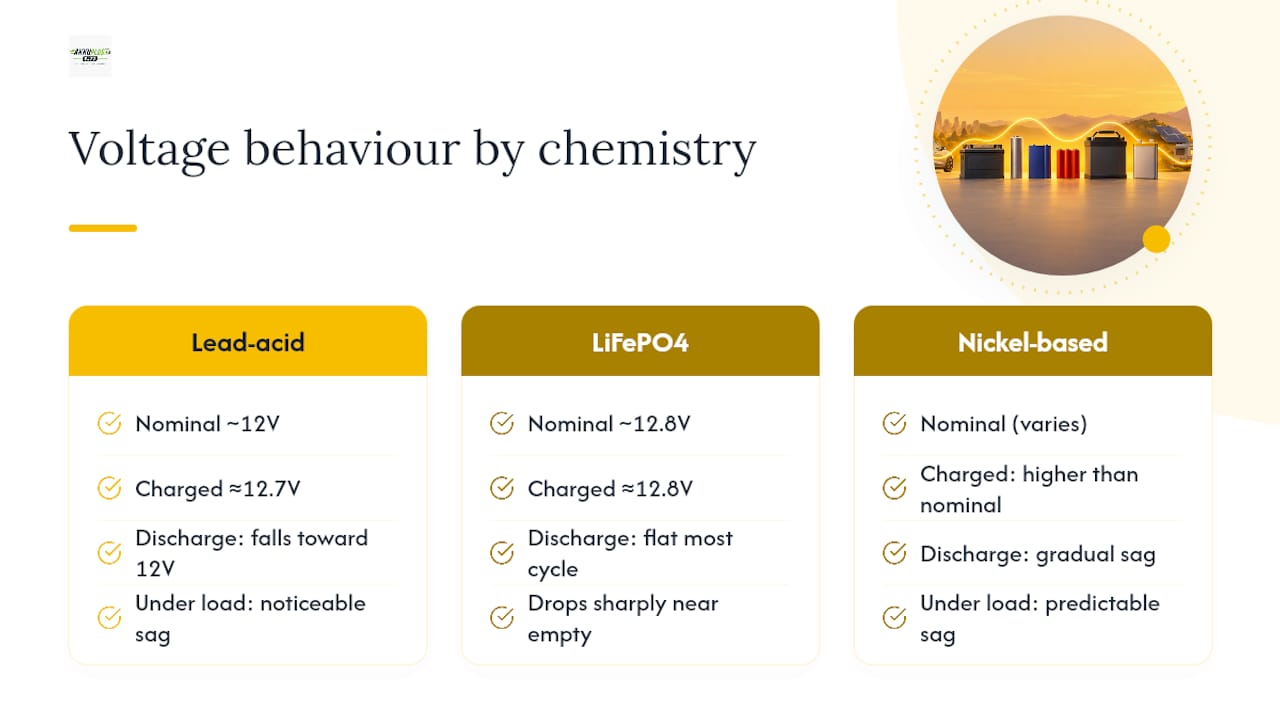
Here's where the math actually breaks if you're not careful: if you calculate Wh using the fully charged voltage reading instead of nominal voltage, you overstate the battery's real energy content. A 100 Ah battery that reads 13V off the charger isn't a 1,300 Wh battery in practical terms, it's closer to 1,200 Wh once you use the 12V nominal figure that reflects its actual average output across a full discharge.
This is also why two batteries with identical Ah ratings can perform very differently under load. A battery under heavy current draw experiences voltage sag, meaning its effective voltage drops below nominal for the duration of that load. Less voltage under sag means less Wh delivered in that moment than the label promises, even though the Ah rating hasn't budged. Cheap batteries with poor internal resistance sag more; better-built cells hold voltage steadier.
The practical takeaway: nominal voltage is a planning tool, not a guarantee. It gets you close enough for sizing decisions, but real-world voltage always fluctuates with charge state, load, and temperature.
The Ah and Wh Mistakes That Trip Up Even Experienced Buyers
The single most common mistake is comparing two Ah ratings without checking whether the voltages match. A 50 Ah battery at 24V holds the same energy as a 100 Ah battery at 12V, but shoppers scanning listings for the bigger Ah number often walk away with less total capacity than they intended.
Another frequent error: treating a power bank's advertised mAh figure as directly comparable to a battery's watt-hour rating. A power bank listed at 26,800 mAh sounds enormous next to a "500 Wh" portable power station, but once you convert that mAh figure at its actual cell voltage, it often lands well under 100 Wh, a fraction of what the power station holds. The units simply aren't on the same scale until you convert them.
People also assume rated capacity equals usable capacity. It doesn't, and the earlier discussion of depth of discharge explains why a 100 Ah lead-acid battery behaves more like 50 Ah in daily use. Ignoring that gap is how systems get undersized.
There's also confusion around what "capacity" even measures. Ah measures charge, not energy, and charge alone tells you nothing about how much work a battery can actually do unless you know the voltage. Treating Ah as a stand-in for total power capability, the way you might casually compare two phone batteries by mAh alone, ignores the multiplication step that actually determines energy content.
Finally, airlines and shipping carriers care specifically about Wh, not Ah, for lithium battery restrictions. If you're transporting batteries for travel or shipping, IATA guidelines set watt-hour thresholds, and misreading your battery's Wh rating can mean a battery gets flagged or rejected at check-in.
Lead-Acid vs Lithium-Ion: How Chemistry Changes the Ah and Wh Story
Battery chemistry decides not just how much energy a cell holds, but how reliably its Ah and Wh ratings translate into real-world performance.
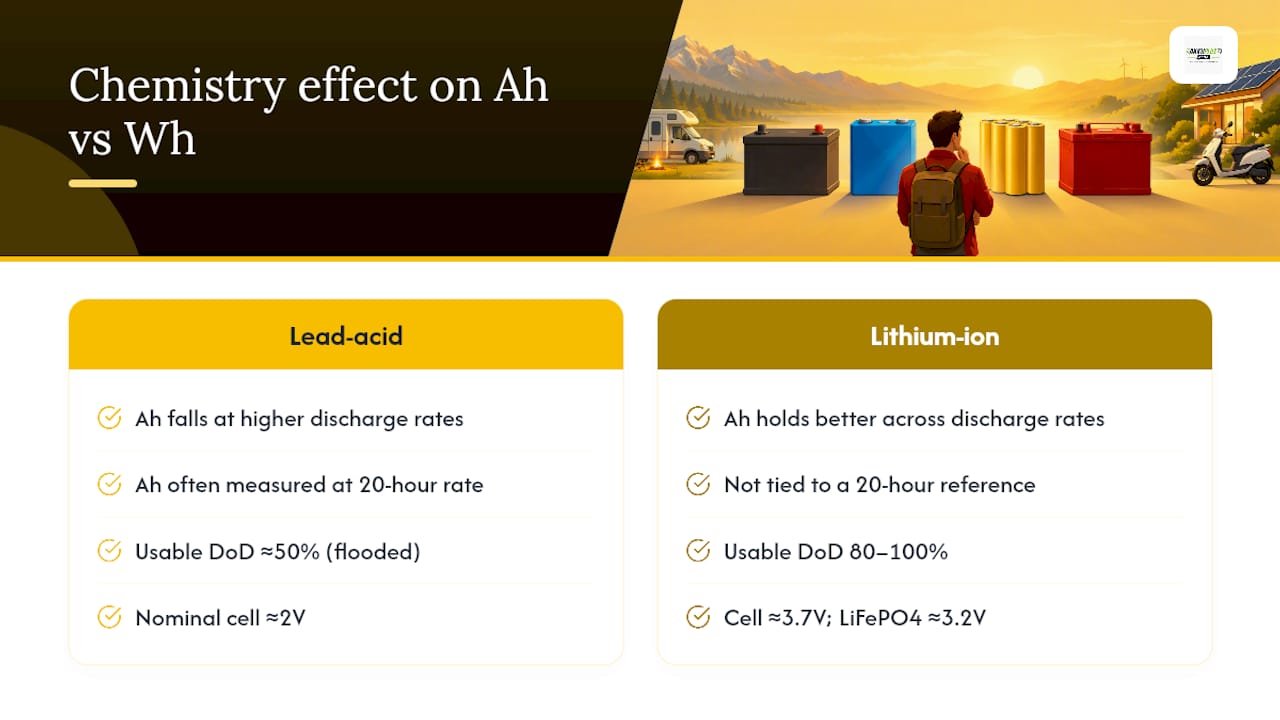
Lead-acid batteries are the older, heavier technology, and their Ah rating is usually measured at a specific discharge rate, often the 20-hour rate. Pull more current than that reference rate and the effective Ah capacity drops, sometimes significantly. Lead-acid also tolerates a much shallower depth of discharge, generally capping around 50 percent for flooded designs, which means the printed Ah number overstates practical capacity more than it does for other chemistries.
Lithium-ion, and specifically LiFePO4 in deep-cycle applications, behaves differently. These cells maintain a flatter voltage curve across most of their discharge cycle, tolerate deeper discharge (often 80 to 100 percent DoD), and hold their rated Ah more consistently regardless of discharge rate, within reasonable limits. That's a major reason lithium packs, despite costing more upfront, deliver more usable Wh per rated Ah than lead-acid over the life of the battery.
The nominal voltage itself differs by chemistry too. A single lithium-ion cell sits around 3.7V nominal, while LiFePO4 cells run closer to 3.2V, and lead-acid cells are roughly 2V each, which is why six lead-acid cells in series make a "12V" battery. These per-cell voltage differences are exactly why pack configuration, not just Ah rating, determines the final Wh figure.
Manufacturers tend to favor Ah as their primary spec because it ties directly to how many cells and how much active material went into the battery. Consumers, on the other hand, care about Wh because that's what actually determines runtime. Reading both numbers, and knowing which chemistry you're buying, keeps you from comparing incompatible specs.
Why Battery Efficiency Changes What You Actually Get in Wh
The rated Wh on a battery's label describes what the cells can theoretically store, not what you'll get back out. Efficiency losses happen at multiple points, and each one chips away at that number.
Charging itself isn't perfectly efficient. Some energy is lost as heat during charging, meaning you put more energy in than the battery ends up storing. Lithium-ion chemistries are relatively efficient here, often retaining a high percentage of input energy, while lead-acid loses noticeably more during charging.
Discharge efficiency matters too, particularly at high C-rates. Pulling current quickly generates internal resistance losses, and that resistance turns some of the stored energy into heat instead of usable power. This is part of why a battery rated at 100 Ah and 1,200 Wh at a slow discharge rate might deliver measurably less usable energy if you draw a large load quickly.
Then there's the equipment between the battery and your device. If you're running an inverter to convert battery DC power into AC for household appliances, expect to lose roughly 10 to 15 percent to conversion inefficiency. That loss applies on top of whatever the battery itself already sacrificed to internal resistance and charging inefficiency.
Add it up and the gap between rated Wh and delivered Wh can be substantial, easily 20 to 30 percent when you stack charging losses, discharge losses, and inverter inefficiency together. That's exactly why the sizing steps earlier in this piece build in margin rather than sizing to the bare rated number. A battery that looks perfectly matched to your needs on paper often falls short in practice if efficiency losses aren't part of the calculation.
Pick the Number That Answers Your Actual Question
Wh is the number that travels across voltages and tells you real energy content. Ah only works cleanly inside a single fixed-voltage system. Run the conversions before you buy, size with margin, not bare minimums, and if you're shipping lithium batteries anywhere, check IATA's watt-hour thresholds first.
— Waldemar Pelich
Get the Right Battery Once You've Done the Math
Once you know the Wh figure your setup actually needs, you can turn that number into an actual purchase instead of another spec sheet to decode. Some battery suppliers stock single cells, sealed lead-acid and lithium packs, and custom-built battery packs, plus repair and cell-replacement services for devices where the original pack no longer holds its rated capacity.

If your calculation points to a 12V system, browse the battery category for options at that voltage, or check battery packs if you need a custom configuration built to a specific Ah or Wh target. Not sure whether your current battery is actually delivering its rated capacity anymore? A quick check with a battery tester tells you before you spend money replacing something that might just need a repair. Requesting a quote for a custom pack or repair service can help skip the guesswork on your next battery purchase.
Sources
For deeper reading beyond this guide: the IEA's energy storage overview covers why capacity metrics matter at grid scale, while IATA's lithium battery guidance is the authority on shipping and transport rules. For technical conversion explainers, Offgrid Benchmark and RELiON both walk through the math in more depth.
- Battery Capacity: Amp-Hours vs Watt-Hours Explained
- Ah vs Wh: What's the Difference in Battery Capacity?
- What Is Battery Capacity? Ah, Wh, kWh and Runtime Explained - Avepower
FAQ
How many watt-hours are in a 100 Ah battery?
It depends entirely on voltage. At 12V, a 100 Ah battery holds 1,200 Wh; at 24V it holds 2,400 Wh; at 48V it holds 4,800 Wh. Always multiply Ah by nominal voltage, not the fully charged reading, to get an accurate figure.
How many watt-hours are in 1 Ah?
At 12V, 1 Ah equals 12 Wh. The exact number scales directly with voltage, so 1 Ah at 24V equals 24 Wh, and 1 Ah at 3.7V (a typical lithium cell) equals 3.7 Wh.
Is 100 Wh the same as 20,000 mAh?
Not usually. A 20,000 mAh power bank rated at its typical 3.7V cell voltage works out to roughly 74 Wh, meaningfully less than 100 Wh. The mAh figure only matches the marketing number when you account for the actual voltage it was measured at.
Are Wh and Ah the same thing?
No. Ah measures electrical charge, while Wh measures actual energy, and the two only connect once you multiply by voltage. Two batteries with identical Ah ratings can hold very different amounts of energy if their voltages differ.
Where can I check my current battery's real capacity?
AkkuPlus sells battery testers suited to standard cells and button batteries, useful for confirming actual voltage before running Ah to Wh conversions. Current pricing for testers and repair services is listed directly on the AkkuPlus site.
Recommended
This article was created with the assistance of Artificial Intelligence (AI) and has been reviewed by our editorial team. Despite careful preparation, we assume no liability for the completeness, accuracy, or timeliness of the information provided. The technical data and specifications supplied by the respective manufacturer shall always prevail.