

For starter batteries, UPS backup, and anything demanding a hard burst of current, AGM wins. For solar banks, mobility scooters, and other slow, deep-cycle jobs, especially in hot climates, gel wins. The one rule that overrides both choices: match your charger to the battery chemistry, because the wrong voltage settings will quietly wreck either one within months.
TL;DR:
- AGM batteries are better suited for high-current demands like engine starting and UPS backup systems, due to their low internal resistance.
- Gel batteries excel in deep-cycle applications such as solar banks and mobility devices, especially in hot climates, thanks to their thermal stability and longer cycle life.
- Proper matching of the charger to the battery chemistry is crucial, with AGM requiring higher voltage settings than gel, to prevent capacity loss and early failure.
- Deep discharges reduce cycle life for both chemistries, but gel batteries typically withstand more cycles at higher depths of discharge before deteriorating.
- Avoid using a gel charger on AGM batteries or vice versa, as incorrect voltage settings can cause sulfation or permanent capacity damage.
Table of Contents
- AGM vs Gel Battery: How Construction Drives the Difference
- AGM vs Gel Battery Performance: Cycles, Capacity, and Heat
- What Voltage Should You Charge AGM or Gel At?
- Which Battery Fits Which Job?
- What to Check Before You Buy an AGM or Gel Battery
- The AkkuPlus Take on Choosing Between AGM and Gel
- Ready to Match Your Battery to the Right Charger
- Sources
- FAQ
AGM vs Gel Battery: How Construction Drives the Difference
Both are sealed lead-acid designs, but what holds the electrolyte in place changes everything downstream. AGM (Absorbent Glass Mat) batteries sandwich the electrolyte inside thin fiberglass mats pressed against the lead plates. That mat wicks acid tightly against the plate surface, which is why AGM batteries produce low internal resistance and handle high surge currents so well.
Gel batteries take a different route. The sulfuric acid is mixed with silica until it turns into a thick paste rather than a free liquid. That gel fills the space around the plates and, because it doesn't slosh or settle, it largely eliminates electrolyte stratification, which is one reason gel cells tend to deliver higher cycle life in deep-discharge service.
The practical fallout of these two builds:
- AGM dries out faster under sustained overcharging, since the mat holds a fixed volume of acid with nowhere to replenish from.
- Gel develops permanent voids if it's ever gassed too hard, since bubbles trapped in a paste don't rise and vent the way they do in liquid acid.
- Both chemistries are vulnerable to sulfation when left partially discharged for weeks, but gel's denser structure slows the reaction slightly.
AGM vs Gel Battery Performance: Cycles, Capacity, and Heat
Cycle life is where the two chemistries really separate, and depth of discharge (DOD) decides most of it. Drain either battery to 50% DOD instead of 20%, and you can cut its usable cycle count by more than half. That's true across both technologies, but gel tends to hold up better under repeated deep draws.
Typical Cycle Bands: AGM deep-cycle variants commonly run 300 to 600 cycles at 50% DOD, while gel cells in the same service often reach 500 to 900 cycles, largely because gel resists the internal stratification that accelerates plate degradation in AGM over time.
Temperature flips the advantage depending on the season. Gel holds up better in sustained heat, losing capacity more slowly at high ambient temperatures, while AGM performs better in cold and under sudden high-rate loads. That's a direct consequence of the same construction gap: AGM's exposed mat electrolyte responds fast to a cold-weather crank demand, while gel's denser mass buffers against heat-driven grid corrosion.
What that means in the field:
- A rooftop solar bank baking in summer sun ages faster on AGM than on gel.
- A starter battery in a winter garage cranks more reliably on AGM than gel.
- A standby UPS sitting in a climate-controlled server closet barely notices the difference either way.
What Voltage Should You Charge AGM or Gel At?
AGM and gel don't just tolerate different charging currents. They need different voltage ceilings, and getting this wrong is the single most common way owners kill either battery early.
- AGM absorption voltage: typically in a higher voltage range for a 12V battery, with float at moderate voltage.
- Gel absorption voltage: typically in a lower voltage range than AGM, with slightly lower float voltage.
- Temperature compensation: both chemistries need the charger to reduce voltage slightly as ambient temperature rises, since heat accelerates gassing at any fixed voltage.
- Current tolerance: AGM accepts higher charging currents and recovers faster from a deep discharge, while gel is far less forgiving of overvoltage.
The risk of getting this backward is not theoretical. Running AGM on a gel charger repeatedly causes chronic undercharging and sulfation, while pushing gel with AGM-level absorption voltage creates internal gas pockets that permanently shrink capacity. If you're stuck with only one charger type in an emergency, a single short session won't ruin the battery, but don't make it a habit, and check the electrolyte temperature by hand afterward. It should feel warm, never hot.
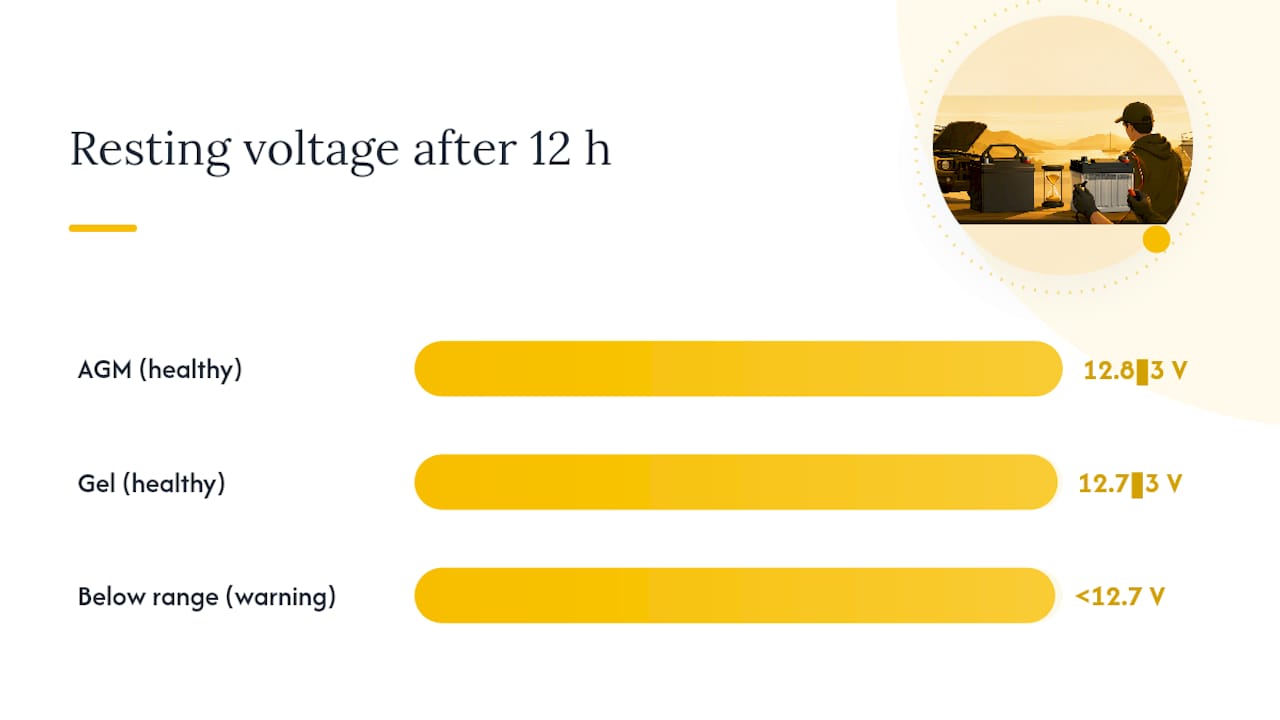
Pro Tip: After the first three charge cycles on a new battery, check the resting voltage 12 hours after disconnecting the charger. A healthy AGM should settle around 12.8 to 12.9V, and gel around 12.7 to 12.8V. A lower reading signals your charger's absorption voltage is set wrong for that chemistry.
Which Battery Fits Which Job?
Matching chemistry to application matters more than chasing a spec sheet number, since the right choice usually comes down to load profile and ambient temperature rather than one chemistry being universally better.
- Starter engines: AGM, because cranking needs a fast burst of current the fiberglass mat delivers, and most alternator charge profiles are tuned for AGM's higher absorption voltage anyway.
- Solar and off-grid banks: gel, since these systems spend long stretches at partial state of charge (PSOC), and gel's thermal stability and cycle depth make it the frequent pick for high-cycle solar installs.
- RV and boat house banks: depends on your charging system. If the onboard charger or alternator can't be reprogrammed for gel's lower voltage ceiling, AGM is the safer default.
- Mobility scooters and wheelchairs: gel is common here because of its resilience to daily deep discharges over years of use.
- UPS and standby power: AGM, largely for cost and because standby float behavior plays to AGM's strengths without stressing its cold-weather advantage.
What to Check Before You Buy an AGM or Gel Battery
Skim past the marketing copy and go straight to five numbers on the product page.
- Amp-hour (Ah) rating matched to your actual daily draw, not just the battery's physical size.
- Recommended absorption and float voltages, listed explicitly, not buried in a generic spec PDF.
- Maximum charge current or C-rate, so you know your charger won't overdrive the battery.
- Operating temperature range, especially if the battery lives in an engine bay, attic, or unheated shed.
- Cycle rating or warranty term, which tells you more about real service life than any marketing claim.
Walk the installation once it arrives: confirm orientation matches the listing, leave clearance for heat dissipation, and never box a battery into a sealed compartment with no airflow. Treat any listing that says only "sealed lead acid" with no AGM or gel subtype, skips charge-voltage numbers entirely, or comes from a seller who won't confirm the chemistry on request, as a red flag worth walking away from.
The AkkuPlus Take on Choosing Between AGM and Gel
Most of the AGM versus gel debate online treats this like a rivalry with a single winner. It isn't. The honest framing is that these are two different tools built for two different jobs, and the real failure mode isn't picking the "wrong" chemistry, it's picking the right chemistry and then feeding it the wrong charger.
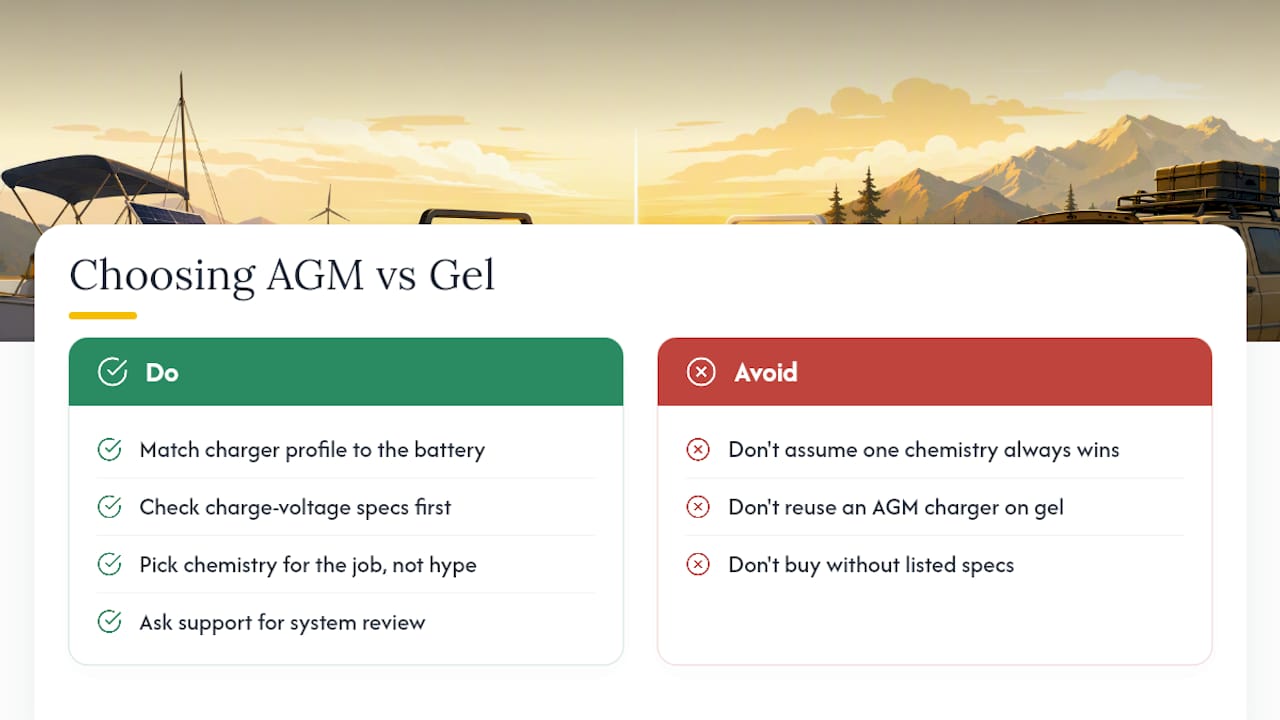
That's the pattern we see over and over: someone buys a gel deep-cycle battery for their solar setup, inherits an old AGM-tuned charger from a previous system, and wonders six months later why capacity has cratered. The battery wasn't the problem. The charger profile was.
AkkuPlus stocks both AGM and gel product lines with charge-voltage specs listed directly on each product page, because that's the detail most retailers bury or omit. Support teams can walk through your specific application, whether it's a starter swap, a solar bank rebuild, or a mobility battery replacement, before you commit to a purchase.
— Waldemar
Ready to Match Your Battery to the Right Charger
Guessing at compatibility is how batteries die early. AkkuPlus lists absorption and float voltages directly on product pages, so you're not left cross-referencing a manufacturer PDF after the sale.

Start by comparing Ah capacity and charge-voltage specs side by side. If you're replacing a starter battery, the Optima Red Top AGM starter battery is built for exactly the high-crank demand covered above. For standby or UPS use, the Long WP2.2-12 AGM battery fits smaller backup applications with its specs listed plainly on the page. Pair either with a charger that offers a dedicated AGM or gel mode rather than a single fixed setting, and if you're unsure which mode your existing charger uses, contact AkkuPlus support with your device model and battery specs before you plug in.
Sources
The technical claims on internal resistance, cycle life, charging voltages, and thermal behavior draw from published battery-industry technical guides, including comparisons from BatteryStuff, Fullriver Battery, Battery Skills, JYC Battery, and a technical comparison paper hosted by BAE Batteries USA.
- AGM vs. Gel Batteries: Which is Right for Your Application? — Fullriver Battery
- AGM vs Gel Deep Cycle Battery: Technical Comparison Guide — JYC Battery
FAQ
Which Is Better, AGM or Gel Battery?
Neither is universally better. AGM wins for high-current jobs like starting engines and UPS backup, while gel wins for slow, deep-cycle use like solar banks and mobility devices, especially in hot climates.
Can I Charge an AGM Battery With a Gel Charger?
Not as a regular practice. A gel charger's lower absorption voltage will chronically undercharge an AGM battery over repeated cycles, leading to sulfation and shortened lifespan.
What Are the Downsides of Gel Batteries?
Gel batteries are more sensitive to overvoltage, charge more slowly than AGM, and cost more per amp-hour. They also perform noticeably worse in cold weather than AGM.
Can I Jump-Start a Car With an AGM Battery?
Yes. AGM's low internal resistance and fiberglass mat design make it well suited to delivering the fast current burst a jump-start requires, which is part of why it's the default choice for starter applications.