
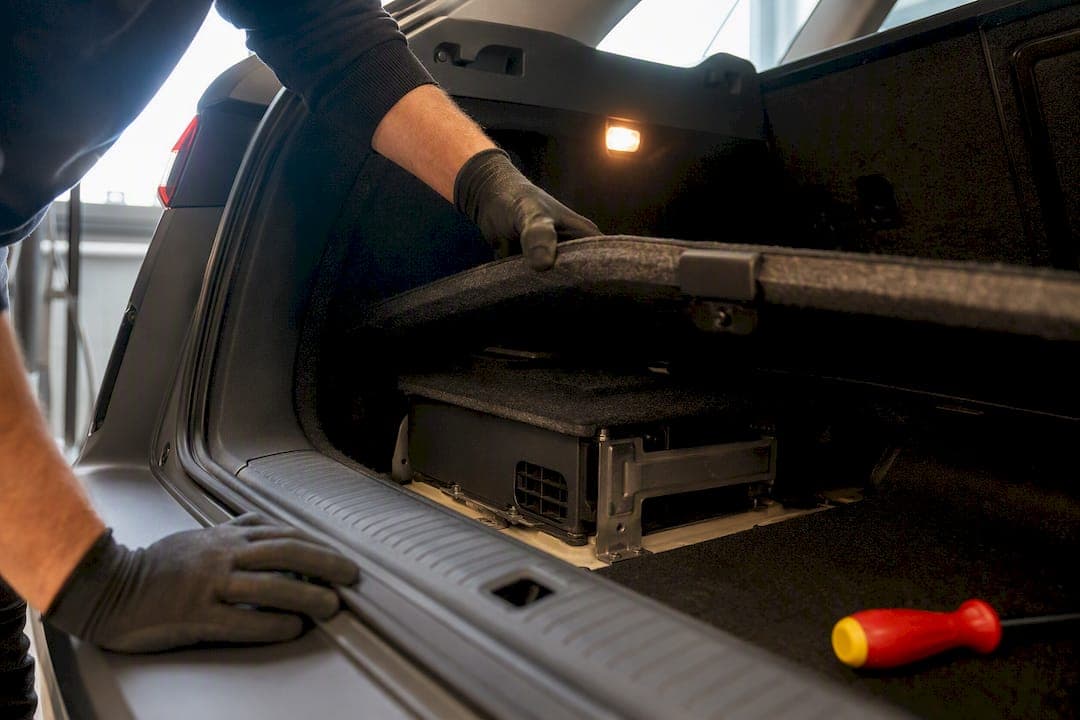
If your car has basic start-stop and no regenerative braking, an EFB battery usually does the job. If it has recuperation, heated seats, a big infotainment system, or any combination of heavy electrical loads, AGM is the safer bet. One rule overrides both: if your car left the factory with AGM, only AGM goes back in, confirmed against EN test standards and your vehicle's own battery management system.
TL;DR:
- AGM batteries are essential for vehicles with regenerative braking, high electrical loads, or factory-installed AGM systems, and cannot be replaced with EFB without risking system errors.
- EFB batteries suit cars with basic start-stop systems and are more affordable upfront but generally have a shorter cycle life and lower charge acceptance compared to AGM.
- Upgrading from EFB to AGM is possible but requires verifying BMS compatibility, considering physical dimensions, and properly registering the new battery to prevent undercharging or warning lights.
- Mounting location influences battery lifespan, as AGM is more heat-sensitive and benefits from cooler, enclosed compartments, while EFB tolerates engine bay heat better.
- Proper identification via the battery label and vehicle documentation is crucial, with manufacturer guidelines strongly advising using the originally specified battery type to ensure system reliability.
Table of Contents
- AGM vs EFB at a Glance
- What Actually Separates AGM and EFB Batteries?
- Which Battery Should You Buy?
- Can You Upgrade From EFB to AGM? The Compatibility Rules
- Does Mounting Location Matter for AGM vs EFB?
- How Do You Know Which Battery Is Currently in Your Car?
- How Long Should Each Battery Actually Last?
- What Akkuplus Recommends When You're Buying
- Ready to Check Fitment? Here's Where to Start
- Sources
- FAQ
AGM vs EFB at a Glance
Before you dig into the engineering, here's the short version.
- Construction: AGM traps electrolyte in a glass mat and seals the cell; EFB is a flooded lead-acid design with a reinforced polyester fleece separator.
- Best for: AGM suits cars with regenerative braking, high accessory loads, or premium trim; EFB suits compact and mid-range cars with simple start-stop.
- Cycle life ratio: AGM typically outlasts a conventional starter battery by roughly three times; EFB lands closer to double.
- Cost: EFB costs less upfront; AGM costs more but often works out cheaper per year of service if your car actually needs it.
- OEM/compatibility: AGM-equipped cars require AGM replacements. EFB-equipped cars can sometimes take an AGM upgrade, but not automatically.
Before you buy anything, check your battery label or vehicle handbook. That single step prevents most of the compatibility headaches described below.
What Actually Separates AGM and EFB Batteries?
The difference comes down to how each battery holds its electrolyte and how fast it can accept a charge. AGM, short for Absorbent Glass Mat, uses a fiberglass mat saturated with electrolyte instead of free-flowing liquid. The cell is sealed and recombinant, meaning gases produced during charging get reabsorbed rather than vented. That design gives AGM lower internal resistance, which translates directly into faster charge acceptance and a longer service life. VARTA's technical comparison points to this as the reason AGM handles vehicles with regenerative braking and heavy electrical loads so much better than standard batteries.
EFB, or Enhanced Flooded Battery, is a different animal. It keeps the traditional flooded lead-acid layout but adds a polyester fleece separator around the plates, which reduces active material shedding and improves cycle durability over a classic flooded starter battery. According to intAct's buying guide, that upgrade is enough for simpler start-stop systems, just not enough for cars that recover braking energy or run a lot of onboard electronics.
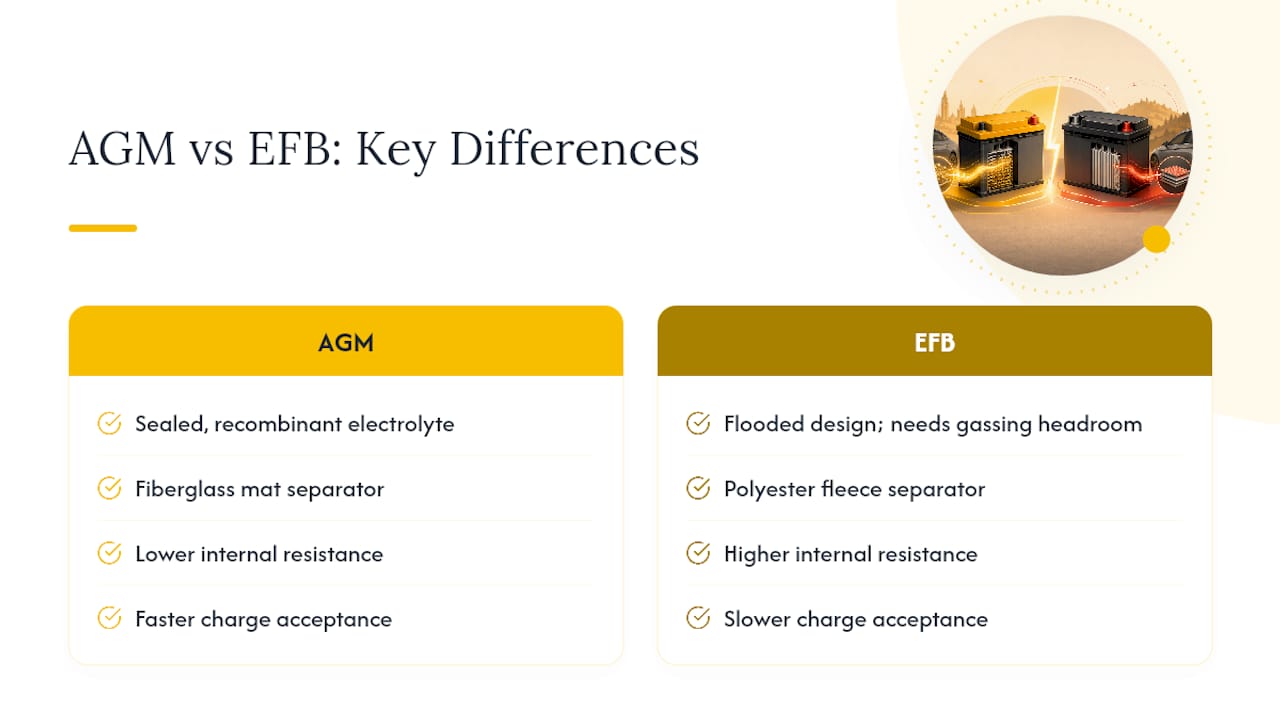
In practice, this shows up during short trips. A car doing a lot of stop-and-go city driving barely gives its battery time to recharge between starts. AGM recovers charge faster in that window. EFB tolerates repeated cranking better than a conventional battery, but it loses ground on charge acceptance, cold-crank punch, and vibration resistance when the driving pattern gets demanding. AGM also handles water loss differently since it's sealed, while EFB, being a flooded design, still needs some headroom for gassing.
Which Battery Should You Buy?
Work through these in order, and stop as soon as one applies to your situation.
- Your car came with AGM from the factory. Replace it with AGM only. The charging algorithm, the battery sensor, and often the entire energy management system are calibrated around AGM's internal resistance and voltage curve. Dropping in an EFB here can trigger warning lights or leave the alternator working against the battery instead of with it.
- Your car came with EFB and you drive mostly short trips, run a lot of accessories, or added recuperation after market. An AGM upgrade is worth pricing out. It costs more, but the extra charge acceptance and cycle life often pay for themselves over a few years.
- Your car has no start-stop system at all. A conventional flooded battery or EFB usually covers it. AGM's advantages barely register if the alternator isn't cycling the battery hard.
- Budget is tight and mileage is low. EFB is the pragmatic choice. Save the AGM premium for a car that will actually stress the battery enough to justify it.
Can You Upgrade From EFB to AGM? The Compatibility Rules
Some cars lock you into AGM because the battery sensor, charging voltage curve, and BMS logic were all calibrated for AGM's electrical characteristics from day one. Swap in an EFB on one of these cars and the system may misread the state of charge, undercharge the battery, or throw a dashboard warning. Banner's technical guidance treats this as a hard boundary, not a suggestion.
Going the other way, EFB to AGM, is often fine but never automatic. Run through this before you buy:
- Look up your VIN or check the handbook for the factory-specified battery type and capacity.
- Confirm what kind of battery sensor is fitted; some only work correctly with one chemistry.
- Check physical dimensions and terminal position, since AGM and EFB cases aren't always interchangeable even at the same Ah rating.
- Ask how the alternator and any smart charging system will respond to the new internal resistance.
- Plan for a BMS reset or battery registration after installation.
Pro Tip: A battery that isn't registered with the car's BMS after replacement can quietly undercharge for months. If your dashboard has thrown a battery warning after a swap, that's usually the reason. A workshop can register the new battery in minutes.
Does Mounting Location Matter for AGM vs EFB?
Where the battery sits under, or in, your car changes how long either technology lasts. Engine-bay mounting exposes the battery to the highest and most variable temperatures. Trunk or under-seat mounting, common on many premium models, runs cooler and more stable.
AGM is the more heat-sensitive of the two. Sustained high temperatures accelerate separator drying and internal aging, and Banner's guidance warns this can shorten service life well below its rated potential, in extreme cases raising thermal-runaway risk. If your manufacturer allows relocation or offers a heat shield, use it.
EFB tolerates engine-bay heat somewhat better in relative terms, which is one reason it remains the sensible pick for compact cars with tight, hot under-hood packaging and no realistic option to relocate the battery.
How Do You Know Which Battery Is Currently in Your Car?
Don't guess from looks. AGM and EFB cases can look nearly identical from the outside.
- Check the battery label first. It should say "AGM," "Absorbent Glass Mat," "EFB," "Enhanced Flooded Battery," or carry a "Start-Stop" designation.
- Note the part number and cross-reference it against your vehicle handbook or a VIN-based parts lookup.
- If the label is worn or missing, a workshop can confirm the type in a few minutes with the right diagnostic tools.
- Never rely on case color or shape alone. Manufacturers reuse similar housings across both chemistries.
How Long Should Each Battery Actually Last?
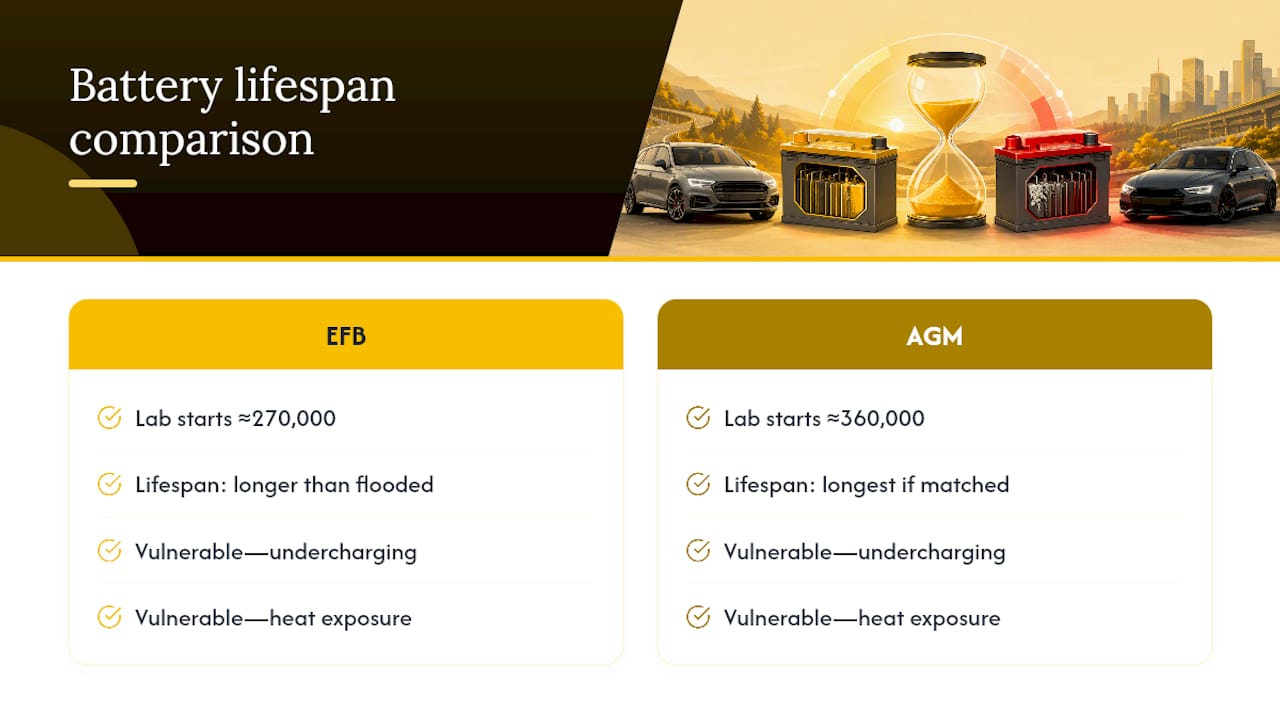
Manufacturer testing gives a useful, if optimistic, benchmark. Automotive cites lab figures of up to roughly 270,000 motor starts for EFB and up to roughly 360,000 for AGM under ideal test conditions.
In real-world terms, that generally works out to EFB lasting a few years longer than a conventional flooded battery, and AGM stretching further still when it's matched to the right car and driving pattern. Neither number holds up if the battery is abused.
The usual causes of early failure are undercharging from short trips that never fully replenish the battery, sustained heat exposure, sulfation from long periods of disuse, and deep discharges from accessories left running. Keep a battery healthy with occasional float charging during storage, a proper smart charger rather than a basic trickle charger, periodic voltage checks, and avoiding letting the battery sit at low charge for extended stretches.
What Akkuplus Recommends When You're Buying
Some online retailers stock both AGM and EFB batteries with pricing and availability set for the German market, allowing you to compare options for your specific vehicle rather than guess. Our general guidance: if your car left the factory with AGM, buy AGM, no exceptions. If it came with EFB and you're weighing an upgrade, it's worth confirming BMS compatibility before you order, and letting a workshop handle installation on anything with a battery sensor or start-stop electronics.
— Waldemar
Ready to Check Fitment? Here's Where to Start
Once you know whether your car needs AGM or EFB, the fastest path is checking fitment directly rather than cross-referencing spec sheets from memory. Akkuplus lists both chemistries with clear labeling, including AGM options like the Optima Red Top starter battery for cars that need the extra charge acceptance, and smaller-format AGM units like the Long WP2.2-12 for auxiliary or specialty applications.
If you're not certain which chemistry your car takes, start at the Akkuplus homepage and search by vehicle or battery specification before ordering. For anything with a battery management system or start-stop electronics, book a professional fitting rather than swapping it yourself. Getting the registration step wrong is the single most common reason drivers end up with a dashboard warning after an otherwise correct battery swap.
Sources
- Unterschiede zwischen EFB und AGM | VARTA Automotive Batteries
- EFB oder AGM? Die richtige Start-Stopp-Batterie finden | intAct
- Upgrading EFB to AGM start-stop battery | Banner Batteriewissen
- Automotive
FAQ
Is EFB Better Than AGM?
Not universally. EFB is the better fit for compact cars with basic start-stop, while AGM outperforms it in vehicles with regenerative braking or heavy electrical loads.
Can I Replace an EFB Battery With an AGM?
Often yes, but only after confirming the battery sensor and BMS accept AGM's charging characteristics. Skipping that check can cause undercharging or dashboard warnings.
Can You Use EFB Instead of AGM?
No, not if your car came factory-fitted with AGM. The charging algorithm and battery sensor are calibrated for AGM, and fitting EFB can cause the system to misread the battery's state of charge.
How Do I Tell If My Car Battery Is AGM or EFB?
Check the battery label for "AGM," "Absorbent Glass Mat," "EFB," or "Enhanced Flooded Battery" wording, or look up the part number against your vehicle handbook. When the label is unreadable, ask a workshop to confirm before you buy a replacement.