

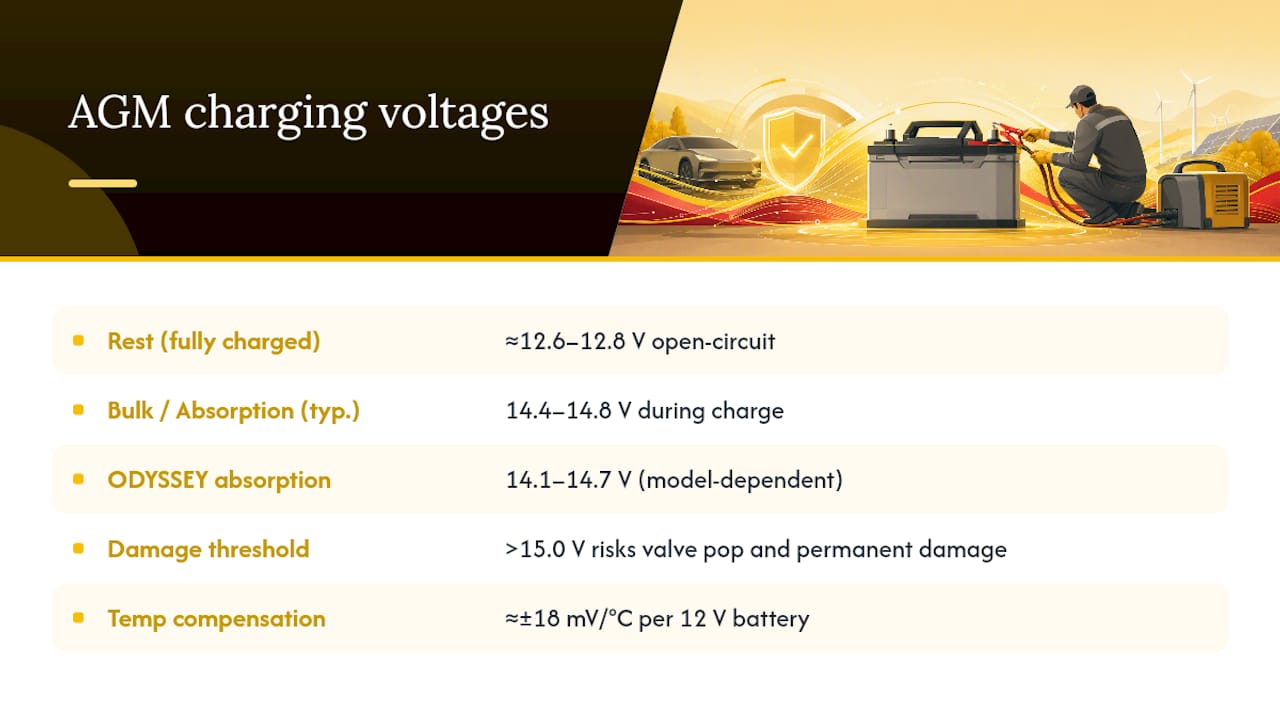
Set your charger's bulk and absorption stage between 14.4 V and 14.8 V, float around 13.6 V, and never let voltage climb past 15.0 V. Before you connect anything, ventilate the area, put on eye protection, and take off rings, watches, and other conductive jewelry. Isolate the battery from the vehicle's electrical system if you're charging it in place, using a charger set specifically to AGM mode rather than a generic flooded-battery program.
Quick safety checklist:
- Charge in a ventilated space, ideally outdoors or in a garage with the door open.
- Wear safety glasses; keep sparks and open flame away from the battery.
- Remove metal jewelry before touching terminals.
- Disconnect the negative terminal first if pulling the battery from a vehicle.
- Confirm the charger is set to AGM, not "flooded" or "gel."
Key Takeaways
Correct AGM battery charging means holding absorption voltage between 14.4 V and 14.8 V, float near 13.6 V, and never exceeding 15.0 V.
| Point | Details |
|---|---|
| Use AGM-specific voltage | Set bulk/absorption to 14.4-14.8 V and float to about 13.6 V; never exceed 15.0 V. |
| Match current to purpose | Use 0.2C-0.4C for quick starter recharges and 0.1C-0.2C for deep-cycle batteries. |
| Compensate for temperature | Adjust voltage roughly ±18 mV per °C per 12 V battery away from 77°F (25°C). |
| Recover low batteries carefully | Batteries below 10.5 V may need a brief manual boost before a smart charger will detect them. |
| Shop AGM-ready equipment | Akkuplus offers AGM batteries like the Optima Red Top RT S and chargers matched to their voltage profile. |
Table of Contents
- Why AGM Battery Charging Requires Different Settings
- The Three Charging Stages: Bulk, Absorption, and Float
- Recommended Voltages, Charge Current, and Temperature Compensation
- How to Choose a Charger That Actually Works With AGM
- Step-by-Step: How to Charge an AGM Battery Safely
- Reviving a Deeply Discharged AGM Battery
- Charging Mistakes That Shorten AGM Battery Life
- Storing and Maintaining an AGM Battery Between Uses
- Safety Rules Every AGM Charging Session Should Follow
- What Research Says About Charging and AGM Battery Lifespan
- A Publisher's Note on Getting This Right
- Finding the Right AGM Battery and Charger for Your Setup
- Frequently Asked Questions
- Sources
Why AGM Battery Charging Requires Different Settings
An AGM battery holds its electrolyte in a fiberglass mat instead of free liquid, and it recombines the oxygen and hydrogen produced during charging inside a sealed valve-regulated case instead of venting it away like a flooded battery. That construction is unforgiving of sloppy voltage control.
Two things follow directly. First, the acceptable voltage window is tighter than what older flooded-battery chargers use. Second, AGM cells are more sensitive to overvoltage and gassing, because there's no reservoir of extra liquid to buffer a mistake. Think of a flooded battery as a bucket that can slosh and refill itself, and an AGM as a sponge. Overfill the sponge and there's nowhere for the excess to go.
The Three Charging Stages: Bulk, Absorption, and Float
Every quality AGM charger cycles through three distinct phases, and understanding what each one does explains why AGM battery charging can't be a one-setting affair.
- Bulk delivers as much current as the charger and battery safely allow, restoring roughly 80% of capacity quickly while voltage climbs.
- Absorption holds voltage steady, typically 14.4 V to 14.8 V, while current gradually tapers as the battery approaches full charge.
- Float drops to about 13.6 V, a maintenance voltage that keeps the battery topped off without driving further gas production.
Equalization, the deliberate overcharge flooded batteries sometimes get to stir electrolyte and balance cells, is normally skipped with AGM. Sealed cells have no electrolyte to stir, and the higher voltages equalization requires can dry out the glass mat permanently.
Pro Tip: You can't check specific gravity on a sealed AGM the way you would a flooded battery, so watch the charger's amp readout instead. When current tapers to near zero at absorption voltage, the battery is effectively full.
Recommended Voltages, Charge Current, and Temperature Compensation
A fully charged AGM battery reads about 12.6 V to 12.8 V open-circuit voltage at rest. During charging, bulk and absorption typically run 14.4 V to 14.8 V, though ODYSSEY's documentation pegs deep-cycle absorption closer to 14.1 V to 14.7 V depending on the model. Anything above 15.0 V risks popping the pressure relief valves and permanently damaging the cell. Always defer to the specific voltage your battery's manufacturer stamps on the case or manual.
Charge current guidelines vary by purpose. A starter battery recovering from a jump start tolerates a higher C-rate, often a moderate rate suitable for quick boosting. A deep-cycle AGM in a solar or marine setup usually charges at a lower rate for gentler, longer cycles. Maintenance or float current is kept low to offset self-discharge.
Temperature compensation matters more than most people realize. ODYSSEY recommends roughly ±18 mV per °C per 12 V battery, meaning voltage should drop as ambient temperature rises above 77°F (25°C) and rise as it falls below that. A battery charging in a hot engine bay at 95°F needs roughly 0.3 V less than one charging in a cold garage at 50°F.
How to Choose a Charger That Actually Works With AGM
Not every "12 volt charger" is safe for AGM battery charging, and this is where a lot of otherwise careful people go wrong.
- Look for an explicit AGM or Absorbed Glass Mat setting, not just a generic "sealed" or "maintenance-free" label.
- Multi-stage charging (bulk, absorption, float) is non-negotiable for long-term battery health.
- Temperature compensation, either automatic or via an included probe, protects the battery in garages, vehicles, and outdoor storage sheds.
- Match the charger's max output to your use case: a small unit for maintenance, a higher-amp unit for regular deep-cycle recharge.
- Automatic taper to float prevents the overcharging that quietly kills AGM batteries over months.
A recovery mode for very low-voltage batteries and a display showing volts, amps, and charging stage are worth paying extra for. Steer clear of bargain constant-voltage chargers with no AGM setting; several on the market push voltage well past 15 V with no cutoff, which is exactly the failure mode that ruins these batteries. A charger like the Ansmann ACS 110 illustrates the kind of microcontroller-based, multi-stage control worth looking for, even if you're shopping a different capacity range.
Step-by-Step: How to Charge an AGM Battery Safely
Charging an AGM the right way isn't complicated, but skipping steps is exactly how people cook a battery or shock themselves.
- Prep the area. Read the battery's label for its specific voltage limits, inspect terminals for corrosion, put on eye protection, remove jewelry, and make sure the space is ventilated.
- Check resting voltage. A multimeter reading tells you whether you're dealing with a routine recharge or a deep-discharge recovery situation (see the next section).
- Connect in the right order. If the battery is out of the vehicle, connect positive first, negative last. If it's staying in the vehicle, connect the charger's positive lead to the battery's positive terminal and the negative lead to a solid chassis ground point away from the battery, not directly to the negative post.
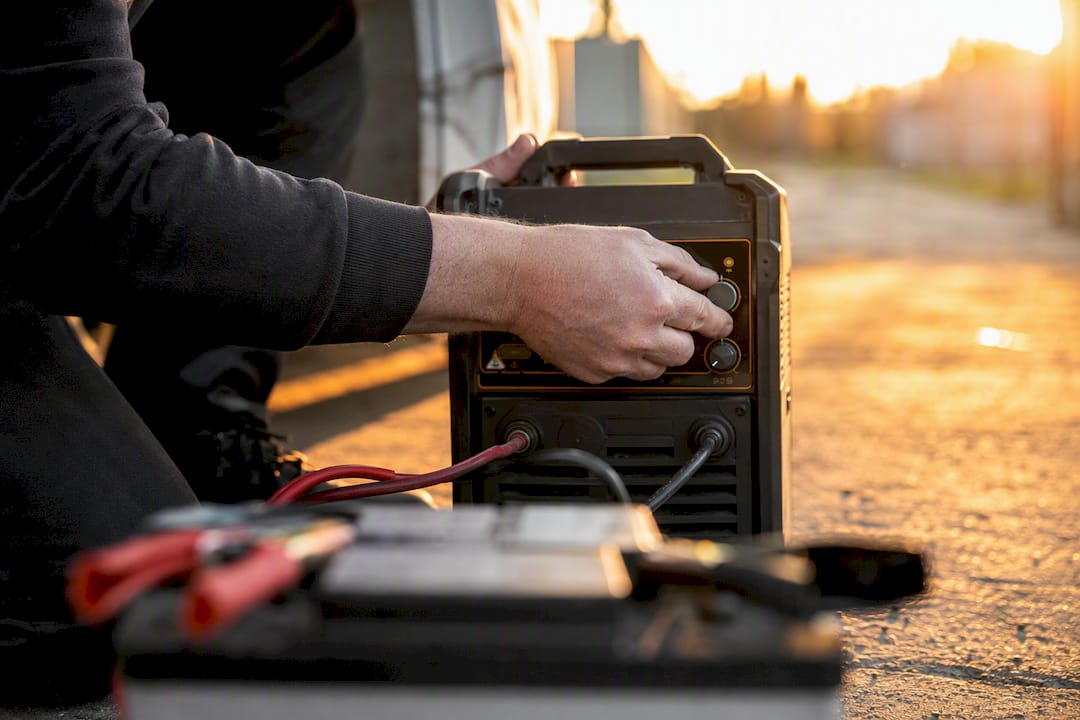
- Set the charger. Select AGM mode, confirm voltage and current match the guidance above, and attach a temperature sensor if your charger supports one.
- Monitor the charge. Watch for the expected amp taper as absorption progresses. If the battery case feels hot to the touch or voltage refuses to stabilize, stop and disconnect.
- Finish clean. Once the charger shifts to float, let it run its course, then disconnect negative first, positive last, and do a quick visual check for swelling or leakage.
Reviving a Deeply Discharged AGM Battery
A battery that's dropped below about 10 V to 10.5 V often won't register with a smart charger at all. That's the charger's safety logic refusing to engage, not necessarily a dead battery.
- Confirm resting voltage with a multimeter before doing anything else.
- If it reads between 5 V and 10.5 V, a brief manual, low-current boost from a basic charger or power supply can nudge voltage up enough for a smart charger to recognize it, typically to around 10 to 11 V.
- Switch to a full AGM-mode charger once detection kicks in, and watch closely for unusual heat or a sulfur smell.
- For a starter battery in a vehicle, a running engine's alternator can sometimes provide enough current to get it moving, followed by a proper charger session.
Below roughly 5 V, sulfation is often permanent, and a swollen case, persistent heat, or any electrolyte odor means it's time to stop and replace the battery rather than keep pushing current into it.
Charging Mistakes That Shorten AGM Battery Life
Most premature AGM failures trace back to one of a handful of avoidable habits.
- Overvoltage or extended high float: pushing past 15.0 V, or leaving a battery on a float setting that's actually set to absorption voltage, slowly dries out the mat.
- Charging too fast in hot conditions: high current in a warm engine bay compounds heat stress; slow the rate or move the battery somewhere cooler.
- Using a non-AGM charger: a flooded-battery program's equalization cycle or higher voltage ceiling can permanently damage AGM cells.
- Letting deep discharges sit: leaving a battery at low voltage for days or weeks accelerates sulfation that even a correct charge cycle can't fully reverse.
Storing and Maintaining an AGM Battery Between Uses
Store AGM batteries fully charged, then check open-circuit voltage periodically.
- A dedicated maintenance charger holding 13.2 V to 13.8 V, commonly around 13.6 V at 77°F (25°C), is the safest way to keep a stored battery topped off without overcharging it.
- Plan a refresh charge every six to twelve months in warm storage, and up to twenty-four months in consistently cool conditions, since ODYSSEY notes maintenance chargers typically supply only 0.5 A to 1.5 A, enough to sustain charge but not to recover a deep discharge.
- Cold storage slows self-discharge considerably; heat accelerates it, so a battery baking in a hot shed needs more frequent checks than one in a cool basement.
Safety Rules Every AGM Charging Session Should Follow
AGM batteries are sealed, but "sealed" doesn't mean risk-free. Under fault conditions or serious overcharge, pressure relief valves can still vent hydrogen gas, which is flammable and explosive in confined spaces.
- Charge in a ventilated area, never in a sealed closet or car trunk.
- Wear eye protection and avoid sparks or open flame near the battery.
- Handle batteries by their carrying handles when available, and set them on a stable, level surface to prevent short circuits from tipping or contact with metal tools.
- Secure the battery in its mounting bracket if it's going back into a vehicle or boat.
If a battery feels hot, swells, or you smell sulfur during charging, stop immediately. Disconnect the charger, move to fresh air, and let the battery cool before inspecting it further. Do not attempt to open a vented cell or continue charging a battery showing case deformation.
What Research Says About Charging and AGM Battery Lifespan
Comparative testing on batteries used in solar applications found AGM cells lost only about 0.9 V over 30 days at rest, versus 1.5 V for gel and 2.4 V for flooded designs, alongside steadier voltage under load. That stability isn't automatic. It depends on consistent, correctly profiled charging.
The practical takeaway is straightforward: hold absorption voltage in the manufacturer's specified range, apply temperature compensation, and avoid repeated deep discharges followed by rushed recharges. Do those three things and an AGM battery holds its performance advantage for years rather than months.
A Publisher's Note on Getting This Right
Getting AGM battery charging wrong is one of the most common ways people shorten a perfectly good battery's life, often without realizing it until the battery won't hold a charge anymore. Akkuplus stocks AGM batteries and the compatible chargers built to handle them correctly, because the hardware matters as much as the technique.
Finding the Right AGM Battery and Charger for Your Setup
Matching charger amperage to your battery's amp-hour rating is where most of the guesswork in AGM battery charging disappears. A 50 Ah starter battery wants a different charger than a 200 Ah deep-cycle bank, and running the wrong size either stalls your recharge or stresses the cells.

Akkuplus carries AGM starter batteries like the Optima Red Top RT S 4.2, a 50 Ah, 12 V unit built for reliable starting power, alongside chargers designed to pair correctly with AGM chemistry. Before buying a charger, confirm it lists an AGM setting explicitly rather than a generic "sealed" label, and check the warranty terms since battery and charger mismatches are a common reason warranty claims get denied. If you're replacing a battery that's given up after one too many deep discharges, browse the AGM starter battery lineup and pick the capacity that matches your original equipment specs before your next trip.
Frequently Asked Questions
What voltage should I use to charge an AGM battery? Set bulk and absorption between 14.4 V and 14.8 V, and float around 13.6 V. Always check your specific battery's label, since some manufacturers specify slightly different ranges within that band.
Can I charge an AGM battery with a regular charger? A standard flooded-battery charger can work in a pinch at low current, but it risks overcharging AGM cells since it lacks the tighter voltage control and absorption tapering AGM chemistry needs. An AGM-specific setting is strongly preferred.
How long does it take to charge an AGM battery? Full recovery from a deep discharge can take 10 to 12 hours once taper time is factored in.
Why is my AGM battery charger showing an error or not starting? This usually means the battery's voltage has dropped below the charger's detection threshold, often around 10 V to 10.5 V. A brief manual low-current boost can raise voltage enough for the smart charger to recognize it.
Is it safe to charge an AGM battery indoors? Charge in a ventilated space regardless of location, since AGM batteries can vent hydrogen gas under fault conditions even though they're sealed. Avoid sealed closets, and keep sparks and flame away from the charging area.
Sources
- ODYSSEY installation, operation and maintenance manual
- Battery charging (AGM) — Rolls Battery Support