
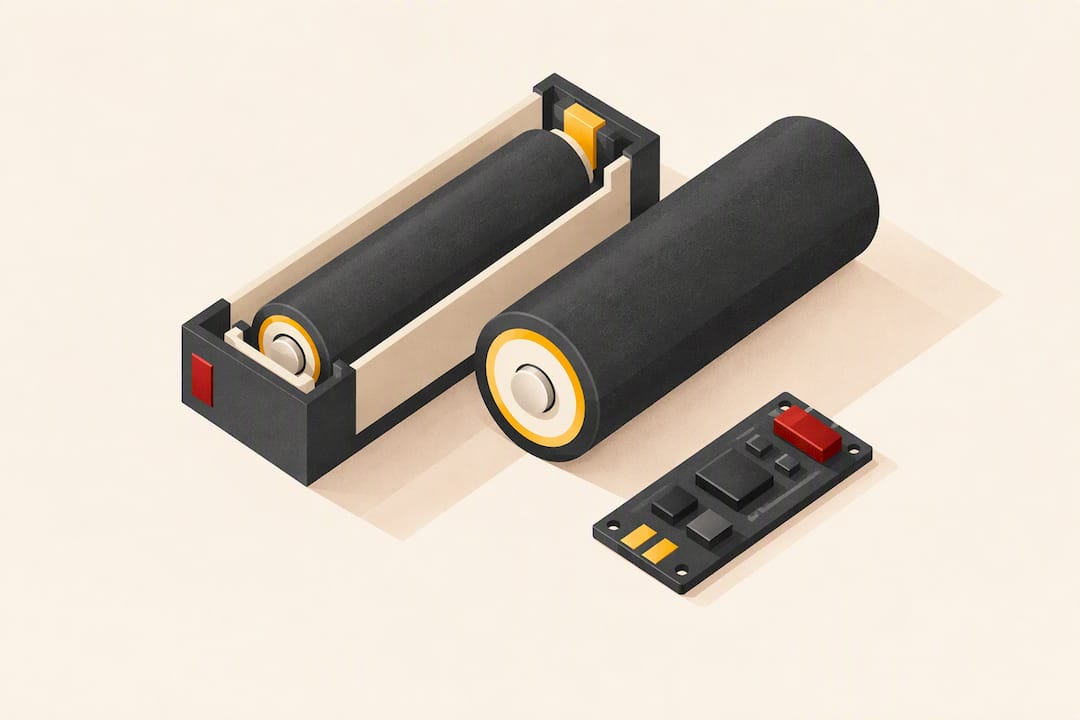
A 21700 cell usually wins when you need higher capacity, longer runtime, or fewer cells per pack, while an 18650 cell stays the better pick for legacy devices, tighter housings, or wherever broad availability matters most. Safety and build quality, driven mostly by chemistry and the manufacturer behind the cell, often matter more than the physical format you choose.
TL;DR:
- Cell size does not determine discharge rating or safety; check the manufacturer’s datasheet, match the BMS to the chemistry and cell count, and allow space for cooling.
- Compare each cell’s price per rated watt hour rather than its sticker price, and avoid listings without manufacturer datasheets or with implausible capacity claims.
- Before replacing a cell, measure the compartment and check terminal clearance; a 21700 will not fit a housing designed for an 18650.
Table of Contents
- Dimensions, naming, and typical capacity ranges
- What longer runtime and fewer cells actually mean for your build
- Discharge power and keeping your pack safe
- Price per cell versus price per watt-hour
- Matching the right cell to your flashlight, e-bike, or DIY pack
- Finding exact specs before you buy or repair
- Why both formats are here to stay
- Where to buy the right cell or get help with your pack
- FAQ
- Sources
Dimensions, naming, and typical capacity ranges
The numbers in both names describe the cell's physical size in millimeters. An 18650 cell measures about 18 mm in diameter and 65 mm in length, while a 21700 cell measures roughly 21 mm by 70 mm. The "0" at the end of each code simply indicates a cylindrical cell shape, a convention borrowed from industrial battery naming.
That extra few millimeters of diameter and length gives the 21700 meaningfully more internal volume, which is why it tends to pack in more active material. Here's how the two compare at a glance:
- 18650: 18 mm x 65 mm, nominal voltage around 3.6 to 3.7V, typical capacities in the lower-to-mid thousands of mAh depending on chemistry and brand.
- 21700: 21 mm x 70 mm, same nominal voltage range, typically higher capacity than an 18650 of comparable chemistry due to the larger cell volume.
- Naming logic: diameter first, then length, both in millimeters, with a trailing zero marking the cylindrical form factor.
Nominal voltage stays consistent across both formats for standard lithium-ion chemistries, so voltage is rarely the deciding factor. Capacity and physical fit usually are.
What longer runtime and fewer cells actually mean for your build
Energy density comes in two flavors: gravimetric (energy per unit of weight) and volumetric (energy per unit of volume), and the 21700 format tends to improve both compared with the 18650. Industry reporting on cell design notes that 21700 cells can offer gravimetric energy density gains of up to around 20% and volumetric gains up to around 30% over 18650 cells in some implementations, with advanced 21700 cells reaching capacities as high as roughly 4800 mAh in certain designs.

That density gain has a practical payoff beyond raw runtime. Higher per-cell capacity means a pack designer can hit a target energy level with fewer parallel strings, which reduces the number of connection points and welds in the finished pack. Fewer connections generally means fewer failure points and a simpler assembly process, which is part of why e-bike and power tool designers have leaned toward larger-format cells in recent years.
That said, format alone doesn't guarantee a specific capacity. A cheap 21700 cell from an unproven manufacturer can underperform a well-made 18650 cell from an established one. Chemistry, electrode quality, and manufacturing consistency shape the real-world number far more than the size stamped on the wrapper.
Discharge power and keeping your pack safe
Maximum continuous discharge current depends far more on internal chemistry and construction than on whether a cell is 18 mm or 21 mm across. Two cells of the same diameter can have wildly different continuous discharge ratings depending on how they're built inside.
Fraunhofer ISE's battery safety research emphasizes that cell manufacturing quality, chemistry, and the battery management system are the primary levers for safe operation, not the physical format of the cell. This matters because a larger 21700 cell does hold more energy in a tighter space, which changes how heat needs to move through a pack. Fraunhofer ISE's work on battery safety points out that larger cells shift the thermal picture and require deliberate spacing and cooling design to avoid heat buildup between neighboring cells.
A separate Fraunhofer initiative, the FAiL project, develops in-situ scanning methods to catch manufacturing defects in larger-format cells before they reach the field, underscoring that quality control becomes more important as cell size increases. When you're sourcing cells or building a pack, keep these checks in mind:
- Confirm the cell's continuous discharge rating comes from the manufacturer's own datasheet, not a reseller's estimate.
- Plan physical spacing between cells to let heat dissipate rather than transfer to neighboring cells.
- Use a BMS that matches the chemistry and cell count of your specific pack design.
Price per cell versus price per watt-hour
The 18650 format has historically carried a price advantage because of its decade-plus head start in mass production, from laptops to early EVs to power tools. The 21700 format is closing that gap as production volume scales, particularly for e-bike and power tool applications where the larger cell has become standard.
A lower sticker price per cell doesn't always mean lower cost for the energy you actually get. Divide the price by the rated watt-hours (voltage times amp-hours) to compare cells on equal footing, especially when one option has notably higher capacity than the other.
- Calculate price-per-Wh rather than comparing raw per-cell prices across formats.
- Check for a published datasheet before buying, since the absence of one is a common sign of a gray-market or relabeled cell.
- Favor sellers with visible specs and a track record over listings with vague or inflated capacity claims.
Pro Tip: If a listed capacity looks unusually high for the price, cross-check it against the cell's known chemistry limits before buying.
Matching the right cell to your flashlight, e-bike, or DIY pack
Before swapping formats in any existing device, measure the battery cavity or holder and confirm the terminal arrangement. A 21700 cell will not fit a housing sized for an 18650, and even a few millimeters of clearance can matter in a tightly machined flashlight body or vape mod.
New pack designs tend to favor the 21700 when space allows, since fewer, higher-capacity cells simplify wiring and can improve mechanical stability. Legacy devices and tight enclosures still favor the 18650, both for fit and because replacement cells remain widely stocked for older gear.
- Measure the available space precisely, including any retaining clips or button-top clearance.
- Check your device's expected current draw against the cell's continuous discharge rating.
- Confirm your charger or BMS supports the chemistry and cell count you're installing.
- Verify chemistry compatibility (such as INR versus ICR) before mixing cells from different sources in one pack.
Finding exact specs before you buy or repair
Checking a cell's listed dimensions, capacity, and datasheet before ordering avoids most fit and performance surprises. Our 18650 single-cell listings show precise measurements like diameter and length alongside capacity figures, so you can confirm fit against your existing holder before committing to a purchase.
Beyond single cells, we offer battery testing, repair, and pack assembly guidance for readers working on retrofits or custom builds. When you reach out about a project, include the device model, the capacity you're targeting, the chemistry you need, and the intended application (flashlight, e-bike, DIY pack, or something else), since those four details are what let us point you to the correct cell the first time.
Why both formats are here to stay
The 21700 format keeps gaining ground in e-bikes and new pack designs where space allows for the larger cell, while the 18650 remains the standard for legacy devices and tighter enclosures. If you're retrofitting older gear, stick with 18650. If you're building something new and have the room, 21700 is worth the look.
— Waldemar Pelich
Where to buy the right cell or get help with your pack
Choosing between formats gets a lot easier once you can see the exact specs side by side, which is why we built our single-cell category to show dimensions, capacity, and chemistry for every listing before you buy. Each product page lists precise measurements so you can confirm fit against your existing holder or housing, whether you're replacing a single cell or sourcing parts for a full pack rebuild.
For broader battery needs beyond single cells, our general battery category covers a wider range of formats and related accessories. If your project also needs testing, repair, or assembly support, our services page outlines the repair and testing options available alongside single-cell sales.
FAQ
What is the highest rated 18650 battery?
Capacity ratings for 18650 cells vary by chemistry and manufacturer, with higher-end cells reaching the upper end of typical modern capacity bands for the format. Check the specific datasheet for any cell you're considering, since published capacity should always come from the manufacturer rather than a reseller's listing.
Is the 21700 battery good for vaping?
A 21700 cell can work well in vaping devices that are built or modified to fit its larger dimensions, offering more capacity than an equivalent 18650. Fit is the limiting factor: confirm your mod's battery compartment is sized for 21 mm by 70 mm before switching, since the two formats are not interchangeable without a compatible housing.
Can I use 21700 instead of 18650?
Only if your device's battery compartment and contacts are sized or adapted for the larger 21700 dimensions, since the two cells are not directly interchangeable. Some devices use adapter sleeves to fit a smaller 18650 into a 21700-sized slot, but going the other way requires a housing built for the larger cell.
Why do 18650 batteries say not for vaping?
Some 18650 cells carry warnings against vaping use because they are not rated for the continuous high-current discharge that unregulated mods can demand. Continuous discharge capability depends on the specific cell's chemistry and construction, so a cell's rating, not just its format, determines whether it's suited to that kind of load.
Sources
- Optimierung der Batteriesicherheit - Fraunhofer ISE
- 21700er-Akku-Rundzellen: oft die bessere Alternative - Elektronikpraxis
Recommended
This article was created with the assistance of Artificial Intelligence (AI) and has been reviewed by our editorial team. Despite careful preparation, we assume no liability for the completeness, accuracy, or timeliness of the information provided. The technical data and specifications supplied by the respective manufacturer shall always prevail.